

Wound care CPT codes cover a range of procedures from selective and surgical debridement through negative pressure wound therapy (NPWT), dressing application, and wound evaluation.
The coding challenge isn’t knowing what the codes are — it’s selecting the right one based on wound depth, tissue type, and procedure performed, then documenting enough clinical detail to survive a payer audit.
Wound care is one of the most frequently audited outpatient service categories, and the debridement code decision (selective vs surgical, area-based vs depth-based) is where most billing errors originate.
A mismatch between the documented tissue level and the CPT code selected can trigger a denial, a downcode, or a post-payment recoupment that the practice doesn’t discover until the money is already gone.
Lets dive in and learn:
- NPWT coding by wound size
- Documentation requirements that prevent denials
- Dressing change and non-selective debridement rules
- Common wound care billing mistakes and the denial codes they trigger
- Selective vs surgical debridement codes and how to choose between them
How are wound care CPT codes organized?
Wound care procedures fall into four main billing categories, each with different coding logic, documentation requirements, and payer scrutiny levels.
+97598 — each additional 20 sq cm
Area-based, not time-based
Targets devitalized tissue only
11043 — muscle and/or fascia
11044 — bone
Depth-based coding
Used in any clinical setting
97606 — wound >50 sq cm
Size-based coding
Chronic wounds, surgical sites
No depth or area requirement
Lower reimbursement than selective
Each category answers a different clinical question. Selective debridement (97597/97598) asks how much surface area was treated.
Surgical debridement (11042-11044) asks how deep did the removal go. NPWT (97605/97606) asks how large is the wound receiving therapy.
Non-selective debridement (97602) covers mechanical or enzymatic cleaning that doesn’t target specific tissue.
The code selection depends on what the provider actually did and documented — not what the wound looks like or how severe it appears.
What is the difference between selective and surgical debridement?
This is the highest-value coding decision in wound care billing, and the one that generates the most denials and audit flags.
Billed by wound surface area (per 20 sq cm)
Sharp, curette, or forceps method
Does not reach subcutaneous depth
Used in outpatient, office, and home health settings
97597 = first 20 sq cm
+97598 = each additional 20 sq cm
Billed by tissue depth reached
11042 = subcutaneous tissue
11043 = muscle and/or fascia
11044 = bone
Used in any clinical setting (not hospital-only)
Higher RVU and reimbursement
The coding decision comes down to two questions.
First, did the provider remove tissue down to a specific depth (subcutaneous, muscle, or bone)?
If yes, surgical debridement codes (11042-11044) apply, and the code depends on the deepest tissue level reached.
Second, did the provider selectively remove devitalized tissue from the wound surface without reaching subcutaneous depth?
If yes, selective debridement (97597/97598) applies, and the code depends on wound surface area.
The most common error is coding selective debridement as surgical (upcoding) because the wound looks deep, even though the provider’s documentation describes surface-level tissue removal.
Payer auditors compare the documented procedure with the code’s depth requirement, and the documentation wins.
If the note says “removal of necrotic tissue from wound bed” without specifying subcutaneous depth, 97597 is the supported code — not 11042.
A clarification that matters for smaller practices is that surgical debridement codes (11042-11044) are not restricted to hospitals or surgical centers. They can be billed in physician offices, outpatient clinics, and wound care centers when the clinical documentation supports the depth of tissue removal.
What CPT code applies to dressing changes?
Dressing changes performed as part of routine wound management are not separately billable in most circumstances — they’re considered part of the E/M service or the wound care procedure being performed. There is no standalone “dressing change CPT code” that applies universally.
CPT 97602 (non-selective debridement) covers wound care that involves wet-to-dry dressings, enzymatic agents, or mechanical cleaning methods. This code applies when the dressing change includes a non-selective debridement component — not for simple dressing replacement without a therapeutic procedure.
When a provider performs only a dressing change with no debridement, evaluation, or active wound treatment, the service is typically billed under the appropriate E/M code (99212-99215) if a separately identifiable evaluation and management service was performed.
For wound care supply billing, HCPCS codes in the A4450-A4456 range cover specific wound dressing materials, but these apply to the supplies themselves, not the act of changing the dressing.
What are the NPWT coding rules?
Negative pressure wound therapy uses CPT 97605 (wound area ≤50 sq cm) and CPT 97606 (wound area >50 sq cm). The code selection depends entirely on wound size — measured at the time of the application. NPWT is commonly used for chronic wounds, diabetic ulcers, surgical wound complications, and pressure injuries.
Documentation must include wound measurements (length × width), the NPWT device type, application duration, and clinical justification for ongoing therapy.
Payers audit NPWT claims for frequency (daily application isn’t always covered), wound progression documentation (the wound should be showing improvement), and medical necessity (the wound must meet criteria defined in the payer’s LCD for wound care).
What documentation prevents wound care claim denials?
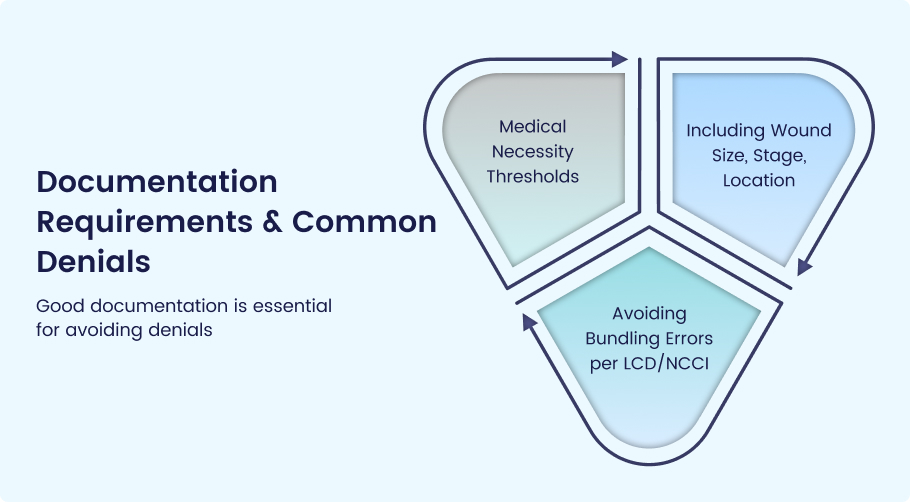
Wound care documentation requirements are more demanding than most procedure categories because the billing codes are tied to measurable clinical data — wound size, tissue depth, and tissue type.
Every wound care encounter should document
- Wound location (anatomical site, laterality)
- Wound healing progression compared to prior visits
- Clinical rationale for the procedure (medical necessity)
- Wound measurements (length × width × depth in centimeters)
- Deepest tissue level reached (for surgical debridement codes)
- Wound surface area treated (for selective debridement codes)
- Tissue type observed (necrotic, slough, granulation, epithelial)
- Procedure performed (selective debridement, surgical debridement, NPWT, non-selective cleaning)
Missing wound measurements alone can trigger a denial — payers require size documentation to validate the CPT code selected, especially for area-based codes (97597/97598) and NPWT (97605/97606).
Wound photography, while not universally required, provides strong audit defense when size or tissue type are questioned.
What wound care coding mistakes cause denials?
A few recurring coding and documentation errors account for a significant share of wound care claim denials.
Billing 11042 when documentation describes surface tissue removal without subcutaneous depth. Payer downcodes to 97597 or denies outright.
97597/97598 require wound surface area. 97605/97606 require wound size for threshold determination. No measurements = no code support.
Billing a wound care procedure plus an E/M visit without modifier 25 and separate documentation supporting a distinct E/M service. Triggers CO-97.
Payers deny ongoing NPWT if notes don’t show wound healing progress. Repeated therapy without clinical improvement triggers LCD review.
11042 requires documentation of subcutaneous tissue removal. “Debridement performed” without depth specification doesn’t support the code.
NCCI bundling rules add another layer.
Debridement codes may bundle with surgical procedures performed on the same wound during the same session — billing 97597 alongside a surgical repair on the same wound will typically trigger a CO-97 denial unless modifier 59 is applied with documentation supporting the debridement as a distinct service from the repair.
Always verify NCCI edits for wound care code pairs before submitting.
How do ICD-10 codes support wound care billing?
The ICD-10 diagnosis justifies the medical necessity of the wound care procedure. Common wound care diagnosis codes include
- E11.621 — Type 2 diabetes with foot ulcer
- L89 series — pressure ulcers (staged by severity)
- Z48 series — encounter for aftercare following surgery
- T81 series — complications of procedures (wound infection, dehiscence)
- L97 series — non-pressure chronic ulcers of the lower extremity (laterality and severity specified)
The ICD-10 code must match the wound type and location documented in the clinical note. A diabetic foot ulcer billed with a generic wound code (instead of E11.621 + L97 with specificity) may deny for insufficient medical necessity because the payer can’t connect the procedure to the condition driving it.
Wound care coding accuracy determines whether you recover or lose revenue on every encounter
A single missing measurement, an undocumented tissue depth, or a debridement type mismatch can flip a clean claim into a denial — and chronic wound patients who return repeatedly multiply that coding error across dozens of encounters before anyone catches the pattern.
MedHeave operates as an embedded revenue cycle department inside medical practices, with AAPC-certified coders who validate debridement code selection against documented tissue depth, verify wound measurements for area-based codes, and check NCCI bundling rules on every wound care claim before submission.
- 90%+ first-pass rate across all claim types
- Claims submitted within 24-48 hours of signed encounter notes
- Denials addressed within 72 hours with payer-specific appeal templates
- No lock-in agreements — 30-day exit, performance-based pricing (4-7%)
- Dedicated account managers with direct access (Monday-Friday, 9-5 EST)
If wound care denials are a recurring problem in your practice, contact MedHeave to see how structured coding closes those gaps.
Frequently asked questions
Here are some frequently asked questions on this topic:
CPT 97597 describes selective debridement of devitalized tissue from a wound, first 20 sq cm or less. “Selective” means the provider targets and removes specific non-viable tissue (necrotic, slough) while preserving healthy tissue — using sharp instruments, curette, or forceps. The code is billed by wound surface area, not by time. For wounds exceeding 20 sq cm of treatment area, add-on code +97598 reports each additional 20 sq cm. Documentation must include the wound surface area treated to support the code.
There is no standalone CPT code for a simple dressing change without a therapeutic procedure. When a dressing change includes non-selective debridement (wet-to-dry, enzymatic, or mechanical cleaning), CPT 97602 may apply. When only a dressing change is performed with no wound treatment, the service is typically captured under the E/M code for the visit. Wound dressing supplies are billed separately using HCPCS codes (A4450-A4456 range, depending on supply type).
CPT 97597 (selective debridement) is area-based — billed per 20 sq cm of wound surface treated, with tissue removal that stays above subcutaneous depth. CPT 11042 (surgical debridement) is depth-based — billed when the provider removes tissue down to the subcutaneous layer. The distinguishing factor is depth of tissue removal, not wound severity. If documentation describes surface-level devitalized tissue removal without reaching subcutaneous depth, 97597 is the correct code. If the provider excised tissue through the dermis into subcutaneous fat, 11042 applies.
Yes, but only when the E/M service is separately identifiable from the wound care procedure, with distinct documentation supporting both. Modifier 25 must be appended to the E/M code. The E/M note should document a clinical evaluation or decision-making process that goes beyond the wound care itself — reviewing comorbidities, adjusting medications, assessing overall health status. Billing an E/M alongside every wound care visit without separate documentation is a pattern that payer auditors specifically target.
Home health wound care commonly uses CPT 97597/97598 (selective debridement), CPT 97602 (non-selective debridement), and E/M codes for wound evaluation. NPWT codes (97605/97606) may also apply when negative pressure therapy is provided in the home. Home health agencies must follow the same documentation standards as office-based practices — wound measurements, tissue type, procedure performed, and medical necessity. Medicare LCDs for wound care define coverage criteria that may vary by Medicare Administrative Contractor region.
NCCI edits define which wound care code pairs cannot be billed together on the same claim for the same wound. Debridement codes typically bundle with surgical repair codes performed on the same wound during the same session. E/M services bundle with wound care procedures unless modifier 25 and separate documentation justify the distinct service. Always check the current NCCI edit table for wound care code pairs — edits update quarterly, and a code combination that was separately billable last quarter may become bundled in the next release.

