

The CO 226 denial code description from the CARC (Claim Adjustment Reason Code) standard reads “Information requested from the patient/insured/responsible party was not provided or was insufficient/incomplete.”
This denial appears when a payer requested specific information — typically from the patient or their insured party — and that information was either never submitted, arrived incomplete, or didn’t meet the payer’s requirements.
CO-226 is not a coding error, a duplicate billing issue, or a coverage denial. It’s an information-response failure — the payer asked for something, and the response didn’t arrive or wasn’t adequate.
The “CO” prefix (Contractual Obligation) means the adjustment is the provider’s write-off responsibility under the payer contract, though the root cause often involves the patient or insured party failing to provide requested data.
In this guide, we’ll be touching on:
- What specifically triggers CO-226 denials
- How CO-226 differs from CO-16, CO-197, and CO-27
- Prevention strategies that stop CO-226 before it starts
- Which department owns each failure point
- The step-by-step resolution workflow
What triggers a CO-226 denial?
CO-226 fires when a payer sends an additional information request (AIR) and the required data isn’t returned — or is returned incomplete. The triggers map to specific operational breakdowns, and each one has a different owner in the billing workflow.
Incomplete date of birth, incorrect subscriber ID, missing relationship to insured, or wrong member name on file.
Payer requested other insurance details — primary/secondary order, other coverage information — and the data wasn’t provided.
Auto accident, workers’ comp, or third-party liability cases where accident date, type, or responsible party information wasn’t submitted.
Payer sent an additional information request (AIR), the provider or patient didn’t respond within the deadline, and the claim denied.
Insurance wasn’t active at date of service, subscriber wasn’t verified, or plan information was outdated when the claim was submitted.
The pattern that makes CO-226 different from most denial codes — it often depends on patient responsiveness rather than provider action alone.
The payer requested information from the patient or insured party, and that information didn’t arrive. For billing teams, this means resolution requires patient outreach, not just internal claim correction.
Emergency departments, urgent care centers, and trauma settings see disproportionately high CO-226 volume because patients often present without complete insurance information, and accident-related claims require liability details that patients may not provide promptly.
COB-related denials are particularly common under CO-226.
When a patient has multiple insurance plans, and the payer can’t determine primary/secondary order because the patient hasn’t provided other coverage details, the claim suspends and eventually denies under 226 logic.
This is distinct from a COB denial where the payer knows the order but disagrees — CO-226 means the payer doesn’t have enough information to even begin coordination.
How does CO-226 differ from similar denial codes?
CO-226 is frequently confused with other information-related and coverage denial codes. The resolution strategy differs for each, so identifying the correct code is the first step toward fixing the claim.
Payer requested data from patient or responsible party. Information wasn’t received or was insufficient. Fix by collecting and submitting the missing patient data.
Claim lacks required information that the provider should have included — missing diagnosis code, procedure code, or supporting documentation. Fix internally without patient involvement.
Precertification or prior authorization wasn’t obtained. Fix by submitting retro-auth documentation or appealing with clinical justification.
Patient’s insurance wasn’t active or didn’t cover the service. Fix by verifying coverage or billing the correct payer.
The most important distinction for billing teams — CO-16 means the provider omitted something from the claim (fix it internally).
CO-226 means the payer asked the patient or insured for something and didn’t receive it (requires patient outreach).
Treating a CO-226 like a CO-16 — attempting to fix it by correcting the claim internally — won’t resolve the denial if the missing information needs to come from the patient.
How do you resolve a CO-226 denial?
CO-226 resolution follows a specific sequence that starts with identifying what the payer requested and from whom.
The time sensitivity of CO-226 is what makes it operationally dangerous.
Many payer systems initially pend the claim while waiting for the requested information, then convert the pend to a denial after the response deadline passes.
By the time the billing team sees the denial on the ERA, the response window may already be partially consumed.
Practices that don’t track payer information requests in real time often discover CO-226 denials after the resubmission deadline has narrowed significantly.
How do you prevent CO-226 denials?
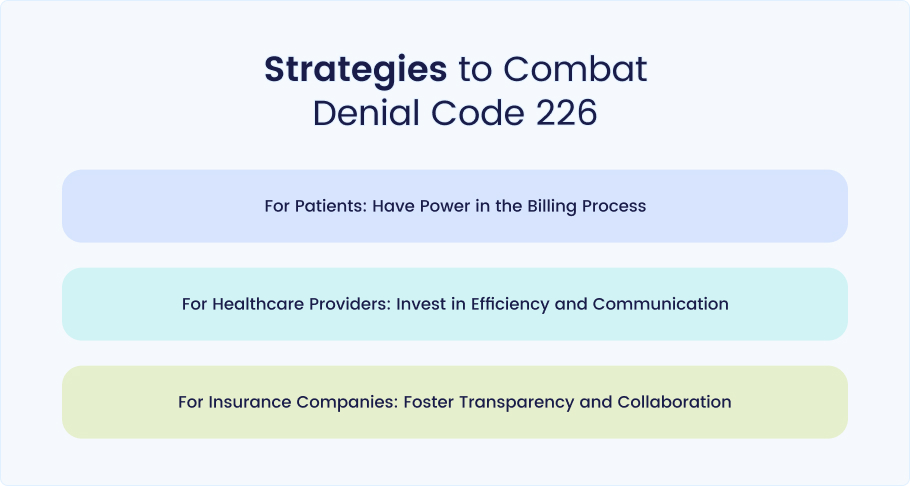
CO-226 prevention lives primarily in the patient registration and intake workflow — the same front-end processes that prevent most information-related denials.
Collect complete insurance and COB data at registration
Real-time eligibility verification should capture not just active coverage but COB information — whether the patient has other insurance, which plan is primary, and whether the visit involves an accident or third-party liability.
Patients arriving at urgent care or emergency settings may not volunteer this information, which is why structured intake questionnaires (rather than open-ended questions) produce more complete data.
Flag accident and liability cases immediately
Auto accident, workers’ compensation, and third-party liability claims require specific data fields that standard registration workflows don’t capture — accident date, accident type, state of occurrence, responsible party, and liability insurer.
Practices that see these cases regularly should build a separate intake form that triggers whenever the visit involves an injury with a potential third-party payer.
Track payer information requests actively
When a payer sends an additional information request, the clock starts.
Many billing teams discover these requests only when the claim eventually denies — weeks after the request was sent.
EHR-integrated tasking systems, payer portal alerts, and regular pending-claims audits catch requests while the response window is still open.
Standardize patient outreach for missing data
CO-226 resolution often requires contacting the patient for updated insurance details, COB information, or accident data.
Practices without a structured patient outreach process (defined contact attempts, escalation timeline, documentation of attempts) frequently write off CO-226 claims simply because the patient outreach never happened systematically.
CO-226 denials are recoverable if you catch them early
CO-226 is a fixable denial — the information exists somewhere, and submitting it resolves the claim.
The revenue loss happens when billing teams miss the payer’s response deadline, fail to track pending claims, or lack a patient outreach process to collect the missing data. Every CO-226 write-off that should have been recoverable is preventable revenue leakage.
MedHeave operates as an embedded revenue cycle department inside medical practices, with billing teams that track payer information requests in real time, manage patient outreach for missing data, and address denials within 72 hours of remittance.
- Eligibility and COB verified before every appointment
- Claims submitted within 24-48 hours of signed encounter notes
- Performance-based pricing (4-7% of collections) with no lock-in
- Denials addressed within 72 hours with payer-specific documentation
- Dedicated account managers with direct access (Monday-Friday, 9-5 EST)
If CO-226 denials are aging into write-offs across your accounts receivable, contact MedHeave to see how structured denial management recovers that revenue.
Frequently asked questions
Here are some commonly asked questions on this topic:
CO-226 is a Claim Adjustment Reason Code (CARC) that means “Information requested from the patient/insured/responsible party was not provided or was insufficient/incomplete.” The payer asked for specific data — typically patient demographics, other insurance details, or accident information — and the requested information wasn’t received or didn’t meet the payer’s requirements. It is not a coding error, a duplicate billing issue, or a coverage denial.
CO-16 means information is missing from the provider — the claim was submitted without required data elements that the provider should have included (missing diagnosis code, procedure code, or supporting documentation). CO-226 means information was requested from the patient or insured party and wasn’t received. The fix for CO-16 is internal claim correction. The fix for CO-226 typically requires patient outreach to collect missing data before resubmission.
The prefix indicates who bears the financial responsibility for the adjustment. CO (Contractual Obligation) means the provider absorbs the write-off under the payer contract. PR (Patient Responsibility) means the cost shifts to the patient. PI (Payer Initiated) indicates a payer-initiated reduction. OA (Other Adjustment) covers adjustments that don’t fit CO, PR, or PI categories. The same CARC 226 definition applies regardless of prefix — the prefix changes who pays, not what happened.
CO-226 can typically be resolved by providing the requested information and resubmitting the claim rather than filing a formal appeal. If the information was actually provided but the payer didn’t process it (or the denial was issued in error), a formal appeal with proof of prior submission is appropriate. Check the payer’s resubmission and appeal deadlines — missing the filing window converts a fixable denial into an unrecoverable write-off.
No. CO-226 is specifically about missing or insufficient information from the patient or insured party. Duplicate billing denials use different CARC codes — typically CO-18 (duplicate claim/service) or CO-97 (service included in another payment). If your claim was denied for alleged duplication, the denial code should be CO-18 or a payer-specific duplicate edit, not CO-226.
Emergency departments, urgent care centers, and trauma facilities see disproportionately high CO-226 volume because patients often arrive without complete insurance information, and accident-related claims require liability details that may not be available at the time of registration. Behavioral health and specialty care practices also see elevated CO-226 rates when COB complexity is high (patients with multiple insurance plans where coordination details haven’t been collected).

