



42% of U.S. adults are living with two or more chronic conditions, according to a 2024 CDC study published in Preventing Chronic Disease (Benavidez et al.). That is not a niche population. That is nearly half your waiting room.
When those patients manage multiple conditions across multiple providers without structured coordination, hospitalizations increase, and outcomes deteriorate. That is the clinical problem Chronic Care Management (CCM) was built to address.
Yet many practices still leave CCM revenue uncaptured, not because their patients do not qualify, but because their team is not sure exactly who qualifies.
Meanwhile, research published in the Journal of the American Geriatrics Society (Jang et al., 2024) found that only 3.4% of eligible Medicare beneficiaries were actually enrolled in CCM as of 2019, up from just 1.1% in 2015.
The qualifying patients are there, but the identification gap is the problem.
CMS has a clear rule for catering to two or more chronic conditions. These are expected to last at least 12 months or until the patient’s death.
Placing the patient at significant risk of acute exacerbation, functional decline, or death. That is it. That is the gate.
This guide goes beyond the standard CMS list, exploring:
- The newer infection-associated categories CMS now recognizes.
- Full chronic care management qualifying conditions breakdown
- The most common qualifying patient profiles
- What falls outside CCM eligibility
Use it as a practical reference, but not as a compliance checkbox.
What are the CMS eligibility requirements for chronic care management?
Before you pull the list of diagnoses, understand the four-part test CMS applies. Every qualifying patient must meet all four criteria.
1. Two or more chronic conditions
A single diagnosis does not qualify for CCM. The patient must present with a minimum of two distinct, recognized chronic conditions. A single-condition patient may qualify for Principal Care Management instead, more on that boundary below.
2. Conditions expected to last 12+ months or until death
Temporary or acute conditions do not count. The qualifying diagnoses must be long-standing. A resolved pneumonia episode, a healed fracture, or a short-term post-surgical condition will not meet the chronic care management eligibility requirements under this prong.
3. Significant clinical risk
This is the criterion that practices most often underestimate. CMS defines significant risk across three dimensions:
- Decompensation: the patient’s overall health status could deteriorate
- Functional decline or death: the condition trajectory carries a serious morbidity risk
- Acute exacerbation: the condition could worsen sharply without coordinated management
Document this risk explicitly in the patient record. Vague notations do not support billing.
4. Need for care coordination
The patient’s complexity must justify ongoing, structured coordination, not just routine follow-up.
Multiple providers, medication regimens, specialist referrals, or social determinants of health factors all support this criterion.
CMS outlines these requirements in detail in the MLN Booklet on Chronic Care Management Services. That document is your compliance anchor. Keep it accessible to your billing team.
Which chronic conditions does CMS list as qualifying?
CMS does not publish a closed, exhaustive list of CCM eligible conditions.
The agency publishes an illustrative list, meaning any condition that meets the four-part test above can qualify, even if it does not appear on the example list.
That said, here is how the commonly cited CMS conditions break down by clinical category:
Cardiovascular and metabolic
- Obesity
- Hypertension
- Hyperlipidemia
- Atrial fibrillation
- Coronary artery disease
- Diabetes mellitus (Type 1 and Type 2)
- Heart failure (congestive heart failure)
Respiratory
- Asthma
- Chronic respiratory failure
- Chronic obstructive pulmonary disease (COPD)
Neurological and mental health
- Epilepsy
- Depression
- Parkinson’s disease
- Alzheimer’s disease and related dementias
- Schizophrenia and other psychotic disorders
Musculoskeletal
- Osteoporosis
- Osteoarthritis
- Rheumatoid arthritis
- Chronic back pain (where meeting duration and risk criteria)
Other Commonly Listed Conditions
- HIV/AIDS
- Autism spectrum disorder
- Stroke and residual deficits
- Chronic kidney disease (CKD)
- Substance use disorders (where meeting criteria)
- Cancer (active treatment or long-term management)
Note that for conditions that qualify for CCM Medicare billing, the diagnosis must appear in the patient’s medical record with supporting clinical documentation, not just a problem list notation.
What Are the Most Common Qualifying Condition Combinations?
This is where eligibility gets practical. The table below reflects real-world chronic care management for diabetes and hypertension and other common pairings, the profiles your panel almost certainly already includes.
| Patient Profile | Conditions | Why It Qualifies |
| Middle-aged adult with metabolic syndrome | Type 2 diabetes + hypertension | Two persistent conditions with compounding cardiovascular risk. Medication management and monitoring are ongoing. |
| Elderly patient with cardiac and respiratory overlap | COPD + congestive heart failure | Both conditions independently carry decompensation risk. Combined, they require active care coordination across specialties. |
| Patient with mood disorder and metabolic disease | Depression + Type 2 diabetes | Depression worsens glycemic control. Combined risk of functional decline is well-documented in clinical literature. |
| Complex cardiac patient | Atrial fibrillation + coronary artery disease | Anticoagulation management, arrhythmia monitoring, and cardiovascular risk reduction require structured coordination. |
| Older adult with cognitive and joint decline | Dementia + osteoarthritis | Functional decline risk is high. Care coordination spans neurology, primary care, physical therapy, and caregiver support. |
| Cancer survivor with pain management needs | Cancer (active or surveillance) + chronic pain | Long-term oncologic monitoring combined with chronic pain management creates multi-provider coordination needs. |
Any of these patients landing in your schedule today likely qualifies. The question is whether your practice has the infrastructure to document, enroll, and bill accurately.
What conditions do NOT qualify for CCM?
Knowing the exclusions is just as important as knowing the inclusions.
Single chronic condition which routes to PCM, not CCM
This is the most important boundary to understand. CCM vs PCM eligibility comes down to condition count.
One complex chronic condition, for instance, advanced heart failure managed intensively, does not meet the two-condition threshold for CCM.
It may, however, qualify for Principal Care Management (PCM), a separate CMS program designed precisely for single-condition complexity.
Do not bill CCM when only one qualifying condition is documented. That is a compliance exposure.
Acute, short-term, or resolved conditions
A urinary tract infection, a healed fracture, or a single episode of pneumonia with full resolution do not meet the 12-month duration standard.
Short-term injuries and self-limiting illnesses fall outside chronic care management eligibility requirements by definition.
Conditions without documented clinical risk
A condition that is well-controlled and stable with no evidence of acute exacerbation risk, decompensation risk, or functional decline risk may be difficult to defend at audit.
Documentation must connect the diagnosis to genuine ongoing risk, not just its continued presence on the problem list.
Patients not enrolled in Medicare Fee-for-Service
CCM is a Medicare Part B program. Patients covered exclusively under Medicare Advantage, Medicaid without Medicare, or commercial insurance are subject to different rules.
Some Medicare Advantage plans mirror CCM coverage but that requires separate verification with the specific payer.
For practices exploring alternatives when CCM does not fit, advanced Primary Care Management (APCM) is a newer CMS pathway worth reviewing.
Do infection-associated chronic conditions qualify?
This is where the guidance has evolved and where many competitors are still giving you 2019 information.
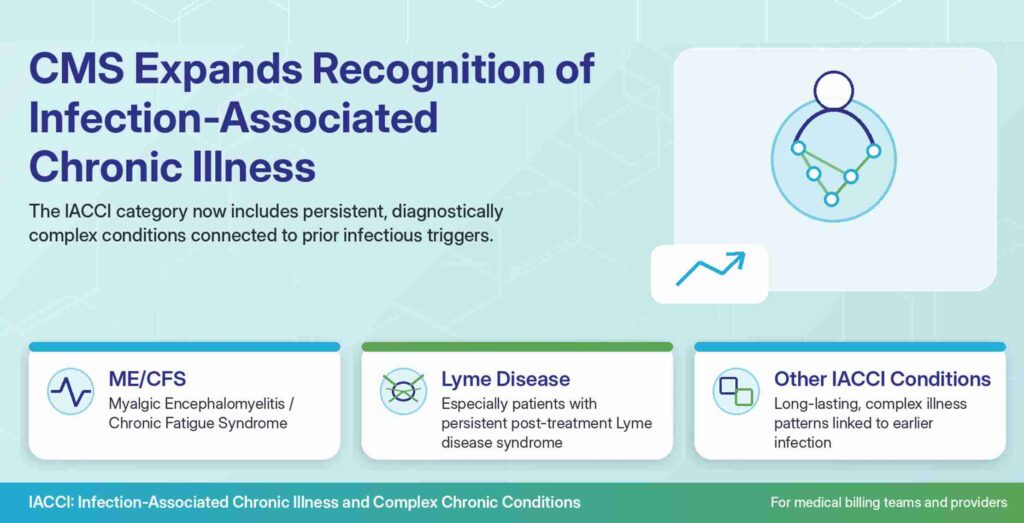
CMS has expanded recognition of infection-associated chronic illness and complex chronic conditions (IACCI). This category now includes:
- Myalgic Encephalomyelitis/Chronic Fatigue Syndrome (ME/CFS)
- Lyme disease, particularly in patients with persistent post-treatment Lyme disease syndrome
- Other diagnostically complex, persistent conditions linked to prior infectious triggers
These conditions frequently present without clean diagnostic clarity, without visible abnormalities on standard labs, and without straightforward treatment pathways.
That complexity is precisely why they can qualify, and why CMS has moved to recognize them explicitly.
For patients with IACCI diagnoses, complex CCM is the relevant billing pathway. Complex CCM requires that the billing encounter involve moderate-to-high complexity medical decision-making (MDM).
The clinical visit must rise to that level, not simply be a check-in. Documentation must reflect the decision-making complexity, not just the diagnosis.
If your practice manages patients with post-infectious chronic illness, your team should know these patients may now have a clearer CCM qualifying diseases list pathway than they did several years ago.
What happens after a patient qualifies for CCM?
Eligibility is the start, not the finish. Here is what follows once a patient meets the criteria.
Initiating visit
Before monthly CCM billing begins, the patient must have a face-to-face visit with the billing provider to initiate or re-initiate care.
Patient consent
Verbal or written consent must be documented. The patient must understand they may be billed a copay for CCM services.
Comprehensive care plan
A structured, patient-centered care plan covering problems, goals, medications, and care coordination must be created and shared.
Monthly touchpoints
A minimum of 20 minutes of non-face-to-face clinical staff time per month is required for standard CCM (CPT 99490). Complex and enhanced CCM codes have higher time thresholds.
24/7 access
The practice must provide patients with around-the-clock access to clinical staff who can address urgent needs.
Medication review and care transitions
Ongoing medication reconciliation and management of transitions between care settings are core components.
Also, only one provider can bill CCM for a given patient in a given month. Coordination with co-managing specialists matters.
Qualifying patients are already in your practice. The revenue system should be READY for them.
CCM eligibility is only valuable when your practice can turn it into clean documentation, accurate enrollment, timely billing, and consistent follow-through.
MedHeave operates as your embedded revenue department, giving your team the structure to capture eligible care management revenue without creating another workflow burden.
- Identify CCM-eligible patients across your existing panel
- Verify Medicare coverage and documentation requirements before billing
- Support accurate coding, claim submission, denial response, and payment posting
- Track revenue performance with clear reporting, not black-box updates
- Keep your practice in control while MedHeave owns the revenue cycle process
Stop leaving qualified CCM revenue buried in your patient panel. Talk to MedHeave about building a revenue cycle process that captures it correctly.
Related guides & resources
The resources below cover closely related topics and the broader service workflow they connect to:
- Chronic care management services — Chronic care management services
- RPM coverage rule changes — Remote Patient Monitoring Policy for 2026
- Risk stratification — Risk Stratification in Healthcare: Models, Levels & Examples
- Modifiers in medical billing — Modifiers in Medical Billing: What They Are, How They Work, & When To Use Them
- Medical billing — Beginner’s Guide to Medical Billing and Coding
- Ambient clinical intelligence — Ambient Clinical Intelligence (ACI): Benefits & Risks
- Prior authorization — Prior Authorization in Medical Billing Explained
Frequently Asked Questions
Here are some commonly asked questions on this topic:
Two or more. Both must be expected to last at least 12 months or until the patient’s death and must place the patient at significant risk of acute exacerbation, functional decline, or death. That is the CMS standard, and it is the same threshold regardless of the specific diagnoses involved.
There is no single closed list. Any chronic condition that meets the duration and risk criteria can qualify. CMS provides an illustrative list covering cardiovascular, metabolic, respiratory, neurological, musculoskeletal, and other categories. But the eligibility test, not list membership, controls. A provider who can document two qualifying conditions with appropriate risk evidence meets the standard.
No. One chronic condition, regardless of severity, does not qualify for CCM. However, it may qualify for Principal Care Management (PCM), a separate Medicare program designed for single-condition complexity. Billing CCM for a single-condition patient is a compliance risk. The CCM vs PCM eligibility distinction is not subtle: it is condition count.
Yes, when combined with at least one other qualifying chronic condition. Depression as a standalone diagnosis does not qualify. But depression paired with diabetes, COPD, heart failure, or another chronic condition is one of the most common qualifying combinations in primary care. Depression’s documented impact on chronic disease management outcomes makes it a clinically relevant second condition in almost every pairing.
The billing provider makes the clinical determination based on CMS eligibility criteria. It is not a payer pre-authorization process. It is a clinical judgment, supported by documentation in the medical record, that the patient meets the two-condition, 12-month, significant-risk standard. Your billing team confirms the documentation supports the claim. The provider owns the eligibility decision.
The patient must be enrolled in Medicare Part B (or Medicare Advantage with CCM coverage, verified separately). They must have two or more chronic conditions meeting the duration and risk thresholds. The billing practice must have the infrastructure to deliver CCM services, documented care plan, 24/7 access, monthly care management time, and appropriate consent. The Medicare chronic care management program has specific documentation and time requirements for each CPT code tier.