
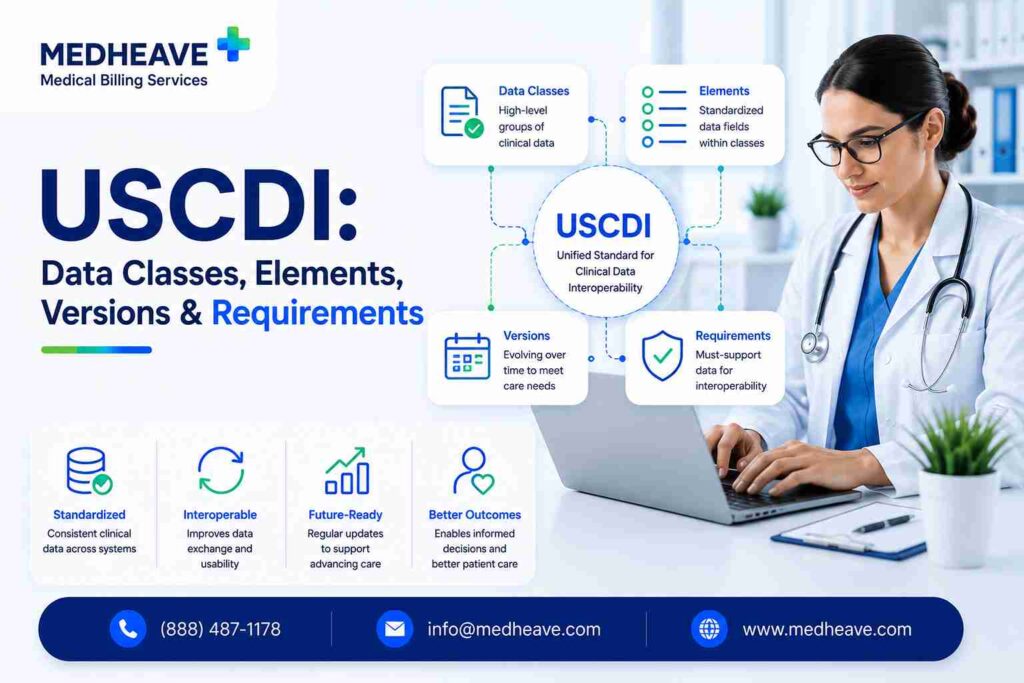
USCDI stands for United States Core Data for Interoperability — a standardized set of health data classes and data elements that defines the baseline for nationwide electronic health information exchange.
Maintained by ONC (the Office of the National Coordinator for Health Information Technology) on behalf of HHS, USCDI establishes a common data vocabulary that certified health IT systems must support.
USCDI is not an API, a file format, or a complete medical record. It defines what data should be exchangeable. How that data is technically structured and exchanged depends on standards like FHIR and implementation guides like US Core.
ONC states that USCDI sets the foundation for access, exchange, and use of electronic health information. The HTI-1 Final Rule adopted USCDI v3 as the new certification baseline effective January 1, 2026 — making USCDI a practical compliance requirement, not a conceptual framework.
In this guide, we’ll be going into:
- How to implement USCDI in practice
- How USCDI differs from FHIR and US Core
- What USCDI+ extends beyond the core dataset
- What USCDI data classes and data elements are
- How USCDI versions work and which one applies now
- Common misconceptions and implementation challenges
What are USCDI data classes and data elements?
USCDI organizes health information into two levels.
A data class is a broad category grouping related data elements by theme or use case. A data element is a specific piece of exchangeable health information within that class.
| Data class | Example data elements | Why it supports interoperability |
| Patient Demographics | Name, date of birth, address, race, ethnicity, preferred language | Identification, matching, equity analysis |
| Allergies and Intolerances | Substance, reaction | Medication safety across providers |
| Medications | Medication name, dose, instructions | Treatment history and safety |
| Laboratory | Tests, values/results | Diagnostic assessment and monitoring |
| Vital Signs | Blood pressure, heart rate, temperature, weight | Clinical assessment |
| Problems | Active and historical conditions | Care coordination and documentation |
| Procedures | Clinical interventions performed | Care history and quality reporting |
| Clinical Notes | Discharge summary, progress note, consultation note | Context beyond structured fields |
| Provenance | Author timestamp, author organization | Trust and traceability |
USCDI v5 (finalized July 2024) added two new data classes — Observations and Orders — along with 16 new data elements including Emergency Department Note, Lot Number, Route of Administration, and Interpreter Needed.
Each version expands the baseline, moving the standard closer to the operational data that clinicians, payers, and patients actually need.
How do USCDI versions work?
ONC publishes new USCDI versions annually — draft versions in January, final versions in July. Not every new version is immediately required for certification.
USCDI VERSION TIMELINE
From baseline to current draft
v1
Original Cures Act baseline. Replaced CCDS. Expired January 1, 2026.
v3
New certification baseline via HTI-1. Required from January 1, 2026. Adds equity and public health elements.
v5
Added Observations and Orders classes. 16 new elements. Finalized July 2024.
v6
Latest finalized version. Released July 2025.
v7
Draft released January 2026. Proposes 30 additions. Open for public comment.
“Latest” and “required” are not the same. Check your certification program and implementation guide for the applicable version.
Draft USCDI v7 proposed 30 additions, with 13 already represented in exchange specifications required by the certification program. ONC reports that 29 are new proposed elements and one revises Smoking Status to become Tobacco Use.
The practical implication for health IT teams is that version awareness is ongoing work. You need to know which version your certification requires, which version your EHR supports, and which version your trading partners expect.
How does USCDI differ from FHIR and US Core?
USCDI defines what data should be available for exchange. FHIR defines how data can be structured and exchanged. US Core defines how FHIR applies in the United States.
| Topic | USCDI | FHIR | US Core |
| Main role | Defines baseline data classes and elements | Defines resources, profiles, and API behavior | Defines U.S. FHIR profiles and interactions |
| Simple meaning | What data is exchangeable | How data is technically represented and exchanged | How FHIR applies to U.S. requirements |
| Managed by | ONC/ASTP on behalf of HHS | HL7 International | HL7 (U.S. Realm) |
| Example | Laboratory test and result | Observation resource | US Core Laboratory Result Observation profile |
The US Core implementation guide explains that USCDI and US Core are complementary — USCDI defines high-level data requirements, while US Core provides detailed FHIR-based profiles for meeting those requirements.
The mapping is not always one-to-one. Some USCDI elements map to multiple US Core profiles, and some US Core content exists beyond USCDI because implementation needs go beyond the policy baseline.
The most common mistake is treating USCDI, FHIR, and US Core as interchangeable. They are layers in the same interoperability stack — and each one solves a different part of the problem.
What is USCDI+?
USCDI+ extends the core USCDI dataset for specific domains and programs that need data elements beyond the baseline.
ONC describes USCDI+ as a service for federal and industry partners to establish, harmonize, and advance domain-specific data element lists.
| Topic | USCDI | USCDI+ |
| Scope | Core nationwide baseline | Domain-specific extensions |
| Purpose | Common exchange foundation | Specialized use cases beyond core data |
| Current domains | N/A (it is the core) | Public health, quality, cancer, behavioral health, maternal health |
| Users | Broad health IT ecosystem | Federal agencies, domain programs, industry partners |
ASTP/ONC and SAMHSA launched a $20 million Behavioral Health Information Technology initiative involving nine pilot projects across nine states, testing the USCDI+ Behavioral Health dataset and FHIR Behavioral Health Profiles in real-world settings.
The behavioral health extension is especially relevant because ONC found that only 68% of substance use and mental health treatment facilities used only an EHR (25% used both EHR and paper charts, 4% had no EHR plans), and only 19% participated in a health information exchange.
Behavioral health remains a major interoperability gap — and USCDI+ is designed to address it.
How does USCDI support quality measurement and patient access?
USCDI underpins two high-profile use cases beyond basic clinical exchange.
For quality measurement, standardized data classes help quality teams calculate digital quality measures using consistent clinical concepts across healthcare settings.
NCQA frames USCDI as relevant to HEDIS reporting and digital quality measurement, where standardized data improves comparability and reduces reporting burden.
For patient access, USCDI-compatible APIs allow patients to retrieve their health information through apps. ONC found that about 9 in 10 U.S. hospitals enabled patient access through an API in 2024, with 70% using standards-based APIs such as FHIR. USCDI determines what data those APIs must be able to provide.
How should organizations implement USCDI?
Here is a roadmap for implementation of USCDI:
USCDI INFRASTRUCTURE
The adoption base that USCDI builds on
99.4%
Of U.S. non-federal acute care hospitals with a certified EHR (2024)
70%
Of hospitals using FHIR-based APIs for patient access (2024)
1B+
Health records exchanged through TEFCA in under one year
19%
Of behavioral health facilities participating in an HIE (major gap)
Sources — ONC Data Briefs (2024–2026), HHS TEFCA announcement (2026)
A practical implementation checklist for health IT teams
- Identify which USCDI version applies to your use case or certification requirement
- Inventory current EHR, claims, lab, and clinical data sources against USCDI data classes
- Map local fields to USCDI data elements
- Identify applicable vocabularies and code systems (SNOMED CT, LOINC, RxNorm, ICD-10-CM)
- Map USCDI elements to US Core/FHIR profiles where API exchange is required
- Validate completeness, accuracy, provenance, and data quality
- Confirm API, C-CDA, or other exchange format requirements
- Test exchange with trading partners and patient-access workflows
- Document gaps and optional elements
- Monitor annual USCDI updates and SVAP advancement opportunities
What are common USCDI misconceptions?
Let’s look at some common misconceptions on this subject:
| Misconception | Better framing |
| USCDI is an API | USCDI defines data requirements, not an API. Pair it with FHIR/US Core for technical exchange. |
| USCDI is the full medical record | It is a core baseline dataset. Organizations will have additional data beyond USCDI. |
| Latest version is always required | Published and required versions can differ. Check certification program rules. |
| FHIR automatically satisfies USCDI | Mapping and US Core profiles are needed. Base FHIR alone does not guarantee USCDI compliance. |
| USCDI+ replaces USCDI | USCDI+ extends the core for specific domains. USCDI remains the foundation. |
| Having the data means it is usable | Data quality, coding consistency, and completeness vary across sources. Validation is ongoing work. |
Epic introduced capabilities supporting USCDI v3 more than a year before the federal requirement — showing that vendor implementation can move ahead of compliance deadlines.
But vendor support does not mean every organization using that vendor has configured, validated, and tested the updated data elements.
When data standards affect your revenue
USCDI compliance shapes what data your EHR can exchange — and data exchange gaps directly affect authorization workflows, claims processing, payer communication, and quality reporting.
MedHeave helps healthcare providers connect interoperability readiness to billing, credentialing, and compliance operations.
- Credentialing support aligned with certified health IT requirements
- Claims and authorization workflows tied to data exchange capabilities
- Denial analysis connected to data completeness and interoperability gaps
- Compliance documentation for payer, certification, and accreditation readiness
Contact MedHeave to connect your interoperability compliance to your revenue cycle performance.
Frequently asked questions
Here are some commonly asked questions about USCDI:
USCDI establishes a standardized baseline set of health data classes and data elements for nationwide interoperable exchange. It defines what electronic health information certified health IT systems must be able to access, exchange, and use. USCDI supports patient access to records, care coordination across providers, quality measurement, public health reporting, and health IT certification requirements. It does not define how data is technically exchanged — that role belongs to standards like FHIR and implementation guides like US Core.
USCDI defines what data should be available for exchange (data classes and elements like medications, lab results, and vital signs). FHIR defines how data can be technically represented and exchanged (resources, APIs, and profiles). US Core is the U.S. FHIR implementation guide that maps USCDI requirements to specific FHIR profiles and interactions. The three are complementary layers — USCDI sets the data floor, FHIR provides the technical infrastructure, and US Core bridges the two for U.S. healthcare implementation.
USCDI v3 became the required baseline for the ONC Health IT Certification Program on January 1, 2026, through the HTI-1 Final Rule. USCDI v6 is the latest finalized version (released July 2025), and Draft USCDI v7 was released in January 2026 for public comment. Organizations should verify which version their specific certification, program, or trading-partner agreement requires — because “latest published” and “currently required” are not always the same version.
USCDI+ extends the core USCDI dataset for specific domains and federal programs that need data elements beyond the baseline. Current USCDI+ domains include public health, quality measurement, cancer, behavioral health, and maternal health. ONC describes USCDI+ as a service for federal and industry partners to harmonize domain-specific data element lists. USCDI+ does not replace USCDI — it builds on the core foundation for specialized use cases where the standard baseline is insufficient.
Later USCDI versions expand social-determinant-related concepts. USCDI v3 and subsequent versions added data elements related to health status assessments, including screening results for food insecurity, housing instability, and transportation barriers. The exact elements and their scope depend on the version. USCDI+ domains (particularly public health and behavioral health) further extend SDOH-related data beyond the core baseline for programs that need deeper social-determinant data for screening, referral, and population health analysis.

