



A timely filing limit (TFL) is the maximum number of days a provider has to submit a claim after the date of service.
Miss it and the claim is denied — regardless of medical necessity, documentation quality, or coding accuracy. The service was valid, the patient was covered, and the provider still doesn’t get paid.
Medicare allows 12 months. Many commercial payers require 90 to 180 days. Medicaid deadlines differ by state.
And the clock does not pause when a claim is rejected — a rejected claim is not a filed claim under most payer rules, which means the provider must correct and resubmit before the original deadline expires.
Here’s what we’ll cover:
- When TFL denials can actually be appealed
- Verified payer deadlines with authoritative sources
- The operational controls that prevent TFL denials before they happen
- How rejected claims affect the filing clock (and why this catches so many teams)
What is timely filing in medical billing?
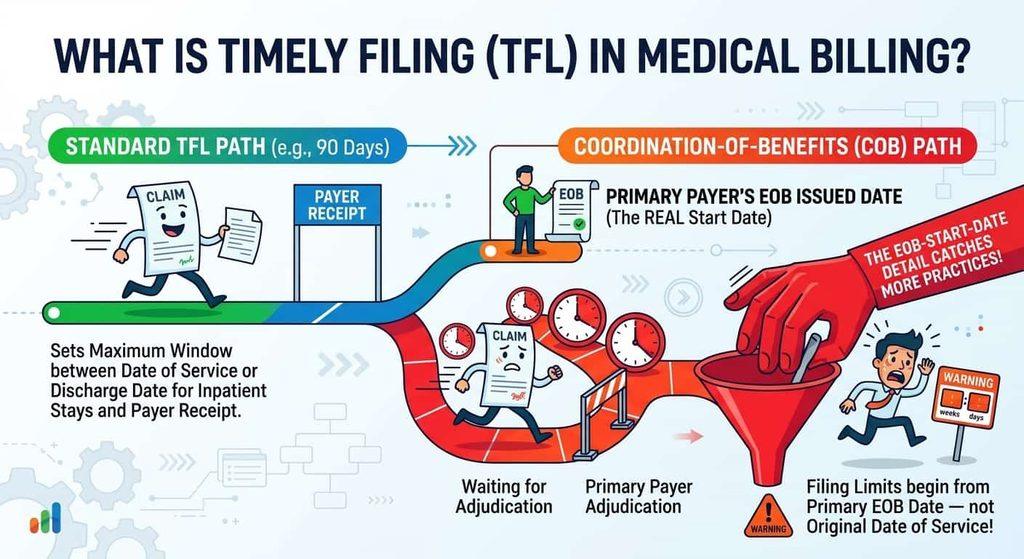
TFL — sometimes called the “filing deadline” or “filing window” — sets the maximum window between date of service and payer receipt of the claim.
For inpatient stays, some payers use the discharge date. For coordination-of-benefits situations, secondary payer filing limits often begin from the date the primary payer’s EOB is issued — not the original date of service.
That EOB-start-date detail catches more practices than any other TFL rule.
Providers who wait for primary payer adjudication before billing the secondary payer may already be running against a tighter clock than they realize (and by the time they notice, the window has narrowed to weeks).
What is Medicare’s timely filing limit?
Medicare’s deadline is the most straightforward in medical billing. According to the CMS Medicare Claims Processing Manual, Chapter 1, Section 70, claims must be submitted within one calendar year (12 months) from the date of service.
| Medicare program | Filing limit | Start date |
| Medicare Part A | 12 months | Date of discharge |
| Medicare Part B | 12 months | Date of service |
CMS specifies that timely filing denials are not initial determinations — which means standard Medicare appeal rights generally do not apply.
Limited exceptions exist for administrative error by Medicare, retroactive entitlement, retroactive Medicaid coordination, and retroactive MA plan disenrollment. “We didn’t get to it in time” does not qualify.
The compliance detail that causes the most preventable Medicare TFL denials is that rejected claims do not stop the clock. First Coast Service Options confirmed in 2026 that returned or rejected claims are not considered filed claims.
A provider who submits a claim with invalid data on day 360 and receives a rejection on day 365 has not filed a timely claim. The corrected resubmission must be accepted before the 12-month deadline — and if it arrives after, Medicare denies it.
For most billing teams, submitting a claim close to the deadline is almost as risky as missing it entirely. One coding error, one eligibility mismatch, and the rejected claim comes back after the window has closed.
Compliance Risk
How a Rejected Claim Becomes a TFL Denial
Rejected claims are not considered filed. The clock does not pause.
12-month filing clock starts
5 days before deadline
Rejected claim was never “filed.” Correction arrives too late.
Revenue permanently lost. Standard appeal rights do not apply.
What are common commercial payer filing limits?
Commercial deadlines are governed by provider contracts, not federal regulation — which makes them harder to track and more variable. The only authoritative source for a specific payer’s filing limit is the provider’s contract or the payer’s current provider manual.
| Payer category | Common filing window | Notes |
| Medicare (FFS) | 12 months from DOS | CMS Claims Processing Manual |
| Medicare Advantage | 90-180 days (varies by plan) | Often shorter than traditional Medicare |
| Medicaid (state programs) | 90 days to 12 months | State manuals govern; no federal standard |
| Commercial PPO/HMO | 90-180 days (contract-specific) | Deadlines vary by product line and state |
| TRICARE | 1 year from DOS (within U.S.) | TRICARE provider handbook |
| Workers’ Compensation | State-specific | Governed by state statutes |
BCBS plans deserve a specific note — they operate as independent regional companies.
A BCBS Georgia filing limit may differ entirely from BCBS Texas or Illinois. Providers should reference their specific BCBS contract rather than assuming any national standard.
For practices contracting with dozens of payers, maintaining a centralized deadline database (updated at least annually during contract renewals) is the only reliable way to track limits at scale.
How do TFL denials affect practice revenue?
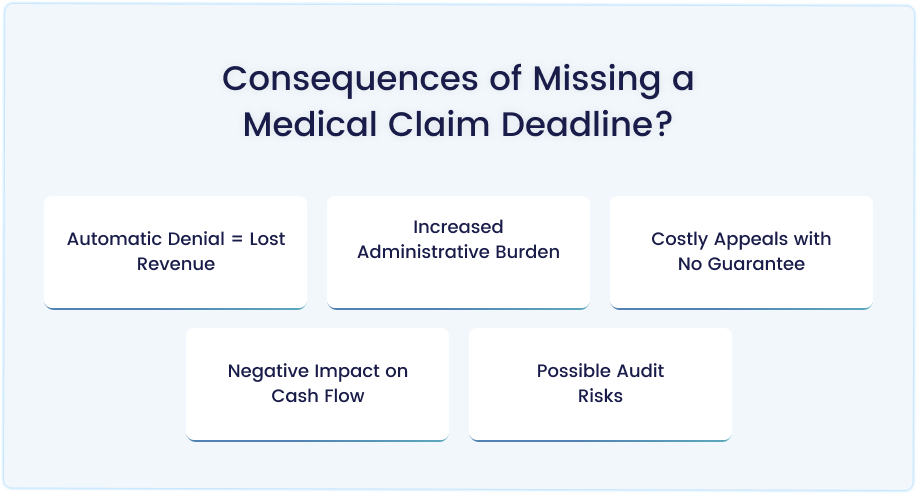
A mid-sized practice submitting 800 claims per month with a 3% TFL denial rate at an average claim value of $175 loses roughly $50,400 per year in unrecoverable revenue.
But the harder cost to measure is the wasted work — every TFL-denied claim had already been coded, scrubbed, and submitted. The documentation exists. The service was rendered. The only thing missing was speed.
For billing teams, TFL denials are a leading indicator of process health.
A practice with rising TFL rates isn’t just losing revenue on those specific claims — it’s revealing that claims move too slowly through the entire revenue cycle, which means other claims are accumulating avoidable delays even if they haven’t yet crossed a deadline.
When can a timely filing denial be appealed?
TFL denials are harder to overturn than most denial types, but they are not always final.
Medicare timely filing appeals generally fail because CMS doesn’t classify late-filing denials as initial determinations. Providers can request reconsideration only if the delay falls under a recognized CMS exception (administrative error, retroactive entitlement, retroactive disenrollment).
Commercial payer appeals may succeed when the provider can demonstrate proof of original timely submission (clearinghouse acceptance report, electronic acknowledgment), payer-caused delay (system outage, incorrect eligibility data), or coordination-of-benefits delay (primary payer adjudicated late).
A timely filing appeal letter should include the claim number, date of service, date of original submission, and proof of transmission. “Clearinghouse acceptance report #47291 confirms transmission on 04/12/2025, within the 90-day window per contract section 4.3” gives the payer something to verify. “We submitted on time” without proof is not persuasive.
What operational controls prevent TFL denials?
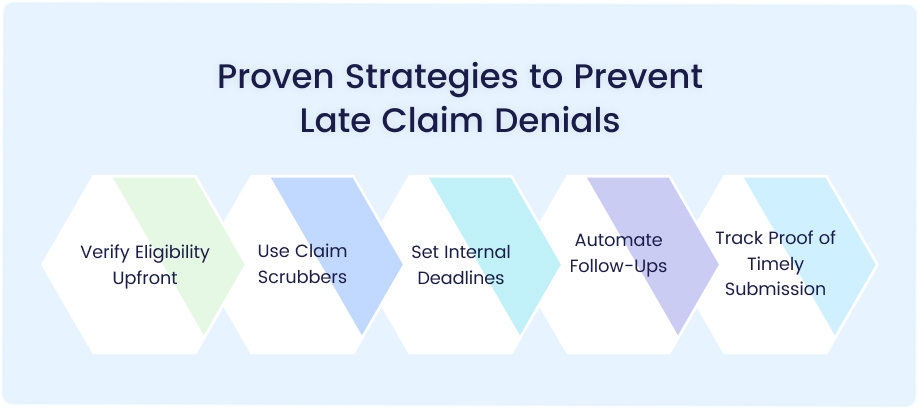
The difference between practices that rarely lose claims to timely filing and those that lose them regularly isn’t awareness of the rules — every billing team knows deadlines exist. The difference is whether the practice treats filing speed as a system design problem.
How is the filing deadline different from the appeal deadline?
These are separate clocks, and confusing them creates problems in both directions.
| Deadline type | What it governs | If missed |
| Filing deadline (TFL) | Submission of the original claim | Payment often permanently forfeited |
| Appeal deadline | Challenge to a denied claim | Denial becomes final; no further payer recourse |
A claim can be filed on time and still denied for other reasons. The appeal deadline for that denial is a separate clock. Missing the filing deadline forfeits the claim. Missing the appeal deadline forfeits the right to challenge the denial.
Timely filing denials are usually a workflow problem
MedHeave helps practices prevent timely filing denials through payer-specific deadline tracking, proactive claim monitoring, and rapid rejection resolution. By treating filing speed as a core revenue cycle KPI—not an administrative afterthought—our team helps ensure claims reach payers well before filing deadlines expire.
- Payer-specific filing deadline tracking
- Daily rejection monitoring and resolution
- Automated aging and escalation workflows
- Coordination-of-benefits claim management
- Dedicated account managers with full reporting visibility
If timely filing denials are creating preventable revenue loss in your practice, contact us to learn how MedHeave helps providers stay ahead of payer deadlines and protect every dollar they’ve earned.
Related guides & resources
The resources below cover closely related topics and the broader service workflow they connect to:
- Denial management services — Denial management services
- Denial management — Mastering Denial Management: A Comprehensive Guide
- Insurance denial mistakes and solutions — 10 Common Mistakes for Insurance Denials and How to Avoid Them
- Claim denial mistakes — Common Mistakes Leading to Claim Denials in Medical Billing
- Minimize denials in a pain management practice — Minimize Claim Denials in Your Pain Management Practice
- Common denial codes — Common Denial Codes in Medical Billing (2026)
- CO-45 denial code — CO-45 Denial Code Explained: Causes & Appeals
Frequently asked questions
Here are some commonly asked questions on this topic:
TFL stands for timely filing limit — the maximum number of days after the date of service that a provider has to submit a claim. If the claim isn’t received within the TFL window, it’s typically denied and the revenue is permanently lost. Medicare’s TFL is 12 months. Commercial payers commonly require 90 to 180 days. Medicaid deadlines vary by state.
No. Under most payer rules — including Medicare — a rejected or returned claim is not considered filed. The provider must correct and resubmit, and the corrected version must be accepted before the deadline expires. First Coast Service Options confirmed this in 2026. Submitting close to the deadline with any data error creates a high risk of permanent revenue loss.
Include the claim number, date of service, date of original submission, and proof that the claim was transmitted within the filing window. Attach clearinghouse acceptance reports or electronic delivery confirmations. Reference the contract section defining the filing limit. Appeals without submission proof rarely succeed; appeals with electronic confirmation of timely transmission have a much stronger basis.
BCBS plans are independent regional companies, so filing limits vary by state and product line. The BCBS Georgia deadline depends on the specific plan, contract, and network status. Reference your BCBS Georgia contract or provider manual for the current deadline rather than relying on generalized references.
The most common causes include delayed initial submission (coding or documentation backlogs), clearinghouse rejections that sit unworked, insurance eligibility errors requiring resubmission, coordination-of-benefits delays between primary and secondary payers, and staff turnover disrupting billing workflow. Most causes are operational — the service was documented correctly, but the claim moved through the revenue cycle too slowly.
No. Limits vary by payer, product line, state, and provider contract. Medicare allows 12 months. Many commercial payers require 90-180 days. Medicaid differs by state. Medicare Advantage plans often use shorter limits than traditional Medicare. The only way to confirm a specific payer’s deadline is to check the provider contract or current provider manual.
A timely filing denial occurs when a claim is submitted after the payer’s filing deadline. The limit varies by insurer, plan, claim type, and circumstances. Review the remittance advice, verify submission dates and proof of timely filing, and determine whether a corrected claim or appeal is permitted.
There is no single timely filing limit that safely applies to every Blue Cross Blue Shield of Georgia claim. Deadlines can differ by product, provider contract, and claim circumstances. Check the current provider manual or contract for the specific plan and claim type before submitting.
GHI-related filing deadlines depend on the specific plan, administrator, provider agreement, and claim type. Do not assume one deadline applies to all GHI coverage. Check the current plan documents or provider contract, including any special rules for corrected claims, secondary claims, and appeals.