
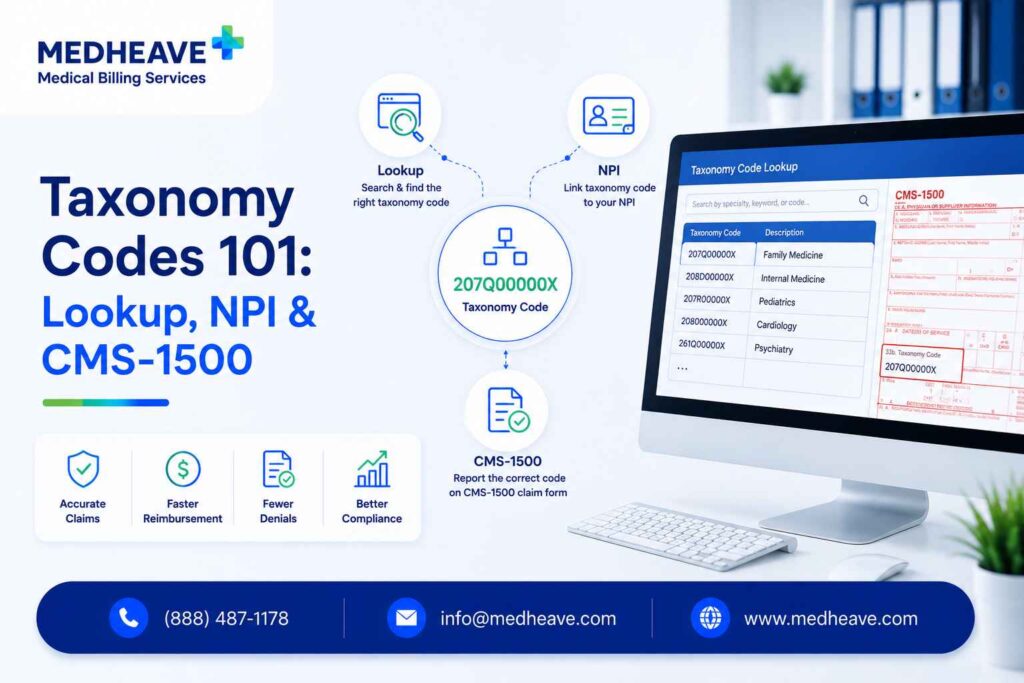
Most providers select a taxonomy code once during NPI enrollment and never think about it again. That works, until a payer flags the code as missing or mismatched, and the claim comes back rejected.
A taxonomy code is a 10-character alphanumeric identifier that tells payers what type of provider you are and what specialty you practice. CMS defines it as the code that “designates your classification and specialization.”
Pick the wrong classification (or let an outdated one sit on your taxonomy code NPI record for years) and the financial consequences show up as preventable denials.
Let’s get into:
- Where the taxonomy code on CMS-1500 belongs on a CMS-1500 form
- How the three-level code structure works and when it updates
- What happens when the code is wrong and how to fix it
- How to look up your code right now
- Common codes by specialty
TLDR: The set-it-and-forget-it code that payers are actually checking
Providers tend to treat taxonomy codes as one-time setup items during NPI enrollment. Payers are starting to enforce them as live billing requirements.
- A taxonomy code is a 10-character alphanumeric identifier that defines your provider type and specialty, not the services you perform
- NUCC maintains the code set and publishes updates every January and July
- Two lookup methods exist. Search NPPES by NPI if you have one, or browse the NUCC taxonomy by provider type if you do not
- On a CMS-1500, the billing provider taxonomy goes in Box 33b and the rendering provider taxonomy goes in Box 24J when the payer requires it
- Peer-reviewed research shows subspecialty taxonomy accuracy sits at just 64%, meaning self-reported codes often do not match actual practice
- Payers like UnitedHealthcare and BCBS of Illinois now reject claims with missing or incorrect taxonomy codes at the field level
How taxonomy codes are structured?
The National Uniform Claim Committee (NUCC) organizes every taxonomy code into three hierarchical levels.
- The broadest is: Provider Grouping (think Behavioral Health & Social Service Providers).
- One level down sits : Classification (Psychologist, for example).
- The narrowest is: Area of Specialization (Clinical, Counseling, School, and so on).
These national taxonomy codes are published twice a year, in January and July.
Each release can add new classifications or retire outdated ones, so a code that was accurate five years ago may not be the right fit today.
Code Anatomy
How a taxonomy code breaks down
Level 1
Provider Grouping
Behavioral Health & Social Service Providers
Level 2
Classification
Psychologist
Level 3
Specialization
Clinical
When no specialization is selected, those digits default to zeroes. 103T00000X = Psychologist (general). 103TC0700X = Psychologist (clinical).
On paper, the gap between 103T00000X and 103TC0700X looks trivial. In practice, it affects payer matching, directory listings, and credentialing records. Payer audits and directory cross-checks are catching those mismatches more often than they used to.
How do you find your taxonomy code?
Two methods cover every scenario. Which one you use depends on whether you already have an NPI.
1. NPPES registry
Head to the NPPES NPI Registry, type in your NPI number, and the taxonomy code shows up in the provider details. The record also flags whether a code is marked primary when multiple codes are on file.
Worth noting, CMS has stated that NPI issuance “does not ensure or validate that the provider is licensed or credentialed.” The taxonomy listed in NPPES is a data point to verify against your payer records, not a primary-source credential.
2. NUCC lookup
If you do not have an NPI yet, go to the NUCC Health Care Provider Taxonomy page and browse by provider grouping, then narrow by classification and specialization.
This taxonomy code lookup covers all provider types. CMS also publishes a Medicare-specific crosswalk linking taxonomy codes to Medicare-eligible provider types, helpful when enrolling through PECOS.
NUCC is explicit that NUCC taxonomy codes “are not used to define services rendered, but instead are used to define areas of specialty.” Providers should select based on education and training. That makes it a business decision, not a clinical one.
Where does the taxonomy code go on a claim?
On a CMS-1500, the code sits in two places.
- The billing provider taxonomy belongs in Box 33b.
- The rendering provider taxonomy belongs in Box 24J, paired with the ZZ qualifier in Box 24I, when the payer requires it.
Not every payer asks for Box 24J.
But when a practice bills under a group NPI and individual providers render services, payers that enforce rendering-level taxonomy will reject claims if that field is blank or mismatched.
The code also transmits electronically on the 837P professional claim within the PRV segment, even when it does not print on the paper form.
For group practices, that split is where most taxonomy-related rejections start. The group NPI needs the right billing provider code in Box 33b, and each individual clinician needs their own rendering code in Box 24J.
Common taxonomy codes by specialty
Providers frequently search for their specific code by specialty name, and the taxonomy code for licensed professional counselor is one of the most common queries.
The table below covers the most commonly searched examples, but always verified through the NUCC taxonomy lookup because subcategories and specializations vary.
| Specialty | Taxonomy Code | Description |
| Family medicine | 207Q00000X | Physician,Family Medicine |
| Internal medicine | 207R00000X | Physician,Internal Medicine |
| Licensed professional counselor | 101YM0800X | Counselor, Mental Health |
| Licensed clinical social worker | 1041C0700X | Social Worker, Clinical |
| Psychologist (clinical) | 103TC0700X | Psychologist, Clinical |
| Psychiatry | 2084P0800X | Physician, Psychiatry |
| Nurse practitioner | 363L00000X | Nurse Practitioner |
| Physician assistant | 363A00000X | Physician Assistant |
Choosing the wrong code, even within the correct grouping, can trigger a payer mismatch.
For behavioral health providers especially, the classification level separates counselors, social workers, psychologists, and marriage and family therapists into entirely different code families.
Picking a neighboring classification is a surprisingly common enrollment error.
What happens if the taxonomy code is wrong or missing?
The claim gets rejected.
When a taxonomy code is missing from a required field (or does not match the payer’s records), the claim fails at the clearinghouse or comes back as a denial.
Fixing it means correcting the code in your billing system, deleting the rejected claim, and resubmitting.
Payer enforcement
Payers are tightening validation at the field level.
UnitedHealthcare’s North Carolina Medicaid program began requiring billing taxonomy codes and a registered NPI on every claim as of January 2025, rejecting submissions with incomplete fields.
BCBS of Illinois followed in August 2025, aligning with Illinois Medicaid rules that deny claims when the billing, rendering, or attending provider taxonomy is missing or inaccurate.
Accuracy gaps
Taxonomy accuracy is also lower than most providers assume.
Oliphant et al. (2023) found that while 99% of surgeons selected the correct general specialty, only 64% selected an appropriate subspecialty.
Vanderlaan and Jefferson (2023) found a similar gap, with the NPI file containing only 60% of certified midwives.
Research Findings
How accurate is taxonomy data, really?
64%
Subspecialty accuracy
Among surgeons in NPPES, Oliphant et al., 2023
60%
Midwives found in NPI file
Of all AMCB-certified midwives, Vanderlaan & Jefferson, 2023
64–68%
Directory specialty consistency
Across 449,282 physicians, Butala et al., 2024
Taxonomy data is self-reported and unverified by NPPES. Providers who enrolled years ago and never updated may be operating under an inaccurate code.
A code picked during initial enrollment may no longer reflect a provider’s current subspecialty or credentialing status.
As payers tighten field-level enforcement, that dormant inaccuracy turns into a live billing problem.
Troubleshooting taxonomy code issues
Start by confirming the billing provider’s code directly with the payer.
The code in your billing software, the code on the payer’s file, and the code in NPPES should all match. If any of those three are out of sync, claims will fail.
For group practices, every clinician needs their own rendering taxonomy in the system.
A common mistake is assigning the group’s code to individual providers instead of each clinician’s specialty-specific one.
If your practice uses supervisee billing, check the payer’s rules on whose code to submit. Some payers want the supervising provider’s, others want the rendering clinician’s.
When rejections persist after a correction, review whether the payer’s credentialing file matches the NPPES record. A mismatch between the enrolled taxonomy and what you submitted will trigger repeated denials, no matter what NPPES shows.
Stop letting a 10-character code hold up your revenue
MedHeave treats credentialing and payer enrollment as revenue readiness, not paperwork.
That includes verifying every provider’s taxonomy, NPI, and payer records are accurate and aligned before a single claim goes out.
When a taxonomy mismatch causes repeated denials, the root cause is usually an enrollment gap — and that is exactly where MedHeave starts.
- Expirables tracked 60 to 90 days before any lapse
- Payer-specific enrollment across 10 to 20+ payers per provider
- Over 95% of credentialing applications approved without rejection
- CAQH profile management and primary source verification handled in-house
Ready to clean up your enrollment records and stop losing claims to preventable rejections? Contact our team today.
Frequently asked questions
Here are some commonly asked questions on this topic:
An NPI (National Provider Identifier) is a permanent 10-digit number that uniquely identifies a healthcare provider or organization in HIPAA-covered transactions. A taxonomy code is a separate 10-character alphanumeric code maintained by the National Uniform Claim Committee (NUCC) that identifies the provider’s type, classification, and specialty. NPIs identify who is billing, while taxonomy codes identify what kind of provider is billing. Many payers use both together to validate claims, credentialing records, and provider enrollment information.
Yes. Payers use taxonomy codes during credentialing, enrollment, and claims processing to verify that your specialty matches your NPI record, CAQH profile, and enrollment application. A mismatch between these records can delay enrollment, trigger requests for additional documentation, or cause claim rejections if a payer requires taxonomy validation on submitted claims. Keeping your taxonomy code consistent across NPPES, CAQH, and payer records helps reduce avoidable administrative delays and billing issues.
Yes. Providers may list multiple taxonomy codes when applying for or updating their NPI record in NPPES if they practice in more than one specialty or hold multiple qualifications. However, one taxonomy code must be designated as the primary taxonomy, and this is the code most commonly referenced during enrollment and by many payers during claims processing. Additional taxonomy codes can be useful when credentialing for multiple specialties, provided they accurately reflect your education, licensure, and scope of practice.
The National Uniform Claim Committee (NUCC) updates the Healthcare Provider Taxonomy Code Set twice each year, with new releases typically published in January and July. Updates may introduce new provider classifications, revise existing descriptions, or retire outdated codes as healthcare specialties evolve. Providers do not automatically receive these updates, so it’s good practice to periodically review your taxonomy code — especially before credentialing, payer enrollment, or when your specialty or scope of practice changes.
The taxonomy code most commonly used by Licensed Professional Counselors (LPCs) is 101YM0800X, which corresponds to Counselor – Mental Health in the NUCC taxonomy. However, the correct taxonomy depends on the provider’s license, specialty, and payer requirements. Some behavioral health professionals use different taxonomy codes based on their credentials, such as marriage and family therapists or clinical social workers. Always verify the appropriate code through the NUCC taxonomy code set and ensure it matches your credentialing and payer enrollment records.

