

Skin graft billing generates more denials than most surgical categories because reimbursement depends on three variables that must align perfectly — graft type, wound surface area in square centimeters, and anatomical location. Get any one wrong, and the claim is either denied or downcoded.
A single grafting case can produce three to five separate line items, each governed by different coding rules, and missing the wound preparation code alone is probably the most common revenue loss in skin graft billing.
In this guide, we’ll be exploring:
- Measurement rules and rounding compliance
- STSG and FTSG code families with size thresholds
- Skin substitute application codes vs. autograft codes
- Modifier logic and the five denial patterns that cost the most
- Wound preparation codes (the line item most billing teams miss)
How does skin graft CPT coding work?
A skin graft claim is not “one code per procedure.” The billing architecture breaks into four layers, each with its own codes, documentation, and denial patterns. Let’s map these layers — the sections that follow cover each code family in detail.
Billing Architecture
4 Layers of a Skin Graft Claim
Each layer has its own codes, documentation, and denial patterns.
15002–15005 — Recipient site prep. Separately billable. Most commonly missed.
15100–15261 (autografts) or 15271–15278 (skin substitutes). Size + site driven.
Q4101–Q4199 for biologics/skin substitutes. Must pair with CPT application code.
ICD-10-CM must justify medical necessity. Etiology + wound stage required.
Capture every billable layer of your graft cases
Wound preparation codes are among the easiest line items to miss on a skin graft claim. MedHeave audits each layer — prep, application, and material — before the claim goes out.
What are the split-thickness skin graft CPT codes?
A split-thickness skin graft (STSG) transfers the epidermis and partial dermis from a donor site to the wound. STSG codes are organized by anatomical location and wound size, with add-on increments of 100 cm².
| CPT code | Body region | Size threshold |
| 15100 | Trunk, arms, legs | First 100 cm² |
| 15101 | Trunk, arms, legs | Each additional 100 cm² (add-on) |
| 15120 | Face, scalp, hands, feet, genitalia, digits | First 100 cm² |
| 15121 | Face, scalp, hands, feet, genitalia, digits | Each additional 100 cm² (add-on) |
So for example, a 250 cm² STSG on the left thigh is reported as 15100 × 1 (first 100 cm²) plus 15101 × 2 (additional 200 cm²). Check payer-specific rules for how fractional units are handled — some require the next full unit, others prorate.
What are the full-thickness skin graft CPT codes?
A full-thickness skin graft (FTSG) transfers the epidermis and entire dermis. Because the donor site requires closure, FTSGs are reserved for smaller wounds where cosmetic or functional outcomes justify the complexity. FTSG codes use smaller size increments than STSG — 20 cm² per unit instead of 100 cm².
| CPT code | Body region | Size threshold |
| 15200 | Trunk, arms, legs | First 20 cm² |
| 15201 | Trunk, arms, legs | Each additional 20 cm² (add-on) |
| 15220 | Face, scalp, hands, feet, genitalia, digits | First 20 cm² |
| 15221 | Face, scalp, hands, feet, genitalia, digits | Each additional 20 cm² (add-on) |
The add-on unit difference between STSG and FTSG is where miscounting creates the biggest billing errors. A 200 cm² STSG on the trunk requires 2 total units. A 200 cm² FTSG on the trunk requires 10 total units (at 20 cm² per unit). Miscounting add-on units is a direct path to either underbilling or audit exposure.
Why are wound preparation codes the most commonly missed revenue?
Before a graft can be applied, the wound bed must be prepared. CMS assigns separate CPT codes for surgical preparation, and these are billed in addition to the graft application — not bundled into it.
| CPT code | Body region | Size threshold |
| 15002 | Trunk, arms, legs | First 100 cm² |
| 15003 | Trunk, arms, legs | Each additional 100 cm² (add-on) |
| 15004 | Face, scalp, hands, feet, genitalia | First 100 cm² |
| 15005 | Face, scalp, hands, feet, genitalia | Each additional 100 cm² (add-on) |
Many billing teams skip these because the operative note doesn’t explicitly describe preparation as a distinct service, or because coders assume the prep is included in the graft code. It is not. When the surgeon debrids necrotic tissue, excises eschar, or creates a viable surface, that work supports a separate preparation code.
For practices with high graft volume, auditing whether 15002–15005 are captured on every eligible case is one of the fastest ways to identify underbilling.
How do skin substitute codes differ from autograft codes?
Skin substitute graft application uses CPT 15271–15278 — a completely different series from autograft codes. Billing a skin substitute under autograft codes (15100–15261) triggers denials because the code doesn’t match the product.
Under 100 cm² wounds
| CPT code | Body region | Increment |
| 15271 | Trunk, arms, legs | First 25 cm² |
| 15272 | Trunk, arms, legs | Each additional 25 cm² |
| 15275 | Face, hands, feet, genitalia | First 25 cm² |
| 15276 | Face, hands, feet, genitalia | Each additional 25 cm² |
100 cm² and larger wounds
| CPT code | Body region | Increment |
| 15273 | Trunk, arms, legs | First 100 cm² |
| 15274 | Trunk, arms, legs | Each additional 100 cm² |
| 15277 | Face, hands, feet, genitalia | First 100 cm² |
| 15278 | Face, hands, feet, genitalia | Each additional 100 cm² |
The HCPCS Q-code (Q4101–Q4199) identifies the specific biologic product. Both the CPT application code and the HCPCS product code must appear on the claim.
Missing the pairing is a leading denial trigger. Many payers also require prior authorization for biologic skin substitutes, and Medicare LCDs often restrict coverage to specific wound types with documented conservative treatment failure.
How is skin graft size measured for coding?
Wound surface area measured in square centimeters drives code selection, add-on unit calculation, and reimbursement. Inaccurate measurement is one of the top audit triggers.
- Measure wound surface area before grafting
- Document length × width in centimeters, converted to cm²
- Separate measurements for each wound site when multiple sites are treated
- Document donor site and recipient site separately
Rounding errors create compliance risk. A wound measuring 85 cm² billed as 100 cm² overstates the area (upcoding).
A wound measuring 115 cm² billed as 100 cm² undercodes the procedure (revenue loss). Precise measurement documented in the operative note at the time of service is the only defensible approach.
Which modifiers apply to skin graft billing?
Modifier selection follows CMS NCCI bundling rules. Incorrect modifiers are a persistent denial cause.
| Modifier | When to use |
| 59 / XS | Grafts at separate anatomical sites during the same session |
| 76 | Repeat graft on a different date within the global period |
| 58 | Planned return for additional grafting during the global period |
| 25 | E/M on the same date as the graft procedure |
Modifiers JW/JZ (drug waste) and modifier 50 (bilateral) are not used for skin graft procedure codes. JW/JZ apply to drug billing, not surgical codes. Modifier 50 is rarely applicable because graft codes are site- and size-specific rather than laterality-based.
Denial Prevention
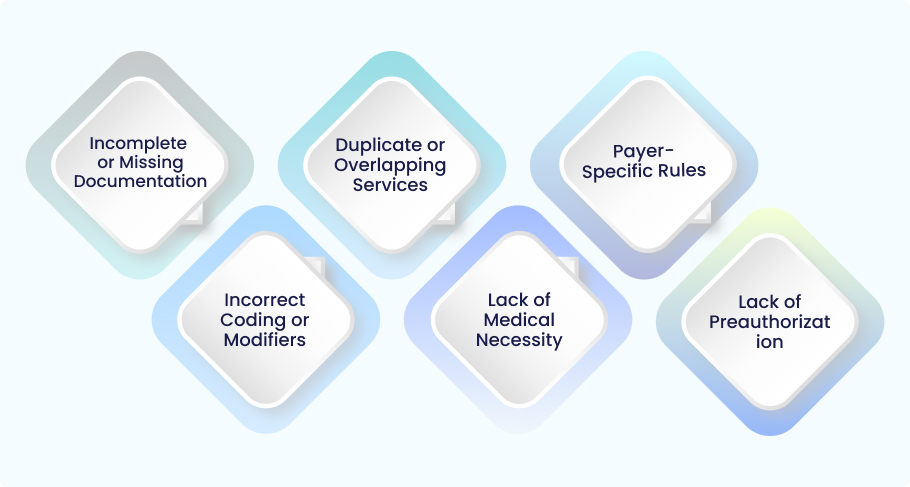
Top 5 Skin Graft Denial Causes and Fixes
How do STSG and FTSG coding compare?
The coding differences affect code selection, add-on calculations, and documentation requirements.
| Factor | STSG | FTSG |
| Tissue harvested | Epidermis + partial dermis | Epidermis + entire dermis |
| Base code (trunk) | 15100 (first 100 cm²) | 15200 (first 20 cm²) |
| Base code (face/hands) | 15120 (first 100 cm²) | 15220 (first 20 cm²) |
| Add-on increment | 100 cm² per unit | 20 cm² per unit |
| Typical wound size | Larger wounds (burns, trauma) | Smaller wounds (face, hands, joints) |
| Donor site healing | Self-heals | Requires closure |
What documentation prevents skin graft denials?
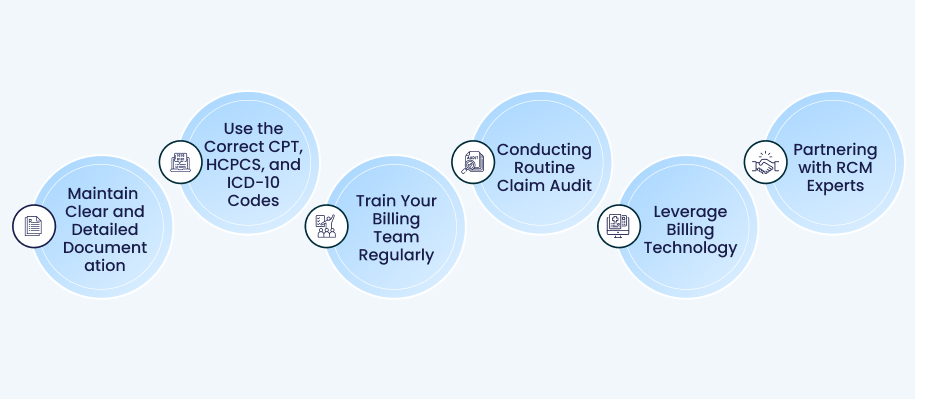
The operative note must support every element of the claim. Documentation gaps are the most frequent cause of graft denials per CMS coding guidance.
- Donor site location and harvest method
- Wound etiology (burn, trauma, chronic ulcer, surgical defect)
- Wound measurements in cm² before grafting, per wound site
- Product name, lot number, and quantity for skin substitute claims
- Recipient site preparation described as a distinct procedural step
- Graft type and source (autograft, allograft, skin substitute — specify product)
- Failed conservative treatment (required for skin substitutes under most LCDs)
Your graft claims shouldn’t lose revenue in the coding gaps
Skin graft coding is multi-layered — wound preparation, graft application, material billing, modifier logic, and LCD compliance all need to align on every claim. Missing wound prep codes alone can cost thousands per quarter.
MedHeave provides surgical coding and revenue cycle management for practices handling complex procedural billing — including full graft coding architecture, HCPCS-CPT pairing validation, and LCD compliance checks before submission.
- Claims submitted within 24–48 hours of signed operative notes
- Wound preparation codes audited on every eligible graft case
- Denials addressed within 72 hours with payer-specific documentation
- Performance-based pricing (4–7% of collections) with no lock-in
Contact us to see how structured surgical billing captures every billable layer of your graft cases.
Frequently asked questions
Here are some commonly asked questions on this topic:
CPT 15100 describes application of a split-thickness autograft to the trunk, arms, or legs, covering the first 100 cm² of wound surface area. For wounds larger than 100 cm², add-on code 15101 is reported for each additional 100 cm² or fraction thereof. The code does not include wound preparation (coded separately under 15002–15005) or graft material for skin substitutes (coded under HCPCS Q-codes). Precise cm² measurement in the operative note drives correct unit calculation.
STSG codes (15100–15121) cover split-thickness grafts that harvest epidermis and partial dermis, with add-on increments of 100 cm². FTSG codes (15200–15221) cover full-thickness grafts harvesting epidermis and entire dermis, with smaller increments of 20 cm². STSG is used for larger wounds like burns and trauma. FTSG is reserved for smaller, cosmetically sensitive areas like the face and hands. Both families are organized by anatomical region and measured in square centimeters before grafting.
Wound surface area is calculated by measuring length and width in centimeters and multiplying (length × width = cm²). Measurements must be taken before the graft is applied and documented in the operative note at the time of service. Each wound site requires a separate measurement when multiple wounds are treated in the same session. Accurate cm² measurement determines the correct base code and add-on unit count. Rounding errors create either upcoding audit exposure or underbilling revenue loss.
Modifiers JW and JZ (discarded drug waste and no waste) do not apply to skin graft procedure codes — they’re used for drug and biologic billing under the JW/JZ waste policy. Modifier 50 (bilateral procedure) is also rarely applicable because graft codes are defined by anatomical region and surface area, not laterality. The modifiers most commonly used with skin grafts are 59/XS (distinct service), 76 (repeat procedure), 58 (staged procedure), and 25 (separate E/M on the same date).
Yes. CPT 15002–15005 cover surgical preparation of the recipient site — excision of open wound, burn eschar, or scar tissue — and are separately reportable from graft application codes. They are not bundled into the 15100, 15200, or 15271 series. The operative note must describe wound preparation as a distinct procedural step with its own documentation. Missing these codes is one of the most common sources of underbilling in skin graft cases across wound care practices.
Skin substitutes use CPT 15271–15278, organized by body region and wound size. Wounds under 100 cm² use the 25 cm² increment codes (15271/15272 for trunk; 15275/15276 for face/hands). Wounds 100 cm² or larger use 100 cm² increment codes (15273/15274 for trunk; 15277/15278 for face/hands). The biologic product is identified with a HCPCS Q-code (Q4101–Q4199). Both the CPT application code and the HCPCS product code must appear on the claim or it denies.

