
Getting an SCA approved depends almost entirely on documentation quality — and on knowing that the agreement itself does not replace prior authorization, does not guarantee in-network cost sharing unless the written terms say so, and does not protect against balance billing unless the provider explicitly accepts the negotiated rate as payment in full.
In this guide, we’ll be going through:
- When an SCA is the right mechanism (and when it is not)
- How SCAs differ from prior authorization, gap exceptions, and transition-of-care agreements
- The step-by-step request process for patients and providers
- What documentation actually gets requests approved
- How long the process takes and where delays happen
- What to check in the written agreement before treatment begins
- What to do after denial
What is a single case agreement?
A single case agreement (SCA) is a temporary contract between a health insurance plan and an out-of-network provider that covers one specific patient’s defined services under negotiated payment terms.
Insurers typically consider an SCA when no suitable in-network provider can deliver the medically necessary care — whether because of specialty gaps, geographic barriers, appointment wait times, or an ongoing treatment relationship that would be clinically harmful to interrupt.
The arrangement does not add the provider to the insurance network permanently.
It creates a one-patient, one-provider, one-service-period exception with agreed reimbursement rates, covered CPT codes, cost-sharing terms, and expiration dates.
When does a single case agreement apply?
An SCA may be considered when the patient’s health plan cannot provide adequate in-network access to medically necessary care.
The clinical need must be documented, and the out-of-network provider must agree to negotiate reimbursement terms with the insurer.
Common qualifying situations:
- In-network wait times would unreasonably delay care
- Listed in-network providers are unavailable or out of reach
- A provider is completing network credentialing but is not yet contracted
- No in-network provider offers the required specialty or treatment method
- Changing providers mid-treatment would disrupt continuity of care and create clinical risk
- The patient requires a language, age-specific, or accessibility accommodation that in-network providers cannot meet
The most important thing to understand before starting — an SCA is not a preference request. “I want this specific provider” is not a qualifying reason.
“No available in-network provider can deliver this specific service within a clinically appropriate timeframe, and here is the documented evidence” is.
Payer guidance consistently shows that approval depends on documentation demonstrating network insufficiency, medical necessity, provider qualifications, and inability of in-network specialists to deliver equivalent care.
How is a single case agreement different from prior authorization?
The most common confusion in SCA requests is treating the agreement as if it also authorizes treatment. It does not.
SCA vs. Related Insurance Mechanisms
Single Case Agreement
Creates temporary contract and payment terms between insurer and OON provider for one patient
Prior Authorization
Approves a specific service under plan coverage and medical necessity rules — no rate negotiation
Gap Exception
Allows in-network coverage for OON services when the network cannot meet the patient’s need
Transition of Care
Temporarily continues existing treatment after a network or plan change — usually time-limited
A more detailed breakdown:
| Mechanism | What it approves | Does it set a provider rate? | Who requests it? | Duration |
| Single case agreement | Contractual and payment terms for one OON case | Yes — negotiated between provider and payer | Patient, provider, or both | Defined in agreement |
| Prior authorization | Medical necessity for a specific service | No | Requesting provider | Per service |
| Network gap exception | In-network treatment of an OON service due to network inadequacy | Not always by itself | Patient or provider | Varies by plan |
| Transition of care | Continued treatment after a provider leaves the network or the patient changes plans | May include temporary rate terms | Patient or provider | Limited transition window |
A plan may require both an SCA and prior authorization. The SCA sets the contractual arrangement. The prior auth approves the clinical service.
Treating one as the other is one of the fastest ways to get a request denied or a claim rejected after approval.
Experienced payer representatives have confirmed that an approved letter of agreement only establishes reimbursement terms — it does not authorize treatment.
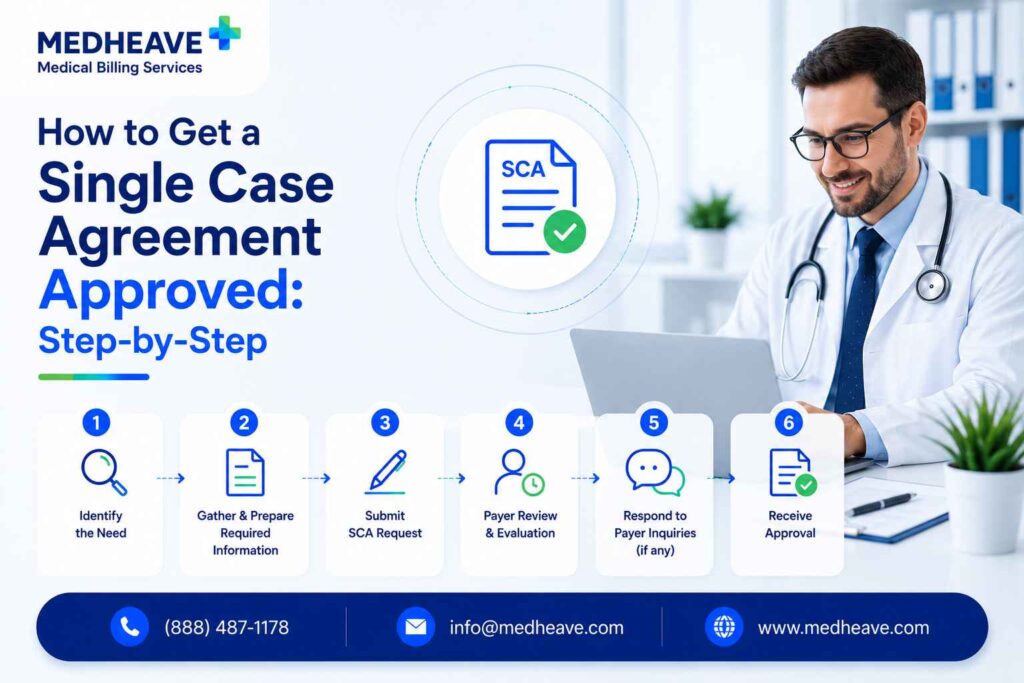
What is the step-by-step process for requesting an SCA?
The request involves three parties — the patient (or caregiver), the out-of-network provider, and the insurance plan.
Call Member Services to identify the plan’s SCA or network exception process.
Request a list of in-network providers who offer the required specialty and service.
Contact every listed provider and document the outcome — are they accepting patients, do they offer the service, what is the earliest appointment, what is the travel distance.
Confirm that the out-of-network provider is willing to participate and negotiate with the insurer.
Submit the formal request to the correct department (case management, utilization management, behavioral health, or provider relations — it differs by plan).
Get a reference number for every call.
Request all decisions in writing.
Supply clinical documentation including diagnosis (ICD-10), treatment plan, requested CPT/HCPCS codes, and medical necessity rationale.
Provide credentials, NPI, tax information, and licensing documentation.
Confirm willingness to negotiate reimbursement.
Review and sign the agreement terms before treatment begins.
Configure billing systems to match the agreement’s covered codes, dates, and authorization numbers.
Review coverage eligibility and out-of-network benefit structure.
Conduct a network adequacy review.
Perform clinical or medical necessity review.
Negotiate reimbursement terms with the provider.
Issue written approval with covered services, dates, rates, cost-sharing terms, and claim submission instructions.
The process typically follows this sequence — benefit verification, network search, clinical review, provider credential verification, rate negotiation, agreement preparation, and (if required) separate prior authorization for the service itself.
What documentation gets an SCA approved?
Documentation quality is the single strongest predictor of approval. A weak request with vague clinical rationale and no network-search evidence gets denied. A strong request with specific, verifiable documentation gets reviewed seriously.
A high-quality SCA submission includes:
- Diagnosis with ICD-10 codes
- Prior treatment history and outcomes
- Estimated treatment duration and start date
- Treatment plan with measurable goals and expected duration
- Out-of-network provider credentials, NPI, and specialty qualifications
- Evidence that no qualified in-network provider is available (the provider-search log)
- Letter of medical necessity from the referring or treating clinician
- Requested CPT/HCPCS codes and service frequency
- Provider’s written willingness to negotiate
- Contact information for both parties
The provider-search log is where most requests succeed or fail. A statement that says “I could not find anyone in network” is weak evidence.
A dated log showing every provider contacted, the outcome of each contact, the earliest available appointment, the distance, and the specific reason each provider cannot meet the clinical need — that is defensible documentation.
| Stronger evidence | Weaker evidence |
| Dated call log with provider names, outcomes, and wait times | “I could not find an available provider” |
| Written appointment wait times from in-network offices | Undated directory screenshot |
| Clinician explanation of why specific expertise is required | General provider preference |
| Defined services, codes, frequency, and treatment duration | Open-ended or vague request |
| Provider confirmation of willingness to negotiate | Assuming the provider will agree later |
The NEEDS framework can be used for organization:
The NEEDS Framework for SCA Documentation
Organize your evidence around five categories that map to what insurers actually evaluate.
N
Network search
Documented calls, dates, outcomes for every listed provider
E
Expertise
Specific clinical capability the OON provider offers
E
Existing care
Continuity risk if treatment is interrupted or transferred
D
Delay or distance
Wait times, travel burden, or geographic access barriers
S
Services
Specific CPT codes, frequency, duration, and start date
How long does a single case agreement take?
There is no universal approval timeline. Anyone quoting a fixed number is guessing.
The actual duration depends on the payer, the plan, the clinical urgency, the documentation completeness, and how quickly the provider and insurer reach rate agreement.
The process breaks into stages, and each stage has its own delay risks:
| Stage | What happens | Common delay |
| Benefit verification | Patient confirms OON benefits and SCA process | Wrong department contacted, incomplete plan information |
| Network search | Patient documents in-network provider availability | Directory inaccuracies, slow provider callbacks |
| Clinical review | Insurer evaluates medical necessity | Incomplete documentation, additional records requested |
| Credential verification | Insurer reviews OON provider qualifications | Missing NPI, licensing, or tax information |
| Rate negotiation | Provider and insurer agree on reimbursement terms | Gap between provider fees and insurer offer |
| Agreement preparation | Written terms issued | Internal payer processing delays |
| System configuration | Payer loads agreement into claims processing system | Provider not correctly flagged, claims auto-deny |
Providers and patients frequently report timelines ranging from several business days to several weeks, depending on urgency and documentation quality.
Urgent clinical situations may qualify for expedited review, but the patient or provider must specifically request it and explain why standard processing timelines would harm the patient.
The single most effective way to shorten the timeline is to submit complete documentation the first time. Every missing document adds a round trip of request-and-response that can add days or weeks.
What should the written agreement include?
Verbal approval is not enough. The written agreement is the controlling document — and treatment should not begin (except in emergencies) until both the patient’s cost-sharing terms and the provider’s reimbursement terms are confirmed in writing.
Review these terms before treatment starts:
- Authorization number
- Provider name, NPI, and location
- Patient name and plan information
- Claim submission address and billing identifiers
- Patient cost sharing (deductible, copay, coinsurance)
- Whether ancillary services (lab, imaging, anesthesia) are included
- Whether the provider accepts the negotiated rate as payment in full (balance-billing protection)
- Negotiated reimbursement rate and payment methodology
- Number of authorized visits, units, or treatment days
- Covered services and CPT/HCPCS codes
- Effective date and expiration date
- Renewal or extension procedure
- Timely filing deadline
The provider-focused literature makes the operational risk clear — claims may be rejected, paid at the wrong rate, processed as out-of-network, or sent to the patient because the provider is not correctly configured in the payer’s system, even with an approved agreement.
In practice, testing the first claim early — before multiple sessions accumulate — catches system configuration errors before they compound into large-scale payment disputes.
What happens if the SCA is denied?
An SCA denial is not the end of the process. But the response depends on understanding the exact reason for the denial.
Common denial reasons and what to do:
Insurer identifies an available in-network provider
Contact the named provider. Document whether they actually accept the patient, offer the service, and have a reasonable appointment timeline. Resubmit with updated search evidence.
Insufficient medical necessity documentation
Strengthen the clinical rationale. Add the referring clinician’s letter, treatment history, and outcome data from prior interventions.
Missing provider information
Supply credentials, NPI, tax ID, and licensing documentation.
Noncovered service
Confirm whether the denial is for the service itself or the out-of-network arrangement. If the service is excluded, an SCA cannot override the benefit exclusion.
Rate negotiation failure
The provider and payer could not agree on terms. The patient may need to discuss whether the provider will accept a lower rate or whether the patient will absorb the remaining gap.
Request submitted after treatment began
Retroactive SCAs are possible with some plans but carry substantially higher financial risk.
Most non-grandfathered health plans provide internal appeal and potentially external review procedures.
File the internal appeal using the plan’s written instructions and deadline, attach the original request with updated evidence, and request the specific criteria the insurer used to deny the request.
Do SCA rules change by plan type?
Yes — and the variation is significant enough that generic SCA advice can be misleading.
PPO plans already provide some out-of-network benefits, so the Single Case Agreement (SCA) may primarily negotiate a better reimbursement rate and patient cost-sharing arrangement.
HMO and EPO plans typically restrict non-emergency out-of-network coverage, making an SCA or network-gap exception the primary pathway to covered out-of-network care.
Coverage is governed by the Summary Plan Description (SPD) and ERISA rather than state insurance regulations, so the regulator and appeal process may differ.
Each Medicaid Managed Care Organization (MCO) maintains its own out-of-network exception process, which varies by state and health plan.
Medicare Advantage plans commonly use terms such as organization determination, network exception, or continuity of care. The phrase “Single Case Agreement” may not be the controlling Medicare term even when the process is similar.
The safest approach across all plan types is to ask the insurer three specific questions before starting — what exception process applies, what documentation is required, and what the appeal route looks like if the request is denied.
Your SCA gets the provider approved. MedHeave gets the claims paid.
A signed single case agreement is only the first step.
The claims built under that agreement still need correct coding, proper authorization references, payer-specific submission rules, and active follow-up — because SCA claims are processed outside normal network routing and are among the most error-prone in any practice’s AR.
At MedHeave, we:
- Manages single case agreement billing from setup through payment
- Submits OON claims with correct payer IDs, authorizations, and negotiated rates
- Denial rework on SCA claims happens the same day the ERA arrives
- Dedicated account managers track SCA expiration dates, visit limits, and renewal windows
Talk to MedHeave about making sure your single case agreement claims actually convert to collected revenue.
Frequently asked questions
Here are some commonly asked questions on this topic:
No. A single case agreement establishes the contractual and payment arrangement between the insurer and an out-of-network provider. Prior authorization is the plan’s approval that a specific service is medically necessary and covered. You may need both — the SCA to set up the provider relationship and the prior auth to approve the clinical service. An approved SCA without the required prior authorization can still result in claim denial.
Timelines vary from several business days to several weeks depending on the payer, clinical urgency, documentation completeness, and speed of rate negotiation. Urgent situations may qualify for expedited review if the patient or provider requests it. The most common delay is incomplete documentation — every missing record adds a request-and-response cycle. Submit complete evidence the first time and follow up with the plan within 3 to 5 business days.
Some plans may consider a retroactive SCA, but approval is uncertain and the financial risk is substantially higher. If the provider has already delivered services without an agreement in place, there is no guarantee the insurer will negotiate favorable terms retroactively. The safer approach is always to secure written terms before non-urgent treatment begins. In genuine emergencies, document the clinical urgency and submit the request as early as possible.
Either can begin. The patient typically identifies the access problem and contacts Member Services to report the network gap. The provider supplies the clinical documentation, credentials, and treatment plan — and negotiates the reimbursement terms. Both sides have responsibilities that cannot be delegated to the other. The process stalls most often when each party assumes the other is handling their part.
Not automatically. The written agreement must specifically state the patient’s deductible, copay or coinsurance, and whether the provider has agreed to accept the negotiated rate as payment in full. Without explicit balance-billing protection in the agreement, the provider may bill the patient for the gap between their standard fee and the insurer’s payment — even with an approved SCA.

