



Physical therapy CPT codes are Current Procedural Terminology codes that identify billable PT evaluations, therapeutic interventions, and rehabilitation services for documentation, claim submission, and payer reimbursement.
Common physical therapy CPT codes — including 97110, 97112, 97116, 97140, 97530, and 97535 — connect each service to accurate insurance billing and compliant reimbursement across Medicare and commercial payers.
Accurate CPT coding for physical therapy reduces claim denials, supports CMS documentation requirements, and helps clinics protect revenue while focusing on patient care.
Here’s what this guide covers:
- Common billing mistakes that trigger denials
- Modifier guidance for GP, KX, CQ, 59, and more
- Full PT CPT codes with timed and untimed codes
- Evaluation codes 97161 through 97164 by complexity
- Treatment code descriptions with real clinical examples
- Comparisons for 97110 vs 97112 vs 97140 vs 97530
- 2026 Medicare thresholds and payment updates
- The 8-minute rule with a unit calculation table
- Documentation checklists by CPT code
TLDR: Physical therapy CPT codes in a nutshell
Physical therapy CPT codes describe every billable PT service — from evaluations (97161-97164) to treatment procedures (97110, 97112, 97140, 97530, 97116, 97535) to modalities (97010, 97035, G0283).
Timed codes bill in 15-minute units using the 8-minute rule, while untimed codes bill once per encounter. Medicare requires the GP modifier on all PT claims, the KX modifier when charges exceed the $2,480 therapy threshold in 2026, and the CQ modifier when a PTA delivers the service.
The code must match the documented intervention, timed minutes, and clinical intent — not the reimbursement amount.
What are the most common physical therapy CPT codes?
The six CPT codes that appear on the vast majority of outpatient PT claims fall into two groups:
- Evaluation codes that open the episode
- Treatment codes that describe the intervention
Here’s a quick-reference table before the full cheat sheet.
| CPT Code | Service | Timed? | When to use it |
| 97110 | Therapeutic exercise | Yes (15 min) | Strength, ROM, flexibility, and endurance exercises |
| 97112 | Neuromuscular re-education | Yes (15 min) | Balance, coordination, posture, and proprioception retraining |
| 97140 | Manual therapy | Yes (15 min) | Joint mobilization, soft tissue mobilization, manual traction |
| 97530 | Therapeutic activities | Yes (15 min) | Functional tasks like transfers, lifting, carrying, squatting |
| 97116 | Gait training | Yes (15 min) | Walking mechanics, stair training, assistive device use |
| 97535 | Self-care/home management | Yes (15 min) | ADL training, home safety, adaptive equipment instruction |
| 97161-97163 | PT evaluation | Untimed | Initial evaluation by complexity (low, moderate, high) |
| 97164 | Re-evaluation | Untimed | Formal reassessment when clinical status or plan changes |
CPT codes describe services, while ICD-10 codes explain the diagnosis. Both are required on a PT claim, and they serve different purposes — the CPT code tells the payer what was done, the ICD-10 code tells them why.
Physical therapy CPT codes cheat sheet
This cheat sheet organizes every commonly billed PT code by category. Bookmark it, print it, or keep it at the front desk (because scrambling for codes mid-documentation is a recipe for errors).
Evaluation and re-evaluation codes
PT evaluations use a tiered complexity model established by the AMA CPT codebook and adopted by CMS for Medicare billing. The complexity level depends on the patient’s history, clinical presentation, and the clinical decision-making required.
| Code | Complexity | When to bill | Documentation triggers |
| 97161 | Low complexity | Stable presentation, limited deficits, straightforward decision-making | 1-2 body regions, minimal comorbidities, predictable recovery |
| 97162 | Moderate complexity | Evolving presentation, more deficits, moderate decision-making | Multiple contributing factors, functional limitations across tasks |
| 97163 | High complexity | Complex or unstable presentation, high decision-making demands | Significant comorbidities, multi-system involvement, uncertain prognosis |
| 97164 | Re-evaluation | New clinical findings, significant change, or formal plan revision | Must document why the re-evaluation was needed — not routine progress |
CMS billing guidance specifies that 97164 is reserved for genuine reassessment, not for routine progress notes that happen during ongoing care. Billing 97164 at every 10th visit without a documented clinical trigger is a common audit flag.
Therapeutic procedure codes (timed)
All therapeutic procedure codes require direct one-on-one patient contact and bill in 15-minute units.
| Code | Service | Clinical use |
| 97110 | Therapeutic exercise | Strengthening, ROM, flexibility, and endurance training |
| 97112 | Neuromuscular re-education | Balance retraining, coordination, proprioception, and motor control |
| 97113 | Aquatic therapy | Therapeutic exercises performed in a pool or aquatic environment |
| 97116 | Gait training | Walking mechanics, stair negotiation, assistive device training |
| 97140 | Manual therapy | Joint mobilization, soft tissue mobilization, myofascial techniques, and manual traction |
| 97530 | Therapeutic activities | Dynamic functional tasks (transfers, lifting, carrying, task simulation) |
| 97535 | Self-care/home management | ADL training, home safety, adaptive equipment, caregiver instruction |
| 97542 | Wheelchair management | Wheelchair assessment, fitting, propulsion, and transfer training |
| 97750 | Physical performance test | Standardized functional testing with a written measurement report |
| 97755 | Assistive technology assessment | Assessment and recommendation of adaptive equipment |
Modality codes
Modalities split into two billing categories based on therapist involvement during the service.
Supervised modalities (untimed, billed once per encounter)
| Code | Modality |
| 97010 | Hot or cold packs |
| 97012 | Mechanical traction |
| 97016 | Vasopneumatic compression |
| 97018 | Paraffin bath |
| 97022 | Whirlpool |
| 97024 | Diathermy |
Constant attendance modalities (timed, 15-minute units)
| Code | Modality |
| 97032 | Electrical stimulation (manual, attended) |
| 97033 | Iontophoresis |
| 97034 | Contrast baths |
| 97035 | Ultrasound |
| 97036 | Hubbard tank |
A quick note on electrical stimulation for Medicare — CMS does not recognize CPT 97014 for unattended electrical stimulation. Medicare uses HCPCS code G0283 instead. Billing 97014 to Medicare will result in a denial, so practices should map their charge master accordingly.
Orthotic, prosthetic, and assistive technology codes
Here are the codes related to Orthotic, prosthetic, and assistive technology:
| Code | Service | Billing note |
| 97760 | Orthotic management and training (initial) | 15-min units; if an L-code is also billed, 97760 covers only the training time |
| 97761 | Prosthetic training (initial) | 15-min units; initial prosthetic encounter |
| 97763 | Orthotic/prosthetic management (subsequent) | For follow-up encounters after the initial fitting and training |
How do you choose the right CPT code for a PT visit?
Picking the right code isn’t about maximizing reimbursement — CMS explicitly states that providers should select the code that most accurately describes the service and treatment intent, not the code with the highest payment. The right framework follows six steps.
- Identify the clinical purpose of the intervention
- Confirm the service requires skilled therapy (not something a patient could safely do alone)
- Match the intervention to the CPT code that describes it best
- Track timed minutes if the code is timed
- Apply required modifiers (GP, KX, CQ, 59 as applicable)
- Confirm the daily note supports every code billed
In practice, the most common coding confusion happens between codes that look similar on paper but describe different clinical interventions. A patient doing wall slides for shoulder ROM is 97110 (therapeutic exercise).
The same patient doing a functional reaching task to simulate placing dishes on a shelf is 97530 (therapeutic activities). The clinical goal, not the body movement, determines the code.
What do the PT evaluation codes mean?
PT evaluation codes 97161, 97162, and 97163 are tiered by patient complexity, not by time spent.
A 45-minute evaluation on a patient with a straightforward ankle sprain (limited history, clear impairments, predictable recovery) is still 97161 if the clinical decision-making is low. APTA confirms this tiered evaluation structure is based on the patient’s presentation, not visit duration.
The re-evaluation code (97164) is even more specific. CMS says ongoing progress assessment is part of regular therapy documentation — 97164 should only be billed when a genuine change in clinical status or a formal plan of care revision has occurred. Billing it at arbitrary intervals (every 30 days, for instance) without a clinical trigger invites audit scrutiny.
For most outpatient PT practices, the split between evaluation levels reflects case mix. A clinic seeing primarily post-operative orthopedic patients will bill more 97162 and 97163 evaluations than a clinic focused on wellness-oriented mobility programs.
What do the most used PT treatment codes mean?
Each treatment code describes a specific clinical intervention. The code must reflect what actually happened during the billed minutes — not a generalized summary of the visit.
CPT 97110 — therapeutic exercise
CPT 97110 covers exercises designed to improve strength, endurance, range of motion, and flexibility. The AMA describes 97110 as therapeutic exercise to develop these impairment-level goals, billed in 15-minute units.
Appropriate clinical examples include:
- ROM stretching protocols for frozen shoulder
- Progressive resistance training after knee replacement
- Endurance-focused exercise for patients deconditioned after hospitalization
The documented goal should be impairment-focused (build strength in the left quadriceps from 3/5 to 4/5) rather than task-focused.
Do not use 97110 for functional movement training where the primary goal is task performance — that’s 97530.
CPT 97112 — neuromuscular re-education
CPT 97112 covers retraining of CPT 97112 covers retraining of:
- Posture
- Balance
- Movement
- Coordination
- Proprioception
- Kinesthetic sense
The clinical application ranges from balance retraining after stroke to proprioceptive drills for chronic ankle instability.
The requirement is a documented neuromuscular deficit. If the patient is doing a single-leg stance on an unstable surface to retrain proprioception after an ankle sprain, that’s 97112.
If they’re doing single-leg squats primarily for quadriceps strength, that’s 97110 — even though the exercise looks similar.
CPT 97140 — manual therapy
CPT 97140 describes skilled, hands-on techniques, including:
- Manual traction
- Joint mobilization
- Myofascial release
- Soft tissue mobilization
CMS documentation guidance for 97140 requires the note to identify the area treated, the technique used, and the objective or subjective effect on function.
97140 is sometimes confused with 97124 (massage). CMS states that 97124 and 97140 should not be billed on the same date of service under certain payer rules.
If the intervention involves skilled mobilization directed at a functional limitation, 97140 is appropriate. If it’s general soft tissue work without a specific skilled clinical rationale, the claim becomes harder to defend.
CPT 97530 — therapeutic activities
CPT 97530 covers dynamic, functional activities designed to improve real-world performance — transfers, lifting, carrying, bed mobility, work simulation, and functional task practice. The goal here is task-level, not impairment-level.
The practical difference from 97110 comes down to clinical intent. Strengthening the hip abductors with resistance bands (impairment goal) is 97110. Practicing sit-to-stand transfers from varying surface heights to improve functional independence (task goal) is 97530.
CPT 97116 — gait training
CPT 97116 covers walking mechanics, stair negotiation, assistive device training, and balance during ambulation. CMS documentation should include: gait distance, assistive device used, assistance level, gait deviations observed, and specific gait training techniques applied.
CPT 97535 — self-care and home management
CPT 97535 covers:
- ADL training
- Compensatory techniques
- Safety instruction
- Adaptive equipment use
- Caregiver education related to self-management
CMS describes 97535 as self-care/home management training, including ADL instruction, safety procedures, and instruction in adaptive equipment use.
A 2025 special communication in rehabilitation research (Griffin et al., 2025) highlights newer caregiver-training reimbursement codes that create a more explicit pathway for documenting and billing caregiver education when the clinical requirements are met — worth monitoring for practices that deliver substantial caregiver instruction.
How do you tell the difference between 97110, 97112, 97140, and 97530?
This is where most coding confusion lives, and where most audit findings start. The codes describe different clinical intentions applied to what sometimes looks like similar physical activity.
| If the primary intervention goal is… | Bill this code | Clinical example |
| Building strength, ROM, flexibility, or endurance | 97110 | Progressive resistance exercises for knee extension after ACL repair |
| Retraining balance, posture, proprioception, or motor control | 97112 | Single-leg balance board drills for a patient with vestibular hypofunction |
| Skilled hands-on mobilization or soft tissue techniques | 97140 | Grade III glenohumeral joint mobilizations for adhesive capsulitis |
| Practicing functional tasks to improve daily performance | 97530 | Simulated grocery bag lifting and carrying to prepare for discharge |
97110 vs 97112
Both are exercise-based, but the clinical target separates them.
97110 addresses impairments like weakness, stiffness, or reduced endurance. 97112 addresses neuromuscular control problems like poor balance, impaired coordination, or deficient proprioception.
When a single exercise targets both (a common scenario), the code should match the primary documented goal for that billed interval.
97140 vs 97110
97140 requires direct hands-on skilled technique by the therapist. 97110 is a patient-performed exercise with therapist supervision and instruction. If the therapist’s hands are on the patient performing mobilization, it’s 97140. If the therapist is instructing and monitoring the patient through an exercise program, it’s 97110.
97140 vs 97530
When billing 97140 and 97530 on the same date of service, practices need to be aware of NCCI edit pairs. If both codes are billed for the same session, modifier 59 (or the more specific XE, XP, XS, or XU) may be needed — but only when the services are truly separate and distinct (different time intervals, different clinical purposes, documented independently).
How do timed and untimed CPT codes work?
Physical therapy CPT codes fall into two billing categories — timed codes billed in 15-minute units and untimed codes billed once per encounter. Getting this wrong inflates or deflates the claim, and either direction creates problems.
Timed codes
Timed codes (97110, 97112, 97116, 97140, 97530, 97535, 97032, 97033, 97034, 97035, 97036, and others) require direct one-on-one patient contact and bill in 15-minute increments. The number of billable units depends on the total timed minutes across all timed codes for that date of service.
CMS uses the 8-minute rule to calculate Medicare therapy units. When a single timed service is provided, at least 8 minutes must be documented to bill one unit. The full unit-to-minute breakdown is shown in the table below.
| Total timed minutes | Billable units |
| 8-22 | 1 |
| 23-37 | 2 |
| 38-52 | 3 |
| 53-67 | 4 |
| 68-82 | 5 |
Mixed-code example — A session includes 36 minutes of 97110 and 7 minutes of 97140, for a total of 43 timed minutes. That supports 3 total units. CMS guidance shows this would be billed as 2 units of 97110 and 1 unit of 97140, because the remaining minutes are allocated to the code with the most time first.
Many commercial payers follow the 8-minute rule, but some (notably certain Blue Cross plans and workers’ compensation carriers) use different rounding methods. Always verify the payer’s specific timed-code policy before assuming Medicare rules apply across the board.
Untimed codes
Untimed codes (evaluations 97161-97164, supervised modalities like 97010 and 97012, and group therapy 97150) are generally billed once per encounter, regardless of how long the service takes.
Payment still depends on coverage, medical necessity, and payer-specific rules — “untimed” doesn’t mean “automatically covered.”
For group therapy (97150), CMS requires constant attendance by the therapist but does not require one-on-one contact. Each patient in the group receives a separate charge for 97150.
Which modifiers do PT claims need?
Modifiers are where a technically correct CPT code still gets denied — because the modifier was missing, wrong, or used without proper documentation support.
| Modifier | What it signals | When to use it |
| GP | Service under a PT plan of care | Every outpatient PT claim to Medicare |
| KX | Services above threshold remain medically necessary | When Medicare PT+SLP charges exceed $2,480 in 2026 |
| CQ | Service furnished in whole or in part by a PTA | Medicare claims involving PTA-delivered services |
| CO | Service furnished in whole or in part by an OTA | OT claims only (included here for cross-reference) |
| 59 | Distinct procedural service | When two codes from an NCCI edit pair are both clinically appropriate |
| XE | Separate encounter | More specific alternative to 59 |
| XP | Separate practitioner | More specific alternative to 59 |
GP modifier
Required on virtually all outpatient PT claims submitted to Medicare. Without it, the claim may be rejected at the system level before it even reaches a human reviewer.
KX modifier
The CY 2026 KX modifier threshold is $2,480 for PT and SLP services combined, with a separate $2,480 threshold for OT. APTA also reports the 2026 threshold at $2,480, up from $2,410 in 2025 and $2,330 in 2024.
When a patient’s annual therapy charges cross that threshold, the KX modifier must be added to confirm that continued services are medically necessary and that documentation supports ongoing treatment. Without KX, Medicare will deny services above the threshold.
CQ modifier (PTA services)
CMS states that services furnished in whole or in part by a PTA are paid at 85% of the otherwise applicable Part B amount (effective January 1, 2022). The CQ modifier identifies these claims. Failing to append CQ when a PTA delivers the service creates a compliance problem — and retroactive recoupment if audited.
Modifier 59 — when to use it
Modifier 59 is one of the most misused modifiers across all of healthcare billing (not just PT). CMS defines it as indicating a distinct procedural service that is not normally reported together with another service but is appropriate under the circumstances.
Before appending modifier 59, run through this check:
- Are the two codes an NCCI edit pair?
- Does the documentation independently prove each service?
- Is a more specific modifier (XE, XP, XS, XU) available and more appropriate?
- Were the services genuinely separate and distinct (different time intervals, different anatomical areas, or different clinical purposes)?
Using modifier 59 as a default override to bypass NCCI edits — without documentation to prove the services were distinct — is a compliance red flag that invites post-payment audit.
What should PT documentation include by CPT code?
Documentation is the bridge between the CPT code and the payment. A correctly selected code with weak documentation still gets denied, because the payer (or auditor) can’t verify that the billed service actually happened as described.
CMS requires that therapy documentation support the use of each procedure as it relates to a specific therapeutic goal. Every daily note should include these baseline elements:
- Patient response to treatment
- Description of the service performed
- Medical necessity link to the plan of care
- Skilled reason the service required a therapist
- Objective finding or measurable patient limitation
- Body region or functional task addressed
- CPT code billed for each intervention
- Plan or progression for the next visit
- Timed minutes per code
Beyond those basics, each major code has documentation elements that auditors specifically look for.
| Code | What auditors want to see |
| 97110 | Specific exercises, sets/reps/resistance, body region, progression from prior visit, objective measure (ROM, strength grade) |
| 97112 | Neuromuscular deficit identified, balance or coordination challenge described, cueing provided, proprioceptive activity detailed |
| 97140 | Technique named, body region, clinical reasoning for manual intervention, patient response, effect on function |
| 97530 | Functional task described, performance limitation identified, safety concerns, carryover to daily function |
| 97116 | Gait pattern, device used, distance walked, stairs attempted, assistance level, gait deviations observed |
| 97535 | ADL task practiced, adaptive equipment used, caregiver involvement, safety instruction provided |
The consistent failure pattern in PT documentation is vague, templated language that doesn’t connect the intervention to the individual patient.
“Pt tolerated well, continue POC” does not support a claim.
“Patient completed 3 sets of 10 hip abduction with 5 lb resistance, improved from 3/5 to 3+/5 strength, progressing to standing next visit to support independent transfers” does.
What are the most common PT coding mistakes that trigger denials?
Denials rarely come from exotic coding scenarios. They come from predictable, repeated errors that practices keep making because nobody built a reliable check into the workflow.
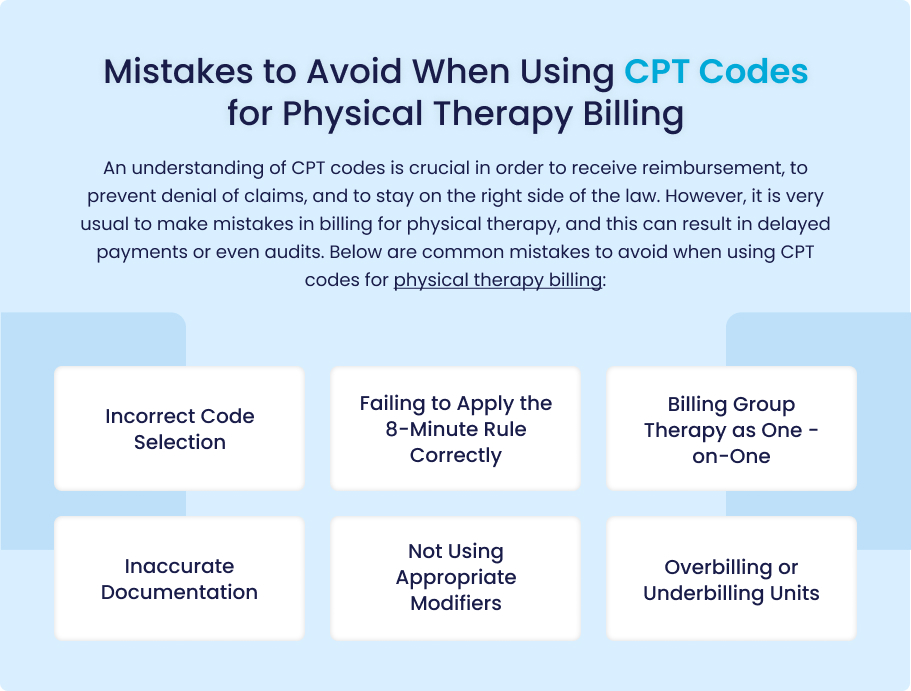
The most frequent denial triggers in PT billing include the following:
- Missing the GP modifier on Medicare PT claims
- Billing overlapping timed codes for the same time period
- Missing the CQ modifier when a PTA delivered the service
- Billing 97112 without documenting a specific neuromuscular deficit
- Missing the KX modifier when charges exceed the annual threshold
- Reporting timed units that don’t match the documented total timed minutes
- Billing 97110 when 97530 better describes the functional task performed
- Applying modifier 59 automatically instead of verifying the NCCI edit separation
- Billing 97014 to Medicare instead of G0283 for unattended electrical stimulation
- Confusing supervised and constant attendance modalities (billing 97010 as a timed code)
- Using 97750 for routine ROM or strength testing that should be part of the evaluation or ongoing documentation
CMS prohibits concurrent billing of direct one-on-one therapeutic procedure codes for the same time period. If 97110 and 97140 are both performed in a visit, the minutes must be separate and non-overlapping — and the note must prove it.
In practice, the most expensive mistakes aren’t the individual denied claims. They’re the systemic patterns that go unnoticed for months — like a clinic consistently under-reporting PTA involvement and missing CQ modifiers, or routinely billing 97164 re-evaluations without clinical triggers. Both create retroactive recoupment exposure if a Medicare contractor audits the provider.
What about dry needling, RTM, home health, and OT codes?
Several related topics appear in searches alongside physical therapy CPT codes. Here’s a brief clarification on each without turning this article into a different guide entirely.
Dry needling
Dry needling CPT coding varies by payer policy and state practice act. Some payers accept CPT 20560 (1 or 2 muscles) and 20561 (3 or more muscles), while others have their own coverage rules or don’t cover it at all. Before billing, check the state licensing board’s position on dry needling within PT scope and verify the payer’s specific coverage and coding policy.
Remote therapeutic monitoring (RTM)
RTM codes allow PT practices to bill for monitoring patient activity data between visits. The primary codes include 98975 (initial device setup), 98977 (monitoring musculoskeletal system data), and 98980/98981 (treatment management services). RTM rules are still evolving, and payer adoption varies — verify current CMS and commercial payer guidance before building an RTM billing workflow.
Home health PT billing
Home health PT operates under a different payment system (the Patient-Driven Groupings Model for Medicare home health) with distinct billing rules. The CPT codes may be the same, but the payment methodology, visit frequency rules, and documentation requirements differ from outpatient. Practices transitioning between settings should review payer-specific home health billing requirements separately.
OT vs PT CPT codes
Occupational therapy and physical therapy share some CPT codes (97110, 97140, 97530, and others), but the plan of care modifier differs — PT uses GP, OT uses GO. Payment thresholds are tracked separately ($2,480 for PT+SLP combined, $2,480 for OT separately in 2026). The CQ modifier applies to PTA-furnished services; the CO modifier applies to OTA-furnished services.
How do physical therapy CPT codes affect reimbursement?
CPT codes do not have a single universal reimbursement rate. What a practice receives for 97110 depends on several interacting variables, and the code itself is just one input.
Medicare calculates PT reimbursement using the physician fee schedule formula — relative value units (RVUs) multiplied by a conversion factor, adjusted for geographic locality and setting (facility vs. non-facility). CMS finalized two CY 2026 conversion factors: $33.57 for qualifying APM participants and $33.40 for non-participants, up from $32.35 in 2025.
Commercial payer rates are negotiated independently and may differ substantially from Medicare. The same CPT code billed to Medicare, a Blue Cross PPO, and a workers’ compensation carrier can produce three different payment amounts for the same service.
Practices that want to verify current Medicare rates for specific PT codes should use the CMS Physician Fee Schedule Lookup Tool — it provides code-level RVUs, conversion factors, and geographic adjustments for any billing locality.
Physical therapy CPT codes PDF and printable checklist
For practices that want a quick desk reference, here’s a summary of the printable elements covered in this guide:
- 8-minute rule unit calculation table
- Documentation checklist by major CPT code
- Modifier reference table (GP, KX, CQ, 59, XE, XP)
- Code comparison table for 97110/97112/97140/97530
- Complete PT CPT code cheat sheet (evaluation, treatment, modality, orthotic/prosthetic codes)
Save this page or print the tables above for a ready reference that covers the codes, rules, and modifiers most PT practices need daily.
Need help with physical therapy billing and coding?
Getting PT CPT codes right requires more than a cheat sheet — it takes consistent documentation, current modifier knowledge, payer-specific awareness, and ongoing staff training.
When claim denials stack up or coding takes more time than patient care, outsourced billing support becomes a practical option.
Medheave Medical Billing Services works with physical therapy practices to reduce denials, improve coding accuracy, and manage the billing cycle so clinicians can spend more time treating patients.
Visit www.medheave.com to learn how we can help your practice.
Related guides & resources
The resources below cover closely related topics and the broader service workflow they connect to:
- Physical therapy billing services — Physical therapy billing services
- Strategies to maximize reimbursement — Physical Therapy Billing Strategies to Maximize Reimbursement
- 8 minute rule — 8-Minute Rule for Billing: PT, OT & Psychotherapy
- CPT codes for inpatient rehab — CPT Code for Inpatient Rehab (2026): IRF CPT Codes & Billing
- Modifiers in medical billing — Modifiers in Medical Billing: What They Are, How They Work, & When To Use Them
- Rehabilitation billing explained — Rehabilitation Billing: Medicare Rules & Coding Fixes
Frequently asked questions
Here are some commonly asked questions about physical therapy CPT codes:
The most frequently billed physical therapy CPT codes are 97110 (therapeutic exercise), 97140 (manual therapy), 97112 (neuromuscular re-education), 97530 (therapeutic activities), 97116 (gait training), 97535 (self-care/home management), 97161-97163 (evaluations by complexity), 97164 (re-evaluation), 97035 (ultrasound), and G0283 (unattended electrical stimulation for Medicare). The exact mix varies by clinic specialty and patient population.
CPT 97110 is the therapeutic exercise code used for interventions that target strength, endurance, range of motion, and flexibility. It bills in 15-minute timed units and requires direct one-on-one patient contact. The documented goal should be impairment-focused — building quadriceps strength, improving shoulder ROM, or restoring cardiovascular endurance — rather than task-focused functional training (which falls under 97530).
CPT 97110 is the therapeutic exercise code used for interventions that target strength, endurance, range of motion, and flexibility. It bills in 15-minute timed units and requires direct one-on-one patient contact. The documented goal should be impairment-focused — building quadriceps strength, improving shoulder ROM, or restoring cardiovascular endurance — rather than task-focused functional training (which falls under 97530).
The 8-minute rule is a Medicare billing method for calculating units on timed therapy codes. At least 8 minutes of a timed service must be documented to bill one unit. One unit covers 8-22 minutes, two units cover 23-37 minutes, three units cover 38-52 minutes, and four units cover 53-67 minutes. The rule applies to total timed minutes across all timed codes for a given date of service.
CMS lists the CY 2026 KX modifier threshold at $2,480 for PT and SLP services combined, with a separate $2,480 threshold for OT. When charges exceed the threshold, the KX modifier must be added to confirm that services remain medically necessary and supported by documentation. Without KX, Medicare denies services above the limit.
In most cases, yes. Medicare outpatient PT claims require the GP modifier (indicating a PT plan of care) on every line. The KX modifier is needed once charges pass the annual threshold. The CQ modifier must appear when a PTA furnished the service. Modifier 59 or its more specific alternatives (XE, XP, XS, XU) may be needed when billing NCCI edit pairs on the same date.
The CPT codes are the same across payers, but the billing rules, modifier requirements, documentation standards, and reimbursement rates differ. Medicare follows specific timed-code rules (the 8-minute rule), requires GP/KX/CQ modifiers, and uses G0283 instead of 97014 for unattended electrical stimulation. Commercial payers may have different unit-rounding rules, prior authorization requirements, and covered service policies.
CPT 90834 is a psychotherapy code for individual therapy sessions of 45 minutes, and modifier 95 generally indicates synchronous telehealth delivery. Neither code is a standard physical therapy treatment code. If this combination appears on a PT-related search, it likely reflects a mixed-practice billing question rather than a PT-specific one.