



Billing Medicaid requires enrollment with your state’s Medicaid program (or its contracted Managed Care Organizations), verification of patient eligibility before every visit, correct coding with CPT/HCPCS/ICD-10, and claim submission through the state’s billing portal or a clearinghouse.
Unlike Medicare — which follows federal rules uniformly — Medicaid is administered by individual states under federal guidelines, which means billing rules, covered services, reimbursement rates, and prior authorization requirements vary from state to state.
The most important thing to understand before billing your first Medicaid claim — Medicaid enrollment is separate from Medicare enrollment. PECOS (the Medicare enrollment system) does not enroll providers in Medicaid.
Each state runs its own Medicaid provider enrollment process through its state Medicaid agency, and providers who bill Medicaid MCOs must also credential separately with each managed care plan.
This guide covers:
- How to enroll as a Medicaid provider
- The step-by-step claim submission workflow
- Fee-for-service vs managed care billing models
- Eligibility verification and prior authorization rules
- State-specific billing variation and how to manage it
- Common Medicaid denial codes and how to fix them
Simplify Medicaid enrollment across your states and plans
State screening, MCO credentialing, and provider ID setup can stretch enrollment for weeks. MedHeave helps practices manage that process alongside their broader billing operations.
How do you enroll as a Medicaid provider?

Medicaid provider enrollment is handled by your state Medicaid agency — not CMS, not PECOS, and not a federal portal. The process varies by state but follows a general framework.
Step 1: Gather required enrollment information
You’ll need an active NPI (National Provider Identifier), your Tax Identification Number (TIN), state license information, taxonomy code, and practice location details.
Step 2: Complete state Medicaid enrollment and screening
The state assigns a Medicaid provider ID (sometimes called a Medicaid billing number) after enrollment is approved. This ID is required on every Medicaid claim you submit.
Enrollment timelines range from 30 to 90 days depending on the state and whether the application requires site visits, background checks, or additional documentation.
CMS requires provider screening at varying levels (limited, moderate, or high risk) based on provider type, and high-risk categories may require fingerprinting.
Step 3: Credential with Medicaid managed care plans
For states that rely heavily on Medicaid Managed Care, enrollment with the state Medicaid agency alone may not be enough.
Most Medicaid beneficiaries are assigned to private MCOs that administer their benefits, and providers must credential separately with each MCO to bill for patients enrolled in those plans.
Missing MCO credentialing is a common reason new providers see Medicaid claims denied — the state enrollment is complete, but the MCO doesn’t recognize the provider.
What is the difference between fee-for-service and managed care billing?
Who processes your Medicaid claims depends on how the patient’s coverage is structured — and billing the wrong entity is a guaranteed denial.
Paid per service at state fee schedule rates
Less common (declining in most states)
Used more in rural areas
State processes claims through MMIS
MCO sets its own reimbursement rules
Dominant model in most states
Requires separate credentialing per MCO
Each MCO may have different edits and PA rules
The managed care model creates a billing reality that many providers underestimate — each MCO operates as a separate payer with its own prior authorization rules, covered services, modifier requirements, and timely filing deadlines.
A service covered by one Medicaid MCO may require authorization from another or not be covered at all by a third, even though all three contract with the same state Medicaid program.
What does the Medicaid claim submission workflow look like?
Here’s the submission workflow:
A critical billing rule — Medicaid is always the payer of last resort. If the patient has any other insurance coverage (commercial plan, Medicare, workers’ compensation), the other payer must be billed first.
Medicaid only pays the remaining balance after all other coverage has been exhausted. Submitting a claim directly to Medicaid when the patient has primary coverage elsewhere will deny under coordination of benefits rules.
Claims are submitted electronically via the state Medicaid portal (MMIS), through a clearinghouse, or directly to the MCO’s claims system.
Electronic claims typically process within 7-30 days depending on the state and payer, while paper claims take significantly longer. Most state Medicaid programs and MCOs have timely filing limits ranging from 90 to 365 days — missing the deadline converts a fixable claim into an unrecoverable write-off.
What are the most common Medicaid denial triggers?
Medicaid denial rates tend to run higher than Medicare or commercial insurance, largely because of eligibility volatility (patients gain and lose coverage more frequently) and the layered complexity of MCO-specific rules.
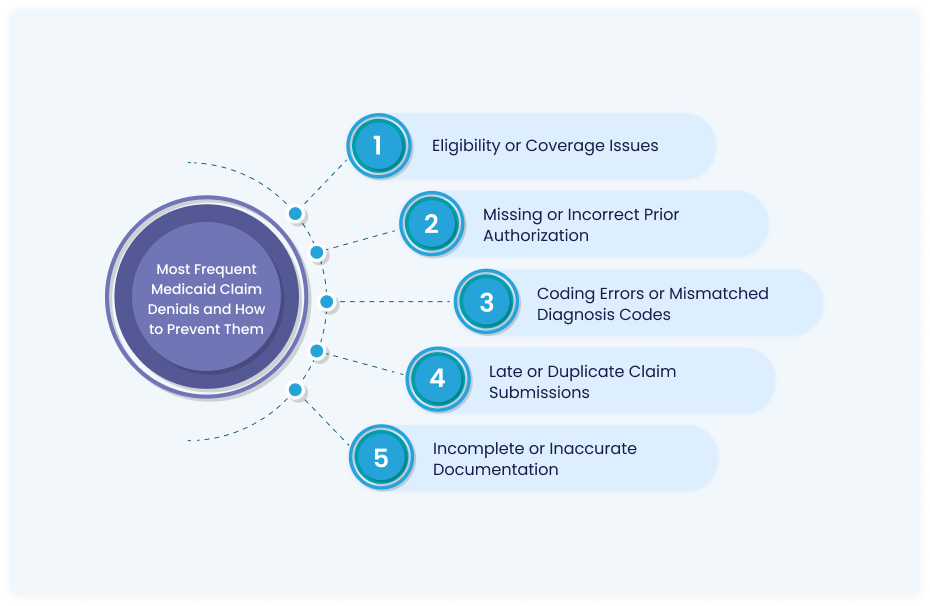
Eligibility churn is the operational challenge that makes Medicaid billing structurally harder than Medicare or commercial billing. Medicaid patients can gain or lose coverage month to month based on income changes, employment status, and state redetermination cycles. A patient who was eligible last Tuesday may not be eligible this Tuesday, and a claim submitted for the wrong date of service relative to eligibility produces an automatic denial. Practices that verify eligibility only at initial registration (instead of before every visit) absorb preventable losses on every encounter where coverage has lapsed.
How does state variation affect Medicaid billing?
Every Medicaid billing rule exists in two layers — the federal baseline and the state-specific implementation. CMS sets minimum requirements (covered populations, mandatory benefits, HIPAA code sets), but states control reimbursement rates, covered services beyond the federal minimum, prior authorization requirements, MCO contracting, billing form requirements, and timely filing limits.
For practices operating in multiple states, this creates a multiplied compliance burden. A service that’s covered without PA in one state may require authorization in the next, and the same MCO brand (UnitedHealthcare Community Plan, for example) may apply different rules in different states because the managed care contract is negotiated state by state.
The practical approach — maintain payer-specific billing rules for every Medicaid plan your practice serves, verify state and MCO rules before submitting claims (not just coding rules), and update your billing system whenever state Medicaid issues policy bulletins or rate changes.
What documentation does Medicaid require?
Medicaid documentation requirements mirror general medical billing standards but carry additional emphasis on medical necessity and state-specific compliance.
Every Medicaid encounter should document:
- Clinical findings
- Diagnosis (ICD-10)
- The patient’s presenting condition
- Procedure performed (CPT/HCPCS)
- Medical necessity justification
- Provider signature
- Treatment plan
For time-based services, documented treatment time is required. For services requiring prior authorization, the authorization number must appear on the claim.
Medicaid audits focus heavily on whether documentation supports the medical necessity of the service — not just whether the service was performed.
CMS program integrity guidelines require states to conduct regular provider audits, and Medicaid fraud investigations (through the OIG and state Medicaid Fraud Control Units) carry criminal exposure for patterns of improper billing.
Medicaid billing complexity doesn’t have to mean lost revenue
Medicaid billing combines state-specific rules, MCO variability, eligibility volatility, and strict documentation requirements into a billing environment that generates more preventable denials than Medicare or commercial insurance.
Every eligibility lapse that wasn’t caught, every claim sent to the wrong MCO, and every missing authorization converts billable revenue into write-offs.
MedHeave operates as an embedded revenue cycle department inside medical practices, with billing teams that verify Medicaid eligibility and MCO assignment before every encounter, track prior authorization requirements per plan, and address denials within 72 hours.
- Claims submitted within 24-48 hours of signed encounter notes
- Performance-based pricing (4-7% of collections) with no lock-in
- Eligibility verified before every appointment including MCO assignment
- Dedicated account managers with direct access (Monday-Friday, 9-5 EST)
- Denials addressed within 72 hours with payer-specific appeal documentation
If Medicaid denials are eroding your collections, contact MedHeave to see how structured billing eliminates those gaps.
Related guides & resources
The resources below cover closely related topics and the broader service workflow they connect to:
- Medical billing services — Medical billing services
- HIPAA compliance in medical billing — HIPAA Compliance in Medical Billing: All you need to know
- Health first colorado CPT code billing — Colorado Medicaid Fee Schedule: 2026 Rates & Rules
- ABN — ABN in Medical Billing: Rules, Modifiers & Liability
- Clean claims — Clean Claim Explained in Medical Billing Context
- Maximize revenue — Proactive Medical Billing Tips to Maximize Revenue
Frequently asked questions
Here are some commonly asked questions on this topic:
Your Medicaid billing number (provider ID) is issued by your state Medicaid agency after completing the provider enrollment process. Apply through your state’s Medicaid provider enrollment portal — not PECOS (which is Medicare only). You’ll need an active NPI, state license, TIN, taxonomy code, and practice details. Processing takes 30-90 days depending on the state and provider risk level. If you also need to bill Medicaid MCOs, credential separately with each managed care plan after receiving your state Medicaid ID.
It depends on the patient’s coverage structure. For fee-for-service (FFS) Medicaid patients, claims are processed by the state Medicaid agency through its MMIS (Medicaid Management Information System). For managed care patients — which represent the majority of Medicaid beneficiaries in most states — claims are processed by the patient’s assigned MCO. Submitting a claim to the state when the patient is enrolled in an MCO (or vice versa) will result in a denial.
Before every visit. Medicaid eligibility changes more frequently than Medicare or commercial coverage because it’s tied to income, employment, and state redetermination cycles. A patient who was eligible at their last visit may have lost coverage since then. Real-time eligibility verification at the point of scheduling and again on the day of service catches lapses before the encounter happens and prevents CO-27 eligibility denials.
No. Medicaid is administered by individual states under federal guidelines, and billing rules vary significantly. Covered services, reimbursement rates, prior authorization requirements, MCO contracts, timely filing limits, and modifier rules all differ by state. The federal baseline (mandatory populations, HIPAA code sets, medical necessity) is consistent, but everything above that baseline is state-determined. Practices billing in multiple states must maintain separate billing rule sets for each state’s Medicaid program.
Medicaid uses the same HIPAA-mandated code sets as Medicare and commercial payers — ICD-10-CM for diagnoses, CPT for procedures, and HCPCS Level II for supplies, drugs, and equipment. Standard modifiers (25, 59, 76, etc.) apply, though some states and MCOs have additional modifier requirements or restrictions. Claims are submitted on CMS-1500 (professional) or UB-04 (institutional) forms via electronic 837 transactions.
Billing units refer to the quantity reported for a CPT or HCPCS code on a claim. For time-based codes (like 97110 therapeutic exercise), one unit typically equals 15 minutes of treatment. For drug codes (J codes), units are based on the dosage descriptor (per mg, per mL). For procedure codes, one unit usually equals one procedure performed. Medicaid state programs and MCOs may have unit limits per day, per visit, or per authorization period — exceeding those limits triggers a denial.