



Incident to billing is a Medicare Part B reimbursement mechanism that allows services performed by auxiliary personnel (nurse practitioners, physician assistants, clinical staff) to be billed under a supervising physician’s NPI at 100% of the Medicare Physician Fee Schedule rate instead of 85%.
The OIG has launched a national audit of Medicare Part B incident to payments with expected completion in FY 2026, evaluating whether claims met requirements and whether payments were appropriate. The compliance window is not theoretical in nature — it is active.
Let’s explore:
- When incident to is and isn’t allowed
- Common mistakes that trigger recoupments
- Direct supervision rules (including virtual supervision changes)
- How incident to compares to direct NPP billing and split/shared visits
- The five CMS requirements that must be met on every visit
- Documentation that survives an OIG audit
Why does incident to billing pay more?
When an NPP delivers a service that’s part of an existing physician-directed treatment plan, that service can be billed under the supervising physician’s NPI at 100% of the Physician Fee Schedule — rather than the 85% rate for direct NPP billing.
The 15% difference adds up fast. A practice where NPs handle 30 follow-up visits per week at an average E/M reimbursement of $120 leaves roughly $540 per week on the table if those visits qualify but are billed directly. Over a year, that exceeds $28,000 from a single provider.
But the financial incentive creates a compliance trap. Many practices default to billing incident to without verifying every requirement on every visit. When even one element fails, the entire claim is non-compliant.
Confirm your incident-to claims can survive an OIG review
MedHeave checks each of the five CMS requirements against your documentation before submission, so the 15% reimbursement gain doesn’t turn into a recoupment risk.
What are the five CMS requirements?
All five must be satisfied simultaneously on every visit. Failing any single one disqualifies the claim.
Compliance Checklist
All 5 Requirements Must Be Met — Every Visit
Failing any single requirement disqualifies the claim from incident to billing.
Diagnosis established. Treatment plan created. Documented.
Ongoing management, not just chart co-signatures.
Physician in office suite, immediately available. Phone-only fails.
Established patient, established diagnosis, follow-up care.
Employed by or contracted through the billing entity.
1. Initial physician service
The supervising physician must personally evaluate the patient and establish both the diagnosis and the treatment plan. Auxiliary personnel cannot initiate care independently and retroactively qualify the visit as incident to.
2. Active physician participation
The physician’s involvement doesn’t end after the first visit.
CMS requires ongoing active participation — reviewing progress notes, adjusting the treatment plan, maintaining case management. A physician who signs off on notes but never re-evaluates the patient is not meeting the standard.
3. Direct supervision
The supervising physician must be physically present in the office suite and immediately available to assist during the NPP’s service. Being reachable by phone does not satisfy the requirement.
CMS has expanded virtual direct supervision through real-time audio-video technology for certain services under the CY 2025 Medicare Physician Fee Schedule Final Rule.
Practices relying on virtual supervision should verify which specific services qualify rather than assuming blanket coverage.
4. Existing treatment plan
The visit must contribute to an already-established course of treatment.
A follow-up blood pressure check for a patient with a documented hypertension management plan qualifies.
A visit where the patient presents a new complaint requiring a new diagnosis and new treatment plan does not — even if the patient is established.
Now there is a high chance for compliance failure here.
For example, a patient comes in for a diabetes follow-up but mentions new shoulder pain. The NP evaluates the shoulder, orders imaging, and starts a treatment plan.
That shoulder evaluation is a new episode of care and cannot be billed incident to, even though the diabetes follow-up portion could.
5. Practice expense
The auxiliary personnel must be employed by or contracted through the billing entity. Independent contractors working outside the practice’s employment structure create a qualification problem.
When is incident to billing allowed?
The following scenarios qualify when all five requirements are met.
| Scenario | Why it qualifies |
| Hypertension follow-up by NP under existing management plan | Established patient, established diagnosis, physician-created plan, physician in office |
| Diabetes medication adjustment by PA per physician’s standing orders | Follow-up within existing treatment plan, direct supervision present |
| Post-surgical wound check by clinical staff | Continuation of physician-initiated post-procedure care plan |
| Chronic pain medication refill visit with NP | Established pain management plan, no new diagnosis, physician available |
| INR check and warfarin dose adjustment by NP | Anticoagulation management within documented physician-established protocol |
When is incident to billing not allowed?
Failing any requirement forces billing under the NPP’s own NPI at the 85% rate.
| Scenario | Why it fails |
| New patient’s first visit with an NP | No physician-established treatment plan exists |
| Established patient presents a new complaint requiring new diagnosis | New episode of care, not part of existing plan |
| NP sees patient while physician is at the hospital | Direct supervision requirement not met |
| Physician available by phone but not in the office suite | Phone availability doesn’t satisfy direct supervision |
| Service in a hospital inpatient or outpatient setting | Incident to applies to office/clinic settings only |
| Independent contractor NP not employed by the practice | Service is not a practice expense |
How does incident to compare to direct billing and split/shared visits?
Each model has different rules, different reimbursement, and different compliance exposure.
Reimbursement Impact
The 15% Gap: Incident to vs. Direct NPP Billing
Incident to Billing
100%of Medicare Physician Fee Schedule
Higher compliance burden. Physician must be on-site. All 5 CMS requirements must be met.
Direct NPP Billing
85%of Medicare Physician Fee Schedule
Lower compliance risk. NPP bills under own NPI. No supervision location requirement.
The real decision for most practices is whether the compliance overhead justifies the 15% gain. For high-volume follow-up practices with physicians consistently on-site, incident to is defensible.
For practices where physician availability is unpredictable or NPs handle mixed visit types, direct billing at 85% may protect more revenue than incident to risks losing through recoupments.
What documentation survives an OIG audit?
With the OIG actively auditing incident to claims, documentation is the difference between a compliant practice and a repayment demand. Every incident to visit must prove all five requirements were satisfied.
The progress note should include all of the following:
- Supervising physician’s name
- Clinical findings from the current visit
- Patient name, date of service, and rendering provider
- Signatures from both the NPP and the supervising physician
- Reference to the physician-established diagnosis and treatment plan
- Treatment plan modifications and whether the physician directed them
- Statement confirming the supervising physician was present in the office suite
A compliant note reads:
“Patient seen for follow-up of hypertension per Dr. Smith’s treatment plan established 3/15/2025. BP 138/86. Medications reviewed. No changes. Dr. Smith present in office suite during visit.”
A non-compliant note reads:
“Follow-up visit. BP checked. Medications continued.”
Under audit, the second note cannot prove eligibility regardless of whether requirements were actually met.
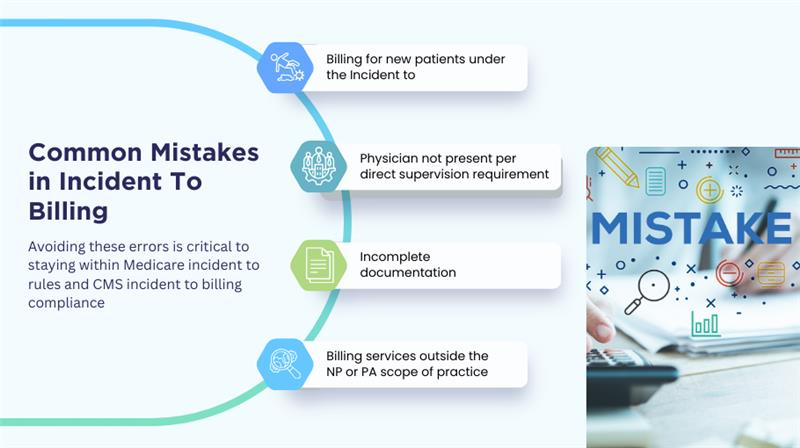
What are the common incident to billing mistakes?
CMS audit findings and OIG compliance reports surface the same errors repeatedly.
What are the Medicare audit risks right now?
The OIG’s national audit signals that CMS considers incident to a high-risk billing area.
Because the claim appears under the physician’s NPI, Medicare cannot distinguish incident to services from physician-performed services through claims data alone — detection requires chart-level review, which is exactly what the audit involves.
Practices found non-compliant face claim recoupments, civil monetary penalties, and in cases of knowing disregard, False Claims Act liability.
The exposure scales with volume — 500 improperly billed visits creates a far larger repayment demand than 20. The most protective step right now is an internal review of incident to claims, checking that each file documents all five CMS requirements.
Protect every incident-to claim before it becomes an audit liability
Most failures aren’t obvious violations — they come from small gaps in supervision, treatment plan linkage, or visit classification that surface only during audits or recoupments.
MedHeave ensures incident-to billing is structured, documented, and validated as part of your revenue operations — not left to interpretation at the point of service or billing entry.
- Validates all 5 CMS incident-to requirements before claim submission
- Ensures physician involvement and treatment plan linkage is properly documented
- Flags new complaints and mixed-visit scenarios that disqualify incident-to billing
- Verifies supervision requirements, including location and virtual supervision rules
- Separates incident-to eligible vs non-eligible encounters at the charge level
- Builds audit-ready documentation aligned with OIG review standards
MedHeave treats incident-to billing as a compliance-controlled workflow, ensuring you capture the 15% reimbursement benefit only when it is fully defensible — not just assumed.
If you want to secure incident-to revenue without exposing your practice to audit risk, contact us.
Related guides & resources
The resources below cover closely related topics and the broader service workflow they connect to:
- Medical billing — Beginner’s Guide to Medical Billing and Coding
- Medical credentialing — Simplifying Medical Credentialing: An Introductory Guide
- Place of service codes — Place of Service Codes in Medical Billing: CMS POS List, Telehealth & Reimbursement Guide
- POS 11 — POS 11 Explained: Reimbursement, Rules & Errors
- Prior authorization — Prior Authorization in Medical Billing Explained
- Modifiers in medical billing — Modifiers in Medical Billing: What They Are, How They Work, & When To Use Them
Frequently asked questions
Here are some commonly asked questions about incident-to billing:
Incident to billing is a Medicare Part B mechanism that allows services performed by auxiliary personnel — NPs, PAs, clinical staff — to be billed under a supervising physician’s NPI at 100% of the Medicare Physician Fee Schedule. Without incident to, NPP services are generally reimbursed at 85%. CMS requires the physician to perform the initial service, establish the treatment plan, remain actively involved, provide direct supervision, and the service to be a practice expense. All five requirements must be met every visit.
NPs can provide services billed incident to when all CMS requirements are met. However, NPs should weigh the professional visibility tradeoff — incident to claims appear under the physician’s NPI, meaning the NP builds no Medicare claims history. In states with full practice authority, NPs may benefit from billing directly to establish an independent professional record, even at the 85% rate.
Direct supervision — physician physically present in the office suite and immediately available — is the standard requirement. CMS has expanded virtual direct supervision through real-time audio-video for certain services under recent Physician Fee Schedule final rules. Phone-only availability does not meet the standard. Verify which specific services qualify for virtual supervision under current CMS rules before applying it.
No. Incident to requires an existing physician-established treatment plan. New patients have no prior qualifying physician encounter and no established plan. The first visit must be billed under the provider who performs the evaluation — if that’s an NP or PA, it’s billed at the 85% rate under their NPI.
Auditors examine medical records at the chart level, checking whether all five CMS requirements were met and documented for each billed service. Non-compliant claims result in recoupment demands. Widespread non-compliance can lead to civil monetary penalties and False Claims Act liability. The current OIG national audit (expected completion FY 2026) makes the risk immediate for any practice billing incident to.
Reconsider incident to when supervising physician availability is inconsistent, when NPs routinely handle new complaints alongside follow-ups, when documentation quality can’t reliably prove all five requirements, or when the practice faces a Medicare audit. In those situations, the 15% gain is smaller than the financial risk from recoupments and audit costs. Direct billing at 85% eliminates most incident to compliance exposure.