



The ICD 10-CM code for depression depends on what the provider documents.
F32.A covers depression, unspecified — the right pick when the record says “depression” without specifying major depressive disorder, severity, or episode pattern.
Meanwhile, F32.9 is major depressive disorder (MDD), single episode, unspecified, and F33.9 is MDD, recurrent, unspecified.
Both F32 and F33 sit within the F30–F39 mood disorders block of ICD-10-CM, which is the U.S. morbidity classification maintained by CMS and NCHS.
Mixing up F32.A and F32.9 are among the most common depression coding errors — and they change how payers interpret the claim.
What this guide covers:
- Documentation checklist and billing notes
- Severity, remission, and recurrence coding
- A F32 and F33 code table with documentation triggers
- F32.A vs F32.9 comparison (the biggest confusion point)
- Step-by-step code selection for depression
- Related codes that get confused with MDD
What are the depression ICD 10 codes for F32 and F33?
The two main depression code families in ICD-10-CM handle most encounters.
F32 covers depressive episodes (including MDD, single episode), while F33 covers recurrent major depressive disorder.
The table below includes every billable code in both families, plus the documentation phrase that typically triggers each one.
| Code | Description | Use when documentation says |
| F32.A | Depression, unspecified | “Depression” without MDD, severity, or episode detail |
| F32.0 | MDD, single episode, mild | Single episode, mild severity documented |
| F32.1 | MDD, single episode, moderate | Single episode, moderate severity documented |
| F32.2 | MDD, single episode, severe without psychotic features | Severe single episode, no psychotic features |
| F32.3 | MDD, single episode, severe with psychotic features | Severe single episode with delusions or hallucinations |
| F32.4 | MDD, single episode, in partial remission | Single episode, partial remission documented |
| F32.5 | MDD, single episode, in full remission | Single episode, full remission documented |
| F32.81 | Premenstrual dysphoric disorder | PMDD documented |
| F32.89 | Other specified depressive episodes | Atypical depression, post-schizophrenic depression, or other specified episode |
| F32.9 | MDD, single episode, unspecified | MDD single episode documented, severity not specified |
| F33.0 | Recurrent MDD, mild | Recurrent episode, current episode mild |
| F33.1 | Recurrent MDD, moderate | Recurrent episode, current episode moderate |
| F33.2 | Recurrent MDD, severe without psychotic features | Recurrent severe episode, no psychotic features |
| F33.3 | Recurrent MDD, severe with psychotic features | Recurrent severe episode with psychotic symptoms |
| F33.40 | Recurrent MDD, in remission, unspecified | Recurrent MDD in remission, partial/full not specified |
| F33.41 | Recurrent MDD, in partial remission | Recurrent MDD, partial remission documented |
| F33.42 | Recurrent MDD, in full remission | Recurrent MDD, full remission documented |
| F33.9 | Recurrent MDD, unspecified | Recurrent MDD documented, severity/remission not specified |
CMS confirms these codes in the current ICD 10-CM listings for outpatient psychotherapy billing. The provider’s documented diagnosis drives code selection — not the screening instrument or lab result by itself.
Move past F32.9 as your default depression code
MedHeave’s coders review behavioral health charts for the documentation needed to support the most specific F32 or F33 code available, reducing repeat unspecified-code flags.
How is F32.A different from F32.9?
F32.A and F32.9 look similar on the surface, but they represent different clinical scenarios — and choosing the wrong one is the single most common depression coding mistake in behavioral health billing.
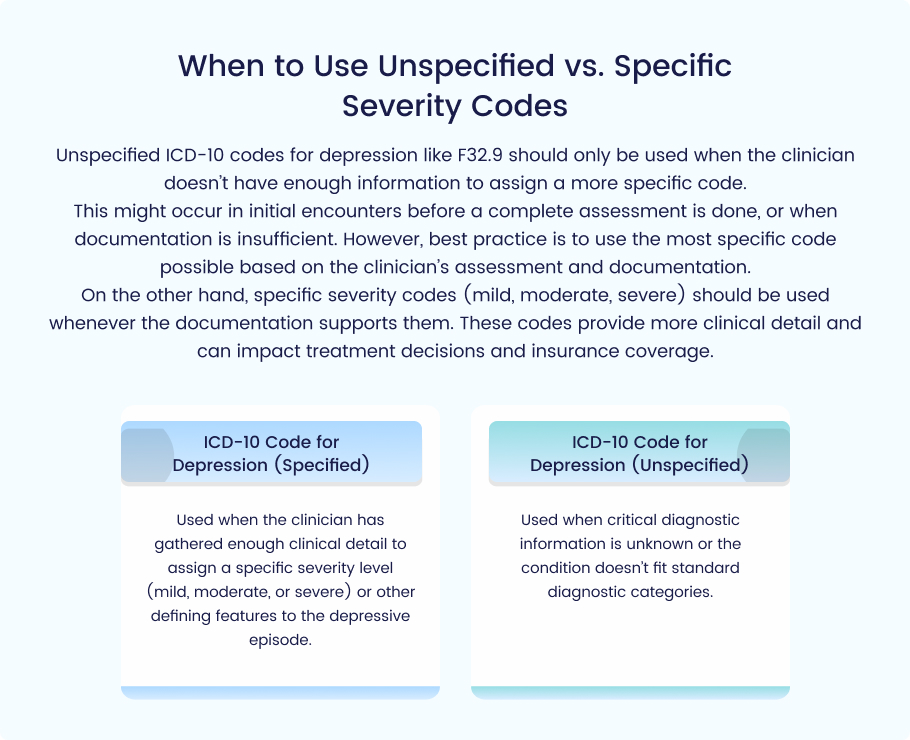
F32.A is depression, unspecified. It applies when the record documents “depression” or “depressive disorder” without enough clinical detail to support a major depressive disorder diagnosis, episode type, or severity level. Think of it as the code for vague depression documentation.
F32.9 is major depressive disorder, single episode, unspecified. It requires the provider to have documented MDD and identified it as a single episode, even though the severity wasn’t specified.
The practical split looks like this:
| Documentation phrase | Better code direction |
| “Depression” | F32.A |
| “Depression NOS” | F32.A |
| “Depressive disorder, unspecified” | F32.A |
| “Major depressive disorder, single episode” | F32.9 (severity not documented) |
| “MDD, recurrent, unspecified” | F33.9 |
| “MDD, recurrent, moderate” | F33.1 |
Using F32.9 as the default for every vague depression note is a coding habit that predates F32.A’s availability — and it overstates the diagnosis when the provider hasn’t actually documented MDD.
ICD-10-CM code descriptions confirm F32.A as the appropriate unspecified depression code when MDD isn’t established.
How do you choose the right depression ICD 10 code?
Code selection for depression follows a five-step logic that starts broad and narrows based on what the provider actually documented (not what the coder suspects).
Step 1 — Depression or MDD?
If the record says “depression” without specifying MDD, F32.A is the likely landing spot.
If MDD is documented, move to step 2. Coders shouldn’t upgrade a vague “depression” to MDD without provider confirmation — that’s a query, not a code assignment.
Step 2 — Single episode or recurrent?
F32 codes apply to single episodes. F33 codes apply when the provider documents recurrent MDD (two or more episodes with no history of mania).
A 2025 UK study of 5,136 MDD patients found that the F32 versus F33 coding split was significantly associated with treatment-resistant depression status, with recurrent cases showing higher odds of treatment resistance (BJPsych Open).
Getting this step right has downstream clinical implications beyond billing.
Step 3 — Severity documented?
When the provider documents severity, the code gets more specific.
- Mild — F32.0 (single) or F33.0 (recurrent)
- Moderate — F32.1 (single) or F33.1 (recurrent)
- Severe with psychotic features — F32.3 (single) or F33.3 (recurrent)
- Severe without psychotic features — F32.2 (single) or F33.2 (recurrent)
If severity isn’t documented, the unspecified code (F32.9 or F33.9) may be the best available option — but querying the provider often fills the gap and yields a cleaner claim.
Step 4 — Remission status?
For patients no longer in an active episode, remission codes apply.
- Partial remission — F32.4 (single) or F33.41 (recurrent)
- Full remission — F32.5 (single) or F33.42 (recurrent)
- Remission, unspecified — F33.40 (recurrent only)
Step 5 — Different diagnosis entirely?
Several conditions share depressive symptoms but live in different code families. Before assigning an F32 or F33 code, confirm the documentation doesn’t point to bipolar disorder (F31.-), adjustment disorder with depressed mood (F43.21), dysthymia (F34.1), or substance-induced mood disorder.
What depression codes get confused with F32 and F33?
Several conditions produce depressive symptoms but require entirely different ICD 10-CM codes. Billing the wrong code family creates clinical documentation mismatches and can trigger payer review.
| Condition | ICD-10-CM code | Why it differs from F32/F33 |
| Depression, unspecified | F32.A | Not MDD — no episode type or severity established |
| Dysthymic disorder (persistent depressive disorder) | F34.1 | Chronic low-grade depression, separate from episodic MDD |
| Adjustment disorder with depressed mood | F43.21 | Depressed mood tied to identifiable stressor, doesn’t meet MDD criteria |
| Adjustment disorder, mixed anxiety and depressed mood | F43.23 | Mixed anxiety-depression response to stressor |
| Bipolar disorder, current episode depressed | F31.- | Depression with documented mania/hypomania history — never coded as F32/F33 |
| Unspecified mood disorder | F39 | Mood disorder documented without enough detail for any specific category |
| Premenstrual dysphoric disorder | F32.81 | Separate specified depressive disorder within F32 |
| Postpartum depression | F53.0 | Depression associated with childbirth period (coding depends on documentation and ICD 10-CM instructions) |
A few patterns worth flagging for coders and providers:
Dysthymia vs chronic depression
“Chronic depression” in clinical shorthand often means F34.1 (dysthymia/persistent depressive disorder), not a recurrent MDD code. The provider’s documented diagnosis determines which family applies.
Depressed mood alone
A depressed mood finding (R45.0 or similar) is not the same as a depression diagnosis. If the provider hasn’t documented a depressive disorder, assigning an F32 or F33 code overstates the clinical picture.
Postpartum depression
Coding for depression during pregnancy or the postpartum period may involve F53.0, standard F32/F33 codes, or O-chapter codes depending on the documentation, timing, and ICD-10-CM tabular instructions. There’s no single rule that covers every scenario.
Treatment-resistant depression
ICD-10-CM doesn’t have a standalone code for treatment-resistant depression (though ICD 11 introduces 6A7Z-related concepts).
In current coding, treatment-resistant MDD is typically coded with the appropriate F32 or F33 code based on severity and episode pattern, with treatment history captured in the clinical record.
What should the documentation checklist look like for depression coding?
The gap between a clean depression claim and a denied one usually lives in the provider’s assessment section. If the chart answers these questions, the coder has enough to assign a specific code and defend it on review.
- Is the episode single or recurrent?
- Are psychotic features present or absent?
- Is there a prior history of depressive episodes?
- Is severity documented (mild, moderate, severe)?
- Is the patient in partial remission, full remission, or neither?
- Is a depressive disorder diagnosed (and is it MDD or something else)?
- Are related conditions documented (anxiety, substance use, bipolar history)?
- Is the documentation clear enough to support the code, or does the coder need to query?
For most practices, the documentation gap isn’t that providers don’t know the severity — it’s that they document it in progress notes but leave the assessment field vague.
A 2025 Swedish study of 2,431 depression treatment episodes found that only 28.2% had guideline-concordant outcome measurement, with much lower rates in pharmacotherapy (10.2%) than psychological treatment (71.6%) (Frontiers in Psychiatry).
Structured assessment tools like PHQ-9 can support severity documentation — but the ICD-10-CM code still follows the provider’s diagnostic statement, not the screening score.
Can you bill F32.9 for depression?
F32.9 is a valid, billable ICD 10-CM code. A code being billable, however, doesn’t mean it’s the best-supported option for every depression encounter. CMS guidelines emphasize coding to the highest available specificity when documentation supports it.
In practice, unspecified codes like F32.9 and F33.9 may trigger additional documentation requests from payers — especially for ongoing therapy claims where severity should be documented by the second or third visit.
The risk isn’t that the code is invalid; it’s that repeated use of unspecified codes across multiple encounters signals incomplete documentation, which can slow reimbursement and flag charts for review.
A reasonable approach is to use F32.9 or F33.9 for initial encounters where the provider hasn’t yet completed a full assessment, then update to the most specific code once severity and episode pattern are established.
How do ICD 10-CM and DSM-5 work together for depression?
DSM-5 (published by the American Psychiatric Association) provides clinical diagnostic criteria for major depressive disorder — the symptom counts, duration requirements, functional impairment thresholds, and exclusion rules that clinicians use to make the diagnosis.
ICD-10-CM provides the reportable diagnosis codes for billing and health record classification.
The two systems align closely for MDD. DSM-5 severity levels (mild, moderate, severe) map directly to ICD-10-CM specifiers (F32.0/F33.0 through F32.3/F33.3).
DSM-5 remission statuses map to the F32.4/F32.5 and F33.40-F33.42 codes. The clinical diagnosis follows DSM-5 criteria; the billing code follows ICD 10-CM.
Where they sometimes diverge is in documentation. DSM-5 allows clinical specifiers (with anxious distress, with melancholic features, with seasonal pattern, with peripartum onset) that don’t each have a unique ICD-10-CM code.
A provider may document “MDD, recurrent, moderate, with anxious distress” — the ICD-10-CM code captures F33.1 (recurrent, moderate), while the anxious distress specifier lives in the clinical record without changing the code.
What about ICD 10-CM depression coding for specific scenarios?
Several search queries point to clinical scenarios where the “right” depression code isn’t immediately obvious. Here’s how the most common ones resolve.
Mild depression
F32.0 (single episode) or F33.0 (recurrent) when the provider documents mild MDD. If only “mild depression” appears in the chart without an MDD diagnosis, the coder should query — “mild depression” alone may not support an F32.0 assignment.
Moderate depression
F32.1 (single) or F33.1 (recurrent). Same documentation principle — the provider needs to document MDD with moderate severity, not just “moderate depression” in isolation.
Severe depression
F32.2/F33.2 without psychotic features, or F32.3/F33.3 with psychotic features. The presence or absence of psychotic symptoms (delusions, hallucinations) changes the code and has significant treatment implications.
Chronic depression
“Chronic depression” may point to F34.1 (dysthymia/persistent depressive disorder) rather than recurrent MDD.
The provider’s documented diagnosis determines which code family applies. If the chart says “chronic MDD, recurrent,” an F33 code would be appropriate.
History of depression
When a patient has a past history of depression but no current episode, personal history codes (Z86.59) may apply rather than active F32/F33 codes. Active remission codes (F32.4, F32.5, F33.40-F33.42) are used when the provider documents the MDD as currently in remission.
Postpartum depression
Coding for postpartum depression depends on the provider’s documentation and ICD 10-CM tabular instructions. F53.0 applies to postpartum depression as documented.
Standard F32/F33 codes may also be used depending on clinical documentation and encounter context. There is no single timing rule that applies universally.
Treatment-resistant depression
ICD-10-CM doesn’t have a standalone treatment-resistant depression code.
Code the documented MDD severity and episode pattern using F32 or F33 codes, and document the treatment history in the clinical record.
A brief note on international terminology — “depresión” (CIE-10) maps to the same conceptual categories, though ICD-10-CM is the U.S. clinical modification and may differ from international ICD 10 versions.
“Depression” and “depressive disorder” in ICD-10-CM share code families but carry different specificity levels.
How can Medheave help with depression coding accuracy?
Behavioral health billing has a higher denial rate than many other specialties, partly because depression coding requires precise severity, episode, and remission documentation that many EHR templates don’t prompt for.
Medheave’s certified coders handle the F32/F33 specificity, F32.A vs F32.9 selection, and payer-level documentation requirements so your practice isn’t chasing preventable appeals.
- Denial trend analysis for behavioral health claim rejections
- Coding audits to identify F32.9 overuse and documentation gaps
- CDI support for severity, recurrence, and remission documentation
- Accurate depression code selection across F32, F33, and related families
Contact Medheave for a behavioral health coding review.
Related guides & resources
The resources below cover closely related topics and the broader service workflow they connect to:
- Mental health billing services — Mental health billing services
- Behavioral health case management CPT codes — Behavioral Health CPT Codes: 99484, 99492 & More
- CPT code for case management — CPT Code for Case Management Behavioral Health (2026)
- Common documentation barriers — What Documentation Barriers Are Common in Behavioral Health Claims?
- Behavioral health billing and credentialing — The Behavioral Health Billing & Credentialing Guide for 2026
- Challenges and solutions 3 — Behavioral Health Billing: Challenges and Solutions
- Risks of manual billing — Risks of Manual Billing in Behavioral Health
Frequently asked questions
Here are some commonly asked questions on this topic:
The ICD-10-CM code depends on the provider’s documentation. F32.A is depression, unspecified — used when the chart says “depression” without establishing MDD, severity, or episode type. F32.9 is major depressive disorder, single episode, unspecified, and F33.9 is MDD, recurrent, unspecified. For specific severity levels, use F32.0–F32.3 (single episode) or F33.0–F33.3 (recurrent). The FY 2026 ICD-10-CM Guidelines require coding to the highest documented specificity.
F32.A applies when the record says “depression” without enough detail to support an MDD diagnosis. F32.9 applies when the record documents MDD, single episode, but doesn’t specify severity. Treating F32.9 as the default for every depression note is a common coding error — F32.A is the correct unspecified depression code when MDD hasn’t been established. ICD10Data confirms that F32.A covers “Depression, unspecified” as a separate billable code.
MDD is coded under F32.- for a single episode or F33.- for recurrent episodes. The final digit depends on severity (mild, moderate, severe without psychotic features, severe with psychotic features) and remission status (partial, full, unspecified). F32.9 is MDD, single episode, unspecified. F33.9 is MDD, recurrent, unspecified. For billing, use the most specific code supported by the provider’s assessment.
Recurrent major depressive disorder uses F33 codes. F33.0 is mild, F33.1 is moderate, F33.2 is severe without psychotic features, and F33.3 is severe with psychotic features. Remission codes include F33.40 (unspecified remission), F33.41 (partial remission), and F33.42 (full remission). F33.9 covers recurrent MDD when severity or remission isn’t documented. The recurrent designation requires documentation of at least one prior major depressive episode.
F33.3 is major depressive disorder, recurrent, severe with psychotic features. It applies when the provider documents recurrent MDD at severe intensity with associated psychotic symptoms (delusions or hallucinations). F33.3 differs from F33.2 (severe without psychotic features) specifically by the presence of documented psychotic symptoms, which changes both treatment approach and coding.
F32.9 is a valid, billable ICD-10-CM code for MDD, single episode, unspecified. However, CMS guidelines emphasize coding to the highest specificity when documentation supports it. Repeated use of F32.9 across multiple encounters — especially after full assessment — may signal incomplete documentation and can trigger payer review or additional documentation requests. Using severity-specific codes (F32.0–F32.3) is recommended whenever the provider has documented the severity level.
Dysthymic disorder (persistent depressive disorder) is coded as F34.1, not under the F32 or F33 MDD families. F34.1 covers chronic, lower-grade depressive symptoms that persist over a longer period. If the documentation says “chronic depression” without specifying MDD, the coder should query the provider to determine whether F34.1 or an F33 recurrent code is more appropriate.
Postpartum depression coding depends on the provider’s documentation and ICD-10-CM instructions. F53.0 covers postpartum depression when documented as such. Standard F32 or F33 codes with appropriate severity specifiers may also be used depending on the clinical documentation and encounter context. DSM-5 uses a “with peripartum onset” specifier for mood symptoms beginning during pregnancy or within four weeks after delivery, but ICD-10-CM code selection follows the documented diagnosis and tabular instructions rather than a single timing rule.
ICD-10-CM does not have a standalone code for treatment-resistant depression. Code the documented MDD severity and episode pattern using the appropriate F32 or F33 code, and document the treatment history and treatment response (or lack of response) in the clinical record. A 2025 UK study found that nearly 48% of MDD patients met criteria for treatment resistance, and recurrent depression (F33) was more common in the treatment-resistant group — reinforcing that accurate episode coding carries clinical weight beyond billing.
Depressed mood alone (without a documented depressive disorder) may be captured with a symptom code rather than an F32 or F33 diagnosis code. If the provider hasn’t documented a depressive disorder diagnosis, assigning an F32 or F33 code based on mood symptoms alone would overstate the clinical picture. The coder should query when the chart describes depressed mood but doesn’t include a formal depression diagnosis.
When both depression and anxiety are documented as separate diagnoses, both conditions should be coded — typically an F32 or F33 code for the depression and an F41 code (such as F41.1 for generalized anxiety disorder) for the anxiety. ICD-10-CM doesn’t have a single combined “depression with anxiety” code in the F32/F33 families. If only mixed anxiety and depressive symptoms are documented without a formal MDD diagnosis, F41.8 (other specified anxiety disorders) or the provider’s specific documented diagnosis would guide code selection.
The FY 2026 ICD-10-CM code set became effective October 1, 2025, and applies through September 30, 2026. The core F32 and F33 depression code families remain structurally unchanged from recent years. F32.A (depression, unspecified) continues as a separate billable code from F32.9. Coders should review the CDC/NCHS ICD-10-CM files page for any updates to inclusion terms, excludes notes, or coding guidelines that may affect depression code selection.