
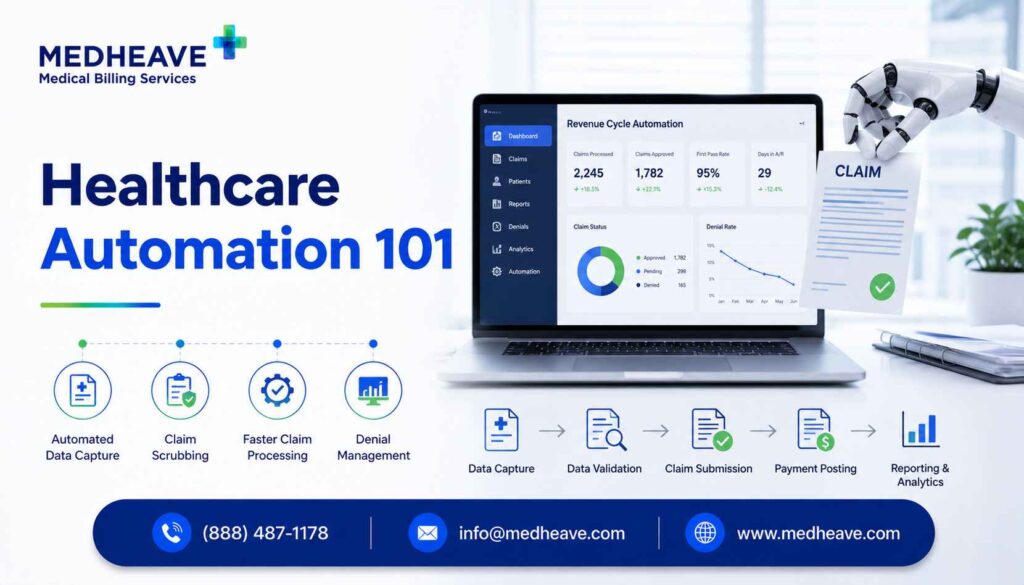
Healthcare automation is the use of software, AI, workflow rules, and system integrations to reduce manual work across clinical, administrative, revenue cycle, patient access, and compliance workflows.
It includes everything from ambient documentation tools that draft clinical notes in real time to RPA bots that verify insurance eligibility across payer portals — and the category is growing fast, even if adoption remains uneven.
A 2025 JAMA Health Forum study using U.S. Census data found that mean AI use among healthcare firms reached 8.3% in 2025, compared with 19.2% in professional services and 23.2% in information services.
Healthcare adopts automation more slowly than other industries because safety, liability, regulation, and workflow complexity raise the bar for deployment. Here is what this guide covers:
- How to decide what to automate first
- The four types of healthcare automation
- Compliance, integration, and governance risks
- Which healthcare workflows create the most automation value
- How to measure ROI and avoid common implementation failures
- Real use cases across clinical, RCM, patient access, and compliance workflows
Which healthcare workflows create the most automation value?
Not every workflow is a good automation candidate. The strongest first targets are high-volume, rules-heavy, repetitive, measurable, and low-risk — tasks where the cost of manual execution is clear and the exception rate is manageable.
AUTOMATION VALUE MAP
Where automation creates the most operational value
📝
Documentation
Less after-hours charting
💰
Revenue cycle
Lower cost to collect
🔑
Prior authorization
Faster approvals
📅
Patient access
Shorter wait times
🔍
Compliance
Easier audit trails
🔗
Care coordination
Fewer referral gaps
The 80/20 rule applies directly. A small number of repetitive workflows usually generate most of the administrative drag.
Eligibility verification, appointment reminders, claims scrubbing, denial follow-up, and clinical note drafting happen thousands of times per month in most practices — making them natural first targets.
What are the four types of healthcare automation?
The SERP and market tend to blur RPA, workflow automation, AI, and agentic automation into one category. They are different tools for different problems.
| Type | Best for | Healthcare example |
| RPA (robotic process automation) | Repetitive clicks across systems | Pulling eligibility data from payer portals |
| Workflow automation | Rules-based routing and handoffs | Assigning referrals by specialty and urgency |
| AI automation | Language, prediction, classification | Summarizing clinical notes or classifying incoming faxes |
| Agentic automation | Multi-step tasks with decision points | Tracking prior authorization status and updating worklists |
RPA handles the copy-paste layer. Workflow automation handles the routing layer. AI handles the language and prediction layer. Agentic automation combines steps across systems — but it remains the least mature category.
A 2026 benchmark of healthcare administrative computer-use agents found that the best-performing agent achieved only 36.3% end-to-end task success across 135 expert-defined tasks. Fully autonomous administrative agents are not yet reliable for most real healthcare workflows.
How does automation apply across healthcare departments?
Here’s an overview of the application of automation across multiple areas in healthcare:
Clinical documentation
Ambient AI scribes use NLP to draft clinical notes during patient encounters.
A 2025 JAMA Network Open study of 100 clinicians found that ambient documentation reduced mean time spent in notes from 6.2 to 5.3 minutes per appointment, with significant drops in mental demand and perceived effort.
Kaiser Permanente reported more than 2.5 million uses of ambient AI scribes in one year, estimating 15,700 hours saved compared with nonusers.
The tradeoff is that automation reduces writing burden while potentially increasing review burden. Clinicians still approve every note — and AI-drafted content that goes unreviewed creates a different kind of risk.
Revenue cycle management
RCM automation can touch every step from eligibility verification through payment posting
- Appeal letter drafting and tracking
- Automated claims submission to payers
- Claims scrubbing for coding errors before submission
- Eligibility and benefits verification before appointments
- Denial identification, categorization, and prioritization
- Payment posting and reconciliation
The CAQH Index reported that medical prior authorization electronic adoption rose from 31% to 40% between the 2023 and 2025 reports.
Medical claim status inquiry adoption reached 81%. Adoption is advancing, but major manual bottlenecks remain — particularly in prior authorization, denial management, and appeals.
Prior authorization
Prior authorization automation gathers clinical evidence, populates payer forms, tracks submission status, and flags missing documentation.
The process is a strong automation candidate because it involves structured rules, repetitive steps, and measurable delays.
One practical limit worth noting is that AI can produce clinically strong prior authorization content, but a 2026 preprint found that LLM-generated prior authorization letters sometimes missed:
- Billing codes
- Follow-up details
- Duration requests
Administrative completeness still requires human review — even when the clinical narrative is well-constructed.
Patient access
Automation in patient access covers
- Care gap identification and outreach
- Triage routing for incoming messages and referrals
- Digital intake forms that pre-populate from existing records
- Automated appointment reminders and waitlist management
- Fax ingestion tools that convert unstructured documents into structured data
Compliance and audit
Automated compliance tools maintain audit trails, collect evidence for regulatory review, manage access logs, and flag policy violations.
The value is less about speed and more about coverage — automated systems can monitor every transaction, while manual compliance depends on sampling.
How should organizations measure healthcare automation ROI?
Generic “automation saves time” claims are not useful without workflow-specific metrics. The right KPIs depend on the workflow being automated.
| Workflow | Measured by |
| Documentation | Minutes per note, after-hours charting time |
| Revenue cycle | Days in A/R, clean claim rate, cost to collect |
| Prior authorization | Time to authorization, requests for additional information |
| Patient access | No-show rate, call abandonment, time to schedule |
| Denials | Denial rate, appeal success rate, recovery dollars |
| Compliance | Audit completion time, access log coverage |
The biggest ROI measurement mistake is calculating time savings per task without accounting for exception handling, staff training, integration maintenance, and the review burden that automation shifts from one person to another.
What are the risks and failure modes?
Healthcare automation fails most often when organizations automate a broken workflow rather than fixing it first.
AUTOMATION LANDSCAPE
Current adoption and savings data
$258B
Administrative costs avoided through electronic transactions in 2024
100%
Of 43 surveyed health systems with ambient documentation adoption activity
8.3%
AI use among healthcare firms in 2025 (vs 23.2% in information services)
36.3%
Best end-to-end success rate for administrative AI agents (2026 benchmark)
Sources — CAQH Index (2025), Poon et al. JAMIA (2025), Nguyen et al. JAMA (2025), HealthAdminBench (2026)
Common failure modes include
- Skipping staff input during workflow design
- Poor EHR or practice management integration
- Weak PHI governance, audit trails, or access controls
- Measuring time savings without tracking where the work shifted to
- Ignoring exception handling (the 20% of cases that don’t follow the happy path)
- Over-relying on AI outputs without human review for clinical or patient-facing content
- Automating workflows that are already broken (bad process + automation = faster bad process)
The National Academy of Medicine’s 2025 AI Code of Conduct calls for accurate, safe, reliable, and ethical AI systems in health and medicine — emphasizing independent evaluation, transparency, and attention to bias and risk across populations. Healthcare automation is not a plug-and-play software deployment. It’s a governed sociotechnical change.
How should a practice implement healthcare automation?
Implementation works best as a staged process, not a big-bang rollout.
Map the workflow first
Identify every actor, system, handoff, wait time, exception, and current metric before selecting software.
Start with one high-frequency use case
Eligibility verification, appointment reminders, documentation, prior authorization, or denial follow-up are common first targets.
Define where humans must review
Clinical judgment, patient-facing communication, payer submission, and high-risk claim decisions all need human checkpoints.
Integrate with the system of record
Whether the integration uses FHIR APIs, HL7 interfaces, RPA, or surface automation, the EHR or practice management system remains the source of truth.
Measure baseline and post-launch KPIs
Use workflow-specific metrics from the ROI table above — not generic “hours saved” estimates.
Scale only after exceptions are under control
The happy path works early. The real test is whether the system handles cancellations, edge cases, payer rejections, and unusual clinical scenarios without creating new manual work.
What should buyers verify before choosing a vendor?
A practical evaluation checklist for any healthcare automation tool
- Does it handle exceptions transparently?
- Does it maintain audit logs for automated actions?
- Does the vendor sign a Business Associate Agreement?
- Does it report workflow-level ROI (not just feature usage)?
- Does it support the exact workflow you want to automate first?
- Does it integrate with your EHR or practice management system?
- Can staff review and override outputs before they reach patients or payers?
When automation meets your revenue cycle
Healthcare automation creates real value when it connects clinical workflows to billing, authorization, and compliance systems — and falls short when those connections are incomplete.
MedHeave helps healthcare providers automate the administrative side of care delivery without losing oversight or creating compliance gaps.
- Denial pattern analysis and appeal support
- Compliance documentation review for audit readiness
- Prior authorization management with payer-specific tracking
- Revenue cycle automation across eligibility, claims, denials, and payment posting
Contact MedHeave to identify which workflows your practice should automate first.
Frequently asked questions
Here are some commonly asked questions about healthcare automation:
Healthcare automation is the use of software, AI, workflow rules, and system integrations to reduce repetitive manual work across clinical, administrative, revenue cycle, patient access, and compliance workflows. Common examples include ambient clinical documentation, automated eligibility verification, claims scrubbing, prior authorization support, appointment reminders, denial management, referral routing, and audit trail collection. Automation does not typically replace clinical judgment — it handles the structured, repetitive steps that consume staff time and delay care delivery.
The four practical categories are RPA (robotic process automation), workflow automation, AI automation, and agentic automation. RPA handles repetitive clicks across systems, such as pulling eligibility data from payer portals. Workflow automation manages rules-based routing and handoffs. AI automation handles language, prediction, and classification tasks like note summarization or fax triage. Agentic automation combines multi-step tasks with decision points, though it remains the least mature category for healthcare operations.
The 80/20 rule means that a small number of repetitive, high-volume workflows usually generate most of the administrative burden in a healthcare organization. Eligibility checks, appointment reminders, claims submission, denial follow-up, and clinical documentation happen thousands of times monthly in most practices. Starting automation with those high-frequency tasks produces measurable results faster than trying to automate complex, low-volume edge cases first.
Automation can support HIPAA-compliant workflows, but compliance depends entirely on how the tool handles protected health information. Buyers should verify that the vendor signs a Business Associate Agreement, uses encryption for data at rest and in transit, implements role-based access controls, maintains audit logs for all automated actions, and supports human review for outputs that involve PHI. “HIPAA compliant” as a marketing claim requires operational verification, not just a vendor’s self-assessment.
Most clinics benefit from starting with a high-volume, rules-based workflow where manual execution creates measurable delays or errors. Common first targets include appointment reminders and no-show follow-up, insurance eligibility verification, patient intake digitization, clinical documentation support, prior authorization tracking, and denial identification. The best starting point depends on where the practice loses the most staff time, revenue, or patient experience quality.

