
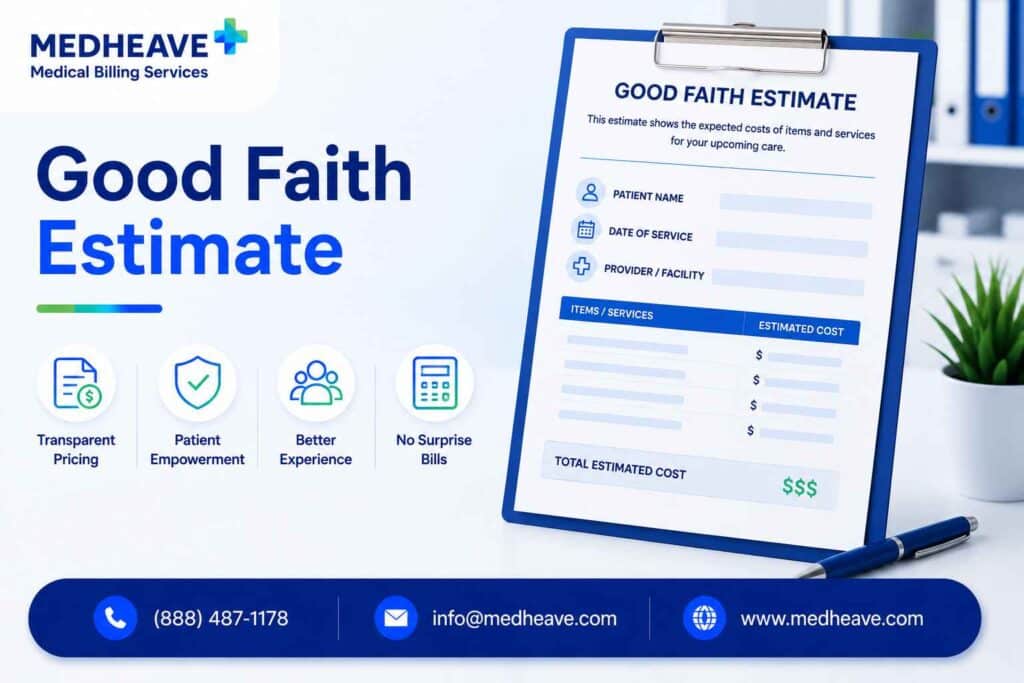
A good faith estimate (GFE) is a written, itemized estimate of expected healthcare charges that providers and facilities must give to uninsured or self-pay patients before scheduled, non-emergency care.
The requirement became federally enforceable under the No Surprises Act in January 2022 and applies to every healthcare provider and facility in the United States — hospitals, physician practices, ambulatory surgical centers, imaging centers, laboratories, and therapy offices included.
The estimate is not a bill. It is not a guarantee. It is not a contract. It is a projection of expected charges based on the services and information reasonably available at the time it is prepared.
If the final bill from a provider or facility exceeds that provider’s or facility’s GFE by $400 or more, the patient may qualify for a federal dispute process with an independent reviewer.
In this guide, we’ll be shedding light on:
- The definition of Good Faith Estimate
- What happens if no GFE is provided
- Best practices for GFE compliance
- What a GFE does & doesn’t cover
- FAQs about Good Faith Estimates
- The $400 dispute rule explained
- Common GFE mistakes to avoid
- Required information in a GFE
- Who qualifies for a GFE
- GFE delivery deadlines
TLDR: Good Faith Estimate
A Good Faith Estimate (GFE) is a written estimate of expected healthcare costs—not a bill or price guarantee.
Providers must give a GFE to uninsured and self-pay patients before scheduled, non-emergency care.
The rule has been in effect since January 2022 under the No Surprises Act.
GFEs must be delivered within 1–3 business days, depending on when the service is scheduled.
A compliant GFE includes itemized charges, provider details, billing codes, and required disclosures.
A GFE may not include charges from other providers (e.g., hospital, anesthesia, or lab).
If a bill exceeds a provider’s GFE by $400 or more, patients may qualify for the federal PPDR dispute process.
The $400 threshold applies to each provider individually, not the total cost of care.
Missing a required GFE can expose providers to CMS complaints and compliance risk.
Strong GFE workflows improve price transparency, patient trust, and billing accuracy.
Who qualifies for a good faith estimate?
The federal GFE requirement applies to patients who are either uninsured or choosing not to use their insurance for the service. The regulation expressly includes someone who has coverage but does not want the claim submitted to that coverage.
Patients who qualify:
- No health insurance coverage of any kind
- Have insurance but choose to pay out of pocket for this service
- Insurance does not cover the specific service being scheduled
Patients who do not receive a GFE under this rule:
- Using insurance for the service (they receive an Explanation of Benefits instead)
- Receiving emergency care (the requirement applies to scheduled, non-emergency services)
A common point of confusion — patients sometimes receive a GFE and wonder why they got a “billing document” when they have insurance.
The answer is usually that they elected self-pay for that visit, or the provider’s system flagged them as uninsured based on registration data.
When must the estimate be delivered?
The CMS timeline rules are tied to when the service is scheduled or when the patient requests an estimate — not to the date of service itself.
| Scheduling situation | GFE deadline |
| Service scheduled 10+ business days ahead | Within 3 business days of scheduling |
| Service scheduled 3–9 business days ahead | Within 1 business day of scheduling |
| Service scheduled fewer than 3 business days ahead | Not required under the federal scheduling rule |
| Patient requests an estimate before scheduling | Within 3 business days of the request |
GFE Delivery Timeline
10+ days out
GFE due within 3 business days of scheduling
3–9 days out
GFE due within 1 business day of scheduling
Under 3 days
Not required under the federal scheduling rule
Patient requests before scheduling
GFE due within 3 business days of request
The “fewer than 3 business days” rule is important for billing teams. It does not mean the patient has no rights — it means this specific federal scheduling deadline does not apply.
State laws may impose additional requirements, and CMS still encourages providers to give estimates whenever possible.
What must a good faith estimate include?
The federal regulation (45 CFR §149.610) specifies the required fields. In practice, the GFE should give the patient enough information to understand what they are being charged for, by whom, and how much.
Patient and provider information
- Patient name, date of birth, and contact details
- Provider or facility name, NPI, and Tax Identification Number
- Service location
Service and charge details
- Total expected charges
- Description of each scheduled service
- Expected charge for each item or service
- Diagnosis codes (ICD-10), when applicable
- Procedure codes (CPT, HCPCS, DRG, or National Drug Code)
Disclosures and limitations
- Notice that actual charges may differ
- Statement that the estimate is not a bill
- Notice that separately scheduled services may require their own estimate
- Information about the patient’s dispute rights if the bill exceeds the estimate by $400 or more
The estimate must be provided in written form — paper or electronic — that the patient can retain. A verbal price quote does not satisfy the federal requirement.
What may not be included in the estimate?
This is where billing disputes originate. A patient assumes the GFE covers the entire episode. It may not.
Charges from a different provider or facility
A surgeon’s GFE covers the surgeon’s charges. The hospital, anesthesia group, laboratory, and radiologist may each bill separately.
CMS warns consumers that a GFE may cover only one provider or facility and that patients may need multiple estimates.
Services scheduled separately
- Follow-up imaging
- Preoperative testing
- Post-procedure consultations
- Physical therapy after surgery
Services that could not reasonably be anticipated
Complications during a procedure or additional findings during an exam may generate charges not included in the original estimate.
“Unexpected” should not become a blanket excuse for costs that were reasonably foreseeable — but it is a legitimate limitation of any estimate prepared before care occurs.
The safest advice for patients — ask every expected biller whether its charges are included in the estimate. The safest practice for billing teams — identify co-providers at scheduling and coordinate estimates or clearly disclose which charges are excluded.
What does a good faith estimate look like?
Let’s look at few examples:
One-time procedure example
| Expected biller | Service | Estimated charge |
| Orthopedic surgeon | Knee arthroscopy | $1,800 |
| Ambulatory surgical center | Facility fee | $3,200 |
| Anesthesia group | General anesthesia | $900 |
| Reference laboratory | Pathology | $220 |
| Total estimated episode | $6,120 |
Each line is a separate provider or facility. The patient may receive up to four separate GFEs — one from each biller. The $400 dispute threshold applies to each provider or facility individually, not to the combined total.
Recurring therapy example
| Service | Frequency | Per-session estimate | 6-month total |
| Initial assessment | Once | $250 | $250 |
| Individual therapy session | Weekly | $175 | $4,200 |
| Estimated total | $4,450 |
For recurring services, the GFE should state the anticipated frequency, period, and number of sessions. Federal rules cap a recurring-service estimate at 12 months.
Weak estimate
“Procedure: approximately $3,000.”
There is no itemization, provider identification, or codes. No disclosure about separate billers. Neither do we see a dispute-rights notice. This does not meet the federal standard.
How does the $400 dispute rule work?
If the final bill from a specific provider or facility exceeds that provider’s or facility’s estimated amount by $400 or more, the patient may qualify for the federal Patient-Provider Dispute Resolution (PPDR) process.
Eligibility requirements
The patient generally needs:
- The $25 administrative fee
- A copy of both the estimate and the bill
- An initial bill dated within the past 120 calendar days
- A charge from at least one provider or facility that is $400+ above that provider’s estimate
- Uninsured or self-pay status for the care
- A GFE received before the care
What happens during the dispute
- Existing collection activity must stop
- An independent reviewer evaluates the estimate and bill
- The provider cannot move the disputed bill into collections
- The patient and provider may still settle directly at any time
- New late fees cannot be charged while the process is pending
- The reviewer may uphold the estimate, the bill, or an amount between them
What the $400 rule does not do
The threshold applies per provider or per facility — not to the combined total across all billers.
A patient who receives four separate bills, each $300 above the respective estimate, may not qualify for PPDR even though the total overage is $1,200.
CMS provides the full dispute resolution guide and initiation process on its website.
What if the patient never received an estimate?
The absence of a GFE does not erase the bill. But it does create compliance exposure for the provider.
For the patient
Request Your GFE
Ask for a copy immediately. Providers are required to keep Good Faith Estimates available for up to six years.
Report Missing Estimates
If a Good Faith Estimate should have been provided but wasn’t, file a complaint with CMS.
Know the PPDR Limitation
The formal Patient-Provider Dispute Resolution (PPDR) process requires a Good Faith Estimate. Without one, the $400 dispute pathway may not be available.
Explore Other Options
Negotiate directly with the provider, request an itemized bill, ask about financial assistance, or review any applicable state-law consumer protections.
For the billing team
A missing GFE means the practice failed a federal compliance requirement. It does not automatically void the bill, but it removes the patient’s formal dispute pathway while exposing the practice to CMS complaints, audit risk, and reputational damage.
The simplest prevention is building GFE generation into the scheduling and eligibility verification workflow so estimates are triggered automatically when a self-pay or uninsured patient books a service.
Good faith estimate vs other healthcare documents
Here is a comparison of GFE with other important healthcare documents:
| Document | Who provides it? | When received | What it shows | Is it a bill? |
| Good Faith Estimate | Healthcare provider or facility | Before self-pay care | Expected charges for scheduled services | No |
| Explanation of Benefits | Health insurer | After claim processing | How the claim was adjudicated — allowed amounts, payments, patient responsibility | No |
| Medical bill | Provider or facility | After care | Amount the patient owes | Yes |
| Hospital price estimator | Hospital website tool | Before care | Calculated estimate based on user-entered details | No |
The GFE is the only document on this list that carries a federal dispute mechanism tied to a specific dollar threshold.
An EOB has its own insurance appeal process. A medical bill can be negotiated or challenged through other channels. They are not interchangeable.
Common good faith estimate mistakes
Here are some commonly made mistakes:
1. Assuming one estimate covers the entire episode
A surgeon’s GFE does not include the facility, anesthesia, lab, or imaging charges unless those providers are explicitly listed. Patients should ask. Billing teams should disclose.
2. Providing only a verbal price
The federal requirement specifies a written document that the patient can retain. A phone conversation about approximate costs does not satisfy the GFE obligation.
3. Comparing combined totals instead of each biller
The $400 dispute threshold applies per provider or per facility. A patient who compares only the episode total may miss a qualifying overage from one biller or file an invalid dispute based on combined charges.
4. Missing the 120-day filing window
The PPDR process requires the initial bill to be dated within the past 120 calendar days. A patient who discovers the overage late may lose access to the federal dispute process.
5. Treating the estimate as a guaranteed maximum
A GFE is based on information available at the time of preparation. Clinical circumstances change. Additional services may become medically necessary.
The estimate sets an expectation, not a price ceiling — though a provider that consistently bills far above its estimates faces both dispute liability and patient trust problems.
How billing teams should manage GFE compliance
The GFE is not a clinical document. It is a billing operations task that starts at scheduling and connects to eligibility verification, charge estimation, patient communication, and collections.
Build GFE generation into the scheduling workflow
- Document delivery method and date
- Track delivery deadlines by scheduling date
- Flag self-pay and uninsured patients at registration
- Trigger estimate creation when the appointment is booked
Identify co-providers at scheduling
- Determine whether the facility, anesthesia, lab, or imaging will bill separately
- Coordinate estimates or clearly disclose which charges are excluded
- Document what the patient was told
Use actual fee schedule data
- Include CPT, HCPCS, and diagnosis codes
- Update estimates when fee schedules change
- Track estimate-to-final-bill variance by provider and service
- Base estimates on the practice’s current cash-pay or self-pay rates
Retain documentation
- Document any revised estimates
- Link estimates to patient accounts
- Store issued GFEs for at least six years
- Maintain delivery records (date, method, recipient)
GFE Compliance Workflow for Billing Teams
1
Patient schedules service
2
Registration flags self-pay or uninsured
3
Billing builds itemized estimate
4
GFE delivered within deadline
5
Estimate stored and linked to account
6
Final bill compared against estimate
Is a good faith estimate still used for mortgages?
The term “good faith estimate” historically applied to mortgage lending.
For most standard mortgages today, borrowers receive a Loan Estimate — the GFE was combined with other disclosures under TRID rules administered by the CFPB.
A GFE is still used for reverse mortgages. If you arrived here looking for mortgage information, the CFPB’s Loan Estimate guide is the current resource.
The estimate sets the expectation — MedHeave makes sure the billing matches.
Good faith estimate compliance starts at scheduling and ends when the final bill is accurate, defensible, and collected.
Most practices treat GFEs as a paperwork requirement. The ones that build estimate generation into their billing workflow avoid disputes, protect patient trust, and collect faster.
- GFE-triggering logic is built into the eligibility and scheduling workflow
- We verify insurance and self-pay status before every scheduled appointment
- Disputes and billing complaints are tracked and resolved through structured follow-up
- Patient responsibility estimates are based on current fee schedules and verified benefits
- Every patient balance is checked against EOB and estimate data before statements go out
Talk to MedHeave about turning GFE compliance from a paperwork task into a revenue cycle advantage.
Frequently asked questions
Here are some commonly asked questions about good faith estimates:
A good faith estimate is a written, itemized document showing the expected charges for scheduled healthcare services. Providers and facilities must give it to uninsured or self-pay patients before non-emergency care. It includes service descriptions, diagnosis and procedure codes, expected charges, and provider information. The estimate is not a bill or a guarantee — it is a projection based on the services and information reasonably available at the time it is prepared.
Yes, if you choose not to use your insurance for that specific service. The federal regulation includes patients who have coverage but elect to pay out of pocket. When you use insurance, you receive an Explanation of Benefits after the claim is processed instead. If you are unsure whether your plan covers a service and want pricing information before deciding, you can request a GFE as a self-pay patient — but using insurance later may change the financial terms.
You may qualify for the federal Patient-Provider Dispute Resolution process. The $400 threshold applies to charges from a specific provider or facility compared to that provider’s or facility’s estimated amount — not the combined total across all billers. You generally need the GFE, an initial bill dated within the past 120 calendar days, and a $25 administrative fee. During the dispute, the provider cannot send the bill to collections or charge late fees.
No. A GFE is based on information available at the time it is prepared. Actual charges may differ if clinical circumstances change, additional services become necessary, or the treatment plan is modified. The estimate sets a documented expectation — and if the final charge exceeds it by $400 or more from a single provider or facility, the patient gains access to a federal dispute process. It is a transparency tool, not a price ceiling.
Not necessarily. A surgeon’s GFE covers the surgeon’s expected charges. The hospital, anesthesia group, laboratory, and imaging provider may each bill separately and may each issue their own estimates. CMS advises patients to ask whether each expected biller is included. If charges from a provider are not listed, request a separate estimate from that provider before the service.
The initial bill must be dated within the past 120 calendar days when you file the dispute. This window starts from the date of the first bill — not the date of service. If you discover the overage months after receiving the bill, the filing deadline may have already passed. Review your estimate against the bill as soon as the bill arrives to preserve your dispute rights.

