




Full code is a medical order directing clinicians to attempt all appropriate resuscitation measures if a patient’s heart stops or breathing ceases. Those measures typically include:
- Mechanical ventilation
- Endotracheal intubation
- Defibrillation for shockable heart rhythms
- CPR (chest compressions and rescue breathing)
- Advanced cardiac life support (Wexner Medical Center)
- IV or IO administration of medications such as epinephrine
Full code is the default status at most hospitals unless a different order is documented. Here’s what the rest of this guide covers.
- Billing and CPT coding for resuscitation events
- Questions to ask before choosing or changing code status
- How full code compares to DNR, DNI, and comfort-focused orders
- How code status gets documented through advance directives and POLST
- What full code care includes (and what it does not guarantee)
What does full code care include?
When a patient carries a full code status and experiences cardiac or respiratory arrest, the response team follows established Advanced Cardiac Life Support (ACLS) protocols.
The interventions below work together — the goal is restoring circulation and breathing long enough for the underlying cause to be treated.
| Full code measure | What happens | When it applies |
| CPR | Chest compressions circulate blood; rescue breaths deliver oxygen | Immediately when pulse or breathing is absent |
| Defibrillation | A controlled electric shock resets a dangerously abnormal heart rhythm | Only for shockable rhythms like ventricular fibrillation or pulseless ventricular tachycardia |
| Intubation | An endotracheal tube is placed into the airway to protect it and deliver oxygen | When the patient cannot maintain an open airway independently |
| Mechanical ventilation | A ventilator machine takes over breathing | After intubation, when spontaneous breathing is inadequate |
| Emergency medications | Drugs like epinephrine (given IV or IO) support heart function and blood pressure | During the arrest, per ACLS algorithm timing |
| Cardiac monitoring | Continuous ECG tracking guides rhythm-based decisions | Throughout the event and into post-arrest care |
What full code does not mean
Full code authorizes resuscitation — it does not mean “do everything in every medical situation.” A patient on full code status can still have other treatment preferences documented (declining a specific surgery, for example). The scope of a full code order applies specifically to the response during cardiac or respiratory arrest (AMA Code of Medical Ethics).
Turning resuscitation events into clean, defensible claims
CPR, intubation, and ventilator management each carry their own documentation and coding rules. MedHeave’s billing team helps practices capture these encounters accurately from the chart to the claim.
Full code also does not guarantee survival or a good neurologic outcome
Let’s look at numbers to learn more than what most patient-facing explanations suggest.
A 2024 BMJ study found that the probability of survival after in-hospital cardiac arrest dropped below 1% once CPR exceeded 39 minutes (BMJ 2024).
Among those who do survive to hospital discharge, roughly 85% have a favorable neurologic outcome according to AHA’s 2025 data (AHA Highlights 2025) — but that percentage applies to survivors, not to all patients who undergo CPR.
Clinicians are not obligated to continue CPR indefinitely. During the event, the team continuously evaluates the patient’s rhythm, response to treatment, duration of resuscitation, and likely neurologic outcome before deciding whether to continue CPR.
How does full code compare to DNR, DNI, and comfort-focused care?
Code status orders define what happens during cardiac or respiratory arrest only. They do not control routine medical care. The comparison below clarifies how each option works in practice.
| Code status | CPR attempted? | Breathing tube placed? | Other medical treatment? | Plain-language summary |
| Full code | Yes | Yes, if needed | Yes | Attempt all appropriate resuscitation |
| DNR (Do Not Resuscitate) | No | Depends on other orders | Often yes — antibiotics, fluids, oxygen, surgery may continue | Often yes — antibiotics, fluids, oxygen, and surgery may continue |
| DNI (Do Not Intubate) | May vary | No | Often yes | No endotracheal tube or invasive ventilation |
| Comfort-focused care | Usually no | Usually no | Comfort treatments only — pain management, symptom relief | Focus on comfort rather than aggressive intervention |
The visual below highlights the core decision at a glance, while the table above gives you the full reference detail.
Breathing tube — Yes
Medications — Yes
Defibrillation — Yes
Breathing tube — Varies
Other treatment — Often yes
Comfort care — Yes
Breathing tube — No
Other treatment — Often yes
Oxygen — May continue
Breathing tube — Usually no
Pain relief — Yes
Symptom relief — Yes
DNR
A DNR order (sometimes called DNAR, for “Do Not Attempt Resuscitation”) tells the medical team not to perform CPR if the patient’s heart or breathing stops.
A DNR order does not mean “do not treat.” Patients with DNR orders still receive medications, oxygen, wound care, antibiotics, and other appropriate treatments unless their care plan limits those separately (Merck Manuals).
DNI
DNI stands for Do Not Intubate.
A DNI order typically prohibits endotracheal intubation and invasive mechanical ventilation, though other respiratory support (supplemental oxygen, noninvasive ventilation) may still be permitted depending on the patient’s goals and care plan.
Patients can have DNI without DNR, or both together — but combining CPR with a refusal of intubation creates practical tension, since effective CPR often involves airway management.
Orders need to be discussed clearly so the care team knows exactly what is and is not authorized (PMC — Differentiating DNI from DNR).
Comfort-focused care
Comfort-focused orders (sometimes called comfort measures only, or in some regions, DNR-CCA) prioritize symptom relief and dignity over aggressive life-prolonging interventions.
Comfort care and DNR-CCA are not identical everywhere — in Ohio, for example, DNR-CCA may allow standard medical care until the moment of cardiac or respiratory arrest, while a broader comfort-focused plan may limit burdensome treatments earlier (ScienceDirect).
Local definitions vary, so the exact scope depends on institutional policy and the patient’s documented wishes.
Are patients automatically full code?
At most U.S. hospitals, patients are treated as full code unless a DNR, DNI, or other limiting order is documented in the medical record.
The Ohio State Wexner Medical Center describes full code as the default code status for patients who have not had an explicit conversation with their medical provider indicating otherwise (Wexner Medical Center).
The default exists so emergency care is never delayed when preferences are unknown. But relying on a default alone carries risk — a 2025 study of 201 older injured adults found that only 38% had discussed CPR with a clinician, and just 21% were asked about code status during admission (Journal of Applied Gerontology, 2025).
When patients or families are not given clear information about survival odds and likely outcomes, the full code default may not reflect what they would actually choose.
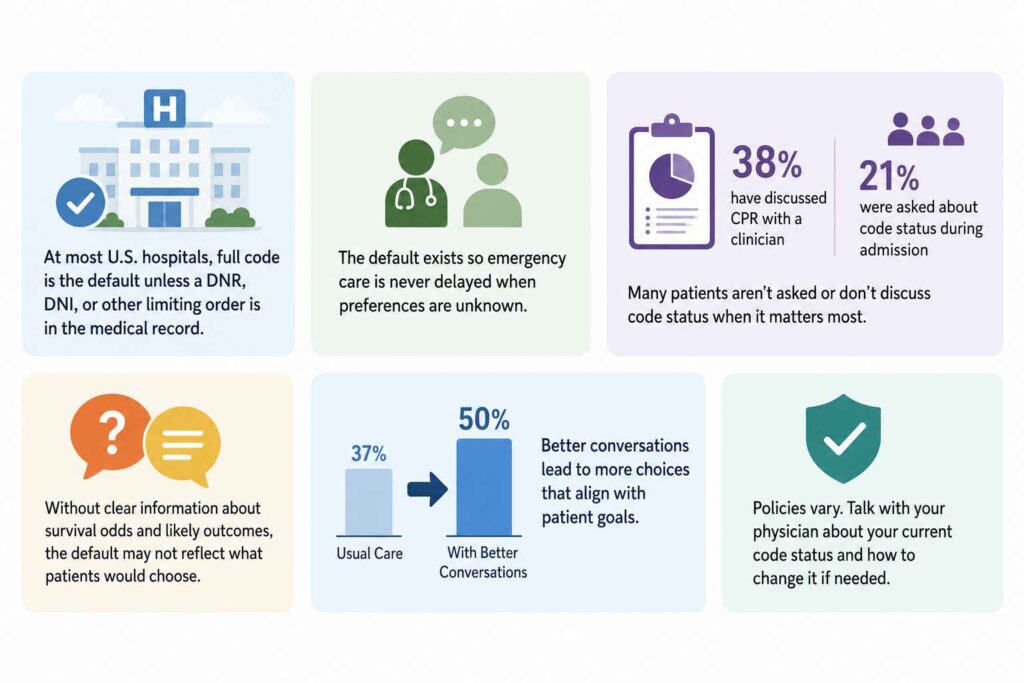
A 2025 randomized trial published in NEJM Evidence tested structured shared decision-making during code status conversations.
Documented DNR choices rose from 37.2% to 50.0% when clinicians explained expected outcomes clearly (adjusted risk ratio 1.37, 95% CI 1.25-1.50, p < 0.001), and patients reported less decisional uncertainty.
In practice, better conversations change decisions — and hospitals that skip code status discussions may end up performing CPR on patients who would have declined it.
Policies vary by facility, state, and care setting. Patients should ask their physician what their current code status is and how to change it if their goals differ from the default.
What is the difference between full code and Code Blue?
Readers sometimes confuse “full code” with “Code Blue” because both involve the word code in a hospital. They refer to different things.
Full code
Full code is a patient’s resuscitation status — it tells the care team what to do for that patient during cardiac or respiratory arrest. It is a medical order recorded in the chart.
Code Blue
Code Blue is a hospital emergency alert, not a patient preference. When Code Blue is announced over the PA system, it signals that a patient is experiencing a life-threatening event (usually cardiac or respiratory arrest) and a response team should come immediately with a crash cart, defibrillator, and airway equipment.
Hospital emergency color codes are not universally standardized.
Some regions and hospital associations have recommended standard sets, but meanings can vary by facility. Many systems have moved toward plain-language alerts (announcing “medical emergency” rather than “Code Blue”) to reduce confusion (HASC).
The connection between the two is simple — when a Code Blue is called for a full code patient, the response team attempts resuscitation.
If the patient has a DNR order, the Code Blue response may be modified or not initiated depending on the facility’s protocol.
How is code status documented?
A full code order exists by default in many hospitals, but patients who want something other than full code (or who want to formalize their full code preference) document their wishes through specific legal and medical instruments.
Advance directive
An advance directive is a legal document that records a person’s care preferences for future situations when they cannot speak for themselves.
MedlinePlus defines advance directives as legal documents that tell providers and others what care a person agrees to or declines in advance (MedlinePlus). Living wills and healthcare powers of attorney are both types of advance directives.
Living will
A living will specifies which medical treatments the person does or does not want if they become unable to communicate. It may address CPR, ventilators, tube feeding, dialysis, and other interventions.
Healthcare power of attorney
Also called a healthcare proxy, a healthcare power of attorney names someone to make medical decisions on the patient’s behalf if the patient loses decision-making capacity.
The person chosen becomes the surrogate decision-maker and can accept or refuse treatments — including resuscitation — according to the patient’s known values.
POLST, MOLST, or POST
POLST (Physician Orders for Life-Sustaining Treatment) and similar forms (MOLST, POST, depending on the state) are portable medical orders designed for people with serious illness or frailty.
Merck notes that POLST differs from advance directives because it is a medical order focused on a current condition rather than a future hypothetical (Merck Manuals).
POLST forms are signed by a clinician and are meant to travel with the patient between care settings. Form names and legal requirements differ by state.
What questions should you ask before choosing code status?
Deciding on full code, DNR, or DNI is not a one-time checkbox — it is a conversation that should happen early and be revisited as health changes. The questions below help patients and families prepare for that conversation with the care team.
Expected outcomes
Ask the physician directly about survival likelihood given the patient’s specific condition, age, and illness burden.
Generic CPR survival numbers (roughly 1 in 4 for in-hospital arrest, roughly 1 in 10 for out-of-hospital arrest) are starting points, not individual predictions.
For surgical patients, a 2025 JAMA Network Open study showed that machine-learning models could predict 30-day mortality after perioperative cardiac arrest with an AUROC of 0.80, suggesting that individualized outcome estimates are becoming more precise (JAMA Network Open, 2025).
Temporary vs. long-term support
If CPR succeeds and the patient needs a ventilator, is mechanical ventilation likely to be temporary (days to weeks with a path to recovery) or potentially indefinite?
The answer shapes whether intubation aligns with the patient’s goals.
Patient values
What does the patient prioritize — more time regardless of condition, avoiding machines, being at home, comfort, or trying every available treatment?
There is no universally “right” code status.
The AMA’s ethics guidance emphasizes respect for patient autonomy, including a patient’s informed decision to refuse resuscitation even when that refusal may result in death (AMA Code of Medical Ethics).
Surrogate decision-maker
Who will speak for the patient if they lose the ability to communicate?
Naming a healthcare proxy in writing — and having a conversation with that person about goals and values — reduces confusion during an emergency.
What does full code look like in real-life situations?
The examples below show how full code status plays out in different clinical contexts. Each one highlights a different layer of the decision.
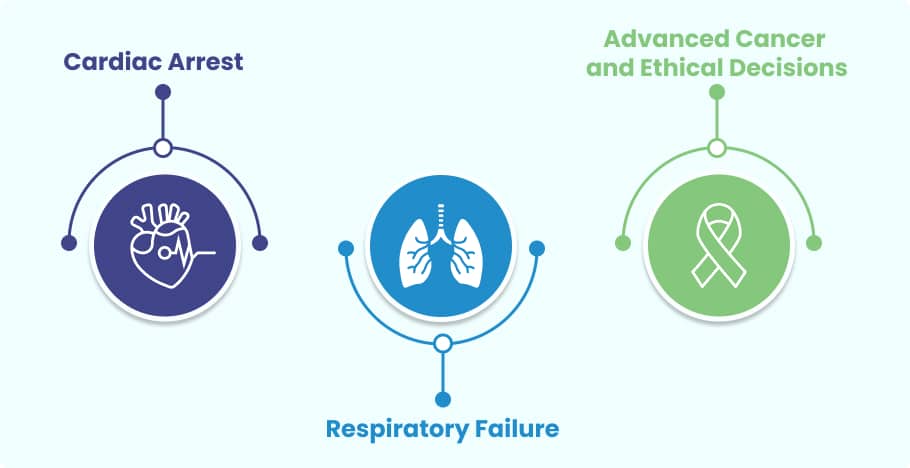
Cardiac arrest
A 68-year-old patient on a medical-surgical floor loses consciousness. The monitor shows ventricular fibrillation — a shockable rhythm.
Because the chart shows full code status, the team calls a Code Blue, begins CPR, and delivers a defibrillator shock.
Epinephrine is given IV per the ACLS algorithm. After several minutes, the patient regains a pulse (ROSC — return of spontaneous circulation) and is transferred to the ICU for post-arrest monitoring and targeted temperature management.
Asystole (a flatline rhythm) is non-shockable. In that scenario, the defibrillator stays ready, but shocks are not delivered until or unless the rhythm changes.
CPR and medications are the primary interventions for asystole under ACLS protocols (AHA ACLS Algorithms).
Respiratory failure
A 54-year-old man with acute pneumonia deteriorates despite oxygen therapy. His oxygen saturation drops critically, and he becomes unresponsive.
His full code status authorizes the team to intubate and connect him to a mechanical ventilator while IV antibiotics and vasopressors treat the underlying infection and support blood pressure.
After several days in the ICU, the infection resolved enough for the patient to be extubated and weaned off the ventilator.
Respiratory arrest and cardiac arrest are related but not identical. For a full code patient whose breathing stops but who still has a pulse, airway and ventilatory support come first — chest compressions begin only if the pulse is also lost.
Advanced illness
An 82-year-old woman with advanced metastatic cancer is admitted with worsening shortness of breath. She has maintained a full code status. When her breathing fails, the team begins CPR and ventilator support per her documented code status.
After resuscitation, she remains dependent on life support.
Following a goals-of-care conversation with the patient’s family and palliative care team, her code status is changed to DNR to prioritize comfort and dignity.
A change from full code to DNR should reflect the patient’s own decision when they have capacity, or an authorized surrogate’s decision under applicable law if the patient cannot speak for themselves.
A physician, nurse practitioner, or other authorized clinician (depending on jurisdiction) signs and records the new order.
What are common misconceptions about full code?
Several misunderstandings about code status lead to confusion during emergencies and can affect billing documentation.
“Every treatment in every situation”
Full code applies specifically to cardiac and respiratory arrest. It does not automatically authorize every medical intervention in every emergency.
A patient can be full code and still have documented preferences about other treatments.
The phrase “every possible life-saving measure” (common in patient-facing explanations) is imprecise — “all medically appropriate resuscitation measures during cardiac or respiratory arrest” is more accurate.
“DNR means do not treat”
A DNR order limits CPR during cardiac or respiratory arrest.
It does not stop routine care, comfort measures, antibiotics, IV fluids, oxygen, pain management, or surgical treatment unless the patient’s other orders limit those separately.
“Code status is permanent”
A patient with decision-making capacity can revisit code status with the care team at any time — especially after a new diagnosis, before surgery, or when health goals shift.
When the patient cannot speak for themselves, a legally authorized surrogate may change the order where state law permits (familydoctor.org).
“CPR usually works”
Stating that “CPR is one of the most effective life-saving techniques” overstates the evidence. CPR can save lives, particularly in witnessed arrests with shockable rhythms and rapid defibrillation.
But survival depends on the arrest setting, cause, rhythm, timing, patient condition, and quality of the response team.
A 2024 study found that hospitals with specialized code teams had higher survival to discharge (7.6%) than those relying on ward-team response alone (1.9%), showing that outcomes are system-dependent, not just patient-dependent (PLOS One, 2024).
How should resuscitation events be billed and documented?
For healthcare providers and billing teams, accurate documentation of full code events directly affects reimbursement, compliance, and audit outcomes.
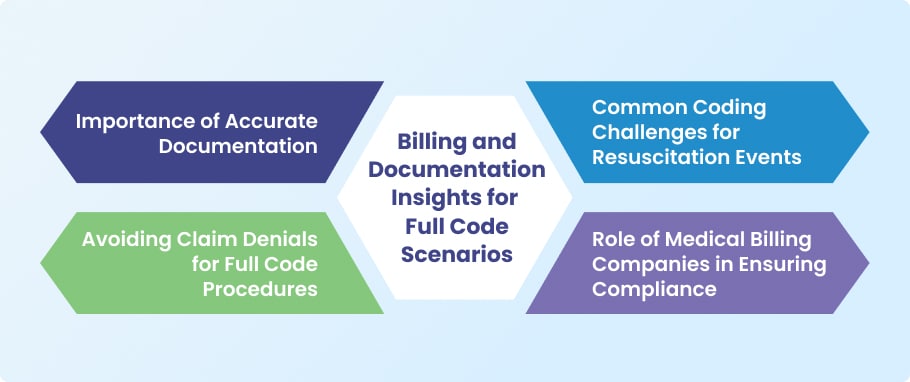
The billing side of code status is where clinical documentation meets revenue cycle management.
Documentation requirements
Thorough documentation during and after a resuscitation event supports accurate coding and defends against claim denials. The medical record should capture specific details.
- Patient response and outcome
- Names and roles of clinicians involved
- Clinical circumstances leading to the arrest
- Medications given, with route (IV/IO) and timing
- Date, time, and duration of the arrest and interventions
- Whether resuscitation time was separate from critical care time
- Specific procedures performed (CPR, intubation, defibrillation, central line)
Documentation supports accurate code selection — but it does not guarantee reimbursement. Payment depends on payer policy, coverage rules, medical necessity review, and National Correct Coding Initiative (NCCI) edits (CMS NCCI Policy Manual).
Common CPT codes
The table below summarizes frequently used CPT codes in resuscitation billing. Each code has specific documentation and reporting requirements that vary by payer.
| CPT code | Service | Billing notes |
| 92950 | Cardiopulmonary resuscitation | CPR time cannot be counted toward critical care time. Report for CPR services performed. |
| 31500 | Emergency endotracheal intubation | Requires documentation of the clinical need for intubation and who performed it. |
| 99291-99292 | Critical care (first 74 minutes and each additional 30 minutes) | Time-based. Exclude time spent performing separately billable procedures like CPR. |
| 94002-94004 | Ventilator management | Medicare contractors have stated these are not separately payable from E/M codes (including critical care) for the same provider, same patient, same date of service. |
| 36556 | Central venous catheter insertion | Document medical necessity and the clinical context for placement. |
Common billing errors
Resuscitation billing creates frequent compliance friction because multiple procedures overlap in time. Errors that trigger denials or audit flags include the following.
- Counting CPR time toward critical care time (the two must be separated)
- Failing to document who performed each procedure (physician vs. nursing staff)
- Submitting CPT 92950 without documenting CPR duration and patient response
- Using ICD-10 code I46.9 (cardiac arrest, cause unspecified) when the cause is documented and a more specific code applies
- Billing ventilator management codes (94002-94004) alongside critical care without checking payer-specific rules — Medicare guidance says modifier 25 does not apply when those codes are not separately payable from E/M services (Noridian Medicare)
Diagnosis coding
I46.9 (cardiac arrest, cause unspecified) is commonly used as the primary diagnosis for resuscitation events.
When the cause or precipitating condition is identified — myocardial infarction, respiratory failure, sepsis, arrhythmia — a more specific diagnosis code should be listed as primary, with I46.9 listed as a supporting code when appropriate (CMS).
Focus points
For most practices, the highest-risk areas in resuscitation billing come down to three things.
Time separation
CPR minutes and critical care minutes must be tracked and reported independently
Procedure-level documentation
Capturing who did what, for how long, and under what clinical circumstances
Payer-specific rules
Checking whether bundling edits or LCD/NCD restrictions apply before submitting claims
Practices that handle high-acuity patients or run frequent code events benefit from periodic billing audits of resuscitation claims, with attention to payer-specific NCCI edits and modifier requirements (ACEP Critical Care FAQ).
When should you talk to a doctor about code status?
Code status is not a permanent label. It should be part of an ongoing conversation, especially at certain inflection points.
- During hospital admission
- After a new serious diagnosis
- Before surgery or major procedures
- When recovery is no longer expected
- When health goals or personal values shift
- When preparing or updating advance directives
For providers, starting code-status conversations early — ideally during admission, not during an emergency — leads to better documentation, fewer ethical conflicts, and care that more accurately reflects patients’ wishes.
Related guides & resources
The resources below cover closely related topics and the broader service workflow they connect to:
- Hospital billing services — Hospital billing services
- Hospital billing guide — How Does Hospital Billing Work: Process, Forms, & Reimbursement
- Medical billing — Beginner’s Guide to Medical Billing and Coding
- Place of service codes — Place of Service Codes in Medical Billing: CMS POS List, Telehealth & Reimbursement Guide
- Emergency room billing explained — Emergency Room Billing 2026: Claims, Coding & Payment
Frequently asked questions
Here are some commonly asked questions about this topic:
Being full code means the medical team should attempt all appropriate resuscitation measures if a patient’s heart stops or breathing fails. The response typically includes CPR, defibrillation (when the heart rhythm allows it), endotracheal intubation, mechanical ventilation, emergency medications given IV or IO, and advanced cardiac life support protocols. Full code is a resuscitation order, not a guarantee of survival. AHA data puts adult in-hospital cardiac arrest survival to discharge near 23.6%, and the outcome depends heavily on the arrest cause, timing, patient condition, and the quality of the response team.
No. Full code and DNR are opposite positions on the same decision. Full code means resuscitation should be attempted during cardiac or respiratory arrest. DNR (Do Not Resuscitate) means CPR should not be performed if the heart or breathing stops. A DNR order does not automatically stop other treatments — patients with DNR orders commonly still receive antibiotics, oxygen, IV fluids, pain management, and routine medical care unless their care plan restricts those separately.
In most U.S. hospitals, patients are treated as full code unless a different code status order is documented. The default is meant to prevent delays when a patient’s preferences are unknown. However, policies vary by facility and state, and the default may not match what a patient would choose after a clear conversation about expected outcomes. Patients and families should ask the medical team about their current code status and discuss whether it reflects their actual goals.
Full code authorizes all appropriate resuscitation efforts during cardiac or respiratory arrest. DNR means CPR should not be performed during arrest. DNI means Do Not Intubate — a breathing tube should not be placed. A patient can have DNI without DNR (meaning CPR is allowed, but intubation is not), though combining them can create practical tension since effective CPR often requires airway management. Each order should be discussed and documented clearly to avoid conflicting instructions during an emergency.
It can. Full code may result in temporary life support — intubation and mechanical ventilation — if the patient cannot breathe independently after resuscitation. Whether that life support is temporary or long-term depends on the underlying condition, the patient’s response to treatment, and the clinical trajectory afterward. Patients who want to avoid long-term mechanical ventilation should discuss specific preferences with their doctor, separate from the full code decision.
In most cases, yes. A patient with decision-making capacity can discuss changing code status with their physician at any time. If the patient lacks capacity, a legally authorized decision-maker (such as a healthcare proxy or surrogate) may request the change under applicable state law. The new order must be signed by an authorized clinician and recorded in the medical record to take effect.
There is no single best code status for every patient. Full code may be appropriate when the patient’s condition is reversible, and resuscitation has a reasonable chance of meaningful recovery. For patients with advanced illness, multiple organ failure, or terminal diagnoses, CPR may offer limited benefit and could add to suffering. The safest path is an honest conversation with a physician who understands the patient’s condition, expected outcomes, and personal values.
Yes. A DNR order applies to CPR during cardiac or respiratory arrest. It does not automatically restrict other medical treatments. Many patients with DNR orders still receive surgery, antibiotics, blood transfusions, dialysis, oxygen therapy, wound care, and comfort measures — depending on their care plan and documented preferences. DNR means “do not perform CPR,” not “do not treat.”