
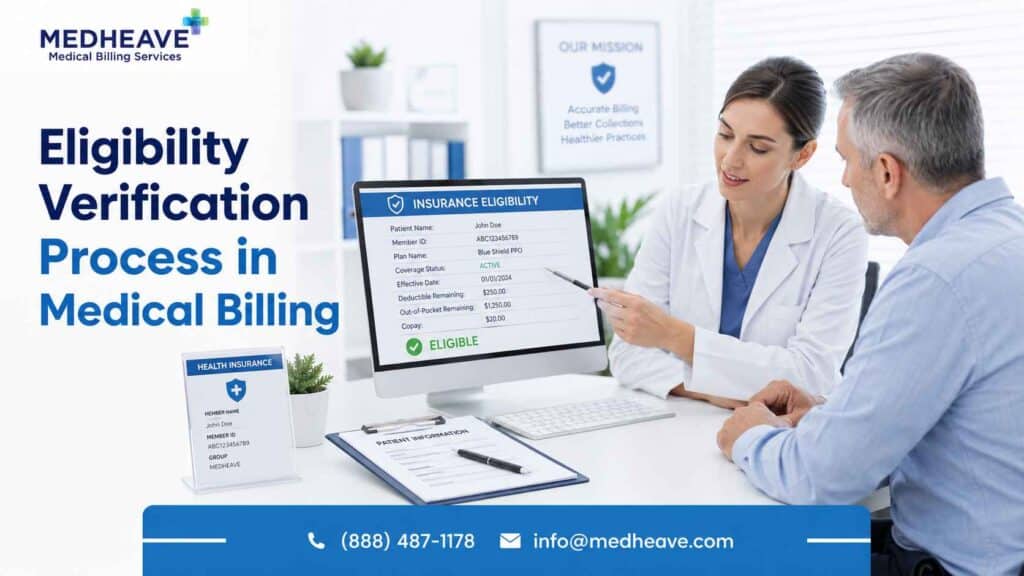
Eligibility verification process in medical billing is a structured pre-service workflow that confirms a patient’s insurance coverage before care is delivered.
When done consistently, it prevents the majority of front-end claim denials and protects practice revenue.
According to Optum, eligibility and registration errors account for 24% of all claim denials.
It is the single largest denial category, ahead of authorization failures, documentation gaps, and medical necessity disputes combined.
However, most of them are entirely preventable.
This guide gives front-desk supervisors, billing specialists, and practice administrators the workflow to make that happen.
Eligibility verification vs. benefits verification vs. prior authorization
These are three distinct processes.
Unfortunately, these three terms are frequently confused and that costs practices’ money. Each process answers a different question, happens at a different point, and prevents a different type of denial.
| Process | What it confirms | When it happens | Denial it prevents |
| Eligibility verification | Active coverage, policy status, payer, plan type, network status | At scheduling; 48-72 hours before visit | CO-177 (inactive coverage), CO-22 (wrong payer) |
| Benefits verification | Copay, deductible, coinsurance, OOP max, visit limits, exclusions | After eligibility is confirmed; before service | CO-96 (non-covered service), CO-204 (benefit limitation) |
| Prior authorization | Payer approval for a specific service or procedure based on medical necessity | Before scheduling or performing the service | CO-197 (missing authorization) |
| Referral | PCP or specialist approval required by the plan before a patient sees another provider | At scheduling, before the appointment | CO-96/CO-97 (service requires referral; not obtained) |
The eligibility verification process: step by step
The eligibility verification process follows seven defined steps. They include:
- Collecting patient and insurance data
- Confirming active coverage
- Verifying service-specific benefits
- Checking authorization and referral requirements
- Estimating patient responsibility
- Documenting all findings
- Reverifying when circumstances change
The insurance verification process in medical billing should follow a consistent phased workflow. Each step below is discrete, documentable, and assignable. Together, they form a clean claim.
Step 1: Collect patient and insurance information
It begins with scheduling, and incomplete data at intake creates every problem that follows. Collect all required fields for medical insurance eligibility verification before confirming the appointment.
| Data Category | Required Fields |
| Patient Demographics | Legal name, date of birth, address, phone number |
| Insurance Card (Front) | Member ID, group number, payer name, plan name |
| Insurance Card (Back) | Claims address, customer service phone, preauthorization line |
| Subscriber Information | Subscriber name, DOB, relationship to patient (self/spouse/dependent) |
| Secondary Coverage | Secondary payer name, member ID, group number (if applicable) |
| Visit Information | Reason for visit, anticipated procedure/service, date of service |
Scan both sides of the insurance card. Never rely on information from a previous visit. Plans change, employers change, and coverage lapses without notice.
Step 2: Confirm active coverage and plan details
Verify that the policy is currently active for the scheduled date of service. Confirm the following:
- Coverage status: Active, inactive, or terminated
- Effective and termination dates
- Plan type: HMO, PPO, EPO, HDHP, or Medicaid/Medicare
- In-network status for the rendering provider and facility
- Coordination of benefits (identify whether another payer is primary)
A policy that was active at the last visit may no longer be active. Always verify coverage for the specific date of service, not the last date of service.
Step 3: Verify service-specific benefits
Once active coverage is confirmed, drill into the benefits verification in medical billing layer. Collect the following for the specific service type being rendered:
- Copayment amount for the applicable service category (primary care, specialist, urgent care)
- Deductible is the annual amount and amount remaining
- Coinsurance percentage after deductible
- Out-of-pocket maximum is the individual and family totals, and amounts remaining
- Visit limits and frequency restrictions (especially for PT, chiropractic, and behavioral health)
- Benefit limitations or exclusions relevant to the planned service
Document exact dollar amounts where available. Ranges and approximations lead to inaccurate patient estimates and collection problems at checkout.
Step 4: Check prior authorization and referral requirements
Flag every service that requires payer approval before it is rendered. This step is non-negotiable.
The AMA has reported that 93% of physicians say prior authorization delays access to necessary care. According to KFF analysis, approximately 9% of claim denials in Medicare Advantage cite missing or invalid authorization. Preventing those denials begins from here.
For each service, verify:
- Whether a prior authorization is required
- Whether a referral is required (HMO plans, especially)
- The authorization number if already obtained, and its effective dates and approved units
- Whether the authorization covers the planned place of service (e.g., office vs. outpatient facility)
If authorization has not been obtained, do not schedule the service until it is. Retroactive authorization is not guaranteed and is increasingly rare.
Step 5: Estimate patient responsibility and communicate it
Calculate the expected patient responsibility before the appointment. Use deductible remaining, coinsurance rate, and copay amounts confirmed in Step 3.
Then communicate that estimate clearly. The following script gives front-desk staff a consistent, compliant approach:
Suggested staff script: “Based on the insurance information we have on file, your estimated responsibility for today’s visit is [AMOUNT]. This includes your [copay/remaining deductible/coinsurance]. This is an estimate; your final balance will be confirmed once the claim is processed. Do you have any questions before your appointment?”
Collecting copays and known patient balances at or before the time of service significantly reduces post-service collection costs.
Practices that communicate patient estimates proactively report higher point-of-service collection rates.
Step 6: Document verification results
Every verification call, portal query, or electronic transaction must be documented.
Without a clear audit trail, you cannot dispute a denial, recover lost claims, or demonstrate due diligence during a payer audit.
| Documentation Field | What to Record |
| Verification Date & Time | Date and time the verification was completed |
| Verification Source | Phone call, payer portal, clearinghouse, EHR integration |
| Call Reference Number | Confirmation or reference number from payer representative |
| Coverage Confirmed | Policy active: Yes/No; Effective date; Termination date |
| Benefits Confirmed | Copay, deductible, coinsurance, OOP max, visit limits |
| Auth/Referral Status | Required: Yes/No; Auth number; Approved dates/units |
| Staff Initials | Staff member who completed verification |
Store verification documentation in the patient’s account within your EHR or practice management system. Attach notes directly to the appointment when possible.
Step 7: Recheck before the visit when needed
A single verification at scheduling is not always sufficient. Reverify when any of the following apply:
- The appointment was rescheduled
- The service is high-cost or requires authorization
- The patient is new to your practice
- The patient is on Medicaid, Marketplace, or a plan known for frequent eligibility changes
- The patient reports a change in coverage, employer, or life event (marriage, job change)
- More than 30 days have passed since the initial verification
Optum data shows that 44% of denials originate at the front end of the revenue cycle, at scheduling, registration, and pre-service verification. Reverification is not redundant; instead, it is protection.
When should eligibility be verified?
Eligibility should be verified at four points: at scheduling, 48 to 72 hours before the visit, on the day of service, and before claim submission.
Timing is as important thoroughness. Use the following framework:
Active coverage, payer, network status, and authorization/referral requirements
Prevents scheduling services that cannot be covered
Full benefits, patient responsibility, and authorization status
Allows time to resolve issues before the appointment
Coverage is still active and no mid-month termination occurred
Catches last-minute coverage lapses or eligibility changes
Correct payer and member ID are on file
Provides a final insurance check before the claim goes out
For high-volume practices, batch eligibility checks 48 to 72 hours before the visit are an efficient way to identify issues across the full appointment schedule, not just individual patients.
How eligibility verification prevents claim denials?
Eligibility verification prevents claim denials by catching the most common front-end errors before a claim is ever submitted:
- Inactive coverage
- Wrong payer data
- Missing authorization
- Non-covered services
- Incomplete patient information
The connection between eligibility verification errors and specific denial codes is direct. Understanding the mapping helps billing teams prioritize what to catch and what to fix.
According to Experian Health research, 50% of claim denials are due to missing or incorrect data. 32% are attributed specifically to registration and eligibility errors. The table below maps common verification failures to the denial codes they produce.
| Verification Failure | Denial Code | Denial Reason | Prevention |
| Inactive or lapsed coverage | CO-177/PR-177 | Coverage not in effect at time of service | Confirm effective dates |
| Wrong payer on file | CO-22/CO-109 | Claim submitted to incorrect payer | Verify payer and member ID at intake |
| Missing prior authorization | CO-197 | Precertification or authorization absent or invalid | Flag auth requirements pre-visit |
| Non-covered service/benefit exclusion | CO-96/CO-204 | Service not covered or not covered for diagnosis | Check exclusions and frequency limits |
| Missing or incorrect patient data | CO-16 | Claim lacks information needed for adjudication | Validate demographics and insurance fields |
A clean claim passes adjudication on the first submission. Consistent pre-visit verification is the single most reliable method for achieving clean claim rates above industry benchmarks.
Common eligibility verification mistakes and how to fix them
The most common eligibility verification mistakes include:
- Using outdated insurance information
- Skipping secondary coverage
- Failing to check authorization requirements
- Not documenting the payer response
Even experienced billing teams repeat the same errors. The following table identifies the most common eligibility verification errors, their downstream impacts, and the corresponding operational fixes.
| Mistake | Impact | Fix |
| Using an old insurance card without re-verifying | Wrong payer, wrong member ID, denied claim | Require card scan at every visit. Never reuse previous visit data without confirming it is current. |
| Misspelled or transposed patient name | CO-16 denial, claim lacks required information | Cross-check name against government-issued ID. Correct in EHR before claim is created. |
| Skipping secondary insurance | Missed coordination of benefits; unpaid secondary balance | Ask at every visit whether the patient has secondary coverage. Document subscriber and plan details. |
| Not documenting the payer response | No audit trail to dispute a denial | Record reference number, benefits confirmed, staff initials, and date in the patient account. |
| Ignoring authorization requirements | CO-197 denial; retroactive auth often unavailable | Build auth check into verification workflow. Do not schedule until auth status is confirmed. |
| Assuming last visit’s coverage is still active | Claim submitted to terminated or changed plan | Reverify at every scheduling event. Coverage changes without patient notification. |
Source: Experian Health reports that 32% of claim denials are attributed directly to registration and eligibility data errors, nearly all of which appear in this list.
Manual vs. automated eligibility verification
Both manual and automated verification methods are valid, and most practices use a combination of both.
The right approach depends on patient volume, payer mix, and EHR capabilities. Automation improves speed and scale; manual review remains essential for complex cases.
How a practice runs health insurance eligibility verification depends on volume, EHR capabilities, and payer mix. The table below compares common methods.
| Method | How It Works | Strengths | Limitations |
| Phone Call | Staff calls payer IVR or representative directly | Useful for complex cases; allows real-time follow-up questions | Time-intensive; no documentation unless staff records it manually |
| Payer Portal | Staff logs into payer website to check status | More reliable than phone; displays current benefits | Requires separate login per payer; not scalable for large volumes |
| Clearinghouse | EDI 270/271 transactions submitted electronically | Batch processing; integrates with PMS/EHR; fast turnaround | Responses vary by payer; benefit detail may be limited |
| EHR/RCM Integration | Automated eligibility checks triggered within EHR workflow | Seamless; reduces manual steps; built into scheduling workflow | Quality depends on EHR vendor and payer connectivity |
| Real-Time Eligibility Software | Dedicated real-time eligibility verification tools pulling live payer data | Fast, scalable, high response-rate; supports batch eligibility | Requires integration setup; adds to operational cos |
Important: Automation accelerates verification; it does not replace judgment. Coordination of benefits disputes, unusual benefit structures, Medicaid managed care variations, and ambiguous payer responses still require staff review. CAQH estimates over $15 billion in annual savings opportunity from fully electronic eligibility transactions, yet CAQH also reports 96% electronic adoption alongside persistently high denial rates. The data is clear: technology improves throughput; process ensures accuracy.
Eligibility verification by service type
Verification requirements vary by service type.
Physical therapy carries visit limits and authorization thresholds. Imaging often requires prior auth and place-of-service confirmation.
Behavioral health benefits frequently operate under a separate payer.
Different service types carry different verification requirements. A one-size-fits-all checklist misses the nuances that drive service-specific denials.
Primary care
Confirm copay tier for office visits (preventive vs. problem-focused), deductible status, and whether a referral is required for specialist services discussed during the visit.
For HMO patients, confirm that the rendering provider is the assigned PCP.
Physical therapy
PT benefits are among the most restricted.
Confirm annual or per-episode visit limits, whether prior authorization is required after a set number of visits, and whether a physician referral is required before therapy begins.
Frequency limits reset annually, verify the plan year start date, not the calendar year.
Imaging and radiology
Many payers require prior auth for advanced imaging (MRI, CT, PET). Confirm place of service requirements: some payers mandate outpatient facility over office-based imaging.
Verify that the imaging center is in-network, as the facility network status is separate from physician network status.
Surgery
Surgical cases require the most thorough verification.
Confirm deductible remaining (surgery often fully applies), auth status for both the procedure and facility, in-network status of the surgeon and the facility (both must be verified separately), and whether assistant surgeon or anesthesia benefits are covered.
Behavioral health
Behavioral health benefits are frequently carved out to a separate managed care organization. Verify the correct behavioral health payer independently from the medical plan.
Confirm session limits, whether real-time eligibility verification tools support the behavioral health payer, and whether the provider is in the behavioral health network (which may differ from the medical network).
Staff checklist for eligibility verification
This checklist covers every required data field, timing checkpoint, documentation step, and escalation trigger for the complete eligibility verification process in medical billing.
It is designed to be handed directly to front-desk staff and billing coordinators as a daily operational reference.
Use the checklist below as a daily operational reference. It is designed for front-desk staff, billing coordinators, and anyone responsible for insurance verification training at your practice.
A downloadable PDF version is available, you can contact MedHeave to request it.
| ELIGIBILITY VERIFICATION CHECKLIST – MedHeave |
| SECTION A: DATA COLLECTION (At Scheduling) |
| ☐ Obtained legal name (matches government ID) |
| ☐ Confirmed date of birth |
| ☐ Collected member ID and group number from insurance card |
| ☐ Identified payer name and plan type |
| ☐ Confirmed subscriber name and relationship to patient |
| ☐ Asked about secondary insurance and documented if applicable |
| ☐ Documented reason for visit and anticipated service |
| SECTION B: COVERAGE VERIFICATION (48 to 72 Hours Before Visit) |
| ☐ Confirmed coverage is active for the date of service |
| ☐ Verified effective date and termination date |
| ☐ Confirmed plan type and in-network status |
| ☐ Verified copay amount for applicable service category |
| ☐ Verified deductible amount and remaining balance |
| ☐ Verified coinsurance percentage |
| ☐ Verified out-of-pocket maximum and remaining balance |
| ☐ Checked visit limits and frequency restrictions |
| ☐ Identified any benefit exclusions relevant to the service |
| SECTION C: AUTHORIZATION & REFERRAL |
| ☐ Determined whether prior authorization is required |
| ☐ Determined whether a referral is required |
| ☐ Confirmed authorization number and valid dates/units (if applicable) |
| ☐ Confirmed place of service matches authorization (if applicable) |
| SECTION D: DOCUMENTATION |
| ☐ Recorded verification date, time, and source |
| ☐ Documented call reference number (if phone verification) |
| ☐ Entered benefits confirmed in patient account/HER |
| ☐ Noted auth/referral status and details |
| ☐ Added staff initials to verification record |
| ☐ Communicated patient estimate to patient or scheduling team |
| SECTION E: ESCALATION – Reverify When Any Apply |
| ☐ Appointment was rescheduled from original date |
| ☐ High-cost service or surgical procedure |
| ☐ Patient is new to the practice |
| ☐ Patient is on Medicaid, Marketplace, or high-change plan |
| ☐ Patient reported a coverage or life change |
| ☐ More than 30 days have elapsed since initial verification |
Is your practice still losing revenue to preventable eligibility denials?
MedHeave helps small and mid-size practices build clean verification workflows, reduce front-end denials, and recover revenue faster.
Our team specializes in eligibility verification services, denial prevention, and full-cycle revenue cycle management.
Contact MedHeave to request a free denial analysis and downloadable eligibility verification checklist PDF for your team.
Frequently asked questions
Here are some commonly asked questions on this topic:
Eligibility verification in medical billing is the pre-service process of confirming that a patient’s insurance coverage is active, applicable to the scheduled service, and correctly documented in the practice management system. It includes confirming plan type, network status, benefits, cost-sharing, and any authorization requirements.
The core steps in the eligibility and benefits verification process in medical billing include collecting patient and insurance information; confirming active coverage and plan details; verifying service-specific benefits; checking prior authorization and referral requirements; estimating and communicating patient responsibility; documenting verification results; and (7) re-verifying when indicated.
No. Eligibility verification confirms that a patient has active coverage with a specific payer. Prior authorization is a separate payer approval confirming that a specific service is medically necessary and covered under the plan. Both are required where applicable, one does not substitute for the other.
Verification should occur at scheduling, again 48 to 72 hours before the appointment, and on the day of service for high-risk or changed-coverage cases. For claim accuracy, a final check should be performed before claim submission to confirm the correct payer and member ID are on file.
Pre-service how to verify insurance eligibility and benefits workflow prevents the five most common denial triggers: inactive coverage, wrong payer on file, non-covered services, missing or invalid authorization, and missing or incorrect patient data. According to Optum, eligibility and registration errors account for 24% of all denials, more than any other single category.
Yes. Real-time eligibility verification is available through clearinghouses (EDI 270/271 transactions), EHR-integrated eligibility tools, and dedicated revenue cycle platforms. Automation handles high-volume routine checks efficiently. Complex cases, including coordination of benefits disputes, behavioral health carve-outs, and unusual plan structures, still require staff review.

