
An EMR stores a patient’s chart inside one practice. An EHR is built to share that same information across every provider, hospital, and pharmacy involved in a patient’s care.
The difference sounds small on paper, but it determines whether your billing team can pull payer eligibility data automatically, whether your specialists see a complete clinical picture, and whether your practice meets CMS quality reporting requirements that assume interoperability.
In this guide, we’ll go through the practical differences between EHR and EMR systems.
- How your system choice affects the revenue cycle
- The regulatory context that pushes toward EHR adoption
- How to evaluate vendors and plan an implementation that doesn’t stall
- What EHR interoperability actually enables for billing and care coordination
- Where EMRs still make sense (and the tradeoff you’re accepting)
- What separates EMR from EHR at the functional level
TLDR: EHR versus EMR
- EMRs are digital charts for use within a single organization
- EHRs are interoperable records built to exchange data across providers, labs, pharmacies, and payers
- Most CMS quality and interoperability programs now assume EHR-level functionality
- Solo practices with no outside referrals can sometimes get by on an EMR
- Multi-provider groups and value-based care participants need EHR interoperability
- HL7 and FHIR are the technical standards behind data exchange
- Software supports HIPAA compliance features, but compliance itself is organizational — no system delivers it automatically
What separates an EMR from an EHR?
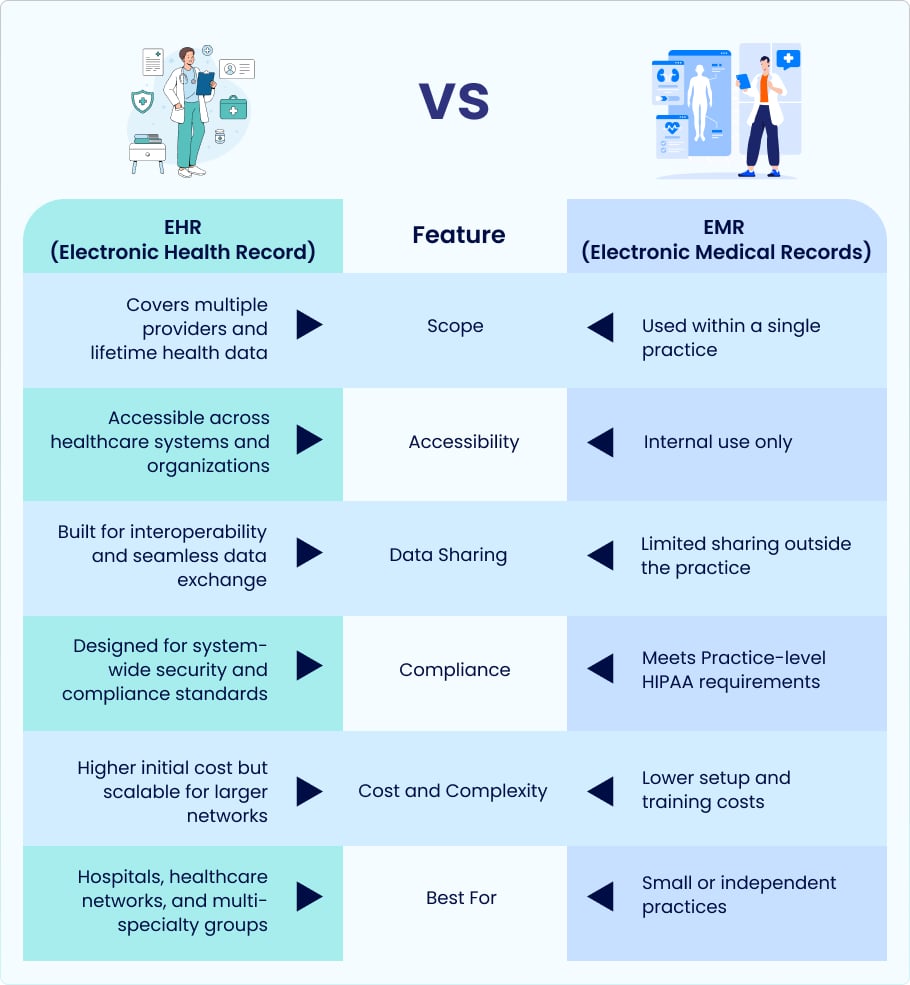
Both digitize the paper chart, but they’re built for different scopes of use — and that scope difference cascades into billing, compliance, and care coordination.
| Category | EMR | EHR |
| Scope | Single practice | Multiple providers and organizations |
| Data sharing | Limited | Built for exchange (HL7/FHIR) |
| Patient portal | Sometimes | Common |
| Population health analytics | Limited | Supported |
| Quality reporting (MIPS, PI) | Limited | Supported |
| Typical cost | Lower | Higher |
The table covers the functional differences. What it doesn’t show is which system actually fits your practice — and that depends more on referral patterns and payer participation than on features alone.
Where do EMRs still make sense?
An EMR isn’t obsolete — it’s a reasonable fit for a specific, narrower situation where the practice operates largely self-contained.
The EMR use case
- Simpler implementation and staff training
- Lower upfront and ongoing software costs
- Solo or small-group practices with minimal outside referrals
- Practices that don’t participate in MIPS, value-based care, or quality reporting programs
The tradeoff
The limitation isn’t a bug — it’s the design.
- Records generally stay within your organization
- Quality reporting and population health tools are typically limited
- Revenue cycle integration (eligibility, claims, ERA posting) may be thinner
- Coordinating care with outside specialists requires manual export or faxing
For most practices, the question isn’t whether an EMR works — it does, within its scope.
The question is whether the practice’s referral patterns, payer requirements, and growth trajectory will outgrow that scope within the next 3-5 years. Migrating from EMR to EHR mid-growth is more disruptive and expensive than starting with the right system.
What does EHR interoperability actually enable?
Interoperability is the feature that justifies an EHR’s higher cost — and it runs on specific technical standards worth knowing by name.
Data exchange standards
HL7 and FHIR aren’t marketing terms — they’re the protocols that make cross-system exchange possible.
- HL7 handles structured messaging between systems
- FHIR enables modern, API-based exchange and is increasingly the standard for new integrations
- Certified EHR technology (CEHRT) is built to meet ONC interoperability requirements
Revenue cycle integration
Interoperability isn’t just clinical — it touches billing directly.
- Lab, pharmacy, and imaging integration reduces duplicate data entry
- Eligibility verification can pull payer data automatically through the EHR
- Many EHR platforms include or connect to revenue cycle management modules
- ERA (Electronic Remittance Advice) posting can flow back into the system automatically
Care coordination
- Discharge summaries route automatically from hospital to PCP
- Medication lists stay current across prescribers and pharmacies
- Specialists receive complete clinical context before the patient arrives
What regulatory context shapes the decision?
Federal policy has pushed toward interoperable systems for over a decade, and the requirements affect which platform clears compliance for certain programs.
Promoting Interoperability Program
The original “Meaningful Use” incentive program evolved into CMS’s Promoting Interoperability Program. MIPS and value-based reporting generally require certified EHR technology — a standalone EMR typically can’t satisfy those requirements.
21st Century Cures Act
The Cures Act requires timely patient electronic access to their health information and restricts information blocking. Practices using systems that can’t share data electronically may face compliance exposure as enforcement evolves.
HIPAA and system claims
One caution worth naming directly — software can support HIPAA compliance features (encryption, access controls, audit trails), but compliance itself is an organizational responsibility. No system delivers HIPAA compliance automatically regardless of vendor marketing claims.
How do you evaluate vendors and plan implementation?
The system itself affects outcomes less than whether the practice actually uses it as designed — which is where most implementations succeed or stall.
Vendor evaluation
- Migration support for existing patient data
- Specialty-specific templates and workflows
- Interoperability with your referral network’s systems
- Billing module integration (or clearinghouse connectivity)
- Total cost including training, maintenance, and interface fees
Implementation planning
Most EHR rollout problems come from underestimating these steps, not from picking the wrong vendor.
- Staff training time before go-live (not during)
- Data migration accuracy from the legacy system
- A plan for the first few weeks of reduced productivity
- A realistic timeline that doesn’t assume zero disruption
- Testing of billing workflows (eligibility, claims, ERA) before full launch
How does the system choice affect your revenue cycle?
The billing connection between EHR/EMR and revenue cycle performance is more direct than most practices realize. A certified EHR with integrated billing modules can automate eligibility checks, pre-populate charge entry fields, and route ERA payments back into the patient account — all of which reduce manual steps and the errors they introduce.
An EMR without those integrations adds manual steps at every handoff between clinical documentation and billing. Charge entry happens separately.
Eligibility is checked in a different system. ERA posting requires manual reconciliation. Each handoff creates an opportunity for data entry error, delay, and missed revenue.
For practices evaluating the cost difference between EMR and EHR, the revenue cycle efficiency gains from an integrated EHR often offset the higher software cost within the first year — especially when clean claim rate and charge lag improve as a result.
Making sure your EHR data actually reaches billing
A certified EHR only helps your revenue cycle if eligibility, coding, and claims data flow out of it cleanly. The integration exists on paper, but whether it’s configured correctly, tested thoroughly, and maintained over time determines whether it actually reduces denials or just adds another system to troubleshoot.
MedHeave works directly with practices’ existing EHR platforms to make sure that connection is actually working.
- Support during EMR-to-EHR migrations
- Performance-based pricing with no lock-in
- Coding accuracy review regardless of platform
- Eligibility and benefits data pulled directly from your EHR
- Claims workflows built around your system’s existing structure
Contact us if your EHR isn’t translating into cleaner claims or if you’re planning a system migration.
Frequently asked questions
Here are some commonly asked questions on this topic:
An EMR is a digital chart used within one practice — it stores clinical notes, orders, and results for that organization’s patients. An EHR is designed to securely share patient information across multiple providers, hospitals, labs, pharmacies, and payers through interoperability standards like HL7 and FHIR. The practical difference shows up in referral coordination, billing integration, and whether the system satisfies CMS quality reporting requirements that assume cross-system data exchange.
Not simply by upgrading a software label. Moving to EHR-level functionality generally requires a platform built for interoperability and certified under ONC standards (CEHRT). Some EMR vendors offer upgrade paths that add interoperability features, but the migration typically involves data conversion, new interface configuration, staff retraining, and workflow redesign. The cost and disruption of a mid-practice migration is one reason many practices evaluate long-term needs before choosing their initial system.
Not always. A solo practice with minimal outside referrals and no participation in value-based care or MIPS reporting may function adequately on an EMR. However, practices that refer patients to hospitals or specialists, participate in quality reporting programs, or plan to grow beyond a single location typically need EHR-level interoperability. The 21st Century Cures Act’s information-blocking restrictions also create compliance considerations for practices that can’t share data electronically.
Epic is an EHR system built for interoperability across hospitals, specialists, and health systems. It supports HL7/FHIR data exchange, patient portals, population health analytics, and CMS quality reporting. Other major platforms like Cerner (Oracle Health), athenahealth, and eClinicalWorks are also EHR systems with interoperability capabilities. The “EMR vs EHR” label is less important than whether the specific implementation is configured for the data exchange your practice actually needs.
No. HIPAA applies to how organizations handle protected health information regardless of whether the system is labeled EMR or EHR. HIPAA requires safeguards like encryption, access controls, and audit trails — features available in both system types. The regulatory push toward EHR comes from CMS programs (Promoting Interoperability, MIPS) and the 21st Century Cures Act, not from HIPAA itself. Compliance is an organizational responsibility, not something any system delivers automatically.

