
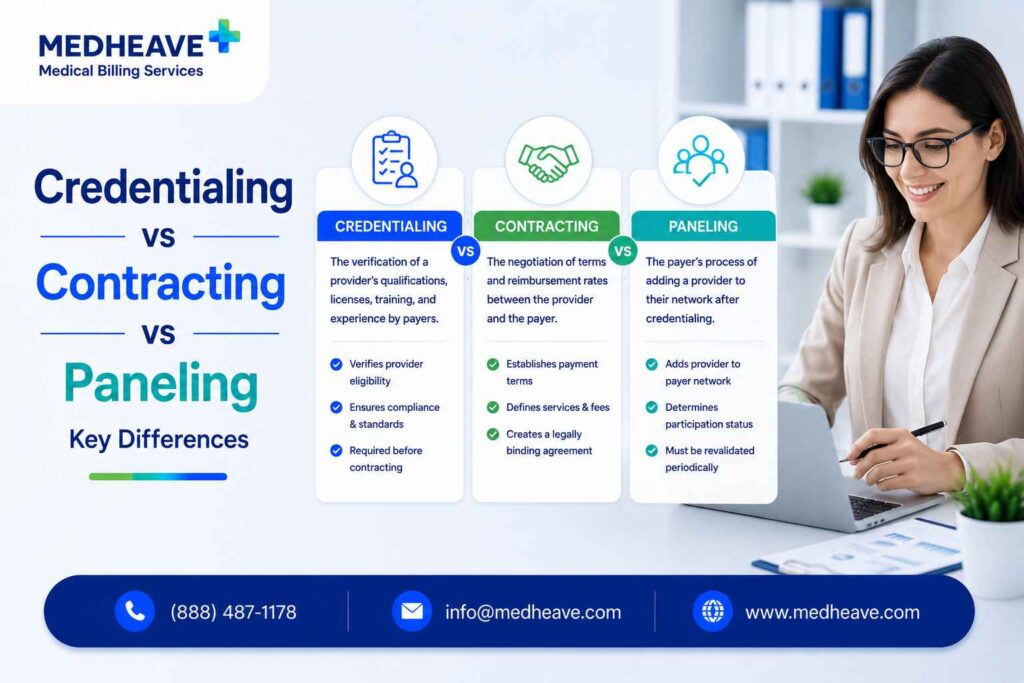
Credentialing, contracting, and paneling are three separate stages of becoming an in-network provider with an insurance company — and confusing them is one of the most common reasons providers experience delayed reimbursements.
Credentialing verifies your qualifications. Contracting sets the payment terms. Paneling activates your network status so claims actually process in-network.
A provider who completes credentialing but hasn’t signed a contract can’t bill at in-network rates. A provider who is credentialed and contracted but not yet paneled won’t appear in the payer’s directory — and claims may still deny.
Let’s explore:
- What each of the three stages actually accomplishes
- Why enrollment and paneling are not the same thing
- The correct sequence and where the process stalls
- Which mistakes cause the most expensive delays
- How long each stage takes by payer type
TLDR: Three stages, one sequence, zero shortcuts
Most reimbursement delays trace back to providers assuming that credentialing alone makes them in-network. It doesn’t.
- Credentialing verifies qualifications (license, education, malpractice, work history) — it answers “is this provider qualified?” but does not establish payment terms
- Contracting establishes the legal agreement between provider and payer — fee schedules, billing rules, timely filing limits, and compliance obligations
- Paneling is the payer’s final activation step — adding the provider to the network directory, enabling in-network claims processing, and setting the participation effective date
- Full network participation commonly takes 60-180+ days across all three stages, with CAQH ProView serving as the central data platform for most commercial credentialing
- Claims submitted before paneling is complete will typically process as out-of-network — even if credentialing and contracting are finished
What does each stage actually do?
The three stages happen in sequence, and each one serves a distinct purpose. Completing one does not automatically trigger the next.
Credentialing
Credentialing is the insurer’s verification process. The payer confirms that the provider holds a valid license, completed appropriate education and training, carries malpractice insurance, has no sanctions or exclusions, and meets the payer’s qualification standards.
Most commercial insurers pull this information from CAQH ProView, which maintains over 4.8 million provider records with approximately 80% of U.S. physicians participating. The credentialing committee reviews the application and either approves, requests additional documentation, or denies.
Credentialing answers one question — is this provider qualified to participate in our network?
It does not establish payment rates, billing rules, or network activation.
Contracting
After credentialing approval, the payer issues a participation agreement. The contract specifies:
- Appeals procedures
- Timely filing deadlines
- Compliance and audit obligations
- Billing and claims submission rules
- Term length and renewal provisions
- Reimbursement rates (fee schedule)
Some payers allow rate negotiation during contracting — particularly for providers in high-demand specialties or underserved geographies. Others use fixed fee schedules with no negotiation.
Contracting answers a different question — under what financial terms will we pay this provider?
A provider can be credentialed (verified) but not yet contracted (no payment agreement). Until the contract is signed, the provider cannot bill at in-network rates.
Paneling
Paneling is the operational activation that follows contracting. The payer loads the provider into its claims processing system, assigns an effective date, adds the provider to its online directory, and enables in-network adjudication.
Paneling is not always automatic or instant after contract signing. Directory updates, claims system loading, and effective-date assignment can take additional weeks.
Providers who assume they’re active the day they sign a contract often discover that claims submitted during this gap process as out-of-network.
Paneling answers the final question — is this provider now live in our network?
| Stage | Purpose | Who decides | Negotiable? | Outcome |
| Credentialing | Verify qualifications | Payer credentialing committee | No | Provider approved or denied |
| Contracting | Set payment terms | Payer + provider | Sometimes | Signed participation agreement |
| Paneling | Activate network status | Payer enrollment team | No | Provider in-network and billable |
Why is the enrollment-to-paneling gap so expensive?
The most common financial mistake is submitting claims before paneling is complete.
A provider who is credentialed and contracted — but whose effective date hasn’t been set or whose directory listing hasn’t been activated — will have claims processed as out-of-network.
Consider a mental health provider generating $8,000 per week in insurance claims. A four-week gap between contract signing and paneling activation represents $32,000 in claims that either process at lower out-of-network rates or get denied entirely.
Some payers allow retroactive effective dates, but many do not — and the appeals process for retroactive adjustments is slow.
This is why tracking paneling completion separately from credentialing and contracting is operationally important.
Many practices track credentialing approval and assume the rest happens automatically. It often doesn’t.
THREE-STAGE SEQUENCE
Credentialing → Contracting → Paneling
Stage 1
Credentialing
“Are you qualified?”
30-120 days
Stage 2
Contracting
“What will we pay you?”
2-8 weeks
Stage 3
Paneling
“You’re now active”
1-8 weeks
How long does each stage take?
Timelines vary by payer, application completeness, and provider type. These are realistic ranges based on industry experience — not guaranteed windows.
| Stage | Typical timeline | Main variable |
| Credentialing | 30-120 days | Application completeness and payer backlog |
| Contracting | 2-8 weeks after credentialing | Whether rates are negotiated or fixed |
| Paneling | 1-8 weeks after contracting | Payer systems and directory update cycles |
| Total (end to end) | 60-180+ days | Multi-payer enrollment adds complexity |
Medicare enrollment through PECOS often adds its own timeline on top of commercial credentialing. Medicaid timelines are state-specific and can range from 30 days to several months depending on the state’s processing capacity.
The fastest path through all three stages requires a complete CAQH profile, all documents gathered in advance, applications submitted to multiple payers simultaneously, and consistent follow-up every two to three weeks.
What mistakes cause the most delays?
The pattern is consistent across specialties — the provider’s qualifications are rarely the problem. The paperwork is.
Incomplete CAQH Profile
Submitting a CAQH profile with missing sections, especially work history gaps or an unsigned attestation.
Expired Credentials
Applying before malpractice insurance is renewed or before a new state license has been issued.
Information Mismatch
Different addresses, name variations, or taxonomy codes between the NPI registry, CAQH profile, and payer applications.
Assuming Paneling Is Automatic
Many payers require separate confirmation after contracting before a provider is added to the participating network.
No Payer Follow-Up
Failing to regularly contact payer credentialing departments while the application is under review.
The NPI-CAQH mismatch issue is particularly common with group practices. An individual provider’s NPI type 1 and the organization’s NPI type 2 serve different purposes — credentialing applications need the correct one for the context, and submitting the wrong type triggers a reprocessing cycle.
Can you be credentialed but not yet paneled?
Yes. And this is the most misunderstood part of the process. A provider can be:
- Credentialed but not contracted (verified, but no payment agreement)
- Credentialed and contracted but not paneled (agreement signed, but network not activated)
- Fully paneled (all three complete — eligible for in-network billing)
Only the third status allows in-network claims processing. Practices that track only credentialing status and assume the rest follows automatically often discover gaps when claims start denying as out-of-network.
Stop losing weeks to credentialing gaps
Every day between a provider’s start date and their network activation is revenue the practice never collects.
MedHeave manages the full credentialing-to-paneling lifecycle for healthcare practices — tracking every application, every follow-up, and every payer deadline so your providers start billing on time.
- CAQH profile management and re-attestation tracking
- Contract review and reimbursement rate analysis before signing
- Dedicated follow-up with payer credentialing departments every two weeks
- Full credentialing management from document collection through network activation
- Performance-based pricing — MedHeave only gets paid when your practice gets paid
Contact MedHeave to get your providers credentialed, contracted, and paneled without the administrative backlog.
Frequently asked questions
Here are the questions providers and practice administrators ask most about credentialing, contracting, and paneling.
Technically, you can submit claims before paneling, but they will typically process as out-of-network. Some payers allow retroactive effective dates (meaning they’ll reprocess claims back to a specified date once paneling is complete), but many do not. The safest approach is to confirm the paneling effective date with the payer before scheduling insured patients under that plan.
Enrollment is the broader administrative process of registering a provider with a payer — it encompasses credentialing, verification, and system setup. Paneling is the specific final step where the payer activates the provider in its network directory and claims system. Enrollment can be “complete” from a credentialing perspective while paneling is still pending, which is why tracking both separately is operationally important.
Most payers require recredentialing every two to three years. CAQH ProView requires profile re-attestation every 120 days. Missing either deadline can interrupt network participation — even for providers who have been in-network for years. Practices should maintain a recredentialing calendar that tracks both CAQH attestation deadlines and individual payer recredentialing cycles.
Negotiation is possible during the contracting phase — not during credentialing. Not all payers negotiate, and many use fixed fee schedules. Your leverage increases with specialized skills, high-demand specialties, geographic scarcity, or a demonstrated patient panel. Even when initial negotiation isn’t possible, many contracts allow rate review requests after 12-24 months of billing history.
Credentialing does not automatically transfer when a provider changes employers. The new organization typically needs to credential the provider under its own group, update the practice location, and complete contracting with each payer. CAQH data carries over (the provider keeps the same profile), which reduces documentation effort, but each payer still runs its own verification.

