

The primary CPT code for a transthoracic echocardiogram is 93306, which covers a complete TTE with 2D imaging, M-mode, spectral Doppler, and color flow Doppler.
Transthoracic echocardiography is a noninvasive cardiac ultrasound technique used to evaluate ventricular function, valvular disease, chamber size, heart failure, and cardiomyopathies — and the CPT code selected on each claim determines reimbursement, Doppler billing rules, and audit exposure.
The American Medical Association maintains the CPT code set, and CMS ties each TTE code to specific documentation and medical necessity requirements.
Below, this guide covers
- 93306, 93307, 93308, and congenital echo codes
- Add-on Doppler codes and when they can and cannot be billed separately
- Modifier 26 vs TC and professional/technical billing
- Documentation requirements that prevent denials
- Medicare coverage rules and real-world coding pitfalls
What are the core TTE CPT codes?
The following CPT codes form the standard transthoracic echocardiography billing family. Each one corresponds to a different scope of study and Doppler inclusion.
| CPT code | Description | Doppler included | Study scope |
| 93306 | Complete TTE with spectral Doppler and color flow Doppler | Yes (bundled) | Comprehensive adult |
| 93307 | Complete TTE without spectral or color Doppler | No | Complete imaging only |
| 93308 | Follow-up or limited TTE | No | Focused or repeat |
| 93303 | TTE for congenital cardiac anomalies, complete | No (add-ons allowed) | Congenital studies |
| 93304 | TTE for congenital cardiac anomalies, follow-up or limited | No (add-ons allowed) | Limited congenital |
CPT 93306
CPT 93306 is the most commonly billed echocardiography code in outpatient cardiology. The official AMA description reads “Echocardiography, transthoracic, real-time with image documentation (2D), includes M-mode recording, when performed, complete, with spectral Doppler echocardiography, and with color flow Doppler echocardiography.”
Because 93306 bundles both spectral and color flow Doppler into the base code, separately billing +93320 or +93325 alongside 93306 is generally inappropriate and a frequent NCCI edit trigger.
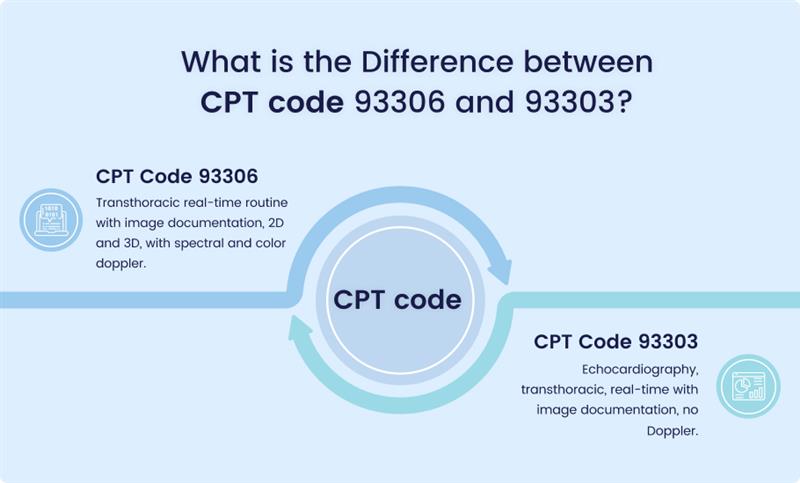
The bundled structure means 93306 is an all-in-one code — the complete echocardiogram transthoracic with color flow that most cardiology practices bill daily.
CPT 93307
CPT 93307 covers a complete transthoracic echocardiogram without Doppler.
All required cardiac structures must still be evaluated (the study is complete in scope), but no spectral or color flow Doppler analysis is performed or documented.
When a practice performs 93307 and also performs Doppler studies during the same encounter, the add-on codes +93320 and +93325 become separately billable.
CPT 93308
CPT 93308 applies to follow-up or limited TTE studies where a focused evaluation (rather than a full cardiac assessment) is clinically appropriate.
Repeat studies for known conditions, targeted valve reassessments, and post-procedure checks typically fall under 93308. Billing 93306 for a limited study is a common audit flag because the documentation won’t support a complete examination.
CPT 93303 and 93304
CPT 93303 and 93304 are specifically designated for congenital cardiac anomalies — not simply “echocardiography without Doppler” as some coding resources incorrectly describe.
CPT 93303 covers a complete congenital TTE, while 93304 covers a follow-up or limited congenital study. Unlike 93306, congenital echo codes allow separate billing of Doppler add-ons (+93320 and +93325) because Doppler is not bundled into the base code.
Pediatric cardiology practices and adult congenital heart programs should verify that coders assign 93303/93304 (not 93306/93307) when the clinical indication is a congenital anomaly, since the documentation requirements and add-on billing rules differ.
Which add-on codes can be billed with TTE?
Add-on codes supplement the base TTE code when specific modalities are performed and documented. The billing rules depend entirely on which base code appears on the claim.
+93325 — No (bundled)
+93321 — No
Doppler is already included. Separate billing = unbundling.
+93325 — Yes (if performed)
+93321 — Yes (limited Doppler)
Doppler is NOT included in the base code.
+93325 — Yes (if performed)
+93321 — Yes (limited Doppler)
Congenital codes allow separate Doppler billing.
A critical nuance that trips up many cardiology coders — +93320 and +93321 should not appear on the same claim. EviCore’s 2025 cardiac imaging guideline explicitly states these two codes should not be requested or billed together, since 93321 is the limited version of 93320.
How do modifier 26 and modifier TC work for echocardiography?
Echocardiography reimbursement splits into two components, and the modifier determines who gets paid for what.
| Modifier | Component | Who bills | Typical scenario |
| 26 | Professional (interpretation and report) | Interpreting physician | Cardiologist reads images at a hospital |
| TC | Technical (equipment, sonographer, supplies) | Facility or practice owning equipment | Hospital or imaging center performs the scan |
| No modifier | Global (both components) | Provider performing and interpreting | Physician-owned office doing everything |
For practices where the cardiologist owns the equipment and interprets the study, global billing (no modifier) captures both components.
When a hospital employs the sonographer and owns the equipment but a separate cardiologist interprets, the hospital bills TC and the cardiologist bills modifier 26.
The reimbursement split is significant — the professional component typically represents about 25–35% of the total allowed amount, while the technical component captures the rest. Practices that misapply modifiers (or forget them entirely) risk duplicate billing flags and payer recoupments.
What documentation does 93306 require?
CMS and payer policies require that a complete 93306 study include documented evaluation of specific cardiac structures. Missing even one required element can downcode the claim to 93308 or trigger a denial.
A compliant 93306 report should document evaluation of
- Aortic root
- Pericardium
- Left and right atria
- Color flow Doppler findings
- Mitral, tricuspid, and aortic valves
- Spectral Doppler findings (pulsed wave and/or continuous wave)
- Left and right ventricles (including wall motion and ejection fraction)
The interpretation and report must be completed by the interpreting physician and signed. When CMS billing guidance for TTE references medical necessity, the ICD-10 diagnosis code on the claim must justify the complete study — CMS lists over 1,000 eligible diagnostic indications.
If spectral Doppler or color flow Doppler documentation is absent from the report, the study no longer meets the 93306 definition. The correct code drops to 93307 (complete without Doppler) or 93308 (limited), and billing 93306 anyway becomes a compliance risk.
What causes echocardiography claim denials?
Most echo billing denials fall into predictable patterns (and the frustrating part is that nearly all of them are preventable with proper claim-level checks).
Spectral or color flow Doppler not documented in the report. Payer downcodes to 93307 or denies outright.
Doppler add-ons billed alongside a code that already includes them. NCCI edits catch and reject.
Documentation supports only a focused exam, but the claim uses the comprehensive code. Audit flag.
Office visit + echocardiogram on the same date without modifier 25 on the E/M code triggers bundling edits.
ICD-10 code doesn’t support the complete study. Repeat echo without documented clinical change denied.
Medicare does not impose a hard annual limit on echocardiography frequency, but repeat studies face scrutiny from Medicare Administrative Contractors (MACs).
Each repeat TTE needs documentation of a new clinical indication or meaningful change in the patient’s condition — performing serial echos on a stable patient without clinical justification invites post-payment review.
How does Medicare cover echocardiography?
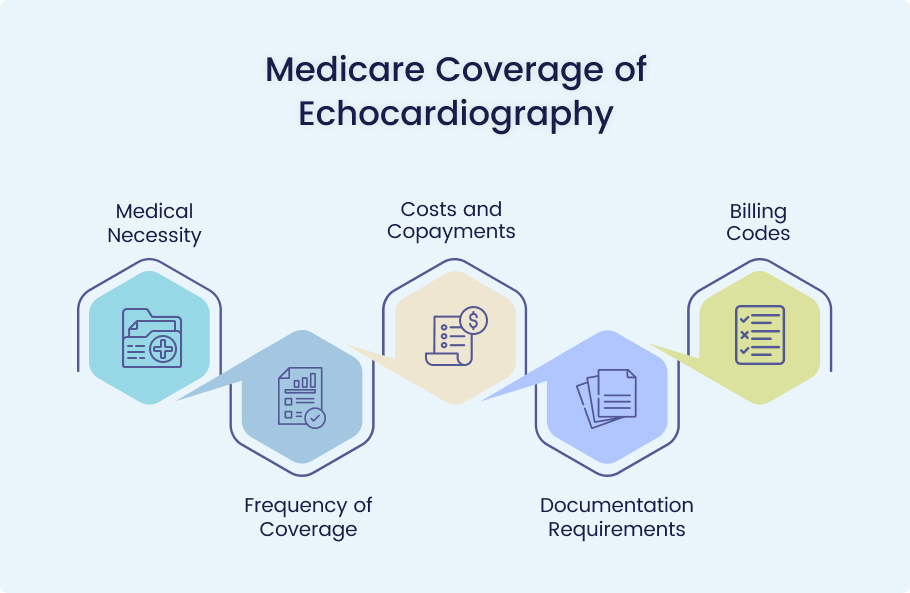
Medicare Part B covers medically necessary echocardiography (both TTE and TEE) and generally pays 80% of the approved amount after the annual deductible.
The patient owes the remaining 20% coinsurance, and facility-based studies may carry additional charges depending on the site of service.
Common Medicare-covered indications include
- Cardiomyopathy evaluation
- Pre-operative cardiac risk assessment
- Evaluation of heart murmurs or suspected valvular disease
- Heart failure assessment (dyspnea, fatigue, reduced ejection fraction)
- Monitoring after cardiac surgery or intervention
- Congenital heart disease diagnosis
Proper ICD-10 coding is the linchpin of Medicare coverage — the diagnosis must clinically justify why the echo was ordered. A claim with CPT 93306 and a vague or unsupported ICD-10 code will stall in adjudication regardless of how well the echo itself was documented.
Accurate echo billing starts with the right billing partner
Echocardiography coding sits at the intersection of clinical documentation, Doppler modality rules, modifier logic, and payer-specific edits — and the margin for error is thin.
A single default code across all studies, or a coder unfamiliar with the 93306/93307/93308 split, can quietly leak revenue for months before anyone catches it.
MedHeave operates as an embedded revenue cycle department inside cardiology practices, with AAPC-certified coders who handle CPT assignment, modifier validation, and NCCI compliance on every echocardiography claim before submission.
- Dedicated account managers with direct access (Monday–Friday, 9–5 EST)
- Denials addressed within 72 hours with payer-specific appeal templates
- Claims submitted within 24–48 hours of signed encounter notes
- 90%+ first-pass rate across all claim types
- 80%+ denial overturn rate
If your cardiology practice is dealing with echo downcodes, add-on code denials, or modifier confusion, contact MedHeave to see how a structured billing process closes those gaps.
Frequently asked questions
Here are some commonly asked questions on this topic:
No. CPT 93306 already includes color flow Doppler in its definition, so separately billing +93325 alongside 93306 constitutes unbundling. NCCI edits will reject the add-on code. The +93325 add-on is appropriate with 93307, 93308, and the congenital echo codes (93303/93304), where color flow Doppler is not bundled into the base code. Always check the base code’s Doppler inclusion before appending any Doppler add-on.
CPT 93306 is a complete transthoracic echocardiogram with spectral and color flow Doppler — requiring documented evaluation of all major cardiac structures. CPT 93308 is a follow-up or limited study used for focused evaluations where a full cardiac assessment isn’t clinically indicated. Billing 93306 when documentation only supports a limited exam is a compliance risk. The choice between the two should be driven by the scope of the clinical evaluation actually performed and documented, not by reimbursement preference.
No. The CPT 93306 descriptor covers 2D imaging and M-mode recording. Three-dimensional echocardiographic rendering is reported separately using CPT 76376 (requiring an independent workstation) or 76377 (concurrent real-time rendering). Some emerging Category III codes also address advanced imaging modalities. Practices performing 3D echo should not assume it falls under 93306.
A complete TTE per CMS billing guidance requires documented assessment of the left and right atria, left and right ventricles (including wall motion and function), mitral valve, tricuspid valve, aortic valve, aortic root, and pericardium. For 93306, spectral Doppler and color flow Doppler findings must also be documented. Omitting any of these elements may result in downcoding to 93308 or a claim denial.
Agitated saline contrast (“bubble study”) is not separately billable from the echocardiography base code. A bubble study uses agitated saline (not a true contrast agent), and no separate CPT or HCPCS code applies. True contrast echocardiography using agents like Definity, Lumason, or Optison is reported with separate HCPCS codes (C8921–C8930 for outpatient hospital settings, and specific Q-codes for the contrast agent itself). Confusing agitated saline with pharmacologic contrast agents is a common billing error.
CPT 93350 and 93351 are stress echocardiography codes — not standard resting TTE codes. CPT 93350 covers echocardiography performed during rest and cardiovascular stress testing (exercise or pharmacologic). CPT 93351 adds physician supervision of the stress component to the imaging. Neither code should be confused with 93306 or used interchangeably for resting echocardiograms. Stress echo billing requires documentation of the stress protocol, monitoring, and pre/post-stress image comparison.
When a cardiologist interprets an echocardiogram but does not own the equipment or employ the sonographer, modifier 26 (professional component) should be appended to the CPT code. The facility performing the technical portion bills modifier TC. If the cardiologist owns the equipment and performs both the technical and professional services, no modifier is needed — global billing applies. Incorrect modifier assignment leads to duplicate payment flags and payer recoupments.

