



The CPT code for total hip arthroplasty (THA) is 27130 — arthroplasty, acetabular and proximal femoral prosthetic replacement.
It reports a primary (first-time) total hip replacement where the surgeon removes the damaged femoral head and acetabulum and implants prosthetic components in both locations.
For conversion from a prior hip surgery to THA, the code is 27132. For revision of a failed THA, the codes are 27134, 27137, or 27138 depending on which components are revised.
CPT 27130 is one of the highest-volume orthopedic codes billed to Medicare and carries a 90-day global surgical package — meaning pre-op evaluation on the day of surgery, the procedure itself, and routine post-operative care are all included in one reimbursement.
Let’s explore:
- The full THA code set (primary, conversion, revision, removal)
- Common THA denial triggers and how to avoid them
- How to choose between 27130, 27132, and 27134
- Global surgical package and NCCI bundling rules
- Laterality modifiers for right vs left hip
Which CPT codes cover total hip replacement?
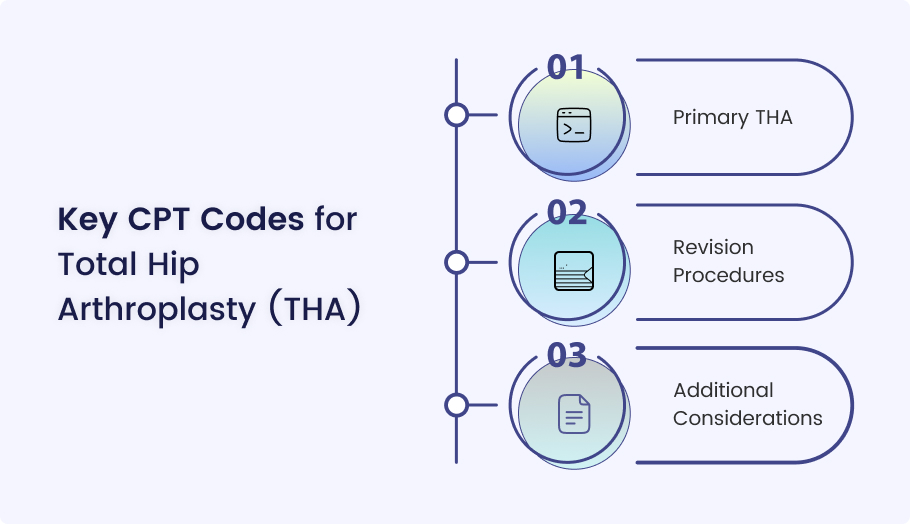
THA coding splits into four categories based on what is happening to the hip joint — whether it is being replaced for the first time, converted from a prior surgery, revised because a previous implant failed, or having the prosthesis removed entirely.
Primary THA
| CPT | Description |
| 27130 | Total hip arthroplasty — acetabular and proximal femoral prosthetic replacement |
CPT 27130 is the standard code when no prior hip arthroplasty exists. The surgeon replaces both the femoral head (ball) and the acetabulum (socket) with prosthetic components. Fixation can be cemented, uncemented, or hybrid — the CPT code is the same regardless of fixation method.
Conversion to THA
| CPT | Description |
| 27132 | Conversion of previous hip surgery to total hip arthroplasty |
CPT 27132 applies when the patient had a prior hip procedure (hemiarthroplasty, internal fixation, failed osteotomy) that is now being converted to a full THA.
The operative complexity is typically higher than a primary THA because the surgeon must address existing hardware, altered anatomy, and potentially compromised bone stock.
The 27132 code carries higher RVU (relative value units) than 27130, reflecting that additional surgical work.
Billing 27130 when the procedure is actually a conversion from prior surgery undervalues the work and leaves reimbursement on the table. Billing 27132 when the patient has no prior hip surgery is upcoding.
Revision THA
| CPT | Description |
| 27134 | Revision of total hip arthroplasty — both components |
| 27137 | Revision of total hip arthroplasty — acetabular component only |
| 27138 | Revision of total hip arthroplasty — femoral component only |
Revision codes apply when a previous THA has failed (due to loosening, infection, fracture, or wear) and the surgeon replaces or repairs the existing prosthetic components. Code selection depends on which components are revised.
- 27134 — both the acetabular cup and the femoral stem are revised
- 27137 — only the acetabular cup is revised
- 27138 — only the femoral stem is revised
The operative report must clearly document which components were addressed. Missing component documentation is a common denial trigger because the payer cannot verify that the correct revision code was selected.
Prosthesis removal
| CPT | Description |
| 27090 | Removal of hip prosthesis — simple |
| 27091 | Removal of hip prosthesis — complicated (including total hip) |
Removal codes apply when the prosthesis is extracted without replacement — typically in cases of deep infection where a spacer is placed and reimplantation is planned as a separate staged procedure.
If the prosthesis is removed and a new one is implanted in the same session, the revision codes (27134-27138) cover both the removal and reimplantation.
How do you code right vs left hip arthroplasty?
There are three ways of doing that:
Laterality
Specifying whether the procedure was performed on the right or left hip — is required on every THA claim. The CPT code itself (27130) does not indicate which side was operated on. The laterality information comes from two sources.
HCPCS modifiers RT and LT
Appended to the CPT code to identify the right (RT) or left (LT) hip. CPT 27130-RT reports a right total hip arthroplasty. CPT 27130-LT reports a left total hip arthroplasty. Missing the RT/LT modifier on a THA claim produces a CO-16 denial (missing required information) because the payer cannot identify the surgical site.
ICD-10 laterality
The diagnosis code must also specify the affected side. For osteoarthritis of the right hip, the correct code is M16.11. For the left hip, M16.12. A laterality mismatch between the modifier and the diagnosis code (RT modifier with a left-hip ICD-10 code) creates a documentation conflict that triggers a denial or audit.
Bilateral THA
When both hips are replaced in the same surgical session, the billing approach depends on payer rules.
One line with the bilateral modifier applied.
One line with RT and one line with LT, each reported with one unit.
Checking local MAC requirements before submission helps prevent denials caused by incorrect claim structure.
What is the global surgical package for THA?
CPT 27130 includes a 90-day global surgical package — one of the longest global periods in surgical coding. The global package bundles the procedure with related pre- and post-operative services into a single reimbursement.
Services included in the 90-day global period for 27130.
- The surgical procedure itself
- Routine post-operative care for 90 days
- Follow-up office visits related to the surgery
- Pre-operative evaluation on the day of surgery
- Surgical approach components (not separately billable)
- Intraoperative services (standard fluoroscopy, wound irrigation, bone preparation)
Services not included in the global package (potentially separately billable).
- Unrelated procedures during the global period (modifier 79)
- Staged or related procedure by the same surgeon (modifier 58)
- Complications requiring a return to the operating room (modifier 78)
- Significant, separately identifiable E/M service beyond the scope of routine post-op care (modifier 25 or 24)
The global package is the primary reason THA claims have strict bundling rules. Billing a routine post-op visit as a separate E/M during the 90-day global period — without modifier 24 and documentation of a distinct, unrelated service — produces a denial or, worse, a post-payment recoupment that is flagged in audit.
What NCCI bundling rules apply to THA?
The National Correct Coding Initiative (NCCI) establishes bundling edits that define which services are included in 27130 and cannot be billed separately on the same date.
Services commonly bundled with 27130 (not separately billable).
- Routine wound irrigation
- Standard intraoperative fluoroscopy
- Standard bone preparation and reaming
- Hardware implantation as part of the primary procedure
- Surgical approach (the method of accessing the hip joint)
Services that may be separately billable with appropriate documentation.
- Complex wound closure beyond routine THA closure
- Nerve monitoring (CPT 95940/95941) when indicated and documented
- Bone grafting (e.g., CPT 20902 for autograft) when performed as a distinct service and not part of the standard THA technique
The NCCI edits apply automatically in payer systems. Submitting a code that is bundled with 27130 without modifier support results in a line-level denial — the primary THA is paid, but the bundled service is denied. Checking NCCI edit pairs before claim submission prevents these denials.
Code selection guide
Which THA code fits the surgical history?
First-time replacement of both acetabulum and femoral head
Converting hemiarthroplasty, ORIF, or failed fixation to full THA
Replacing or repairing existing prosthetic components
What triggers THA claim denials?
THA is one of the most heavily audited orthopedic procedures due to its high reimbursement value and the volume of claims submitted. Denials cluster around a few predictable patterns.
Missing laterality
A THA claim without RT or LT modifier, or with a laterality mismatch between the modifier and the ICD-10 diagnosis code. The payer’s system cannot confirm which hip was replaced and either denies the claim (CO-16) or holds it for manual review.
Primary coded as revision (or vice versa)
Billing 27134 (revision, both components) when the operative report describes a first-time THA without any prior implant history.
Or billing 27130 (primary) when the surgeon actually converted a failed hemiarthroplasty to a full THA — which should be 27132. The distinction between primary, conversion, and revision is not a coding preference; it is defined by the patient’s surgical history.
Bundled services billed separately
Submitting a separate line for intraoperative fluoroscopy, surgical approach, or routine bone preparation alongside 27130.
NCCI edits bundle these automatically. The 27130 line is paid; the bundled line is denied. The fix is knowing the NCCI edit pairs and removing bundled services from the claim before submission.
Missing prior authorization
Most commercial payers require preauthorization for THA. The authorization request typically needs.
- Functional impairment documentation
- Clinical rationale for surgical intervention
- Documented failed conservative treatment
- Radiographic evidence of joint degeneration
Without authorization, the claim is denied regardless of clinical appropriateness — and many payers do not allow retroactive authorization for elective joint replacement.
Incomplete operative report
The operative report must document which components were implanted (acetabular cup, femoral stem, femoral head), whether fixation was cemented or uncemented, which side was operated on, and whether any additional procedures (bone grafting, nerve monitoring) were performed.
A vague operative report that does not specify components makes it impossible for the coder to distinguish between 27130, 27132, and the revision codes — and opens the claim to audit.
Stop leaving THA reimbursement on the table
Total hip arthroplasty claims carry some of the highest reimbursement values in orthopedic billing — and some of the highest audit exposure.
Every coding decision (primary vs conversion vs revision), every modifier (RT/LT, 50, 78, 79), and every documentation element (component detail, laterality, authorization) directly affects whether the claim is paid, denied, or recouped after audit.
- Verify the patient’s hip surgical history before selecting between 27130, 27132, and 27134-27138
- Append RT or LT on every THA claim and confirm laterality matches the ICD-10 code
- Audit operative reports for component-level documentation before coding
- Confirm prior authorization is in place before elective THA procedures
- Check NCCI edits before submitting add-on codes with 27130
Contact MedHeave to bring orthopedic coding precision to your THA billing workflow — and stop losing reimbursement to preventable coding and documentation gaps.
Related guides & resources
The resources below cover closely related topics and the broader service workflow they connect to:
- Orthopedic billing services — Orthopedic billing services
- Modifiers in medical billing — Modifiers in Medical Billing: What They Are, How They Work, & When To Use Them
- Bundling and unbundling in medical billing — Bundling vs Unbundling in Medical Coding: NCCI Edits & Modifier Guide
- CPT codes for laparoscopic cholecystectomy procedures — CPT Codes for Laparoscopic Cholecystectomy Simplified
- Common surgical CPT codes used in podiatry — The Essential Guide to Common Surgical CPT Codes Used in Podiatry (2026 Update)
- Preoperative clearance — Excelling in Preoperative Clearance Billing: A Comprehensive Guide
- Denial management — Mastering Denial Management: A Comprehensive Guide
Frequently asked questions
Here are some commonly asked questions on this topic:
CPT 27130 is the primary code for total hip arthroplasty — arthroplasty, acetabular and proximal femoral prosthetic replacement. It reports a first-time total hip replacement where both the femoral head and acetabulum are replaced with prosthetic components. CPT 27130 carries a 90-day global surgical package that includes the procedure, pre-operative evaluation on the day of surgery, and routine post-operative care.
The CPT code is still 27130 — laterality is indicated by appending HCPCS modifier RT (right side) to the code. CPT 27130-RT reports a right total hip arthroplasty. The ICD-10 diagnosis code must also reflect the right hip (e.g., M16.11 for primary osteoarthritis, right hip). Missing the RT modifier or having a laterality mismatch between the modifier and diagnosis code triggers a denial.
CPT 27132 is conversion of previous hip surgery to total hip arthroplasty. It applies when the patient has had a prior hip procedure (hemiarthroplasty, internal fixation, failed osteotomy) that is now being upgraded to a full THA. CPT 27132 carries higher RVU than 27130 because the surgical work is typically more complex due to existing hardware and altered anatomy. Billing 27130 for a conversion case undervalues the procedure.
CPT 27130-LT — the same base code with HCPCS modifier LT (left side) appended. The ICD-10 diagnosis code must specify the left hip (e.g., M16.12 for primary osteoarthritis, left hip). Laterality must be consistent between the modifier and the diagnosis code on the claim.
Primary THA (27130) is a first-time hip replacement with no prior arthroplasty. Revision THA (27134, 27137, 27138) involves repairing or replacing components of a previous THA that has failed. Conversion (27132) falls between them — the patient had prior hip surgery (but not a THA) and is now receiving a full replacement. The patient’s surgical history determines which code category applies, and the operative report must document component details for revision cases.
CPT 27130 has a 90-day global surgical package that includes pre-operative evaluation on the day of surgery, the procedure itself, intraoperative services (standard fluoroscopy, wound irrigation, bone preparation, surgical approach), and routine post-operative care for 90 days. Services not included — such as unrelated procedures, return to the OR for complications, or separately identifiable E/M services — require appropriate modifiers (78, 79, 58, or 24) to be billed outside the global package.
CPT 27236 may apply to qualifying open treatment of a proximal femoral fracture, including prosthetic replacement. It is not a universal code for every hip hemiarthroplasty. Confirm the indication, procedure performed, and operative report before selecting the code.
The appropriate CPT code depends on the joint, surgical indication, and procedure performed. CPT 27236 may apply to certain femoral neck fracture procedures involving prosthetic replacement. Do not select a code based only on the term “hemiarthroplasty”; verify the operative documentation and current coding instructions.