



The 90471 CPT code covers the administration of one injectable vaccine during a patient encounter.
The AMA officially defines CPT code 90471 as “Immunization administration (includes percutaneous, intradermal, subcutaneous, or intramuscular injections); one vaccine (single or combination vaccine/toxoid).”
The code reports the administration service only — the vaccine product itself gets billed separately with its own CPT or HCPCS code. CPT 90471 is not age-restricted, though pediatric encounters with physician counseling often require 90460 instead.
In this guide, we’ll be going through:
- Pediatric counseling rules that override 90471
- Modifier 25, modifier 59, and when each applies
- How 90471 separates from vaccine product codes
- The 90471 vs 90472 vs 90473 administration family
- Documentation, denial triggers, and Medicare billing
How does the 90471 CPT code differ from vaccine product codes?
Every immunization encounter requires two billing components — one for the administration service and one for the vaccine product. Conflating the two is one of the most persistent vaccine billing errors, and payers reject claims missing either piece.
| Component | What it represents | Example codes |
| Administration code | The act of injecting the vaccine | 90471, 90472, 90473 |
| Product code | The vaccine itself | 90686 (influenza), 90715 (Tdap), 90732 (pneumococcal) |
CPT 90471 tells the payer that a healthcare professional administered one injectable vaccine. The product code tells the payer which vaccine was given.
Both must appear on the claim for complete reimbursement — submitting 90471 without a vaccine product code (or vice versa) will typically trigger a rejection or a medically unlikely edit (MUE) denial.
For Medicare patients receiving influenza, pneumococcal, or hepatitis B vaccines, CMS assigns specific HCPCS administration codes (G0008, G0009, G0010) rather than CPT 90471.
Commercial payers generally accept 90471, but Medicare claims for these three preventive vaccines should use the corresponding G-code to avoid unnecessary rejections.
Confirm both halves of every vaccine claim are billed
Missing either the administration code or the product code is one of the fastest ways a vaccine claim gets rejected. MedHeave validates that pairing on every immunization encounter before submission.
What is the full vaccine administration code family?
CPT 90471 is just the starting point. The administration code selected depends on the route, the number of vaccines given, and whether the patient received counseling.
A common billing mistake (and one that generates a surprising number of denials) — reporting 90471 multiple times when a patient receives several injectable vaccines during the same visit. The correct approach is 90471 for the first injection, then +90472 for each additional one.
For example, if a patient receives an influenza shot plus a Tdap booster at the same visit, the claim should carry 90471 (first vaccine) and +90472 (second vaccine), along with both vaccine product codes. Billing 90471 twice will trigger a duplicate service edit.
When do pediatric counseling codes replace 90471?
The 90471 CPT code has no hard age limit — technically, it can be used for patients of any age.
But for patients through age 18, a separate code set applies when physician or qualified healthcare professional counseling is provided during the immunization encounter.
No physician/QHP counseling reported
Injectable route (IM, SQ, intradermal, percutaneous)
Additional vaccines → +90472
Physician/QHP counseling documented
First vaccine component
Additional components → +90461
The 90460/90461 codes are structured per component, not per vaccine. A combination vaccine like MMR (measles, mumps, rubella) would generate three component units under 90460/90461, while it would only produce one administration unit under 90471. For pediatric practices with high combination-vaccine volume, using 90460 correctly can increase reimbursement significantly compared to 90471 — but only when counseling documentation supports the code choice.
Incorrectly using 90471 instead of 90460 for pediatric counseling encounters is one of the most common immunization coding audit triggers, according to AAPC vaccine administration guidance. The reverse — billing 90460 without documented counseling — creates the same compliance risk.
Which modifiers apply to 90471 claims?
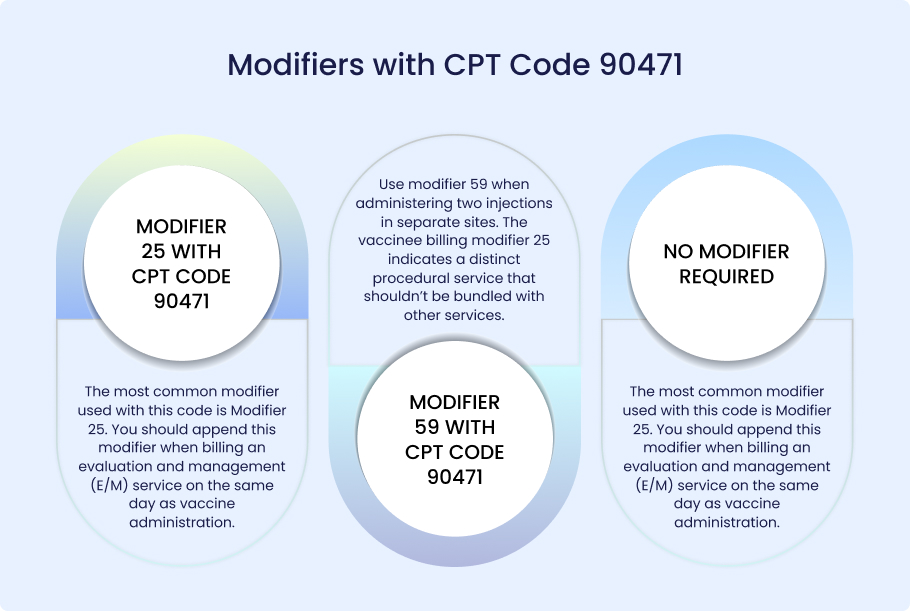
Modifiers on vaccine administration claims are a frequent audit target, and overuse is just as risky as omission.
Modifier 25
Append modifier 25 to the E/M code (not to 90471) when a separately identifiable evaluation and management service is performed on the same day as vaccine administration.
The E/M visit must be documented as a distinct service with its own clinical rationale — a provider cannot simply tack on modifier 25 to justify billing an office visit alongside every immunization.
Modifier 59
Modifier 59 indicates a distinct procedural service and applies in specific payer-edit scenarios.
Some billing guides suggest using modifier 59 whenever vaccines are administered at separate injection sites, but that guidance is misleading.
Modifier 59 is appropriate only when NCCI edits would otherwise incorrectly bundle the services. Applying it routinely (without an actual bundling conflict) can trigger audit scrutiny.
No modifier needed
When 90471 is the sole procedure on the claim — a patient comes in for a vaccine only, no E/M service, no bundling conflict — no modifier is necessary.
Adding modifiers to every 90471 claim regardless of circumstance is a pattern that payer auditors specifically screen for.
What documentation supports a clean 90471 claim?
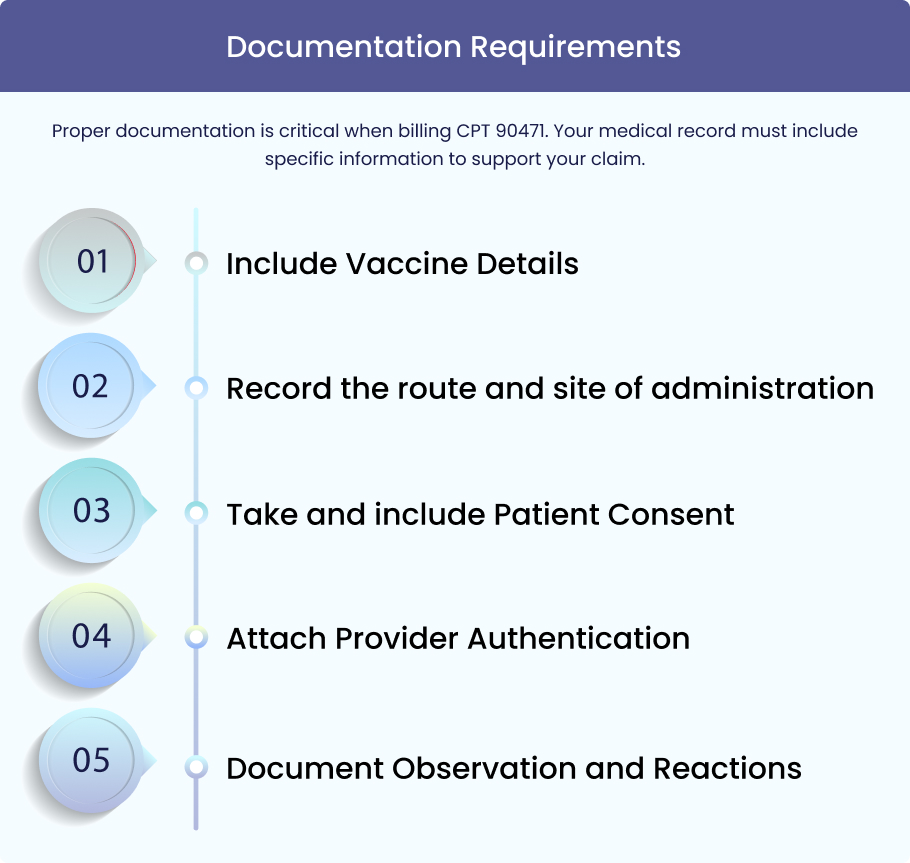
Payers can request medical records to verify any vaccine administration claim, and missing documentation elements are a leading cause of post-payment recoupments.
A compliant 90471 encounter should include
- Dose administered
- Patient or guardian consent
- Provider signature or e-signature
- Injection site (left deltoid, right thigh, etc.)
- Route (IM, SQ, intradermal, or percutaneous)
- Observation period and any adverse reactions noted
- Vaccine name, manufacturer, lot number, and expiration date
- Vaccine Information Statement (VIS) provided to the patient (federal law requires VIS distribution for all CDC-covered vaccines)
The ICD-10 code Z23 (Encounter for immunization) is the standard diagnosis pairing for routine preventive vaccines.
Exposure-based immunizations — rabies post-exposure, tetanus after a wound — typically require more specific diagnosis codes (Z20.3 for rabies exposure, appropriate injury codes for tetanus) rather than the generic Z23.
What triggers 90471 claim denials?
Most vaccine billing denials follow a handful of patterns, and the fix for each is straightforward once the root cause is identified.
90471 submitted without the corresponding vaccine CPT/HCPCS code. Payer rejects for incomplete billing.
90471 billed twice instead of 90471 + 90472. Triggers duplicate service edit.
Patient through age 18, counseling documented, but 90471 billed. Audit trigger and potential underpayment.
No diagnosis code supporting the immunization encounter. Payer returns claim for missing information (CO-16).
Some payers bundle administration into the preventive visit payment. Billing 90471 separately triggers CO-97 denial.
Payer bundling policies deserve special attention because they vary widely.
Some commercial plans include vaccine administration in the preventive visit reimbursement (making separate 90471 billing inappropriate), while Medicare and most Medicaid programs reimburse administration separately.
The only reliable approach is verifying each payer’s bundling rules before submitting — a step many practices skip until denials start accumulating.
How does Medicare handle vaccine administration billing?
Medicare Part B covers medically necessary immunizations and reimburses the vaccine product and administration service separately. For the three major preventive vaccines, Medicare uses its own HCPCS administration codes rather than CPT 90471.
| Vaccine | Product code | Medicare administration code |
| Influenza | 90686 (or applicable) | G0008 |
| Pneumococcal | 90670 (or applicable) | G0009 |
| Hepatitis B (at-risk) | 90746 (or applicable) | G0010 |
Medicare Part B generally pays 80% of the approved amount after the annual deductible, with the patient responsible for 20% coinsurance.
Under the ACA preventive care mandate, most non-grandfathered commercial plans cover ACIP-recommended vaccines without cost-sharing when delivered in-network — though administration billing rules still vary by payer.
Pharmacies can also bill CPT 90471 directly when they have appropriate enrollment, credentialing, and payer contracts in place (a growing segment of immunization billing, particularly for influenza, COVID-19, and shingles vaccines).
Pharmacy billing workflows differ from physician office claims in NDC reporting requirements and place of service coding, so practices and pharmacies should not assume identical billing logic.
Every denied vaccine claim is recoverable revenue
Immunization billing errors — wrong administration code, missing product code, incorrect modifier, overlooked pediatric counseling rules — create a steady drip of preventable denials that most practices don’t quantify until the losses compound across hundreds of encounters.
MedHeave operates as an embedded revenue cycle department inside medical practices, with billing teams that validate administration and product code pairing, verify modifier requirements per payer, and check pediatric counseling documentation before every claim leaves the building.
- 90%+ first-pass rate across all claim types
- Claims submitted within 24-48 hours of signed encounter notes
- No lock-in agreements — 30-day exit, performance-based pricing
- Denials addressed within 72 hours with payer-specific appeal templates
- Dedicated account managers with direct access (Monday-Friday, 9-5 EST)
If your practice is losing revenue to preventable vaccine billing denials, contact MedHeave to see how a structured billing process eliminates those gaps.
Related guides & resources
The resources below cover closely related topics and the broader service workflow they connect to:
- Medical coding services — Medical coding services
- Urology billing CPT codes — CPT Code 52234: TURBT Billing & Urology Coding Guide
- Laser therapy CPT codes — Laser Therapy CPT Codes & Billing 101
- Tick removal coding — ICD-10 Code for Tick Bite & Tick Removal: Diagnosis, CPT, & Billing
- CPT codes for inpatient rehab — CPT Code for Inpatient Rehab (2026): IRF CPT Codes & Billing
- CPT codes for mental health billing — Common CPT Codes for Mental Health Billing
- Anemia ICD 10 codes — Anemia ICD-10 Codes: A Guide for Coders & Providers
Frequently asked questions
Here are some commonly asked questions about CPT code 90471:
No. The 90471 CPT code is not age-restricted and can be used for patients of any age. However, for patients through age 18 when a physician or qualified healthcare professional provides vaccine counseling, CPT 90460/90461 typically applies instead. The age-related confusion stems from early coding guidance that described 90471 as “adult” — the current AMA definition does not limit it by age. The practical rule is that the presence or absence of documented counseling (not the patient’s age alone) determines whether 90471 or 90460 applies for pediatric patients.
CPT 90471 reports the administration of the first injectable vaccine during an encounter. CPT +90472 is an add-on code for each additional injectable vaccine given during the same visit. If a patient receives three shots, the claim should carry one unit of 90471 and two units of +90472, plus the three corresponding vaccine product codes. Billing 90471 multiple times for multiple vaccines in the same encounter will trigger a duplicate service edit and denial.
Yes, but only when the E/M service is a separately identifiable visit with its own clinical documentation. Modifier 25 should be appended to the E/M code (not to 90471) to indicate the office visit was a distinct service beyond the vaccine administration. CMS and commercial payers audit modifier 25 usage aggressively — adding it to every vaccine-plus-visit claim without supporting documentation is a compliance risk.
No. CPT 90471 applies only to injectable routes (intramuscular, subcutaneous, intradermal, and percutaneous). Oral or intranasal vaccine administration — such as FluMist nasal spray or rotavirus oral vaccine — uses CPT 90473 for the first dose and +90474 for each additional dose. Submitting 90471 for a non-injectable vaccine will result in a claim rejection because the route doesn’t match the code definition.
COVID-19 vaccines use product-specific CPT and HCPCS administration codes that change as new formulations receive authorization. The AMA and CMS publish updated COVID-19 vaccine coding guidance as new products enter the market. CPT 90471 may apply for other injectable vaccines given during the same visit as a COVID shot, but the COVID vaccine itself should use its designated administration code — not 90471.
ICD-10-CM Z23 (Encounter for immunization) is the standard diagnosis code for routine preventive vaccine administration. For exposure-based immunizations, more specific codes apply — Z20.3 for rabies exposure, appropriate external cause and injury codes for tetanus prophylaxis after a wound. Submitting 90471 without a supporting diagnosis code is a frequent cause of CO-16 (“claim lacks information”) denials.
Yes. Pharmacies with appropriate payer enrollment, state licensure for immunization services, and billing infrastructure can submit CPT 90471 for injectable vaccine administration. Pharmacy vaccine billing has expanded significantly (particularly for influenza, COVID-19, and shingles), though workflow differences exist in NDC reporting, place of service codes, and payer-specific enrollment requirements compared to physician office billing.