
Charge entry in medical billing is the step where coded services become billable claims.
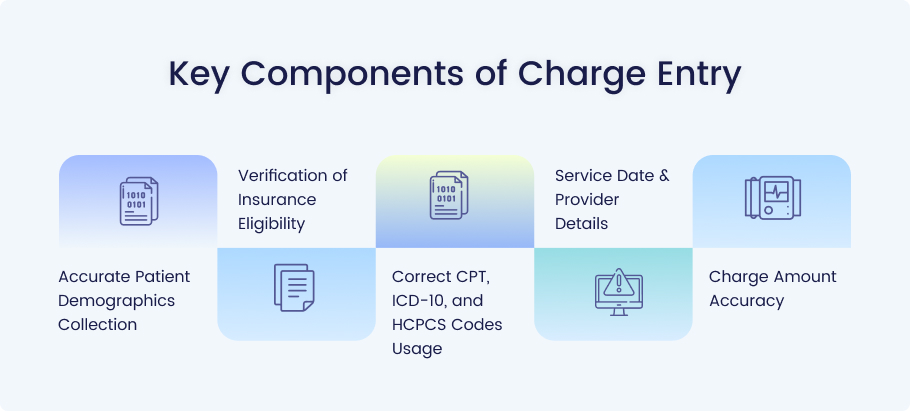
A coder translates the encounter into CPT, ICD-10, and HCPCS codes. Charge entry takes those codes — along with patient demographics, insurance information, provider NPIs, dates of service, and charge amounts — and enters them into the practice management system for claim submission.
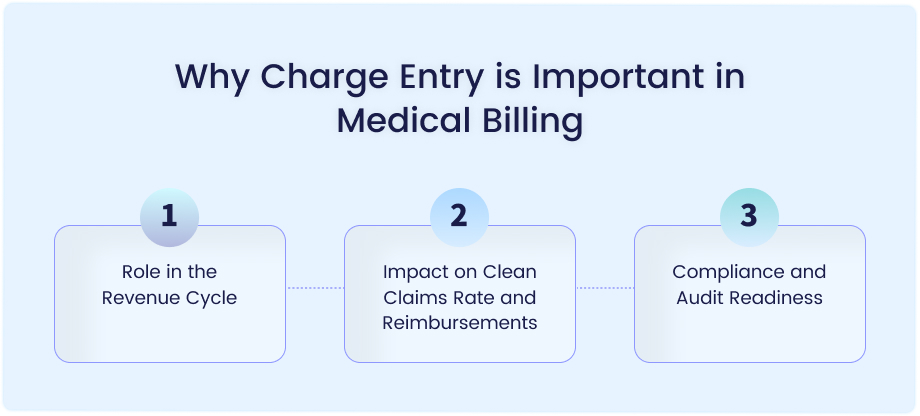
In practice, charge entry is where most preventable billing errors enter the revenue cycle, and charge entry accuracy is one of the strongest predictors of clean claim rate, first-pass resolution, and days in accounts receivable.
Here’s what we’ll cover:
- What charge entry is (and how it differs from charge capture and coding)
- Automated vs. manual charge entry tradeoffs
- Error patterns ranked by revenue impact
- The step-by-step data entry workflow
- KPIs that predict charge entry health
What is charge entry (and what is it not)?
Charge entry is one step in a three-step process that converts a clinical encounter into a billable claim. Each step involves different personnel, different skill sets, and different error patterns.
| Step | What happens | Who does it | Common errors |
| Charge capture | Recording that a billable service occurred | Clinician, clinical staff | Missed services, undocumented procedures |
| Medical coding | Translating the service into CPT, ICD-10, HCPCS codes | Certified coder | Wrong code, insufficient specificity, bundling errors |
| Charge entry | Entering codes + claim data into the billing system | Billing specialist | Data entry errors, insurance mismatches, modifier omissions |
Charge capture is a clinical function. Coding is an interpretive function. Charge entry is a data function — the billing team enters coded information along with all supporting claim fields into the system that generates the claim.
A charge code in medical billing is the combination of a CPT/HCPCS procedure code and its associated charge amount (the dollar figure the practice bills).
The charge amount comes from the practice’s fee schedule — not from what the payer reimburses.
Practices should set charge amounts at or above their highest contracted rate to avoid leaving money on the table, because payers pay according to their own contracted rates regardless.
How should data be entered in medical billing programs?
The charge entry process follows a consistent sequence regardless of which practice management system is used. Payers validate every field during claim processing.
Step 1. Verify patient demographics and insurance eligibility
Confirm that patient demographic details and insurance information match the patient’s current active coverage before charges are entered. Outdated or incorrect insurance data remains one of the most frequent causes of front-end claim rejections.
Step 2. Match dates of service to the actual encounter
Enter dates of service exactly as they occurred. When services are provided on different days, create separate charge lines to ensure accurate claim reporting and reimbursement.
Step 3. Validate provider information and NPIs
Ensure that the rendering provider, billing provider, and referring provider (when required) are entered correctly with valid NPIs. Provider identification errors commonly lead to claim rejections and payment delays.
Step 4. Use coder-assigned CPT and HCPCS codes
Enter CPT and HCPCS codes exactly as assigned by the coding team. If a code appears questionable, route it back for coding review rather than making changes during charge entry.
Step 5. Link procedures to supporting diagnoses
Associate each procedure code with the appropriate ICD-10-CM diagnosis codes to demonstrate medical necessity and reduce the likelihood of payer denials.
Step 6. Apply modifiers as assigned
Append modifiers such as 25, 26, 59, and TC exactly as specified by the coding team. Missing or incorrect modifiers can result in bundling issues, reduced reimbursement, or claim rejection.
Step 7. Enter charges according to the current fee schedule
Use the most current fee schedule when entering charge amounts. Incorrect charges—whether too high, too low, or zero — can create reimbursement discrepancies, audit concerns, or claim edits.
Step 8. Scrub claims before submission
Run all completed charge entries through a claim scrubber before releasing them to the clearinghouse. Pre-submission edits help identify missing information, coding conflicts, and payer-specific errors before they become denials.
Here’s the rundown to the entire data entry pipeline:
What are the most common charge entry errors?
Charge entry errors produce two types of claim failures — rejections (never reaches the payer) and denials (payer refuses payment). Both cost revenue, but they require different fixes.
High-severity errors
Claim is rejected or denied outright.
| Claim Entry Error | What Goes Wrong | Resulting Rejection / Denial Outcome |
| Wrong or missing insurance information | Claim is routed to the incorrect payer or fails eligibility validation due to inactive or mismatched coverage data | Front-end rejection such as “subscriber not found” or eligibility failure |
| Incorrect CPT or ICD-10 code | Transposed digits, missing codes, or incorrect selection during entry | Rejection for invalid code or denial due to lack of medical necessity |
| Missing modifier | E/M billed on same day as procedure without modifier 25, or professional component billed without modifier 26 | Bundling denial or payment reduction due to unbundled or incomplete service reporting |
Moderate-severity errors
Claim is underpaid or delayed.
| Claim Entry Error | What Goes Wrong | Resulting Rejection / Denial Outcome |
| Charge amount below the contracted rate | Incorrectly entered charge is lower than payer contract allowance | No formal denial, but reduced reimbursement leads to silent revenue leakage |
| Wrong date of service | Service date does not match actual encounter or documentation timeline | Duplicate claim denial or medical necessity denial due to date mismatch |
| Wrong place of service code | Incorrect POS used (e.g., office POS 11 instead of hospital outpatient POS 22) | Incorrect reimbursement rate and potential audit or post-payment adjustment |
Low-severity errors
Claim is delayed but eventually paid.
- Missing referring provider NPI when the payer requires one
- Formatting errors that prevent clearinghouse transmission (caught by scrubbing tools)
Which KPIs predict charge entry health?
Charge entry performance is measurable, and tracking these metrics catches problems before they become systemic revenue loss.
| KPI | What it measures | Target |
| Clean claim rate | % of claims accepted on first submission | 95%+ |
| Charge lag | Days between date of service and charge entry | Under 48 hours |
| First-pass resolution rate | % of claims paid without resubmission | 90%+ |
| Denial rate from charge entry | % of denials caused by data entry errors | Track separately from coding denials |
| Days in AR | Average time from submission to payment | Lower is better; driven by entry accuracy |
A clean claim rate below 90% indicates chronic charge entry or coding issues. Tracking the charge-entry-specific denial rate (separate from coding denials) isolates whether the problem is upstream coding or data entry.
How does automated charge entry compare to manual?
Here’s the comparison for three approaches:
Manual charge entry
A billing specialist reading a superbill and typing data into the PMS — this is still standard in many small and mid-sized practices.
It works, but human error enters at every keystroke. A transposed digit, a skipped modifier, a charge amount from last year’s fee schedule.
Automated charge entry
Automated charge entry pulls coded data directly from the EHR into the billing system through interface integration, reducing keystrokes and the errors they produce.
But full automation without validation creates its own risks — auto-populated insurance data may be outdated, charge amounts may pull from an unmaintained fee schedule, and modifiers may not reflect payer-specific requirements.
Hybrid approach
The hybrid approach (automated data flow with manual validation) is where most practices land.
The system populates fields from the EHR encounter. A specialist reviews populated data, verifies insurance, confirms modifiers, and validates amounts before releasing the claim.
The relevant metric isn’t whether automation eliminates all errors — it doesn’t. The metric is whether the denial rate attributable to charge entry decreases after implementation.
What are the compliance considerations?
Charge entry operates under HIPAA for data privacy, CMS guidelines for coding accuracy, and payer-specific rules for claim formatting:
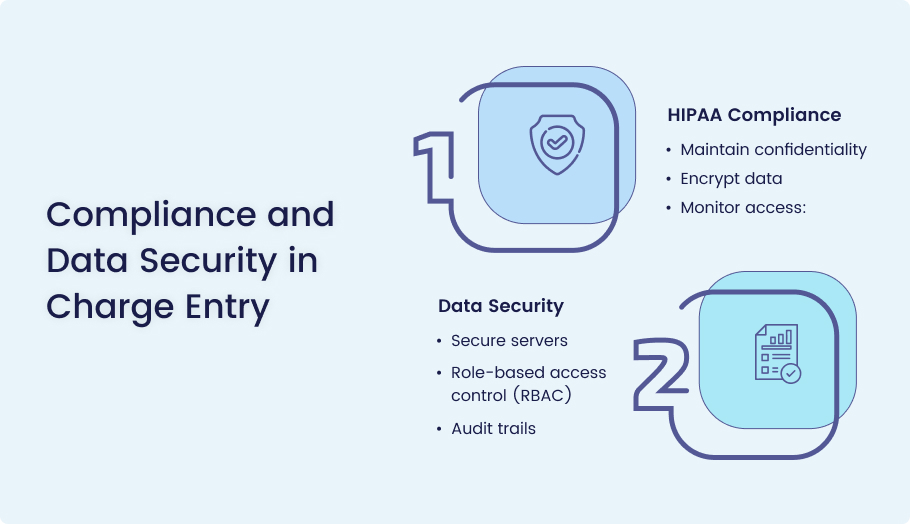
Changing a code during charge entry — even with good intentions — bypasses the coding workflow and creates an audit trail gap that compliance reviewers will flag. Fee schedule maintenance is equally critical; outdated schedules produce either underbilling (revenue loss) or overbilling (audit risk).
Prevent charge entry errors before they become revenue loss
Charge entry is where clinical accuracy becomes financial reality—and where most preventable billing errors enter the revenue cycle. When it breaks, it doesn’t just create rework — it directly slows cash flow, increases denials, and extends days in AR.
For practices where charge entry errors are recurring, the issue is rarely individual mistakes—it’s the absence of a controlled, end-to-end revenue workflow.
- Structured validation between coding and claim submission
- Real-time insurance and demographic verification
- Consistent modifier and fee schedule accuracy checks
- Built-in claim scrubbing before clearinghouse submission
- Dedicated oversight to reduce charge lag and entry-driven denials
If charge entry errors are affecting your clean claim rate or delaying reimbursement, contact us to see how MedHeave operates as an embedded revenue department inside your practice.
Frequently asked questions
Here are some commonly asked questions about charge entry:
Charge entry is the process of entering coded patient services into the billing system for claim generation and submission. It includes entering CPT/HCPCS procedure codes, ICD-10-CM diagnosis codes, modifiers, patient demographics, insurance information, provider NPIs, dates of service, and charge amounts from the practice’s fee schedule. Charge entry sits between medical coding and claim submission in the revenue cycle. Errors during charge entry — wrong insurance, missing modifiers, incorrect codes — are among the most common causes of claim rejections and denials.
Charge capture is the clinical recording that a billable service occurred. Medical coding translates the documented service into standardized CPT, ICD-10, and HCPCS codes. Charge entry is the data entry step where coded information, along with patient demographics, insurance details, and charge amounts, is entered into the billing system to generate a claim. Each step involves different personnel and different error types. Charge capture errors are clinical (missed services). Coding errors are interpretive (wrong code). Charge entry errors are data-driven (typos, omissions, mismatches).
A charge code is the combination of a CPT or HCPCS procedure code and its associated charge amount — the dollar figure the practice bills for that service. The charge amount comes from the practice’s internal fee schedule, not from what the payer reimburses. Practices should set charge amounts at or above their highest contracted payer rate. The payer applies its own fee schedule (Medicare Physician Fee Schedule, commercial contracted rates) to determine the actual reimbursement.
Enter data systematically — verify patient demographics and insurance first, then dates of service, provider NPIs, procedure codes (as the coder assigned them), diagnosis codes linked to each procedure, applicable modifiers, and charge amounts from the current fee schedule. Validate every field against the source document. Run the completed entry through a claim scrubber before releasing to the clearinghouse. Charge entry should be completed within 24–48 hours of the date of service to minimize charge lag and timely filing risk.
After charge entry, the claim passes through claim scrubbing (automated pre-submission validation checking for missing fields, invalid codes, and payer-specific errors). Claims that pass scrubbing are transmitted to the clearinghouse, which performs additional validation before routing to the payer. The payer adjudicates the claim and issues either a payment or a denial. Denied claims enter the denial management workflow for correction and resubmission or appeal.
The five most relevant KPIs are clean claim rate (target 95%+), charge lag (target under 48 hours), first-pass resolution rate (claims paid without resubmission), denial rate attributable to charge entry errors (tracked separately from coding denials), and days in accounts receivable. Tracking by payer and by charge entry staff member isolates specific problem areas.

