




Unbundling meaning in medical billing comes down to one pattern — separately billing procedures or components that should be reported under a single comprehensive CPT code.
When done incorrectly, unbundling triggers CO-97 denials, payer audits, and potential fraud investigations.
Bundling is the opposite — combining related services into one billable code, which is how CMS expects most procedure groups to be reported.
The National Correct Coding Initiative (NCCI) enforces these rules through automated edit pairs that flag incompatible code combinations before or during claims adjudication.
To be able to know and manifest how NCCI edits work, when modifiers can override them, and what documentation you need to support separate billing is what separates a clean claim from a denial or a compliance problem.
In this guide, we’ll be exploring the following areas:
- Audit risks and the fraud-vs-mistake line
- How NCCI Column 1/Column 2 edits and MUEs work
- When unbundling is allowed, which modifiers apply
- Bundling vs unbundling definitions with examples
- CO-97 denials and how to prevent them
What is bundling in medical billing?
Bundling means reporting multiple related services under one comprehensive CPT code instead of billing each component separately.
CMS uses bundling to prevent duplicate reimbursement for services that are clinically part of a larger procedure.
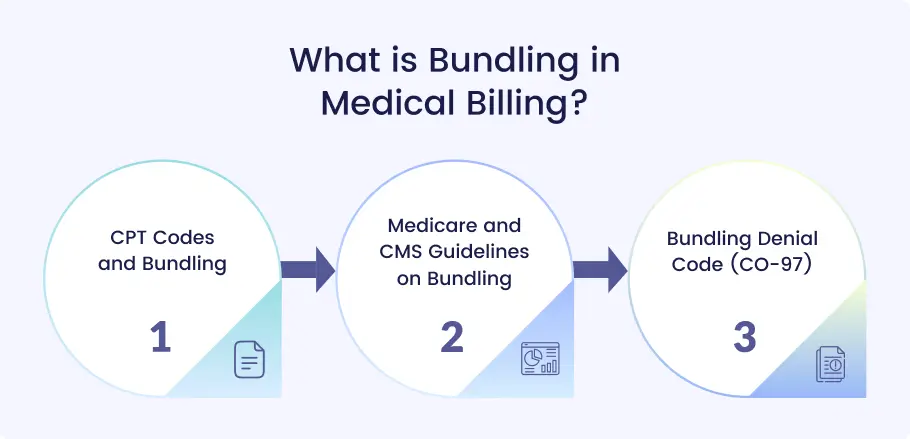
The logic is simple — when a surgeon performs a total hip arthroplasty (CPT 27447), the surgical exposure, implant placement, standard closure, and routine intraoperative work are all included in the reimbursement for that single code.
Billing separately for the incision, closure, or dressing application would constitute unbundling, because those components are already included in the payment for the comprehensive procedure.
Bundling applies across three main payment structures.
Procedure-to-procedure bundling
NCCI edits define specific CPT code pairs where one code (Column 2) is considered a component of a more comprehensive code (Column 1). The component code cannot be billed separately unless a valid modifier and supporting documentation justify it.
Global surgical package bundling
CMS assigns global surgery periods (0-day, 10-day, or 90-day) to surgical codes.
Services within that global period — preoperative care, the procedure itself, and routine postoperative visits — are bundled into the surgical code’s reimbursement.
Billing a separate E/M code for a routine postop visit within the global window is a common bundling violation.
Payment system bundling
Hospital outpatient services are bundled under APCs (Ambulatory Payment Classifications), and inpatient services under DRGs (Diagnosis-Related Groups).
Both systems pay a composite amount rather than itemized reimbursement for individual services within the encounter.
Not sure which of your codes are bundled together?
MedHeave’s coders check every claim against current NCCI edit pairs before submission, so components that belong under one comprehensive code never get flagged as unbundling later.
What does unbundling mean?
Unbundling occurs when a provider bills separately for services that CMS or NCCI rules define as components of a single comprehensive code.
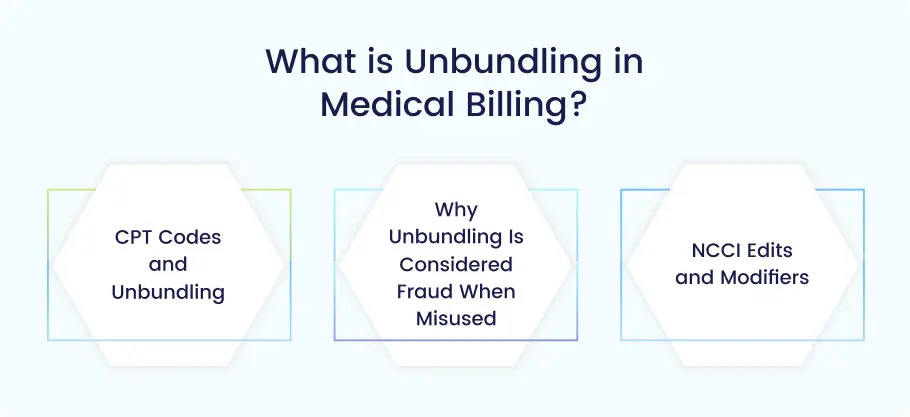
The result is higher reimbursement than intended — which is exactly why payers and the OIG treat it as a compliance priority.
Not all unbundling is fraud.
The line between improper unbundling and a legitimate coding decision depends on clinical circumstances, documentation, and whether NCCI edits allow modifier override for the code pair in question.
Bundling vs unbundling simplified
A simple overview of both phenomena:
| Bundling | Unbundling | |
| Definition | Combining related services into one billable code | Billing components separately that should be grouped |
| CMS intent | Prevent duplicate reimbursement | Flag when code pairs violate NCCI rules |
| Revenue effect | Single payment per comprehensive code | Higher reimbursement (improper) or correctly separated services (legitimate) |
| Compliance risk | Low when following NCCI | High if done without modifier justification and documentation |
| Denial code | N/A | CO-97 |
Let’s look at a practical example of improper unbundling….
A behavioral health provider bills CPT 90837 (psychotherapy, 60 minutes) and a separate E/M code (99214) for the same session without modifier 25 and without documentation supporting a separately identifiable evaluation and management service.
NCCI edits recognize that psychotherapy often includes an evaluative component, so separate billing requires clear evidence that the E/M service was distinct.
How do NCCI edits enforce bundling rules?
NCCI is the primary mechanism CMS uses to prevent improper unbundling. The system operates through automated code-pair edits that run during claims adjudication.
The operational step that most billing teams skip — checking the modifier indicator before appending a modifier. A modifier indicator of “0” means the edit is absolute; no modifier can override it.
Appending modifier 59 to a code pair with indicator 0 will still result in a denial, and repeated attempts flag the claim for audit review.
When is unbundling allowed?
Legitimate unbundling requires that the NCCI edit for the code pair to have a modifier indicator of “1” and that clinical documentation supports the services as distinct. Five scenarios commonly justify separate billing.
Separate anatomical site
The procedures were performed on different body structures. Modifier XS (separate structure) applies.
Separate encounter
The services occurred during different patient encounters on the same date. Modifier XE (separate encounter) applies.
Different practitioner
A different physician or qualified healthcare professional performed the second procedure. Modifier XP (separate practitioner) applies.
Unusual non-overlapping service
The services are clinically distinct in a way not captured by the standard edit. Modifier XU (unusual non-overlapping service) applies.
General distinct service
When none of the X-modifiers fit precisely, modifier 59 may be used — but only as a last resort.
CMS considers modifier 59 an overused catch-all and audits its application more aggressively than the X-modifiers.
Different anatomical site. Most specific — use when location is the reason for separate billing.
Different patient encounter on the same date. Documentation must support separate visits.
Different provider rendered the second service. Applies in multi-provider practices.
Services are distinct but don’t fit XS/XE/XP. Requires strong documentation.
Use only when no X-modifier is more specific. Most audited modifier in medical billing.
A critical rule that catches many practices — modifier 59 should not be appended to E/M codes.
When billing an office visit alongside a procedure on the same date, modifier 25 applies to the E/M code to indicate a separately identifiable service.
Using 59 on the E/M code is incorrect and will either deny or trigger an audit.
What is a bundled denial, and how does CO-97 work?
When a payer determines that separately billed services should have been bundled, the claim returns with CARC CO-97:
“The benefit for this service is included in the payment/allowance for another service/procedure that has already been adjudicated.” The component code is denied while the comprehensive code remains payable.
CO-97 is the most common bundled denial code in medical billing and the single most reliable signal that NCCI edits caught an unbundling attempt.
Common triggers for CO-97 denials include:
- Reporting E/M services within a global surgical period
- Billing add-on codes without an appropriate primary code
- Using modifier 59 on a code pair with the modifier indicator “0”
- Submitting code pairs flagged by NCCI PTP edits without a modifier
- Billing separately for incidental procedures (minor services considered integral to the main procedure)
The difference between CO-97 and an inclusive denial — CO-97 indicates the service is included in another paid service, while inclusive denials (sometimes coded differently by commercial payers) indicate the service cannot be paid at all because it’s considered inherent to the primary procedure.
Both result in zero additional payment, but the appeal strategy differs.
What are the most common bundling mistakes?
Most bundling errors in practice come from system defaults and process gaps rather than intentional manipulation — but payers and auditors don’t distinguish between intent and pattern until an investigation begins.
Modifier overuse
Appending modifier 59 to every code pair that triggers an NCCI edit is the most audited pattern in medical billing.
Payer analytics flag practices with abnormally high modifier 59 usage rates, and the follow-up audit examines whether documentation actually supports distinct services for each instance.
Ignoring quarterly NCCI updates
CMS updates NCCI edit files every quarter.
A code pair that was separately billable last quarter may become bundled in the next update.
Practices that don’t refresh their claim scrubber rules quarterly face a growing gap between their billing logic and current CMS policy.
Global surgical period violations
Billing a separate E/M code for a routine postoperative visit within the 10-day or 90-day global period is a bundling violation unless the visit addresses a new, unrelated problem (requiring modifier 24).
Many practices miss this because their scheduling system doesn’t flag encounters that fall within active global periods.
Incomplete documentation
A modifier without supporting documentation is worse than no modifier at all — it tells the payer you intended to bill separately but can’t prove the services were distinct.
Every modifier override should be backed by clinical notes specifying why the services qualify as separate.
Bundling errors don’t fix themselves
Bundling and unbundling mistakes are process problems — the wrong NCCI edit version, a missing modifier indicator check, an out-of-date claim scrubber, or documentation that doesn’t support the code combination.
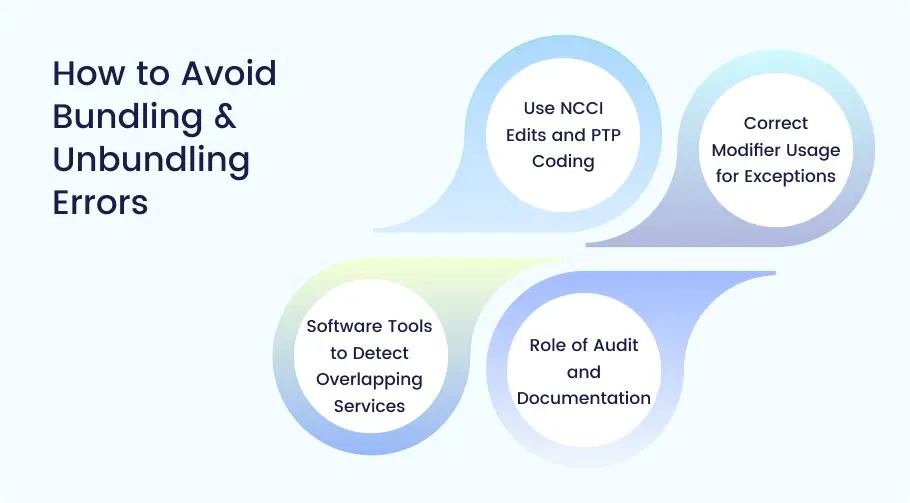
Left unaddressed, these errors compound into recurring CO-97 denials, underpayments, and audit exposure across every affected claim.
MedHeave operates as an embedded revenue cycle department inside medical practices, with AAPC-certified coders who validate NCCI compliance, modifier logic, and documentation alignment on every claim before submission.
- 90%+ first-pass rate across all claim types
- Claims scrubbed against the current NCCI edits before submission
- Denials addressed within 72 hours with payer-specific appeal templates
- No lock-in agreements — 30-day exit, performance-based pricing (4–7%)
- Dedicated account managers with direct access (Monday–Friday, 9–5 EST)
If CO-97 denials and modifier disputes are draining your billing team’s time, contact MedHeave to see how structured claim validation eliminates those gaps.
Related guides & resources
The resources below cover closely related topics and the broader service workflow they connect to:
- Medical coding services — Medical coding services
- Medical coding — Medical Coding 101: The Ultimate Guide
- Downcoding — How DownCoding Can Break Your Revenue?
- Medical coding audits guide — A Comprehensive Guide to Medical Coding Audits
- Is medical coding hard to manage — Is Medical Coding Hard to Manage? A Must-Know Guide For Providers
- CPT codes for healthcare professionals — CPT Codes: A Comprehensive Guideline for Healthcare Professionals
Frequently asked questions
Here are some commonly asked questions on this topic:
Unbundling itself is not automatically illegal. Legitimate unbundling occurs when NCCI edits allow modifier override (indicator “1”) and documentation supports clinically distinct services. Improper unbundling — separately billing bundled components without clinical justification to inflate reimbursement — can trigger OIG fraud investigations, False Claims Act exposure, and repayment obligations. The line between a coding error and fraud depends on pattern, intent, and volume. A single incorrect claim is typically treated as a mistake; a systematic pattern of modifier-59 overuse across hundreds of claims draws a different level of scrutiny.
CARC CO-97 is the standard denial code for bundled services. The full description reads “The benefit for this service is included in the payment/allowance for another service/procedure that has already been adjudicated.” When CO-97 appears, the component code was denied because the payer determined it should have been included in the reimbursement for the comprehensive code. Review the NCCI edit for the code pair and check whether a modifier override is allowed before appealing.
Bundling is about which codes belong together. Upcoding is about which level of service was performed. Bundling related procedures into one comprehensive code; unbundling improperly separates them. Upcoding reports a higher-level service than documentation supports (billing 99215 when the note supports 99213). Both create compliance risk, but they’re distinct violations — upcoding inflates the service level, while unbundling inflates the number of separately reimbursed services.
Yes — when the NCCI edit for the code pair carries a modifier indicator of “1” and clinical documentation supports the services as distinct. The five accepted scenarios are separate anatomical site (modifier XS), separate encounter (XE), separate practitioner (XP), unusual non-overlapping service (XU), or a distinct procedural service (modifier 59 as a last resort). Code pairs with a modifier indicator “0” cannot be unbundled under any circumstances.
The most common cause is billing two codes flagged by an NCCI PTP edit without an appropriate modifier — or appending a modifier without documentation to support it. Missing modifiers, modifier 59 misuse, incidental procedure billing, and E/M services billed within a global surgical period are the top patterns. Keeping claim scrubber software updated with the latest quarterly NCCI edits catches most of these before submission.
Commercial payers use CMS NCCI edits as a baseline but often apply additional proprietary edits, custom code-pair rules, and payer-specific modifier policies. A code pair that Medicare allows with modifier 59 may still deny with a commercial payer that has stricter edit logic. Always verify payer-specific bundling policies in addition to checking CMS NCCI edits, especially for high-volume code pairs.
CMS publishes NCCI edit updates quarterly, with new code pairs added, existing pairs revised, and modifier indicators changed. Practices should update their claim scrubbing tools, encoder software, and coder reference materials after each quarterly release to avoid billing against outdated edit tables. CMS posts current NCCI edit files on the NCCI edits page.