



A peer-reviewed study by Zhu et al. (2024) found a 38% coding error rate in anesthesia billing, the highest across all CPT specialties reviewed.
A 2025 HHS-OIG audit identified $45.7 million in at-risk anesthesia payments, with 20 of 28 sampled sessions lacking adequate documentation.
Anesthesia billing is not complicated because the codes are obscure. It is complicated because payment depends on five variables, CPT code, anesthesia base units, anesthesia time units, anesthesia conversion factor, and modifiers, and errors in any one of them affect the entire claim.
This guide traces each error category back to its source and pairs it with the correct approach. Here is what it covers:
- Top billing errors from audits and research.
- Moderate sedation vs. anesthesia CPT codes.
- Payment formula, units, and conversion factor with example.
- Modifier selection table for provider role, ASA status, and MAC.
- Qualifying circumstance codes and payment impact.
- Anesthesia CPT code ranges by body region.
- 2026 CPT updates and base unit changes.
What CPT codes are used for Anesthesia?
Anesthesia CPT codes run from 00100 to 01999 and are organized by the surgical procedure performed, not the type of anesthesia administered.
General, regional, and monitored anesthesia care (MAC) are all billed under the same procedure-based code; the anesthesia type is indicated by modifier, not by code. This structure is governed by CMS NCCI 2026 Chapter 2, the current policy anchor for anesthesia code pairs and unbundling rules.
The range divides into three broad segments:
- 00100–01860: Surgical procedures
- 01916–01942: Radiological procedures
- 01951–01999: Burns, obstetric, and other non-surgical services
Code selection is determined by the body region and the procedure, use the ASA Crosswalk to match a surgical CPT code to its corresponding anesthesia code.
| Code range | Body region / service | Common examples |
| 00100 to 00222 | Head | 00100 (salivary gland), 00160 (nose/mouth/pharynx), 00210 (intracranial) |
| 00300 to 00352 | Neck | 00300 (superficial), 00320 (larynx/trachea) |
| 00400 to 00474 | Thorax (chest wall) | 00400 (superficial), 00450 (clavicle/scapula) |
| 00500 to 00580 | Intrathoracic | 00520 (closed chest), 00560 (cardiac without pump) |
| 00600 to 00670 | Spine and spinal cord | 00600 (cervical), 00630 (lumbar) |
| 00700 to 00797 | Upper abdomen | 00700 (anterior abdominal wall), 00790 (intraperitoneal) |
| 00800 to 00882 | Lower abdomen | 00800 (anterior abdominal wall), 00840 (intraperitoneal) |
| 00902 to 00952 | Perineum | 00902 (anorectal), 00944 (vaginal delivery) |
| 01112 to 01190 | Pelvis (bony) | 01112 (bone marrow), 01160 (closed pelvis) |
| 01200 to 01274 | Upper leg | 01200 (hip joint), 01250 (lower leg vessels) |
| 01320 to 01444 | Knee and lower leg | 01320 (knee), 01400 (knee arthroplasty) |
| 01462 to 01522 | Foot and ankle | 01462 (closed ankle), 01500 (lower leg vessels) |
| 01600 to 01682 | Upper arm and elbow | 01610 (shoulder), 01630 (humeral head) |
| 01710 to 01782 | Forearm, wrist, hand | 01710 (elbow), 01750 (hand/wrist) |
| 01810 to 01860 | Radiological and other upper extremity | 01820 (wrist arthrography), 01860 (elbow dislocation) |
| 01916 to 01942 | Radiological procedures | 01916 (arterial), 01922 (non-invasive imaging) |
| 01951 to 01999 | Burns, obstetric, other | 01958 (obstetric), 01968 (cesarean) |
Do not select an anesthesia code by anesthesia type. There is no separate CPT code for general anesthesia or for regional blocks. The procedure performed by the surgeon determines the code. The anesthesia provider’s role and method are communicated through modifiers.
How does the anesthesia payment formula work?
Anesthesia payment does not follow the standard RVU-based formula used for other CPT codes.
Payment is calculated as: (base units + anesthesia time units + modifying units) x anesthesia conversion factor, as outlined in Noridian’s anesthesia billing guidance. Each variable must be captured correctly, an error in time documentation or modifier assignment changes the reimbursable total.
× Conversion Factor = Payment
22 × $21.00
= $462.00
Base units
Anesthesia base units are a fixed value assigned to each anesthesia CPT code. They reflect the inherent complexity of the procedure, not the time spent.
CMS publishes base unit values annually in the anesthesia relative value file. Base units for the core 00100 to 01999 range have remained unchanged for CY 2024 through 2026.
The most common documentation error here is billing the wrong code and therefore the wrong base unit value.
An incorrectly assigned code, even if the time and modifier are correct, produces an erroneous claim.
Use the ASA Crosswalk to confirm the correct anesthesia code for each surgical procedure before submission.
Time units
Anesthesia time units are calculated by dividing total anesthesia minutes by 15.
CMS defines the start of anesthesia time as when the practitioner begins preparing the patient for induction.
Time ends when the practitioner safely transfers care to post-anesthesia personnel.
This is a primary audit target. The anesthesia record must document exact start and stop times.
Missing or inconsistent time entries were the leading documentation deficiency in the 2025 HHS-OIG audit, present in 20 of 28 sessions reviewed.
Practices that rely on estimated times or rounded entries are the most exposed to recoupment.
Conversion factor
The anesthesia conversion factor is a dollar multiplier that varies by geographic locality and payer. CMS publishes locality-specific conversion factors annually in the Medicare Physician Fee Schedule.
Commercial payers negotiate their own rates. The conversion factor is the variable most practices do not control, but it must be applied correctly to the total unit count to produce an accurate claim.
Which anesthesia modifiers should you use?
Provider role, physical status, and MAC indicators are the three categories of anesthesia modifiers, and all three are mandatory on every anesthesia claim.
Omitting or misassigning any one of them is one of the most frequently cited errors in OIG audit findings, directly affecting claim adjudication and payment accuracy.
Select the provider role modifier first. It defines who delivered the anesthesia and in what capacity.
Physical status and MAC modifiers are applied in addition to, not instead of, the role modifier.
Provider role modifiers
Here are modifiers sorted by provider roles:
| Modifier | Who uses it | When it applies |
| AA | Anesthesiologist | Personally performed, anesthesiologist present for entire case |
| QK | Anesthesiologist | Medical direction of 2 to 4 concurrent CRNA cases |
| QY | Anesthesiologist | Medical direction of one CRNA |
| QX | CRNA | CRNA performing under physician direction (QK or QY case) |
| QZ | CRNA | CRNA performing independently, no physician direction |
| AD | Anesthesiologist | Medical supervision of more than 4 concurrent cases |
AA and QZ represent the two independent billing scenarios.
When an anesthesiologist personally performs and directs the case, AA applies. When a CRNA performs without physician involvement, in states that have opted out of the supervision requirement, QZ applies.
In medically directed cases, the anesthesiologist bills QK or QY and the CRNA bills the corresponding QX. These pairings must be consistent across both claims, or the payer will reject one or both.
Physical status modifiers
List of physical status modifiers for this category:
| Modifier | ASA physical status | Modifying units added |
| P1 | Normal healthy patient | 0 |
| P2 | Mild systemic disease | 0 |
| P3 | Severe systemic disease | 1 |
| P4 | Severe systemic disease, constant threat to life | 2 |
| P5 | Moribund patient | 3 |
| P6 | Brain-dead patient, organ donor | 0 |
The ASA physical status modifier must reflect the pre-anesthesia evaluation, not the outcome of the procedure.
Assigning P4 or P5 to a patient who does not meet the clinical criteria is a compliance risk, OIG and RAC reviewers cross-reference physical status assignments against the pre-operative assessment in the anesthesia record.
Over-assignment inflates modifying units and increases payment, which is why it appears in audit findings.
MAC and sedation modifiers
MAC and sedation modifiers for anesthesia care:
| Modifier | Description |
| QS | Monitored anesthesia care, required on all MAC claims |
| G8 | MAC for deep complex or markedly invasive procedure |
| G9 | MAC for patient with history of severe cardiopulmonary condition |
QS is required on every monitored anesthesia care claim.
It signals to the payer that the service is MAC, not moderate sedation. G8 and G9 are added when the specific clinical criteria apply and must be supported by documentation.
Appending G8 or G9 without corresponding documentation is a compliance exposure, these modifiers are audited.
What are qualifying circumstance codes?
Qualifying circumstance codes, 99100, 99116, 99135, and 99140, are reported in addition to the primary anesthesia code when specific clinical conditions make the case significantly more complex.
They add additional units to the payment calculation and require supporting documentation.
| Code | Condition | Common documentation requirement |
| 99100 | Patient of extreme age (younger than 1 or older than 70) | Age confirmed in pre-anesthesia assessment |
| 99116 | Utilization of total body hypothermia | Intraoperative temperature record |
| 99135 | Utilization of controlled hypotension | Intraoperative blood pressure log |
| 99140 | Emergency conditions | Documentation of the emergent nature in the operative note |
These codes are not automatically added when a patient is elderly or a case runs long.
The clinical condition must be documented. 99140 in particular requires a clear statement that delay in treatment would result in a significant increase in the threat to life, not simply that the case was unscheduled.
Billing qualifying circumstance codes without that documentation is one of the error patterns flagged in anesthesia billing audits.
How do moderate sedation codes differ from anesthesia CPT codes?
Moderate sedation codes (99151 to 99157) and anesthesia CPT codes (00100 to 01999) are not interchangeable. The correct code set depends on who is providing the sedation and what level of service is being rendered.
| Factor | Moderate sedation (99151 to 99157) | Anesthesia CPT (00100 to 01999) |
| Provider | Typically the proceduralist or a second physician | Anesthesiologist or CRNA |
| Depth of sedation | Moderate, patient responds to verbal stimuli | Deep, general, regional, or MAC |
| Payment method | Standard RVU-based CPT billing | Base + time + modifying units x conversion factor |
| Modifier required | No role modifier | AA, QZ, QK/QX, or QY/QX required |
| GI endoscopy context | Billed separately since January 2017 when proceduralist sedates | Used when separate anesthesia provider is present |
The most frequent misbilling scenario: a proceduralist performs moderate sedation and the claim is submitted under an anesthesia code.
This results in either overbilling or a coordination conflict when a separate anesthesia provider also submits a claim.
For GI endoscopy, moderate sedation has been billed under 99151 to 99157 since January 2017 when the proceduralist administers it. A separate anesthesia provider present for the same case bills under the appropriate 00xxx code.
What does the latest compliance data show for anesthesia billing?
The 2025 HHS-OIG audit of anesthesia services identified $45.7 million in at-risk Medicare payments across a reviewed sample. 20 of 28 sessions reviewed lacked sufficient documentation to support the billed service.
The projected savings from correcting those claims was $17.7 million. These figures reflect patterns that auditors have documented consistently across multiple review cycles, not isolated incidents.
The 38% coding error rate reported by Zhu et al. (2024) in peer-reviewed literature is the highest across all CPT specialties in the study cohort. The most common error categories are:
CMS documentation requirements for anesthesia include:
- Pre-anesthesia evaluation
- Intraoperative anesthesia record with continuous time entries
- Post-anesthesia note
These three records must be present, consistent with each other, and consistent with the submitted claim.
When they are not, the claim is vulnerable to recoupment regardless of whether the service was legitimately performed.
What changed in anesthesia CPT codes for 2026?
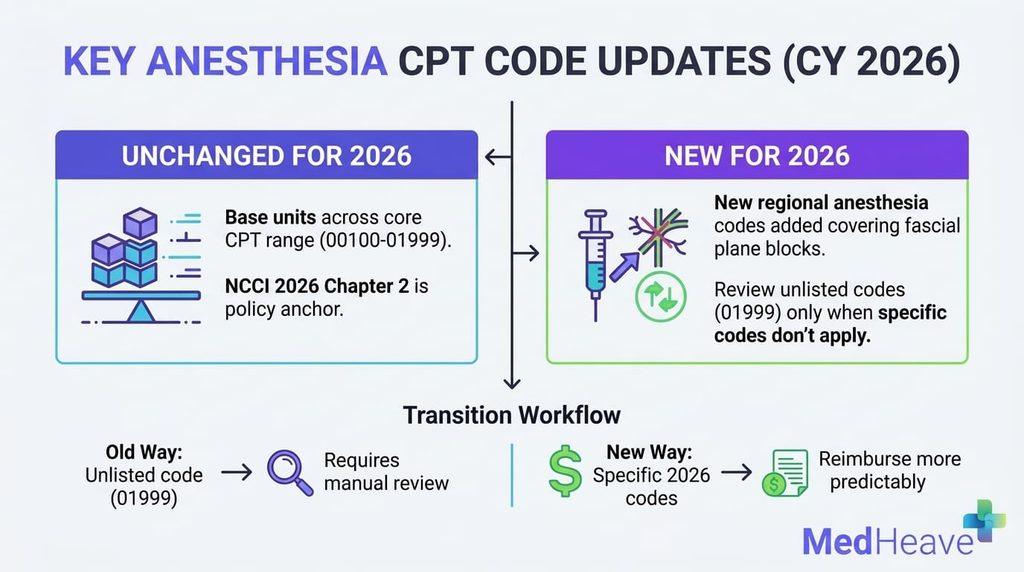
Base units across the core anesthesia CPT code range (00100 to 01999) are unchanged for CY 2026.
The AMA CPT 2026 release, which added 288 new codes across all specialties, included new regional anesthesia codes covering fascial plane blocks, as reported by Kim et al. (2025).
These new codes provide specific reportable codes for procedures previously billed under unlisted codes.
CMS NCCI 2026 Chapter 2 is the current policy anchor for anesthesia code pairs and unbundling rules.
Practices using unlisted anesthesia procedure codes (01999) for fascial plane blocks should review whether a specific 2026 code now applies, specific codes reimburse more predictably and reduce the manual review burden that accompanies unlisted code submissions.
Stop anesthesia billing errors before they cost you revenue
Even small anesthesia coding mistakes can trigger denials, underpayments, or audit exposure.
From CPT code selection and modifier accuracy to time-unit documentation and payment calculations, every detail affects reimbursement.
MedHeave helps anesthesia providers and billing teams:
- Reduce claim denials and payment delays
- Strengthen documentation for audit readiness
- Optimize anesthesia reimbursement across payers
- Improve anesthesia coding accuracy and compliance
- Validate modifiers, base units, and qualifying circumstances
Protect your revenue, reduce billing risk, and keep every anesthesia claim defensible. Contact MedHeave to strengthen your anesthesia billing workflow.
Related guides & resources
The resources below cover closely related topics and the broader service workflow they connect to:
- Anesthesia billing services — Anesthesia billing services
- Anesthesia billing 101 — How to Do Anesthesia Billing: Essential Tips for Billers and Coders
- Modifiers in medical billing — Modifiers in Medical Billing: What They Are, How They Work, & When To Use Them
- Modifiers 59 25 91 — Modifier 59 Explained: Usage, Examples & NCCI Rules
- Medical coding — Medical Coding 101: The Ultimate Guide
Frequently asked questions
Here are some commonly asked questions on this topic:
There is no single CPT code for general anesthesia. Anesthesia CPT codes (00100 to 01999) are selected based on the surgical procedure performed, not the anesthesia type. General, regional, and MAC are all reported under the same procedure-based code. The anesthesia method is communicated through the provider role modifier.
The CPT code for the exam under anesthesia depends on the body area and procedure being examined. Identify the surgical CPT code for the examination procedure, then use the ASA Crosswalk to locate the corresponding anesthesia code. There is no single universal exam-under-anesthesia code.
Divide total anesthesia minutes by 15. Anesthesia time begins when the practitioner starts preparing the patient for induction and ends when the practitioner transfers care to post-anesthesia personnel. Both times must be documented in the anesthesia record. Rounding or estimating either time point is an audit risk.
Yes, in states that have opted out of the CMS physician supervision requirement. CRNA billing without physician direction uses modifier QZ. In states that require supervision, the CRNA bills QX (with direction) alongside the directing physician’s QK or QY claim. The modifier pairing must be consistent across both claims.
MAC is an anesthesia service delivered by an anesthesia professional, billed under the 00100 to 01999 range with modifier QS. Moderate sedation (99151 to 99157) is typically delivered by the proceduralist. The depth of service, provider type, and payment methodology are different. Billing one under the code set of the other is a misbilling error with compliance implications.
“ASA codes” may refer to anesthesia procedure codes or American Society of Anesthesiologists Physical Status classifications. These are different concepts: CPT anesthesia codes identify procedures, while Physical Status classifications describe the patient’s preanesthesia health status. Confirm which terminology is intended before selecting a code.
There is no universal CPT code for administering local anesthesia in every procedure. Local anesthetic administration is often included in the primary procedure’s payment, depending on the service and payer rules. Separate reporting is appropriate only when an applicable code and reporting requirements support it.