



The ICD-10-CM code for unspecified anemia is D64.9 — a billable code used when the provider documents anemia without specifying a type or cause.
But D64.9 is also one of the most scrutinized codes in claim submissions, and defaulting to it when documentation supports a more specific code leads to preventable denials.
Anemia ICD-10 codes fall within the D50-D64 range in Chapter 3 of the ICD-10-CM classification (diseases of the blood and blood-forming organs).
The rest of this guide covers the codes you’ll actually need, organized by the scenarios that most often trip up coders and providers. Here’s what we are going to look at:
- When D64.9 is appropriate and when it’s not
- A documentation checklist for cleaner claims
- Common anemia ICD-10 codes in a quick-reference table
- Sequencing rules for neoplasm and therapy-related anemia
- Code-by-scenario breakdowns for iron deficiency, CKD, chronic disease, chemotherapy, and more
TLDR
D64.9 covers anemia, unspecified. Use it only when the record doesn’t identify a specific anemia type or cause. For iron deficiency anemia, use D50.9 (unspecified) or D50.0 (chronic blood loss).
For anemia in chronic kidney disease, use D63.1 with the appropriate N18 stage code. For anemia in neoplastic disease, use D63.0 sequenced after the malignancy code.
For chemotherapy-induced anemia, use D64.81 sequenced first, followed by the neoplasm code and adverse effect code T45.1X5-.
Code assignment depends on provider documentation — lab results alone don’t determine the code per FY 2026 ICD-10-CM Official Guidelines.
Reduce how often your claims lean on D64.9
MedHeave audits anemia claims for documentation gaps and flags cases where a cause-specific code — like D50.9 or D63.1 — was available but not used.
What are the most common anemia ICD-10 codes?
Most anemia coding errors come down to picking D64.9 when a more specific code fits.
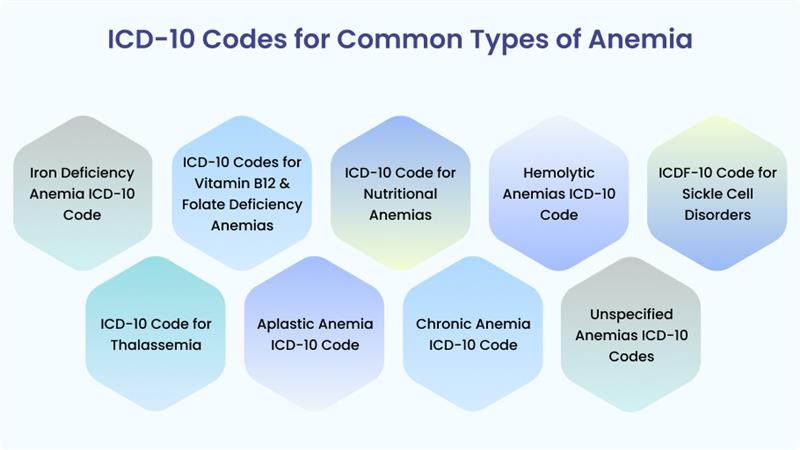
The table below covers the codes that handle the majority of real-world anemia encounters.
| Anemia type | ICD-10-CM code | When to use |
| Anemia, unspecified | D64.9 | Anemia documented without a specific type or cause |
| Iron deficiency anemia, unspecified | D50.9 | Iron deficiency anemia documented without further detail |
| Iron deficiency anemia, chronic blood loss | D50.0 | Chronic blood loss identified as the cause |
| Acute posthemorrhagic anemia | D62 | Acute blood loss anemia documented |
| Pernicious anemia | D51.0 | Pernicious anemia documented (intrinsic factor deficiency) |
| Vitamin B12 deficiency anemia, unspecified | D51.9 | B12 deficiency anemia without additional detail |
| Folate deficiency anemia, unspecified | D52.9 | Folate deficiency anemia documented |
| Nutritional anemia, unspecified | D53.9 | Nutritional anemia without further specificity |
| Anemia in neoplastic disease | D63.0 | Anemia documented as due to malignancy |
| Anemia in chronic kidney disease | D63.1 | Anemia documented as due to CKD |
| Anemia in other chronic diseases | D63.8 | Anemia linked to another chronic disease classified elsewhere |
| Anemia due to antineoplastic chemotherapy | D64.81 | Anemia caused by chemotherapy, with specific sequencing rules |
| Other specified anemias | D64.89 | A specified anemia that doesn’t have a more specific code |
Provider documentation determines which code applies — not the lab values alone. The FY 2026 ICD-10-CM Guidelines make that explicit.
When is D64.9 appropriate for anemia coding?
D64.9 (anemia, unspecified) isn’t inherently wrong. But it should be the fallback, not the default. In practice, most charts contain enough detail to support a more specific code — the issue is usually that coders don’t query providers when the documentation is vague.
Anemia documented without cause
When the record says only “anemia” or “anemia NOS” with no lab interpretation, no etiology, and no linkage to another condition, D64.9 is the correct assignment.
Chronic anemia without etiology
“Chronic anemia” alone doesn’t automatically point to a cause-specific code. If the documentation never identifies iron deficiency, CKD, blood loss, malignancy, or another driver, D64.9 may still apply. But if CKD, a malignancy, or a nutritional deficiency appears anywhere in the chart, a query to the provider is worth the effort (and usually yields a more specific code).
Normocytic or normochromic anemia
Morphology descriptors like “normocytic normochromic anemia” describe the cell shape and color — not the cause. Unless the provider documents a specific etiology alongside the morphology, D64.9 may be the best available option.
Low hemoglobin without diagnosis
“Low hemoglobin” on a lab report is not the same as a documented anemia diagnosis. If the provider hasn’t interpreted the lab finding as anemia in their assessment, the coder shouldn’t assign an anemia code based on the lab alone.
When should you avoid D64.9?
Payer review teams flag D64.9 because it often signals incomplete documentation or lazy code selection — and the reimbursement difference between unspecified and cause-specific anemia codes can be significant, especially in risk-adjusted payment models like HCC.
Iron deficiency anemia
When the provider documents iron deficiency anemia (IDA), use D50.9 for unspecified IDA or D50.0 when chronic blood loss is the documented cause. D50.1 applies to sideropenic dysphagia (Plummer-Vinson syndrome), and D50.8 covers other specified iron deficiency anemias. Ferritin and transferrin saturation results can support the diagnosis, but the code follows the provider’s assessment — not the lab panel.
Acute blood loss anemia
D62 covers acute posthemorrhagic anemia, which is distinct from chronic blood loss iron deficiency (D50.0). The acute vs. chronic distinction changes the code entirely, so documentation should specify the timeline.
Anemia in CKD
D63.1 is the anemia-in-CKD code. It requires an additional CKD stage code from the N18 category (N18.1 through N18.6, or N18.9 for unspecified stage). The CKD code is sequenced first, then D63.1. Failing to link these two conditions is one of the most common anemia coding errors — and it directly affects HCC risk adjustment scoring for Medicare Advantage patients.
Anemia in neoplastic disease
D63.0 applies when the anemia is due to the malignancy itself. Per the FY 2026 ICD-10-CM Guidelines, when the encounter is for anemia management associated with the malignancy, and only the anemia is treated, the malignancy code is sequenced first, followed by D63.0.
Chemotherapy-induced anemia
Anemia caused by antineoplastic chemotherapy uses D64.81 — not D64.0 (which is hereditary sideroblastic anemia, a completely different condition). When the encounter is specifically for managing anemia due to chemotherapy or immunotherapy, the sequencing flips from neoplasm-related anemia.
D64.81 is sequenced first, followed by the neoplasm code and the adverse effect code T45.1X5- for antineoplastic and immunosuppressive drugs.
Which anemia ICD-10 code fits each search scenario?
Coders and providers often search for anemia codes using clinical terms that don’t map neatly to a single code. Here’s how the most common search scenarios resolve.
Severe anemia
“Severe” describes severity, not etiology. ICD-10-CM doesn’t have a separate code for severe anemia — the code depends on the documented type or cause. If no type or cause is documented beyond “severe anemia,” D64.9 may apply, but querying the provider for the underlying condition is the better path.
Symptomatic anemia
If anemia is diagnosed, code the anemia. Symptoms like fatigue (R53.83) or dizziness (R42) may be coded separately only when documented as standalone clinical concerns that aren’t fully captured by the anemia diagnosis.
Low hemoglobin
A low hemoglobin finding on a CBC doesn’t automatically generate an anemia code. Code assignment requires the provider to document anemia as a diagnosis. If documented only as “low hemoglobin” without interpretation, follow up with the provider before assigning D64.9.
Macrocytic anemia
Macrocytic anemia may be related to B12 deficiency (D51 codes), folate deficiency (D52 codes), nutritional anemia (D53 codes), or other causes. The lab morphology doesn’t determine the code — the provider’s documented cause does.
Pernicious anemia
D51.0 applies when the provider documents pernicious anemia (B12 deficiency anemia due to intrinsic factor deficiency, often associated with autoimmune gastritis).
What are the ICD-10-CM sequencing rules for anemia?
Sequencing determines which diagnosis code appears first on the claim, and it varies depending on the clinical relationship.
For most “anemia due to underlying condition” scenarios, the underlying condition is sequenced first, and the anemia code follows. The exception is therapy-related anemia (chemotherapy, immunotherapy, radiation), where the encounter is specifically for managing the anemia — in those cases, the anemia code leads the claim.
Getting this wrong changes how the payer interprets the encounter and can shift reimbursement, especially in risk-adjusted models.
What should the documentation checklist look like?
Good anemia coding starts with good documentation. If the chart answers these questions, the coder has enough to assign a specific code and defend it on review.
- Is the cause or etiology stated?
- Is blood loss identified as acute or chronic?
- Is the anemia acute, chronic, or unspecified?
- Is a medication effect or an adverse reaction involved?
- Has the provider clearly worded the diagnosis, or does the coder need to query?
- Is the anemia linked to CKD, malignancy, chemotherapy, immunotherapy, or radiation?
- Is iron, B12, folate, or another nutritional deficiency documented?
- Is the type of anemia documented in the assessment?
- Is pregnancy or postpartum status involved?
- Is the CKD stage documented (for D63.1)?
When documentation is vague, a clinical documentation improvement (CDI) query to the provider usually resolves the ambiguity faster than an appeal after a denial.
Quick clinical context for coders
Anemia occurs when hemoglobin levels or red blood cell counts drop below normal thresholds, reducing the blood’s oxygen-carrying capacity. Common symptoms include:
- Fatigue
- Dizziness
- Palpitations
- Shortness of breath
- Weakness
- Pale skin
The symptoms don’t determine the ICD-10 code — the documented type and cause do.
Common anemia categories include:
- Iron deficiency anemia
- Thalassemia (D56 codes)
- Sickle cell disorders (D57 codes)
- Anemia of chronic disease (often linked to CKD, cancer, or autoimmune conditions)
- Hemolytic anemia (where red blood cells are destroyed faster than they’re produced)
- Aplastic anemia (bone marrow failure)
- Vitamin B12 deficiency anemia
- Folate deficiency anemia
- Blood loss anemia
Different sources group anemia types differently, so the “7 types of anemia” phrasing seen in search results is an oversimplification.
A brief note on international search terms — “anaemia” is the standard British spelling and maps to the same ICD-10-CM codes. CIE-10 is the Spanish abbreviation for ICD-10. ICD-10-CM is the U.S. clinical modification, and code assignments may differ slightly from international ICD-10 versions used in other countries.
How can Medheave help with anemia coding accuracy?
Anemia-related denials often stem from documentation gaps and coding specificity issues that compound across hundreds of claims per month.
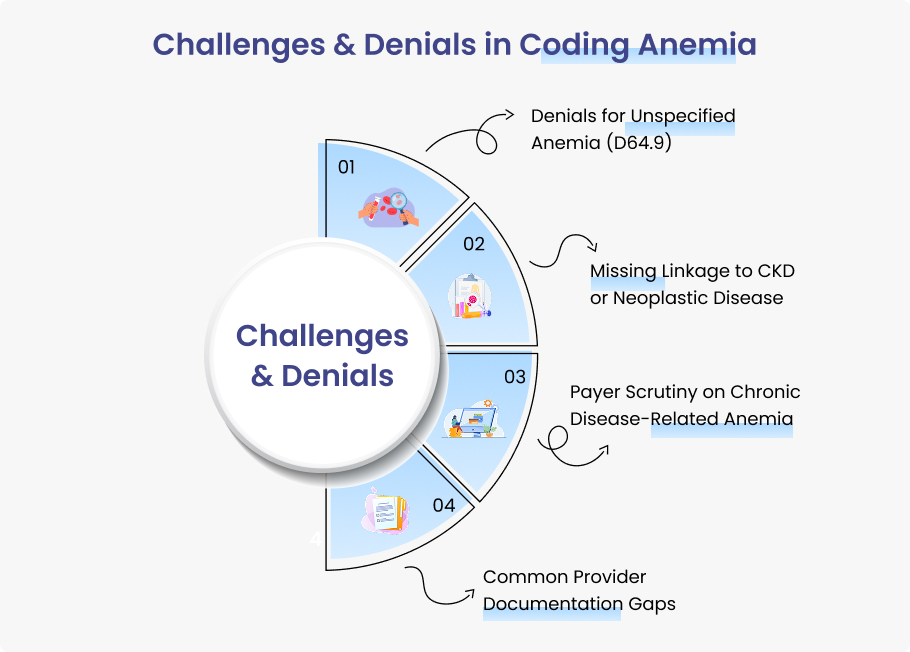
Medheave’s certified coders handle the ICD-10-CM specificity, sequencing, and payer-level documentation requirements so your billing team isn’t chasing preventable appeals.
- Accurate anemia code selection across all D50-D64 categories
- CDI support for linking anemia to CKD, malignancy, and therapy
- Denial trend analysis for anemia-related claim rejections
- Coding audits to identify patterns of D64.9 overuse
Contact Medheave for a coding accuracy review.
Related guides & resources
The resources below cover closely related topics and the broader service workflow they connect to:
- Medical coding services — Medical coding services
- Urology billing CPT codes — CPT Code 52234: TURBT Billing & Urology Coding Guide
- Laser therapy CPT codes — Laser Therapy CPT Codes & Billing 101
- Tick removal coding — ICD-10 Code for Tick Bite & Tick Removal: Diagnosis, CPT, & Billing
- CPT codes for inpatient rehab — CPT Code for Inpatient Rehab (2026): IRF CPT Codes & Billing
- CPT codes for mental health billing — Common CPT Codes for Mental Health Billing
- CPT code 90471 — CPT 90471 Explained: Billing, Modifiers & Medicare
Frequently asked questions
Here are some commonly asked questions about Anemia ICD-10 codes:
The ICD-10-CM code for unspecified anemia is D64.9. It’s a billable code used when the provider documents anemia but doesn’t specify the type or underlying cause. While D64.9 is valid, payers often review it more closely than cause-specific codes like D50.9 (iron deficiency) or D63.1 (anemia in CKD). Assigning the most specific code supported by documentation reduces denial risk and supports better risk adjustment accuracy for value-based payment models.
Iron deficiency anemia (IDA) is coded under the D50 category. D50.9 applies to unspecified iron deficiency anemia. D50.0 applies when chronic blood loss is the documented cause, such as from GI bleeding or heavy menstruation. D50.1 covers sideropenic dysphagia (Plummer-Vinson syndrome), and D50.8 covers other specified iron deficiency anemias. The provider’s documented cause — not the ferritin level alone — determines which code to assign.
Anemia in CKD is coded as D63.1, with an additional code from the N18 category for the CKD stage (N18.1 through N18.6, or N18.9 for unspecified stage). The CKD code is sequenced first, followed by D63.1. The provider must document the causal relationship between CKD and the anemia — having both conditions in the chart without documented linkage doesn’t automatically justify D63.1. Erythropoietin deficiency in CKD is the typical mechanism, but the code assignment follows the provider’s clinical statement.
ICD-10-CM doesn’t have a standalone code for “severe anemia.” Severity qualifiers like mild, moderate, or severe don’t generate separate anemia codes. The code depends on the documented anemia type and cause. If the chart says only “severe anemia” without identifying the type (iron deficiency, blood loss, CKD-related, etc.), D64.9 may apply — but a provider query to clarify the etiology is the better approach. Severity may affect clinical decision-making, but it doesn’t change the ICD-10 category.
D64.9 signals that the documentation didn’t identify a specific anemia type or cause. Payers — especially Medicare and risk-adjusted plans — review unspecified codes more closely because specificity affects reimbursement accuracy, HCC risk scoring, and quality metrics. A D64.9 claim isn’t automatically denied, but it may trigger additional documentation requests or be flagged in post-payment audits. The simplest prevention is documenting the anemia etiology clearly in the assessment and linking it to any underlying condition present in the chart.
Anemia of chronic disease (also called anemia of chronic inflammation) maps to the D63 category when the chronic disease is classified elsewhere. D63.1 covers anemia in CKD. D63.0 covers anemia in neoplastic disease. D63.8 covers anemia in other chronic diseases classified elsewhere, such as rheumatoid arthritis or chronic infections. The chronic disease code is sequenced first, followed by the D63 code. If “chronic anemia” is documented without any linked condition, D64.9 may be the only supported code.
D50.9 represents iron deficiency anemia, unspecified. D50.0 applies to iron deficiency anemia secondary to chronic blood loss, while D50.8 covers other iron deficiency anemias. Select the code that matches the documented diagnosis and cause, following the applicable ICD-10-CM instructions.
D64.9 (Anemia, unspecified) may be appropriate when normocytic anemia is documented without a more specific diagnosis or cause. If the provider identifies an underlying condition, code selection should reflect that documentation and the applicable coding guidelines.
D53.9 (Nutritional anemia, unspecified) is the indexed code for macrocytic anemia not otherwise specified. If the provider documents a specific cause, such as vitamin B12 deficiency, review the applicable code and documentation requirements rather than automatically assigning D53.9.