




ABN stands for Advance Beneficiary Notice of Noncoverage — a CMS-required notice (Form CMS-R-131) that healthcare providers give to Original Medicare beneficiaries before a service is provided when the provider believes Medicare is likely to deny payment. The ABN is not a bill and not a denial — it is a financial warning that transfers potential liability to the patient if Medicare does not pay.
The original article shortened the name to “Advance Beneficiary Notice” (missing “of Noncoverage”), described the ABN as a form “sent to the payer” (it is given to the patient), listed it as applicable to commercial insurance (it applies only to Original Medicare), and misnumbered the Medicare appeal levels. All have been corrected.
In this read, we’ll touch upon:
- When an ABN is required and when it is not
- How modifiers GA, GZ, GX, and GY connect to ABN status
- What makes an ABN invalid (and why that shifts liability back to the provider)
- The five levels of Medicare appeals after a denial
- What happens if the patient refuses to sign
How does an ABN work?
The ABN is fundamentally a financial liability transfer document. Without a valid ABN, the provider generally cannot bill the patient for a service that Medicare denies. With a valid ABN signed before the service, the patient accepts potential financial responsibility if Medicare does not pay.
The sequence works like this:
How do patients choose between the three ABN options?
When an Advance Beneficiary Notice (ABN) is issued, the patient must choose how they want to proceed. Each option carries different implications for service delivery, Medicare billing, and financial responsibility, making it important to understand what each selection means before treatment is provided.
Option 1: Receive the service and bill Medicare
The patient wants the service and requests that a claim be submitted to Medicare. If Medicare pays, the patient owes any applicable cost-sharing. If Medicare denies coverage, the patient is responsible for the full cost.
Option 2: Receive the service without billing Medicare
The patient wants the service but does not want a claim submitted to Medicare. The patient agrees to pay out of pocket, and no Medicare claim is filed.
Option 3: Decline the service
The patient chooses not to receive the service. No service is provided and no claim is submitted.
The patient’s selection determines billing requirements
The option selected on the ABN directly affects claim submission procedures and determines which modifier, if any, should be reported on the claim.
When is an ABN required?
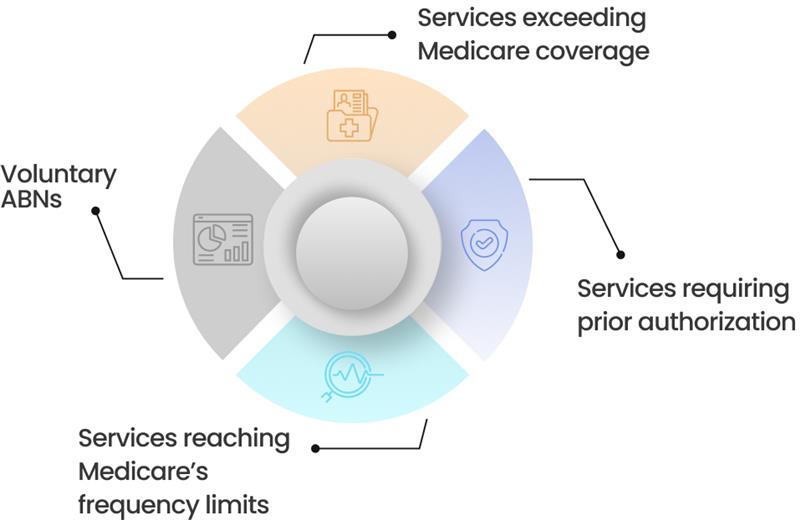
ABNs are required for services that Medicare sometimes covers but may deny in a specific clinical situation.
The provider has reason to believe — based on coverage rules, frequency limits, or medical necessity criteria — that Medicare will likely not pay for this particular service for this particular patient.
Medical necessity concerns
The provider expects Medicare to deny because the diagnosis does not support the ordered service under the applicable Local Coverage Determination (LCD) or National Coverage Determination (NCD). Lab tests ordered without a supporting ICD-10 code that meets the LCD criteria are the most common example.
Frequency limitations exceeded
The patient already received the same service within the Medicare-allowed interval.
Annual screening labs, preventive colonoscopies, and wellness visits all have defined frequency rules. If the patient requests the service again before the interval resets, an ABN is required.
Diagnosis-to-service mismatch
The ICD-10 code linked to the ordered service does not appear on the payer’s covered diagnosis list for that CPT code. The service may be clinically appropriate, but the diagnosis does not meet Medicare’s medical necessity definition for that specific test or procedure.
DME and supply limitations
Medicare has specific coverage criteria for durable medical equipment (CPAP machines, wheelchairs, oxygen equipment). If the patient does not meet the coverage requirements or is requesting a replacement before the allowed timeframe, an ABN is required before the item is provided.
When is an ABN not required?
This is where the original article made errors. ABNs are not required — and should not be issued as mandatory notices — in several common situations.
Statutorily excluded services
Services that Medicare never covers by law (cosmetic surgery, routine dental, routine vision exams, hearing aids) do not require a mandatory ABN.
The provider may issue a voluntary notice as a courtesy, but CMS does not mandate it. The original article incorrectly stated ABNs are required for cosmetic procedures — they are not.
Routine cost-sharing
ABNs are not used to inform patients about standard copayments, coinsurance, or deductibles. The original article incorrectly included cost-sharing obligations as an ABN use case. ABNs address potential noncoverage, not routine patient financial responsibility under a covered benefit.
Emergency services
In genuine emergencies, providers are generally not expected to delay care to issue an ABN. CMS recognizes that emergency situations may prevent the standard pre-service notification process.
Medicare Advantage patients
ABNs apply to Original Medicare (Parts A and B fee-for-service). Medicare Advantage plans — administered by private insurers — use their own notification requirements and coverage determination processes. The standard CMS-R-131 ABN form does not apply to MA plan beneficiaries.
What makes an ABN invalid?
An invalid ABN shifts financial liability back to the provider. If Medicare denies the claim and the ABN is found to be invalid, the provider cannot legally bill the patient — the provider absorbs the cost. CMS is specific about what invalidates an ABN.
Signed after the service
The ABN must be presented and signed before the service is provided. A signature obtained after the patient has already received care is invalid because the patient did not have the opportunity to make an informed decision beforehand.
Blanket or generic wording
CMS explicitly prohibits blanket ABNs — generic notices that cover “all services” or are signed as a routine part of registration.
Each ABN must identify the specific service, the specific reason Medicare may deny it, and the estimated cost for that service.
A form that says “Medicare may not pay for some of your services” without identifying which service and why is invalid.
Missing estimated cost
The ABN must include a good-faith estimate of what the patient may owe if Medicare denies the claim. A blank cost field — or one filled with “unknown” — weakens the ABN’s validity because the patient could not make a fully informed financial decision.
Vague denial reason
The ABN must state why Medicare may deny the specific service. “May not be covered” without further explanation is insufficient. The reason should reference the applicable coverage rule (frequency limit, LCD criteria, medical necessity requirement).
Liability consequences
Who pays when Medicare denies the claim?
The ABN’s validity determines whether the provider or the patient absorbs the cost.
How do ABN modifiers work?
ABN status directly determines which modifier is appended to the claim. The modifier tells Medicare whether a valid ABN was obtained, which affects how the denial is processed and who is financially liable.
| Modifier | ABN status | What it signals to Medicare | Financial consequence |
| GA | Valid ABN on file | Provider expects denial and has proper waiver | Patient may be billed if denied |
| GZ | No ABN obtained | Provider expects denial but has no waiver | Provider is financially liable |
| GX | Voluntary notice for excluded service | Service is statutorily excluded from Medicare | Patient informed as courtesy |
| GY | Service excluded by statute | Medicare never covers this service | Patient is responsible (no ABN needed) |
GA is the modifier that protects the provider. When a valid ABN is on file and modifier GA is appended to the claim, the provider has documented informed financial consent. If Medicare denies the claim, the patient is responsible for payment.
GZ is the modifier that exposes the provider. When the provider expects denial but did not obtain a valid ABN, modifier GZ signals that the provider is financially liable. Medicare denies the claim, and the provider cannot legally bill the patient. The cost becomes a provider write-off.
Submitting a claim without any ABN modifier when an ABN should have been issued — or using GA without a valid ABN on file — creates audit exposure. Medicare compliance audits specifically review GA modifier usage against ABN documentation.
Can the patient still appeal after signing an ABN?
Yes. Signing an ABN does not waive the patient’s right to appeal a Medicare denial. If the patient selected Option 1 (proceed with service and bill Medicare), the claim is submitted to Medicare. If Medicare denies the claim, the patient can appeal the denial through the standard Medicare appeals process.
The five levels of Medicare appeals (corrected from the original article, which misnumbered them).
- Level 1 — Redetermination by the Medicare Administrative Contractor (MAC)
- Level 2 — Reconsideration by a Qualified Independent Contractor (QIC)
- Level 3 — Administrative Law Judge (ALJ) hearing
- Level 4 — Medicare Appeals Council review
- Level 5 — Federal district court judicial review
The original article listed reconsideration as the first level and ALJ as the second. Redetermination is the first level — it is processed by the MAC that originally adjudicated the claim.
What if the patient refuses to sign?
A patient who refuses to sign the ABN has not agreed to accept financial responsibility. The provider has two options.
- Provide the service anyway, accepting the risk that Medicare will deny and the provider cannot bill the patient (because no valid ABN exists)
- Decline to provide the service (the patient can seek care elsewhere)
The provider should document the refusal — noting that the ABN was presented, the patient was given the opportunity to review it, and the patient declined to sign. Some providers note on the ABN form that the patient refused to sign, with the date and a witness signature, to demonstrate that the notice was properly offered.
Stop losing revenue to invalid ABNs and missing modifiers
ABN compliance is one of the most audited areas in Medicare billing because invalid notices shift thousands of dollars in liability from patients back to providers. Every ABN that is signed after the service, issued with generic wording, or submitted with modifier GZ instead of GA represents revenue the practice earned, delivered, and then lost because the paperwork was wrong.
- Issue ABNs before the service — never after
- Never use blanket ABNs at registration — CMS prohibits them
- Append modifier GA to every claim where a valid ABN is on file
- Train front-desk staff on which services trigger ABN requirements under LCDs and NCDs
- Include the specific service, the specific denial reason, and the estimated cost on every form
Contact MedHeave to build ABN compliance into your Medicare billing workflow — and stop writing off denied claims that a valid notice would have made collectible.
Related guides & resources
The resources below cover closely related topics and the broader service workflow they connect to:
- Medical billing services — Medical billing services
- Charge entry — Charge Entry in Medical Billing: Process & Best Practices
- Charge posting — Charge Posting in Medical Billing: Workflow, & Revenue Impact
- Payment posting — Payment Posting & Reconciliation in Medical Billing
- Clean claims — Clean Claim Explained in Medical Billing Context
- A superbill — Superbill in Medical Billing: A Complete Guide for Practices
- A CMS 1500 form — CMS-1500 Form (HCFA-1500): Boxes, PDF, Instructions & Errors
- POS 11 — POS 11 Explained: Reimbursement, Rules & Errors
Frequently asked questions
Here are some commonly asked questions on this topic:
ABN stands for Advance Beneficiary Notice of Noncoverage. It is a CMS-required notice (Form CMS-R-131) issued to Original Medicare beneficiaries before a service is provided when the provider believes Medicare is likely to deny payment. The ABN informs the patient of the potential denial, the estimated cost, and the patient’s options — including whether to proceed with the service and accept potential financial responsibility. The full name includes “of Noncoverage” — the original article shortened it to “Advance Beneficiary Notice,” which is incomplete.
An ABN is required when the provider expects Medicare to deny a service that Medicare sometimes covers — due to medical necessity concerns, frequency limitations, diagnosis-to-service mismatches, or DME coverage criteria. ABNs are not required for services Medicare never covers by statute (cosmetic surgery, routine dental), for routine cost-sharing notifications (copays, deductibles), or for Medicare Advantage patients (MA plans use separate notification processes).
If a valid ABN is not obtained and Medicare denies the claim, the provider generally cannot bill the patient. The provider absorbs the cost as a write-off. Modifier GZ is used to indicate that the provider expected denial but did not obtain an ABN — signaling that the provider accepts financial liability. Without a valid ABN, the patient is protected from unexpected charges, and the provider bears the financial loss.
ABNs apply to Original Medicare (Parts A and B fee-for-service) only. Medicare Advantage plans use their own coverage determination and notification processes — the standard CMS-R-131 form does not apply. Commercial insurance payers have their own notification and authorization procedures that are separate from the Medicare ABN process. Some Medicaid programs have similar notice requirements, but these vary by state.
Modifier GA means a valid ABN is on file — the provider expects Medicare to deny the service and has obtained the patient’s informed financial consent. If denied, the patient may be billed. Modifier GZ means the provider expects denial but did not obtain a valid ABN — the provider accepts financial liability and generally cannot bill the patient. GA protects the provider. GZ exposes the provider. The choice of modifier must match the actual ABN documentation on file.
Yes. Signing an ABN does not waive the patient’s right to appeal. If the patient selected Option 1 (proceed with service and bill Medicare), the claim is submitted. If Medicare denies, the patient can pursue the five-level Medicare appeals process — redetermination (MAC), reconsideration (QIC), ALJ hearing, Medicare Appeals Council, and federal court. Appeals are appropriate when the patient or provider believes the service should have been covered under Medicare rules.