
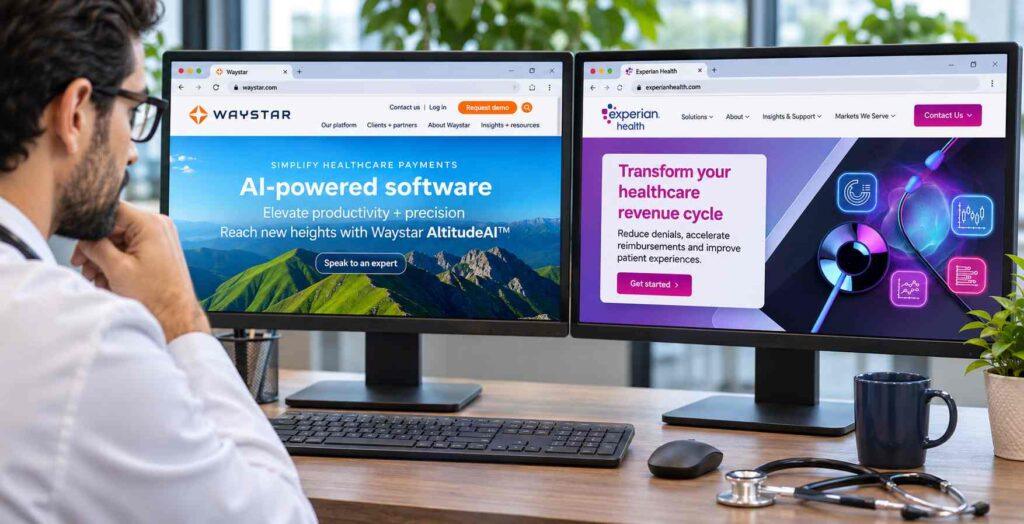


In February 2024, a cyberattack on Change Healthcare disrupted claims processing and payments for providers across the U.S., with consequences HHS described as widespread. Few people think about revenue cycle software until it stops working, and then nobody thinks about anything else.
The problem is rarely that an organization buys bad revenue cycle management software.
The problem is that most buyers judge the dashboard in the demo, then discover later which tasks the software actually performs, which ones still need staff, and whether “service” means automation or an actual team of people.
A slick demo tells you almost nothing about:
- How claims get corrected
- Who gets to submit the appeal
- Or what happens when your clearinghouse goes dark on a Tuesday (ask anyone who lived through the 2024 Change Healthcare outage)
The best healthcare revenue cycle management software comes with clear answers to all three. So to help you out, in this article, we’ll be exploring the following questions:
- Features, pricing, and fit of 10 RCM platforms
- How outsourced RCM works with existing software
- AI-powered claims, appeals, and coding capabilities
- 2025–2026 acquisitions and product launches
- Capterra and G2 user reviews and ratings
Quick skim: 10 RCM software platforms compared
The table shows each platform’s primary fit, pricing, and the documented capability that separates it from the pack. Most RCM software vendors quote individually, so only two figures here are dollar amounts, and one of those is an estimate.
| RCM Software | Best Fit | Pricing Model | Distinguishing Capability |
| Waystar | Practices to health systems | Custom quote, by contracted products and fee structure | Automated appeal drafting and submission, plus Iodine clinical AI |
| Experian Health | Hospitals and large groups | Custom quote, estimated from $50,000 per feature per year | Patient access plus denial, claim status, and contract tools |
| FinThrive | Health systems | Custom quote | Broad enterprise RCM suite |
| Optum (Change Healthcare) | Organizations of all sizes | Custom quote, by software, volume, and services | National clearinghouse scale |
| Epic Resolute | Health systems on Epic | Custom licensing within an Epic agreement | Billing built into the clinical record |
| Inovalon | Post-acute and provider organizations | Custom quote | ABILITY Network connectivity |
| ImagineSoftware | Radiology, anesthesia, pathology, emergency groups | Custom quote | High-volume specialty billing automation |
| AKASA | Health systems | Custom quote | Autonomous inpatient coding and CDI |
| MDClarity | Practices and health systems | Custom quote, software or managed recovery | RevFind agentic AI plus underpayment recovery specialists |
| Infinx | Providers with heavy authorization and RCM workloads | From $5,000/month (Patient Access Plus, annual), others custom quote | AI automation plus end-to-end outsourced RCM teams |
1. Waystar
Waystar is a cloud revenue cycle platform covering eligibility, claims, denial prevention, prior authorization, and patient payments. It went public on Nasdaq in June 2024.
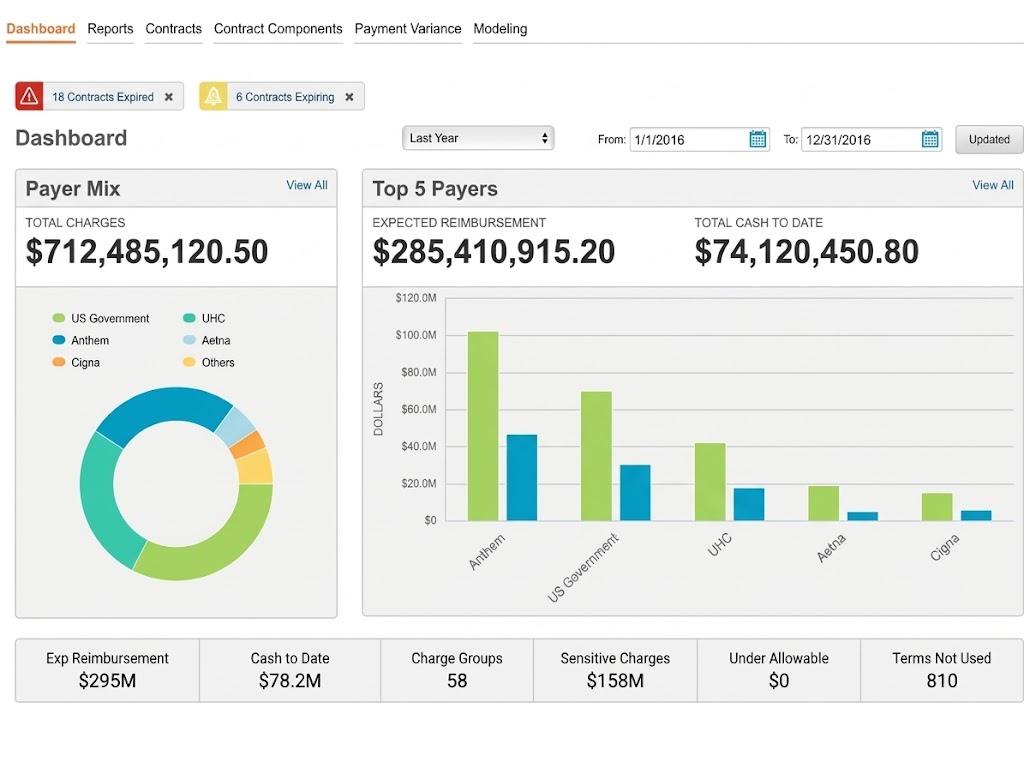
Waystar completed its acquisition of Iodine Software on October 1, 2025, folding Iodine’s clinical AI into its broader clinical and financial intelligence offering. It’s no longer just an announced deal sitting in a press release.
Waystar, Denial + Appeal Management can draft appeal letters automatically and support electronic appeal submission, so some denials get worked before a human has finished their first coffee.
Key features
Waystar works the claim from both ends.
- Claim scrubbing and clearinghouse connectivity
- Denial + Appeal Management with automated appeal drafting and submission
- Eligibility and prior authorization automation
- Clinical AI from Iodine Software
- Patient payment tools
Pricing
Waystar prices through custom quotes. Its SEC filings describe volume-based revenue, but contracts can also include recurring subscriptions, usage commitments, and other negotiated terms, so cost depends on the products and fee structure you sign.
Pros and cons
Broad automation, with a contract worth reading twice.
| Pros | Cons |
| Automated appeal drafting and submission | Configuration takes effort |
| Broad coverage across the revenue cycle | Reviewers flag auto-renewals and price increases |
| Iodine clinical AI now integrated | Fee structure varies by contract |
User reviews about Waystar
As of October 2026, Waystar holds a 4.4/5 overall rating from 214 reviews on Capterra, with a 4.3/5 customer service score and a 4.4/5 ease-of-use score.
Reviewers generally appreciate the claims management, billing automation, reporting, and a fairly friendly interface.
The criticism centers on slow support responses, delayed claim processing, unresolved tickets, and contract terms such as automatic renewals and price increases.
The 4.3/5 support score says most reviewers are happy, but the unhappy ones are specific about waiting. Waystar suits organizations that want to automate claims and payment workflows, as long as they read the service agreement before the renewal date reads them.
2. Experian Health
Experian Health is best known for patient access, including identity verification, eligibility, coverage discovery, and patient estimates. That’s where it started, not where it stops.
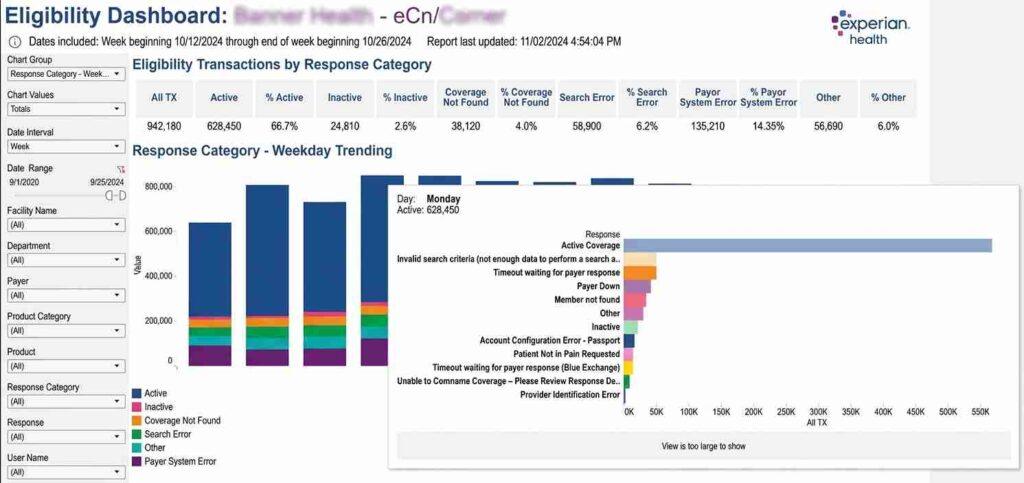
On the back end, Experian offers Denial Workflow Manager, Enhanced Claim Status, ClaimSource, and AI Advantage, which support denial identification, automated prioritization, AR follow-up workflows, and claim correction and resubmission. Its Contract Manager and Contract Analysis products audit payer reimbursement against contract terms, identify underpayments, and model contract changes.
Key features
Experian covers front-end accuracy and back-end recovery.
- Enhanced Claim Status
- Eligibility, identity verification, and coverage discovery
- ClaimSource claim scrubbing, correction, and resubmission
- Denial Workflow Manager and AI Advantage denial prediction
- Contract Manager and Contract Analysis for underpayment detection
Pricing
Experian Health doesn’t publish fixed prices on its website.
It follows a SaaS model with pricing customized to organizational requirements and selected services, and starting prices are estimated at about $50,000 per feature, per year.
Per feature is the phrase to underline. Buying three or four products from the list above adds up fast, so price the bundle you’ll actually use.
Pros and cons
Strong data at both ends of the cycle, with a price tag sized for larger organizations.
| Pros | Cons |
| Coverage discovery finds missed insurance | Estimated $50,000+ per feature per year |
| Denial, claim status, and contract tools | Built mainly for larger organizations |
| Underpayment detection against contract terms | Integration complexity |
User reviews about Experian Health
As of November 2026, Capterra lists no verified reviews for Experian Health’s revenue cycle products.
Its Experian Health Patient Schedule profile shows 0 reviews, so there are no customer service, ease-of-use, or value-for-money scores to report.
For a vendor this size, the silence says more about where its buyers leave feedback than about the product. Ask for references from organizations using the same modules you plan to buy.
3. FinThrive
FinThrive, formerly nThrive, offers an enterprise RCM suite covering patient access, claims, contract management, and analytics.
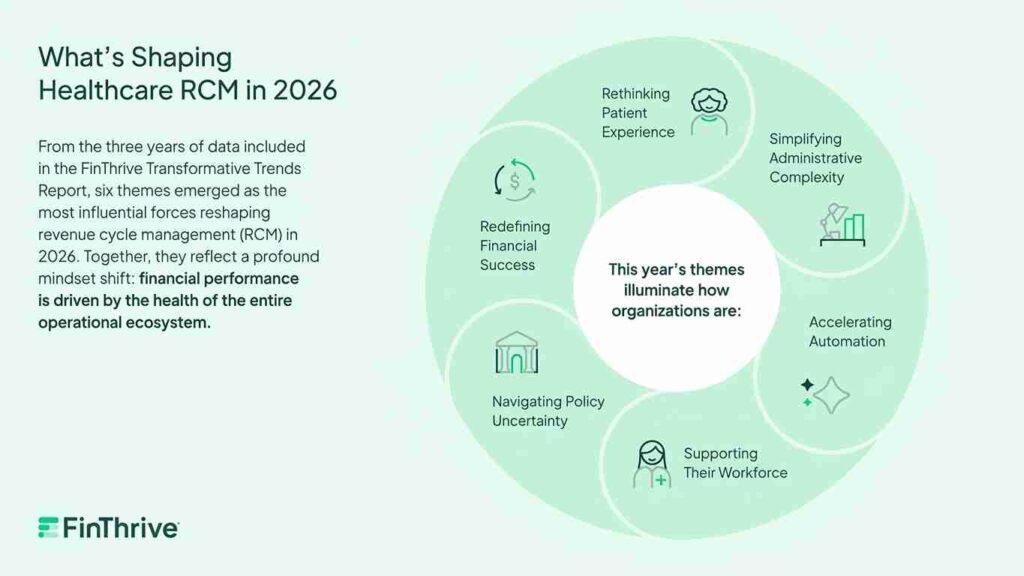
It suits health systems that want one vendor for many modules. Implementation is heavy enough to need its own project manager (and possibly its own therapist).
Key features
FinThrive spans the full cycle.
- Contract modeling
- Claims management
- Enterprise integrations
- Patient access tools
- Revenue analytics
Pricing
FinThrive doesn’t publish fixed subscription prices. Pricing comes through customized quotes based on the selected solutions, organizational requirements, and implementation needs.
Pros and cons
Every module you want, plus the integration project you didn’t plan for.
| Pros | Cons |
| Broad module set | Complex implementation |
| Contract management included | Built for large organizations |
| One vendor across many functions | Quote-only pricing |
User reviews about FinThrive
Capterra doesn’t provide verified customer service, ease-of-use, or value-for-money ratings for FinThrive. References from health systems running the same modules will tell you more than any public score.
4. Optum (Change Healthcare)
Change Healthcare, now part of Optum, runs one of the largest U.S. clearinghouses plus claims and payment tools.
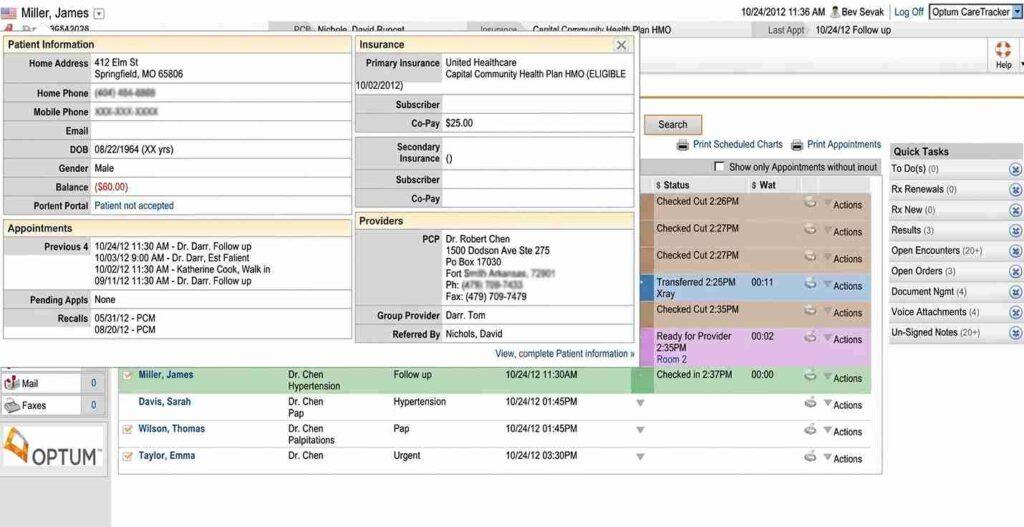
The February 2024 cyberattack showed what happens when one pipe carries everyone’s water. Many organizations kept Change after the outage, but plenty now keep a second clearinghouse on standby like a spare key under the mat.
Key features
Change Healthcare moves claims at national scale.
- Analytics
- Claims editing
- Clearinghouse connectivity
- Payment and remittance tools
- Optum revenue cycle services available separately
Pricing
Optum doesn’t publish fixed subscription prices. Quotes depend on the selected software, transaction volumes, organization size, implementation requirements, and service agreements, and offerings range from standalone software to integrated revenue cycle services.
Pros and cons
Massive pipes, one very large valve.
| Pros | Cons |
| Vast payer connectivity | 2024 outage exposed concentration risk |
| Mature infrastructure | Payer-owned parent company |
| Optional managed services through Optum | Quote-only pricing |
User reviews about Optum (Change Healthcare)
Capterra doesn’t provide verified customer service, ease-of-use, or value-for-money ratings for these products. Feedback on other websites raises concerns about support responsiveness, payment-related issues, and slow resolution of administrative problems.
Keep the target straight when reading reviews. Complaints about Optum’s broader healthcare services aren’t necessarily about any specific Change Healthcare software product.
5. Epic Resolute
Epic Resolute is the billing module inside Epic, covering hospital and professional billing with native access to clinical data.
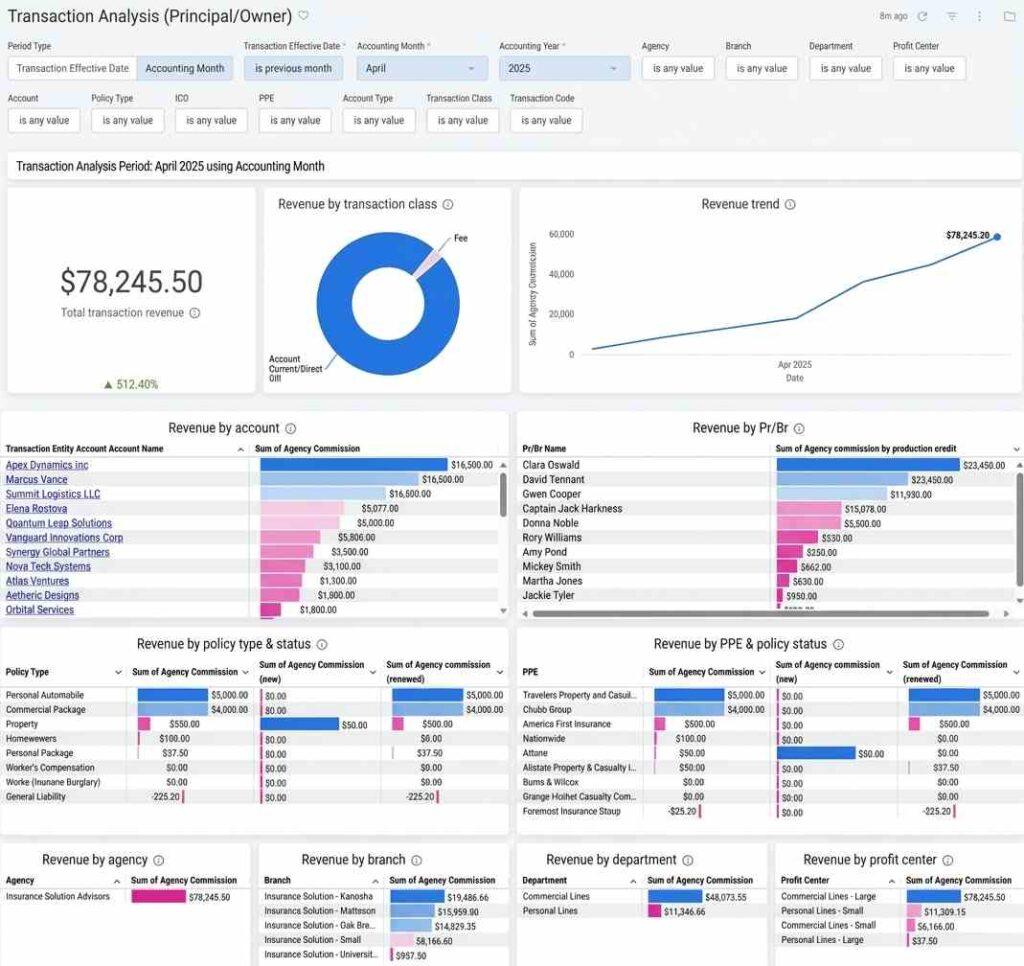
For Epic organizations, it removes the interface between chart and claim. For everyone else, it’s a velvet rope, so it appears here for health system buyers already on Epic.
Key features
Resolute lives inside the chart.
- Integrated reporting
- Native clinical data access
- Claim editing and work queues
- Hospital and professional billing
- Patient statements through MyChart
Pricing
Epic doesn’t publish a standard price for Resolute. Pricing comes through customized licensing and implementation agreements based on organization size, selected modules, hosting model, infrastructure, and support requirements.
Pros and cons
Native integration, members only.
| Pros | Cons |
| No interface between chart and bill | Requires Epic EHR |
| Unified patient billing through MyChart | Build quality varies by organization |
| Coders stop toggling between systems | Work queues can outgrow staffing |
User reviews about Epic Resolute
Capterra doesn’t have a separate review profile for Epic Resolute. Epic’s broader reviews cover its software as a whole, so treat them as feedback on the platform, not on Resolute specifically.
Within Epic organizations, the usual praise is billing that sits beside clinical data, and the usual complaint is work queues that multiply faster than staff can clear them.
6. Inovalon
Inovalon offers eligibility, claims, and analytics tools, including ABILITY Network connectivity, with a substantial presence in post-acute care.
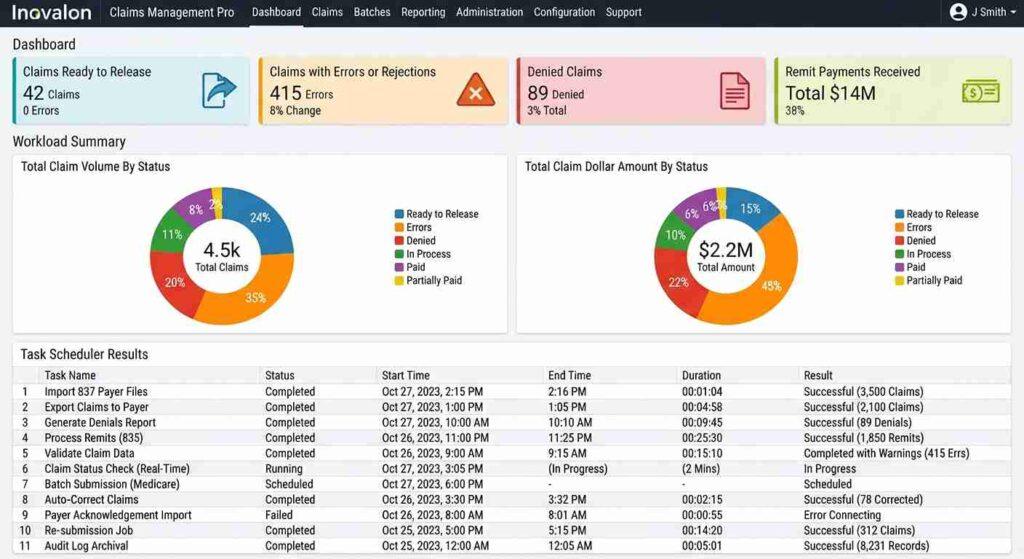
Inovalon Provider Cloud is its platform built for provider claims management, billing, revenue cycle work, and practice administration. Its data assets are serious, and the product lineup is long enough that smaller practices may want a guided tour.
Key features
Inovalon combines data and connectivity.
- Post-acute workflows
- Medicare claim submission and claim status tracking
- Claims and clearinghouse connectivity through ABILITY Network
- Analytics and reporting
- Eligibility verification
Pricing
Inovalon doesn’t publish a complete pricing schedule for Provider Cloud. Quotes are customized by selected applications, organizational requirements, usage, and implementation needs.
Pros and cons
Deep data, crowded menu, and review scores worth investigating.
| Pros | Cons |
| Strong data assets | Lowest review scores on this list |
| Post-acute expertise and Medicare connectivity | Complex product lineup |
| ABILITY Network connectivity | Quote-only pricing |
User reviews about Inovalon
The reviews here cover Inovalon Provider Cloud specifically, not the whole Inovalon company.
As of November 2026, Inovalon Provider Cloud holds a 2.5/5 overall rating from Capterra, with a 2.0/5 customer service score, a 2.9/5 ease-of-use score, and a 2.1/5 value-for-money score.
Reviewers appreciate its claims processing, ERA handling, billing workflows, analytics, and reporting, and some particularly value Medicare claim submission and claim status tracking. Still, a 2.0/5 support score is the lowest on this list by a wide margin, so ask current customers how support works before you sign.
7. ImagineSoftware
ImagineSoftware builds billing and RCM software for hospital-based specialties such as radiology, anesthesia, pathology, and emergency medicine.
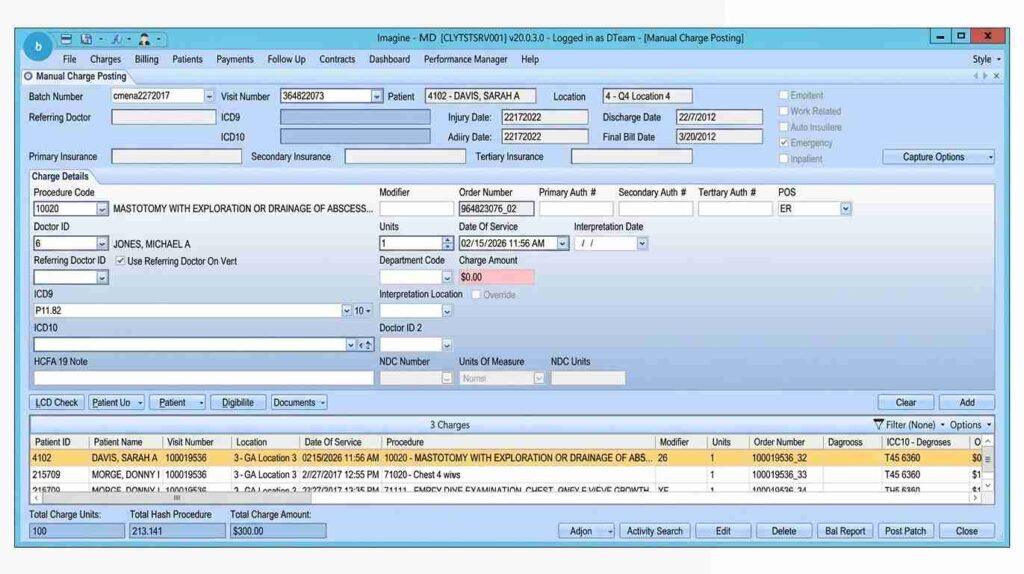
It’s a high-volume engine for specialties that bill thousands of charges a day. An office-based practice would use about a tenth of it.
Key features
Imagine automates specialty billing at scale.
- Automated charge processing
- Billing company support
- Specialty coding rules
- Payment posting
- Analytics
Pricing
ImagineSoftware doesn’t publish fixed subscription prices. Quotes depend on the selected solutions, specialties, organization size, transaction volumes, and implementation requirements.
Pros and cons
Race engine, wrong car for errands.
| Pros | Cons |
| Built for facility-based specialties | Limited fit for office practices |
| High automation | Enterprise implementation |
| Strong for billing companies in these specialties | Quote-only pricing |
User reviews about ImagineSoftware
Capterra doesn’t provide verified customer service, ease-of-use, or value-for-money ratings for ImagineSoftware.
The available feedback suggests its billing and analytics tools can improve operational efficiency, but the small number of reviews makes broad conclusions about its whole portfolio unreliable.
8. AKASA
AKASA uses AI to automate revenue cycle work for health systems, with a growing focus on coding and clinical documentation.
On October 2, 2026, AKASA launched an autonomous AI platform for inpatient coding and clinical documentation integrity. The company reports that its health system customers represent roughly 10% of U.S. inpatient discharges and more than $180 billion in aggregate net patient revenue.
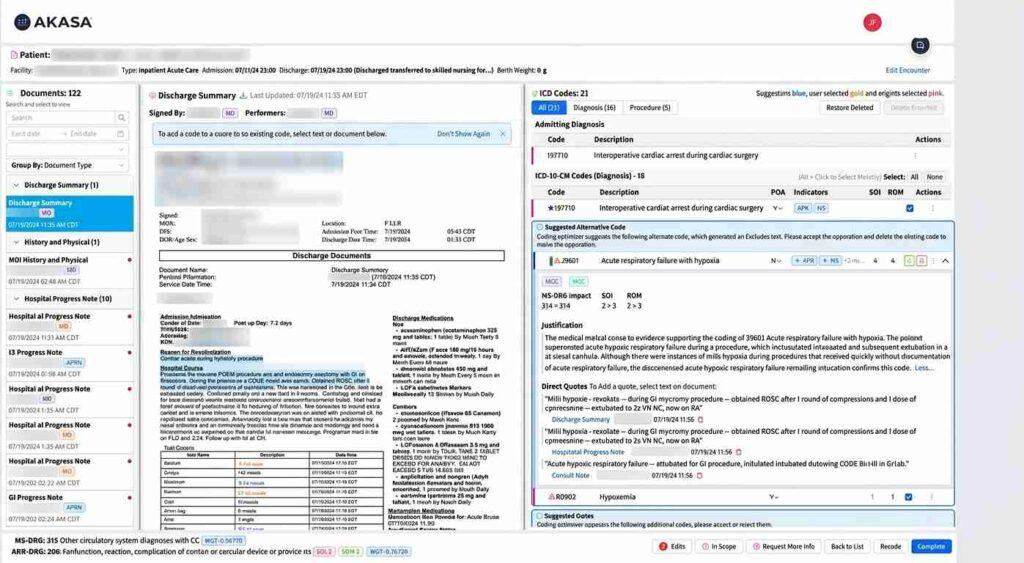
However, it is important to note that the above-mentioned figures are company-reported, not proof of market leadership, but they’re far from a small reference base.
Key features
AKASA targets coding and documentation at health system scale.
- Health system integrations
- Claim status and workflow automation
- Clinical documentation integrity support
- AI automation across revenue cycle tasks
- Autonomous inpatient coding (launched October 2026)
Pricing
AKASA doesn’t publish fixed subscription prices. Pricing is available on request and depends on the AI solutions selected, hospital size, revenue cycle needs, integrations, and implementation scope.
Pros and cons
Big autonomous ambitions, with results to verify.
| Pros | Cons |
| Autonomous inpatient coding and CDI | Built for health systems |
| Large reported customer base | Scale figures are company-reported |
| Reduces manual coding work | No published reviews to check |
User reviews about AKASA
As of November 2026, AKASA has no published customer reviews on Software Advice, so there’s no verified overall rating, customer service score, or ease-of-use score.
Without public reviews, buyers have to do the homework themselves. Request a demonstration and evaluate coding accuracy, EHR integration, implementation requirements, and support arrangements, ideally with references using the October 2026 platform.
9. MDClarity
MDClarity’s RevFind compares what payers paid against what contracts say they owe. On September 30, 2026, MDClarity announced a major expansion of RevFind’s agentic AI, adding:
- Contract intelligence
- Collaborative recovery workflows
- Automated denial and underpayment detection
- Recovery prioritization
- Root-cause analysis
MDClarity also sells Underpayment Recovery Services, where specialists verify payment variances, generate appeals, follow up with payers, and pursue recovered reimbursement. The software-only product still needs staff to act on findings, but buyers can purchase the managed service instead.
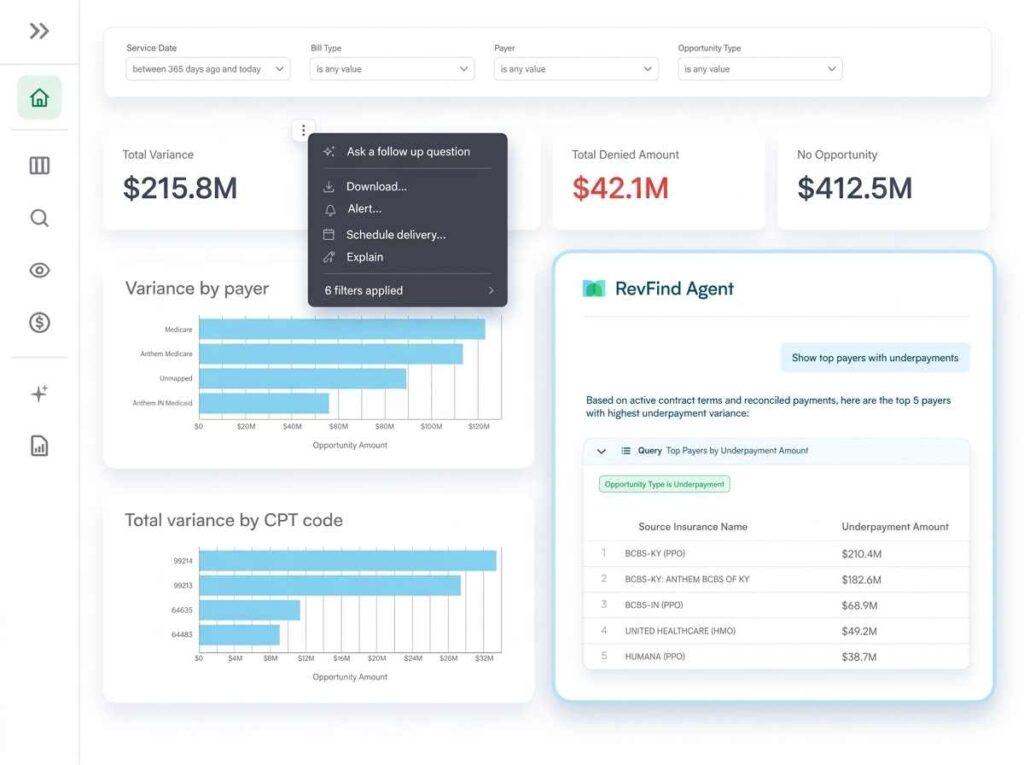
MDClarity reports recovering $160,000 from a single CPT code within three months in one case study. Vendor case studies show what’s possible, not what’s typical.
Key features
MDClarity finds missing money and can help collect it.
- RevFind contract modeling and underpayment detection
- Agentic AI denial and underpayment detection with root-cause analysis
- Recovery prioritization and collaborative workflows
- Underpayment Recovery Services with specialists
- Patient estimates
Pricing
MDClarity doesn’t publish fixed subscription prices. It customizes pricing based on the workflows and solutions each organization selects.
Pros and cons
Finds the money, and now offers people to chase it.
| Pros | Cons |
| Expanded agentic AI for denials and underpayments | Not a claims submission system |
| Optional managed recovery specialists | Loading contracts takes effort |
| Strong G2 rating | Case-study results are vendor-reported |
User reviews about MDClarity
A verified Capterra rating for MDClarity isn’t available. As of November 2026, MDClarity holds a 4.3/5 overall rating on G2.
That’s a healthy score, so the main due diligence is practical. Ask how long contract loading takes and how much of the recovery work your team still has to do.
10. Infinx
Infinx is best known for AI-driven prior authorization and patient access automation, but that’s one specialty, not the whole business.
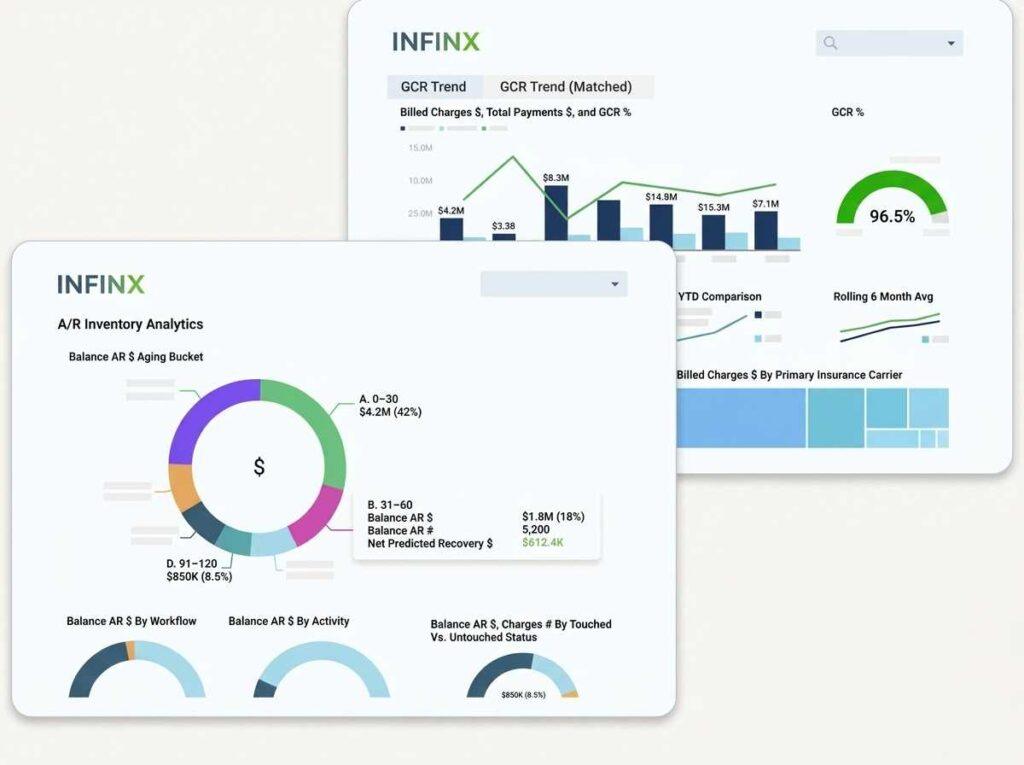
Infinx also provides end-to-end RCM outsourcing, including coding, claim submission, payment posting, AR recovery, denial management, and underpayment recovery. Its service teams work inside clients’ existing systems and make payer phone calls, combining technology with human operators.
Key features
Infinx pairs automation with people who do the follow-up.
- End-to-end outsourced RCM services
- Specialists working inside your existing systems
- Prior authorization and patient access automation
- Autonomous coding and charge capture tools
- Denial management and AR recovery
Pricing
Unlike most vendors on this list, Infinx publishes an official starting price, $5,000 per month for annual engagements of Patient Access Plus. Final cost depends on workflow complexity, transaction volume, integrations, and the delivery model.
| Plan | Price | Limits |
| Infinx Patient Access Plus | Starting at $5,000/month for annual engagements, customized quote | Eligibility verification, benefits checks, patient estimates, and prior authorization processing |
| Infinx Document Capture Plus | Custom quote | AI-powered document classification, data extraction, validation, and automated EHR data entry |
| Infinx RCM Plus | Custom quote | Claims processing, denial management, AR recovery, medical coding, and billing automation |
| Infinx Autonomous Coding | Custom quote | AI-powered medical coding and reduced manual coding workloads |
| Infinx Revenue Cycle Managed Services | Custom quote | End-to-end revenue cycle support, billing specialists, claims follow-up, and reimbursement management |
| Infinx Charge Capture Solutions | Custom quote | Charge capture automation, documentation review, coding support, and revenue leakage prevention |
At $60,000 a year to start, Patient Access Plus is priced for organizations with real authorization volume, not a two-provider office.
Pros and cons
Automation and staffed services under one roof.
| Pros | Cons |
| AI automation plus human-operated services | $5,000/month starting point for Patient Access Plus |
| Published starting price, rare in this category | Most products still require a quote |
| Works inside existing systems | No public Capterra reviews |
User reviews about Infinx
There are no publicly available user reviews for Infinx on Capterra. Ask for references in your specialty, especially from organizations using the managed services rather than the software alone.
How to choose revenue cycle management software
Start with the stage where you lose the most money, then decide whether you need software, staffed services, or both.
Find where revenue leaks
Results depend on where your losses originate. Front-end tools prevent eligibility and authorization errors, while back-end tools recover denials and underpayments. Neither category wins everywhere, so pull your denial and underpayment reports before talking to vendors.
Match the platform to the job
Health systems often compare Epic Resolute, FinThrive, and Waystar. Organizations with authorization backlogs should look at Infinx. Groups that suspect underpayments should compare MDClarity and Experian Health’s contract tools. Facility-based specialty groups belong with ImagineSoftware, and inpatient coding teams should evaluate AKASA.
Decide between software and services
Several revenue cycle management software vendors also sell people. Infinx offers end-to-end outsourced RCM, and MDClarity offers managed underpayment recovery. Ask each vendor which tasks the license automates and which require a separate service agreement.
Compare total cost, not the license
Medical revenue cycle management software pricing depends on contracted products, volume, subscriptions, and implementation. The two figures on this list show the range, from Infinx’s $60,000-a-year starting point for one product to Experian’s estimated $50,000 per feature, per year. Ask for a three-year total covering interfaces, training, minimum commitments, auto-renewal terms, and any service fees.
Read reviews with the right lens
Review coverage in this category is thin. Waystar has 214 Capterra reviews, Inovalon Provider Cloud has 37 with low scores, and several enterprise vendors have none at all. Treat missing reviews as a reason to call references, not as a red or green flag.
Score finalists against these criteria
Use this checklist before signing with any vendor.
- EHR and PM integration
- Clearinghouse flexibility and backup options
- Which corrections, appeals, or coding tasks run automatically
- Availability and cost of human-operated services
- Reporting by payer, provider, and denial reason
- Auto-renewal and price-increase terms
- Security history and incident response
If you’re switching, plan for overlap
Old claims often finish in the previous system while new claims start in the new one. Confirm ERA routing, enrollment updates, and read-only access to historical data before cutover.
Your RCM software still needs a revenue cycle strategy
Revenue cycle software does more than it used to. Waystar drafts and submits appeals, Experian corrects and resubmits claims, and AKASA codes inpatient encounters autonomously. Human oversight still handles exceptions, payer disputes, and decisions about which claims are worth the fight.
MedHeave runs full-cycle revenue operations inside the software you already use, with no platform switch required. According to its published service information, the commitments are these.
- Denial review and corrective action within 72 hours
- Two dedicated account managers per practice with a direct line
- Claims submitted within 24 to 48 hours of signed encounter notes
- 4% to 7% of collections, performance-based, with 30-day exit terms
- Company-reported results of a 98% in-network clearinghouse pass rate and an 80%+ denial overturn rate
MedHeave targets practices collecting $100K+ monthly, with a focus on the $1M to $3M monthly collections range. All figures above are company-reported, not independently audited benchmarks.
Frequently asked questions
Here are some of the commonly asked questions on this topic:
Revenue cycle management software automates the steps between patient registration and final payment, including eligibility checks, claim scrubbing, denial tracking, and payment posting. Many platforms now also correct claims, draft appeals, or code encounters automatically. In revenue cycle management healthcare teams, the software handles volume while staff handle exceptions and payer disputes.
Most vendors quote individually, so published numbers are rare. Infinx’s Patient Access Plus starts at $5,000 per month on annual engagements, and Experian Health’s products are estimated to start around $50,000 per feature, per year. Enterprise suites like FinThrive and Epic Resolute are priced through custom licensing that also covers implementation and support.
No. Medical billing software creates and tracks claims, while RCM systems cover more stages, including eligibility, authorizations, analytics, and underpayment detection. Many organizations run both, with the RCM layer sitting on top of the practice management system.
Not entirely. Automation now handles appeal drafting, claim correction, and some coding, but people still manage exceptions, payer disputes, and judgment calls. Most organizations redeploy staff rather than eliminate them.
Yes. Infinx provides end-to-end outsourced RCM with specialists who work inside your systems and call payers, and MDClarity offers managed underpayment recovery. Both are separate service options, so confirm scope and pricing before assuming a subscription includes them.
No. CMS states that an eligibility response is not a guarantee of payment. The final patient balance depends on claim adjudication, deductibles, coinsurance, and coverage rules.
Single-module tools can go live in weeks, while enterprise suites often take many months. EHR integration is usually the longest step, and loading payer contracts for underpayment tools adds time.