
Credentialing services
You trained to practice medicine, not fight 4 months with payors to get credentialed.
Commercial payer credentialing takes 2 to 4 months. Medicaid takes 1.5 to 3 months. During that window, every patient you see is one you cannot bill in-network. That is the revenue risk that most practices underestimate. Then comes re-credentialing every 1 to 3 years, alongside CAQH attestation, DEA renewals, and PECOS revalidation with their own deadlines. Miss one deadline, and your in-network status is suspended.
MedHeave manages this entire process from initial enrollment through ongoing credentialing. We track every expiration 60 to 90 days ahead and manage 10 to 20 or more payer applications on a 14-business-day follow-up cycle. We verify every application before submitting, so credentialing never becomes the reason your revenue stops.
Our operational footprint
These aren't aspirational targets.
These metrics are what we deliver, consistently, across all practices and specialties we work with.
98%
Approval rate

Under 7 days
Submission timeline

50%+
Early approval ratio

30-60 days
Rejection resolution time

Credentialing is not a one-time task; it is an ongoing process.
Initial credentialing with commercial payers takes 2 to 4 months. Medicare and Medicaid typically run 1.5 to 3 months. During that entire window, you are not generating revenue. Any patients you see before your active date cannot be billed in-network, and unless the payer allows retroactive billing back to your application date, that revenue is simply lost. And if your CAQH profile isn’t up-to-date when a payer pulls it, your application stalls before it even starts.
Then comes re-credentialing every 1 to 3 years. A single missed document or an expired license during that cycle can suspend your participation and stop reimbursements without warning. Layer in DEA renewals, malpractice expirations, multi-state licensing, and PECOS revalidation for Medicare, and credentialing becomes a moving operation with no finish line.

MedHeave tracks every deadline, manages every payer, and keeps your enrollment active so your billing never has to stop and wait for your credentialing to catch up.
The cost of poor credentialing services
Patient volume doesn't fix credentialing gaps.
A fully booked calendar with incomplete credentialing is still a practice that cannot collect, and the problems that quietly drain revenue from most practices are not clinical; they are administrative, and they compound the longer they go unaddressed.

You are seeing patients you cannot bill for
Start seeing patients before credentialing is finalized, and you are carrying a risk most providers underestimate. Holding claims will not save you, since most payers only backdate about 30 days. Some payers allow an earlier date once approved, so those claims can be recovered. If not, that revenue is gone for good.

A small error can make you out of network
Most providers do not find out they have been suspended until a claim comes back denied, and by then the damage is done. A small error, like a wrong checkbox on a routine form, is all it takes. Payers will not warn you first, they just process whatever is on file, so outdated paperwork puts your status at risk.

State lines don't transfer credentials
Operating across multiple states multiplies the credentialing challenge with every state you add. Each state has its own licensing rules, each payer has its own enrollment process, and credentialing cannot start until that state license is approved. That sequence is where most credentialing services fall behind.
Calculate your revenue loss
The cost isn’t obvious until you calculate it.
Providers rarely calculate the revenue sitting on hold during the credentialing window. Enter your average daily patients and reimbursement rate, and see exactly what delays are costing your practice
Fill in your details and click Calculate now to see your estimate.
We didn't write these case studies to brag.
Okay, maybe a little.



Our medical billing services
Everything your credentialing cycle needs is already a part of what we deliver.
Most credentialing problems do not start with a difficult payer; they start with a fragmented process where different parts of enrollment are being tracked by different people with no unified system.
Our credentialing services manage the entire cycle from initial application to ongoing maintenance, ensuring your revenue never falls through the cracks.
Initial credentialing and payer enrollment
We gather all required provider documentation, complete primary source verification against state licensing boards, NPI records, DEA databases, education records, and malpractice insurance providers, then prepare and submit applications to each payer individually. Every application is tracked from submission to approval, with follow-ups running on a 14-day business cycle.


CAQH profile management
Your CAQH profile is the foundation of commercial payer credentialing. If it is incomplete or outdated when a payer pulls it, your application does not move. We keep your profile up-to-date, accurate, and attestation-ready so it never becomes the reason your credentialing stalls.
Medicare and medicaid enrollment, including PECOS
Medicare enrollment runs through PECOS, and errors or gaps in that system create billing problems that are not always immediately visible. We handle your PECOS enrollment and revalidation, manage your Medicaid enrollment by state, and confirm that your NPI, group details, and billing address are consistent across every federal and state record before billing begins.


Re-credentialing
Most payers require re-credentialing services every 1 to 3 years. Missing that cycle creates a lot of paperwork, and to make matters worse, it can suspend your credentialing status while you are actively seeing patients. We track every re-credentialing deadline across every payer you are enrolled with and initiate the process early enough that your participation is never interrupted.
Expirables tracking and license maintenance
Licenses, DEA registrations, malpractice insurance, and any other time-sensitive credentialing documents are flagged 60 to 90 days before expiration. As part of our credentialing services, we send reminders and follow up consistently until updated documents are received and confirmed, so a lapsed document never becomes the reason for suspension.

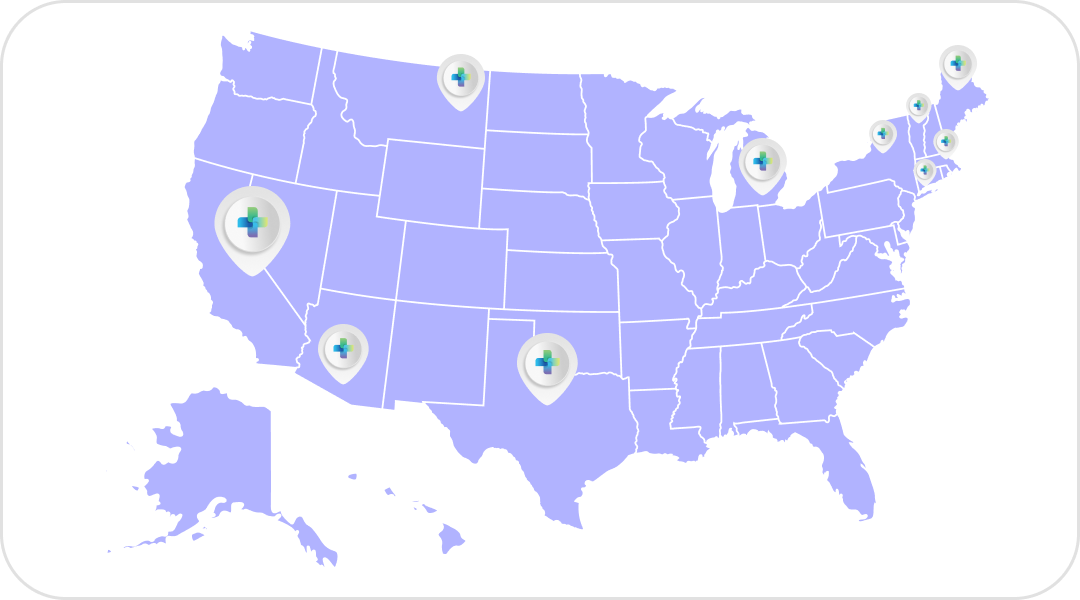
Multi-state credentialing
For practices operating across multiple states, we manage each state as a separate credentialing track. We verify licensure for every state before initiating enrollment, enroll the group under its tax ID in each state, and add individual providers under the group with each payer in that state. Credentialing does not begin in any state until the license for that state is confirmed, keeping the process clean and compliant across every jurisdiction.
Rejection management and appeals
When a payer rejects an application, we identify the reason, correct the issue, and resubmit or file an appeal on your behalf. Most rejections are resolved within 30 to 60 days. We handle follow-up directly with the payer, escalating to supervisors when standard timelines are exceeded, until the application is approved.

Over 95% of credentialing applications submitted by MedHeave are approved without rejection.
Nothing gets submitted until every required document is verified.


Group practice enrollment and provider linking
For providers joining an existing credentialed group, we link them to the group where possible or initiate individual credentialing from the start where required. For group practices expanding into new states or adding new providers, we manage each enrollment individually while keeping the group structure consistent across all payers.
Ongoing credentialing maintenance
After initial enrollment is complete, credentialing does not stop. We manage CAQH attestation, payer re-credentialing cycles, document renewals, address and demographic updates, and directory accuracy on an ongoing basis so your enrollment stays up-to-date without you having to monitor it.


Facility contracts
Urgent care centers, emergency rooms, hospitals and substance use facilities bill under a single facility NPI using a UB-04 claim form rather than individual provider NPIs. A predetermined rate is agreed with the payer regardless of how many providers render services, removing the need for individual provider credentialing. MedHeave manages the full enrollment process for facility contracts so the facility is properly contracted and actively enrolled before billing begins.
Specialties we work with
Built for your specialty, not adapted to it.
Credentialing service requirements, licensing rules, and enrollment timelines are not the same across specialties or payers. We have worked across enough specialties to know where the friction points are before they slow your application down.
Behavioral health
In behavioral health, missing eligibility or session tracking can cost several visits, not just one. We stay ahead of authorization limits, benefit caps, telehealth rules, and co-pay terms so billing stays steady through care.
Podiatry
For podiatry billing, we make sure modifiers like 25 and RT/LT are accurate, services align with global periods and payer edits, and orthotics always meet payer-specific authorization and DME requirements before claims go out.
Urgent care
We handle urgent care billing across walk-ins, diagnostics, and procedures. From there, we track payor coding rules, facility contracts, prior authorizations, and eligibility checks so claims never get delayed, cut, or denied.
Orthopedic
We handle orthopedic billing, making sure procedures get authorized upfront and modifiers like LT/RT and bilateral get applied well. Surgical cases with implants are coded and billed the way payers actually expect for payment.
Cardiology
Cardiology billing often triggers NCCI edit denials, bundling issues, and global period violations when E/M services and procedures are billed together. We manage coding and modifier logic to reduce denials and boost payments.
DME
DME billing is handled by aligning orders, documentation, and delivery timelines with payer rules. We apply HCPCS coding, manage capped rentals, and enforce refill limits so claims are never denied for missing paperwork today.
Pediatrics
In pediatrics, we handle well visits and immunizations, making sure vaccine administration and VFC eligibility are correct. Age-based coding stays accurate as well, so nothing gets missed, underbilled, or delayed at any visit.
Anesthesia
The accuracy of anesthesia billing depends on capturing start and stop times correctly. We ensure precise time capture, apply base units and modifiers, and handle medical direction & concurrency so each unit is billed right.
Don’t see your specialty? We likely work in it.
Most credentialing setups leave you guessing. Ours doesn’t.
Credentialing delays are not always caused by difficult payers; they are caused by disorganized follow-up, missing documents that nobody flagged, and applications that sit untouched for weeks because there is no structured process behind them. Every application we manage runs through the same disciplined workflow from day one.
01
Provider intake and document collection
We start by gathering everything needed upfront: licenses, malpractice insurance, DEA registration, education records, work history, and any other payer-specific documentation. Getting this right at the beginning is what prevents avoidable delays later in the process.
02
Primary source verification
Before any application is submitted, we verify all provider credentials directly through trusted primary sources, including state licensing boards, NPI records, DEA databases, education institutions, and malpractice insurance providers. Nothing is submitted on assumed information.
03
CAQH profile setup and attestation
An incomplete CAQH profile is one of the most common reasons applications stall before a reviewer ever sees them. We build or update your CAQH profile and ensure it is complete before any commercial payer application is initiated.
04
Application preparation and submission
Each payer application is prepared individually according to that payer’s specific requirements and submitted with a complete documentation package. We manage simultaneous enrollments across 10 to 20 or more payers without letting individual applications fall behind.
05
Active follow-up and status tracking
Every open application is followed up on a 14-business-day cycle. We contact payers directly by phone and email, document status update in our internal tracking system, and escalate to supervisors or senior payer contacts when an application exceeds its expected processing window.
06
Rejection review and resubmission
If a payer rejects an application, we identify the reason immediately, correct any issues, and resubmit or file an appeal on your behalf. Most rejections are resolved within 30 to 60 days. We handle all communication with the payer directly until the application is approved.
07
Approval verification and billing clearance
Once approval comes through, we do not hand it off and move on. We verify that your NPI, group details and billing address match exactly with what the payer has on file, confirm your in-network directory listing and ensure payment enrollment is active before billing begins.
08
Ongoing maintenance
Credentialing does not end at approval. We track every re-credentialing deadline, manage CAQH attestation, flag expiring licenses, DEA registrations, and malpractice documents 60 to 90 days in advance, and keep your enrollment updated across every payer and every state on an ongoing basis.
Why MedHeave
You deserve credentialing support that treats your enrollment like it’s the only one on the desk.
There is no shortage of credentialing services. But finding someone who follows up without being chased, catches expiration issues before they become billing problems, and handles rejections without passing them back to you is what counts. That is the baseline we hold ourselves accountable for on every account we manage.
We have won cases that others would have walked away from
Complex credentialing situations are not exceptions to what we do; they are part of it. When a provider was barred from a major commercial payer network despite holding a valid court-granted permission to practice, we took the case, analyzed the verdict, and pushed the payer until approval was granted. That provider left a five-star review.
Primary source verification done in-house
We do not outsource verification to a third party and wait on their timeline. Every credential is verified directly by our team against state licensing boards, NPI records, DEA databases, education institutions, and malpractice providers. That means faster turnaround and no gaps in the chain of accountability.
Ongoing maintenance is part of the package
Ongoing credentialing maintenance is complimentary for practices that work with MedHeave for revenue cycle management. CAQH attestation, re-credentialing cycles, document renewals and demographic updates are managed as part of the engagement, not added on later. The only time additional fees apply is when new providers are added to an existing group and require credentialing from the start.
One dedicated team across every payer and every state
You are not handed off to a different contact for Medicare, a different one for commercial payers, and another for multi-state enrollments. One team manages your entire credentialing operation across every payer, every state, and every renewal cycle, so nothing gets lost in the handoff.
Multi-state without the mess
For practices operating across multiple states, we run each state as its own credentialing track. Every license is verified before enrollment begins in that state, the group is enrolled under its tax ID, and each provider is added individually under the group with every relevant payer.
Closed panels are not a dead end
A closed panel is not always a hard stop. Payers make exceptions for providers who can demonstrate a genuine gap in the network, but the request needs to be built correctly and directed to the right decision maker. We know how to put that case together, and we follow it through until we have a clear answer.
Where it goes wrong
Most practices blame the payer, but the problem usually starts on the submission side.
Payer processing backlogs are real, but they are rarely where credentialing breaks down. The delays and rejections that cost practices the most revenue almost always trace back to something internal, a document that was not flagged, a profile that was not updated, or an approval that was assumed without being verified. When something goes wrong, the starting point is almost always on the submission side, not the processing side.
An outdated CAQH profile
Commercial payers pull your CAQH profile during the credentialing process. If the information on file is incomplete, expired, or has not been attested recently, your application does not move forward until it is corrected and resubmitted. This is one of the most common and most avoidable sources of delay in initial credentialing.
Incomplete documentation at submission
Missing or incomplete documents are the leading cause of credentialing delays. When an application goes out without everything a payer requires, it either comes back immediately or sits in a pending queue until the gap is flagged weeks later. When that happens, enrollment takes longer, claims are delayed, and revenue arrives later than it should.
A lapsed license or credential mid-participation
Payers do not send warnings when a credential on file is approaching expiration. They pay as long as everything is active, and when something lapses, participation can be suspended without notice. Most practices find out when a claim is denied, not when the credentialing status expires.
NPI or demographic mismatches across payer records
If your NPI, billing address, or group details do not match exactly across every payer record, claims will be denied even when credentialing is technically approved. These mismatches are easy to create and time-consuming to trace because they do not always surface immediately after enrollment.
Billing before active status is confirmed
Receiving a payer approval does not automatically mean billing can begin. Many practices start submitting claims as soon as an approval is issued, only to discover that active enrollment has not yet been finalized. Until active status is confirmed and directory information has been verified, billing should remain on hold.
Missing the re-credentialing window
Re-credentialing is required by most payers every 1 to 3 years, and it carries the same consequences as a lapsed license if it is missed. A practice that does not have a system tracking every re-credentialing deadline across every payer it participates with is running on borrowed time.
FAQs
Questions providers like you often ask us about credentialing services.
These are the questions providers ask us when they are trying to understand credentialing, protect their revenue, or identify what is delaying their current applications.
How long does credentialing take with commercial payers versus Medicare and Medicaid?
Commercial payers typically take two to four months from application to approval. Medicare and Medicaid generally run faster at one and a half to three months, depending on the state and how complete the application is at submission. These timelines only hold when the application goes in clean, and the CAQH profile is current at submission.
Can I bill insurance while my credentialing application is still being processed?
No. Billing before credentialing is fully approved and active status is confirmed with the payer puts your claims at risk of denial and in some cases can be treated as a misrepresentation of provider status. Some payers, including Medicare, allow billing back to the application submission date if documentation requirements are met. Many commercial payers do not. The only safe approach is to wait until active status and directory listing are both confirmed before submitting a single claim.
What happens if my credentialing application is denied by a payer?
A rejection is not the end of the process, but it does require an immediate response. The reason for the rejection needs to be identified, the issue corrected, and the application either appealed or resubmitted, depending on the payer’s process. Most rejections are resolved within 30 to 60 days when they are handled promptly. The applications that stall for months after a rejection are almost always the ones where nobody acted on the denial quickly or followed up consistently with the payer after resubmission.
Can a provider be credentialed with multiple payers at the same time?
Yes. Simultaneous enrollment across multiple payers is standard practice and the most efficient way to get a provider operational without staggering their revenue start date. The key is managing each application individually with its own follow-up cycle. We typically manage ten to twenty or more payers per provider at the same time, tracking each one on a structured 14-day follow-up schedule so nothing sits unattended.
What is CAQH, and why does it matter for credentialing?
CAQH is a centralized database that most commercial payers pull information from during the credentialing and re-credentialing process. Providers are required to maintain an active, current, and attested CAQH profile for commercial credentialing to move forward. If the profile has expired documents, outdated information, or has not been re-attested recently, the payer will not process the application until it is corrected. An inactive or outdated CAQH profile is one of the most common causes of delayed credentialing timelines.
What happens to my credentialing if I move locations, change my billing address, or add a new practice site?
Any change to your NPI record, billing address, group details, or practice location needs to be updated across every active payer, your CAQH profile, and your enrollment. If these records fall out of sync, claims will be denied even when your participation status is technically active. Updates need to be pushed through systematically across all enrolled payers, not just updated in one place and assumed to propagate automatically.
You cannot get those unbilled weeks back.
Make sure the next ones are billable.
At $250 per application, MedHeave handles the entire credentialing cycle from application to active enrollment, so the only thing you are focused on is seeing patients and getting paid for it.