
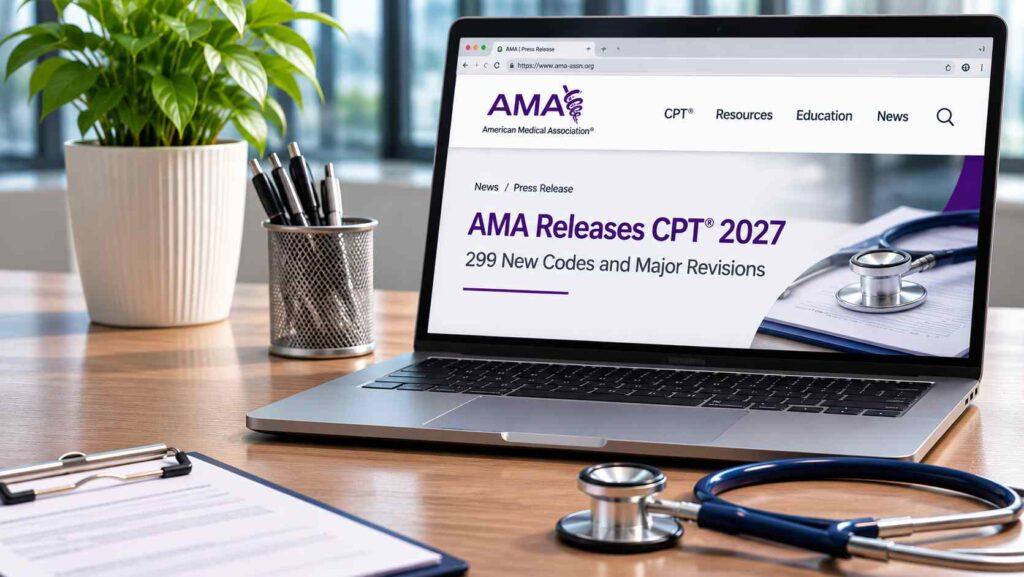

The AMA released the CPT 2027 code set on September 9 with 453 editorial changes — 299 new codes, 74 revisions, and 80 deletions.
Several high-volume code families are being structurally rebuilt, including:
- New ABA reporting pathways
- A growing set of AI-related codes
- The end of traditional global maternity coding
- A complete redesign of unattended sleep testing
- Replacement of a speech therapy code used for decades
CMS finalized the 2027 Medicare Physician Fee Schedule on November 4, so the payment side is no longer proposed — it’s settled. Practices have weeks, not months, to align their documentation, charge capture, authorizations, payer mappings, and claim edits before January 1.
In this article, we’ll explore:
- CPT 92507 replaced by 10 timed speech therapy codes
- A pre-January 1 implementation checklist for billing teams
- Sleep testing, ABA, AI, and six more specialty-level changes
- Final 2027 Medicare conversion factors and what they mean
- Why this CPT update is structurally different from a normal annual refresh
- The maternity billing overhaul and CMS’s unusual cross-year enforcement discretion
The 299-code headline is not the real story
Every year, AMA publishes CPT updates. Every year, billing teams load new codes. CPT 2026 had 288 additions, 46 revisions, and 84 deletions. That was a standard annual cycle. CPT 2027 is not.
The difference is structural.
Several code families are not just getting new numbers — they’re being reclassified in ways that change how services are documented, captured, timed, and reported. For comparison:
| Metric | CPT 2026 | CPT 2027 |
| New codes | 288 | 299 |
| Revised codes | 46 | 74 |
| Deleted codes | 84 | 80 |
| Total changes | 418 | 453 |
The addition count is similar. The revision count jumped 61%. And the deletions include codes that entire specialties have used for years — not obscure add-ons that nobody will miss.
For billing teams, the practical risk is not in the new codes. It’s in the deleted and revised ones. A new code that is missing from your system is visible — your encoder flags it, your scrubber catches it. A deleted code left active in your charge master is invisible until claims start bouncing in January.
STRUCTURAL CHANGES — NOT JUST NEW NUMBERS
The CPT 2027 families that change how you bill
35
Maternity codes affected
Global bundling → phase-specific reporting
10
New speech therapy codes
92507 replaced by timed, condition-specific codes
6
New sleep testing codes
3 old codes → 6 complexity-based codes
43
Total AI-related codes
10 new + revised Appendix S taxonomy
Sources: AMA CPT 2027 release (Sept 9, 2026); CMS CY 2027 PFS final rule (Nov 4, 2026).
Global maternity billing undergoes its biggest overhaul in decades
This is probably the most disruptive single change in CPT 2027. The traditional global maternity package — where antepartum visits, delivery, and postpartum care rolled into one bundled code — is being replaced with phase-specific reporting.
Why the global model is ending
AMA says the existing global structure no longer reflects how maternity care actually works. Different physicians, midwives, specialists, and facilities may participate at different stages of pregnancy.
A single bundled code obscured that reality — and made it difficult to attribute care accurately when multiple providers were involved.
Under the new framework:
- Delivery is reported separately
- Labor management gets its own dedicated codes
- Antepartum visits are generally reported using appropriate E/M codes
- Postpartum visits move to E/M reporting rather than disappearing inside a months-long global package
The scale of the change: 17 codes deleted, 12 new, 6 revised — 35 maternity codes affected total.
New labor management codes
Four new codes distinguish initial versus subsequent days and straightforward versus complex management:
| Code | Function |
| 59080 | Initial-day straightforward labor management |
| 59081 | Initial-day complex labor management |
| 59082 | Subsequent-day straightforward management |
| 59083 | Subsequent-day complex management |
AMA has published extensive FAQ guidance because the new structure raises questions around same-day delivery, care transfers, consultant involvement, and multiple-physician scenarios. If your practice handles OB, this is not optional reading.
For billing teams, the operational impact runs deeper than code numbers. Practices and payers need new logic for:
- Fee schedule mapping
- Transfer-of-care scenarios
- Payer-specific claim edit rules
- Visit capture and charge entry
- Same-day service edits and modifiers
- Provider attribution across care phases
AMA specifically tells health plans to update contracts and claims systems before implementation. The inverse is also true — practices cannot wait for payers to figure it out.
The cross-year exception you need to know
CMS issued a temporary enforcement discretion on October 30 covering maternity episodes that begin in 2026 and continue into 2027. Between January 1 and December 31, 2027, payers may issue business rules allowing certain 2026 maternity codes for these cross-year episodes.
This is important for accuracy. Do not write off every 2026 maternity code as dead on January 1.
For ordinary 2027 maternity services, the new structure applies. But a pregnancy episode that started during 2026 may follow special payer transition instructions.
CPT 92507 is replaced by 10 timed speech therapy codes
If your practice bills speech-language pathology, this change requires immediate attention. CPT 92507, long a staple of speech therapy coding for individual treatment, is being retired.
What replaces it
Beginning January 1, ASHA confirms that individual SLP treatment moves to 10 new timed codes separated by clinical problem:
| Treatment area | Initial 30 min | Additional 15 min |
| Fluency | 92654 | 92655 |
| Speech sound production | 92656 | 92657 |
| Language comprehension/expression | 92658 | 92659 |
| Combined speech + language | 92660 | 92661 |
| Voice/upper airway/resonance | 92662 | 92663 |
This introduces two dimensions that 92507 did not capture in the same way: what was treated and how long treatment lasted. Documentation must support both.
Medicare payment is finalized
CMS accepted the recommended work and direct practice-expense inputs for all 10 codes.
CMS also designated all 10 as “always therapy” services, meaning Medicare therapy-plan requirements apply. The five base codes are subject to Medicare’s therapy Multiple Procedure Payment Reduction.
ASHA explicitly advises SLPs to verify each payer’s implementation — commercial insurers and state Medicaid programs may establish their own transition policies. A CPT code being valid does not guarantee every payer is ready to process it on January 2.
Six new codes restructure unattended sleep testing
CPT 2027 deletes three existing unattended sleep-study codes (95800, 95801, 95806) and replaces them with six codes that differentiate both test complexity and technical versus professional work.
The new code structure
The CMS final rule confirms the following structure:
| Service component | Low complexity | Moderate | High |
| Setup/data acquisition/technical analysis | 95843 | 95844 | 95846 |
| Physician/QHP interpretation and report | 95847 | 95848 | 95849 |
Complexity depends on the number of recording channels and parameter categories. CMS finalized the Medicare valuations, including a work RVU of 1.50 for 95849 (high-complexity interpretation).
Why this is not a simple crosswalk
This is not three codes becoming six with a find-and-replace mapping. A sleep program now needs to understand:
- Device capability and channels captured
- Complexity tier based on parameters recorded
- Which provider or vendor performed each component
- Whether the claim covers technical work, professional interpretation, or both
Practices using third-party device companies, external scoring vendors, or separate interpreting physicians will need to map responsibility more carefully than before.
The old workflow of “pick the sleep code and bill it” no longer matches the reporting structure.
ABA and adaptive behavior services add six Category I codes
CPT 2027 adds six new Category I adaptive behavior codes — 97148, 97149, 97159, 97160, 97173, and 97180 — while revising eight existing codes (97151-97158) and deleting temporary Category III codes 0362T and 0373T.
The two most significant additions
Two codes stand out for their operational impact.
97173 distinguishes direct QHP treatment with analysis — separating it from technician-delivered treatment. This creates a documentation distinction between what a qualified healthcare professional does directly and what they supervise.
97180 creates a dedicated pathway for specified non-face-to-face clinical work, including:
- Assessment planning
- Technician training activities
- Discharge and transition planning
- Data review and protocol modification
Authorization and documentation implications
The new structure creates a more granular hierarchy: technician treatment → QHP direction/analysis → QHP direct treatment → QHP non-face-to-face clinical work.
Each level has its own reporting code, which means authorization requests and service logs need to distinguish between them.
Practices that currently authorize ABA services using broad category approvals may find payers requesting code-level specificity in 2027.
CMS finalized contractor pricing for the new adaptive behavior codes for Medicare. Commercial payer adoption timelines will vary.
CPT adds 10 more AI-related codes
AMA says CPT 2027 adds 10 AI-related codes, bringing the total to 43 AI-related codes in the CPT system. AMA also revised Appendix S, its taxonomy for AI-enabled medical services, which now classifies AI services into three tiers:
| Classification | What the software does |
| Assistive | Presents clinically relevant information requiring clinician interpretation |
| Augmentative | Derives a score, classification, or parameter |
| Autonomous | Independently produces a clinically meaningful interpretation or action |
Within the autonomous category, AMA distinguishes increasing levels of algorithmic independence and physician oversight.
A reality check is necessary here. Having a CPT code does not establish reimbursement. CPT identifies and describes a service.
Medicare, Medicaid, and commercial payers still determine coverage, medical necessity, and payment independently. AMA itself draws this distinction. Do not read “10 new AI codes” as “10 new AI treatments are now covered.”
The more accurate framing: CPT 2027 creates additional pathways to identify and report AI-related services, expanding the vocabulary available to describe what these tools do in clinical practice.
Six more specialty areas with meaningful code changes
The maternity, speech, sleep, ABA, and AI changes dominate the CPT 2027 conversation, but several other specialties face code restructurings that billing teams should not overlook.
Surgical and procedural changes
Nine new Category I codes expand diaphragmatic hernia repair reporting based on cause, surgical approach, and repair type.
The CMS final rule finalized the corresponding work RVUs and practice-expense inputs. Operative reports must now support more precise distinction between approach (laparotomy, thoracotomy, laparoscopy, thoracoscopy) and defect type (traumatic vs. nontraumatic).
The prostate biopsy family is restructured to distinguish transrectal from transperineal biopsy, regional sampling from fusion-targeted lesions, and in-bore guidance techniques.
For billing teams, selecting the correct urology CPT codes means matching the operative procedure to the approach and imaging technique — not relying on old crosswalk assumptions.
Three new LVAD procedure codes (33994, 33996, 33998) distinguish insertion through different arterial/aortic surgical exposures and removal of the device/conduit. Narrower audience, but high-acuity and high-dollar claims.
Time-based and imaging changes
Biofeedback becomes explicitly time-based. CPT 90901 is revised to represent the initial 15 minutes, and new 90903 reports each additional 15-minute increment.
Session documentation now needs reliable direct patient-contact time tracking — a practice cannot reuse untimed charge logic after January 1.
Six existing head/neck MRA codes (70544-70549) have revised descriptors incorporating image postprocessing.
Three new combined head-and-neck codes (70560, 70561, 70562) are added. For radiology groups, this affects order mapping, protocol selection, and whether head and neck services are billed separately or as combined studies.
CMS finalized the 2027 Medicare Physician Fee Schedule
The AMA announcement in September occurred while the CY 2027 PFS was still a proposed rule. That is no longer the case. CMS displayed the final rule on November 4 and published it November 9.
Final 2027 conversion factors
CMS finalized two conversion factors:
- $32.95 for qualifying APM participants
- $32.63 for non-qualifying APM clinicians
Both represent decreases from 2026, partly because a temporary 2.5% statutory payment increase expires.
CPT codes and Medicare payment are separate systems
AMA determines CPT coding. CMS determines Medicare payment policy. Commercial payers and Medicaid programs set their own rules.
A new or revised CPT code does not automatically mean higher reimbursement. The final payment depends on:
- The applicable conversion factor
- Facility versus non-facility setting
- Geographic practice cost adjustments
- CPT reporting rules and RVU assignments
- Payer-specific contract terms and fee schedules
The maternity restructuring, for example, makes individual clinical encounters visible on claims that were previously bundled.
That does not guarantee the sum of unbundled payments exceeds the old global package.
Practices should model the financial impact before January rather than assuming more codes means more revenue.
What billing teams should update before January 1
A strong readiness plan covers code content, clinical workflow, and payer behavior simultaneously. Treating the annual update as a software patch is how transition denials happen.
BEFORE JANUARY 1
CPT 2027 implementation checklist
Load CPT 2027 into EHRs, PM systems, encoders, charge masters, and claim scrubbers
Identify all 80 deleted codes currently used and measure their recent claim volume
Review all 74 revised codes — same number can hide changed descriptors or rules
Map deleted high-volume codes to correct 2027 workflows (not blind 1:1 crosswalks)
Audit open prior authorizations extending into 2027 (maternity, SLP, ABA, sleep)
Update payer fee schedules and contract models for new codes
Update documentation templates where time, complexity, or approach now affects code selection
Validate NCCI edits, unit limits, and payer-specific modifiers as 2027 files release
Train coding, billing, and authorization teams on the changes affecting their workflows
Monitor January and February denials by code and payer to catch implementation problems early
One often-overlooked detail is that the relevant CPT code follows the date the service was performed, not the date the claim is submitted.
A December 2026 service billed or appealed in January 2027 may still require the 2026 code. Systems need to support historical coding while preventing obsolete codes from being used for new services.
How to avoid CPT transition denials in early 2027
January transition denials follow a predictable pattern. Knowing what to watch for is easier than untangling it after the fact.
The failure chain
The most likely implementation failures cascade from upstream errors:
An outdated charge master code can trigger claim rejection at submission.
Billing a revised code using outdated documentation requirements can create coding accuracy errors.
Using an untimed workflow for a new timed service can result in incorrect unit counts.
An authorization tied to a deleted code may not match the code submitted on the claim.
If the new code is missing from the fee schedule, payment may be incorrect or zero dollars.
A charge master update without matching clearinghouse edits can cause rejection at the payer gateway.
The payer may require manual processing or a payer-specific exception until its systems support the new codes.
Monitor by code and payer
Do not treat January denials as noise. Track them specifically by CPT code family and payer to distinguish transition-related problems from normal denial patterns.
If you see a spike in rejections for maternity codes, speech codes, or sleep codes from a specific payer, the problem is probably implementation — not medical necessity or eligibility.
The maternity, speech, and sleep changes are particularly exposed because widely used codes are disappearing or being fundamentally restructured. These are not niche add-on codes that affect a handful of claims per month.
The CPT 2027 update is not a software patch you apply on December 31
Several code families are being fundamentally rebuilt, and each one touches a different part of the billing workflow — documentation, charge capture, time tracking, authorization mapping, claim edits, fee schedules, and payer logic.
The practices that treat this as a coding-team problem will discover in February that it was actually a revenue-cycle problem.
Follow our medical billing news for further updates on coding changes and payer implementation.
MedHeave’s AAPC-certified coders implement CPT guideline changes immediately upon release, with coding accuracy reviews that catch documentation and reporting mismatches before claims submit. When code families change, the entire claim workflow needs to change with them.
- AAPC-certified coding with same-day implementation of annual CPT updates
- Claim scrubbing that validates new codes against payer-specific edit rules
- Denial management within 72 hours, including transition-related rejections
- Weekly reporting that tracks denial patterns by code family and payer