
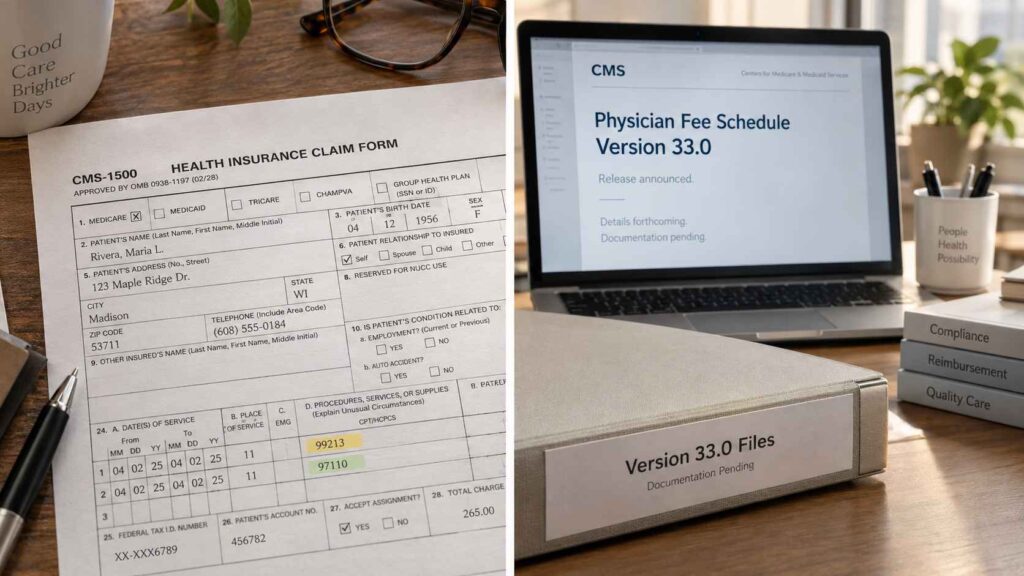

CMS issued Change Request 14611 on September 17, announcing the next quarterly release of its National Correct Coding Initiative Procedure-to-Procedure edits. Version 33.0 becomes effective January 1, 2027, with an implementation date of January 4.
The final code-pair changes have not been published. CMS expects test files around November 2 and the complete additions, deletions, and modifier-indicator change reports around November 17.
How PTP edits affect claims?
NCCI PTP edits identify pairs of HCPCS/CPT codes that generally should not be reported together for the same Medicare beneficiary, by the same provider, on the same date of service.
Each edit pair assigns one code to Column One (eligible for payment) and the other to Column Two (denied unless an appropriate exception applies).
CMS developed NCCI specifically to control improper coding that can result in inappropriate Medicare Part B payments.
Whether a Column Two code can bypass the edit depends on the Correct Coding Modifier Indicator (CCMI) assigned to the pair.
| CCMI value | What it means |
| 0 | NCCI-associated modifier cannot bypass the edit |
| 1 | Modifier may bypass it when clinical circumstances legitimately support it |
| 9 | Not applicable (edit no longer active in relevant manner) |
Source: CMS NCCI FAQ Library
CMS explicitly cautions that modifiers cannot simply be appended to get around an edit. A CCMI of 1 permits a modifier only when the actual clinical circumstances justify it (not as a blanket workaround).
What Version 33.0 can include
Every quarterly NCCI update can contain three types of changes:
New PTP Edits
Code pairs that Medicare will begin denying when submitted together without a valid exception.
Deleted Edits
Code pairs that CMS no longer treats as an active NCCI conflict.
Modifier-Indicator Changes
Pairs where the CCMI shifts — a previously bypassable edit becomes non-bypassable, or vice versa.
Both additions and deletions carry operational consequences. An outdated scrubber can produce two opposite problems — billing a code pair that Medicare now bundles, or suppressing a combination that CMS no longer restricts.
NCCI PTP VERSION 33.0 TIMELINE
The announcement is here — the final edits are not
Sep. 17, 2026
CR 14611 issued — Version 33.0 announced
~Nov. 2, 2026
Test files expected via CMS Hybrid Cloud
~Nov. 17, 2026
Final adds, deletes, and CCMI changes expected
Jan. 1, 2027
Version 33.0 effective (implementation Jan. 4)
Source: CMS CR 14611 / Transmittal R13946CP
What we still don’t know
As of September 22, CMS’s public NCCI PTP page shows Version 32.3 (effective October 1, 2026) as the latest published edit files. No Version 33.0 additions, deletions, or CCMI changes are publicly available.
Several claims that may circulate prematurely are not supported by current evidence.
- Which specialties will see the most Version 33.0 changes — unknown
- Whether denial rates will rise in January — no basis for that prediction yet
- Specific new code pairs being added — CMS has not published the change report
CR 14611 tells contractors not to search historical files solely to retract payments or retroactively pay claims because of the quarterly update, though they must adjust claims brought to their attention.
Now vs November
September is the time for preparation, not code-pair auditing:
Record the Key Dates
Record January 1 as the Version 33.0 effective date and January 4 as the implementation date.
Jan 1 → Effective Jan 4 → ImplementationConfirm Internal Ownership
Confirm who owns NCCI updates internally — your billing software vendor, clearinghouse, coding platform, or your own team.
Plan for the Final Files
Plan to obtain the final adds, deletes, and CCMI changes when they arrive around November 17.
~ Nov 17 → Final filesThe substantive code-pair review — identifying high-volume combinations, testing claim scrubbers, and educating coders on changed modifier indicators — becomes possible only after the final files are published.