
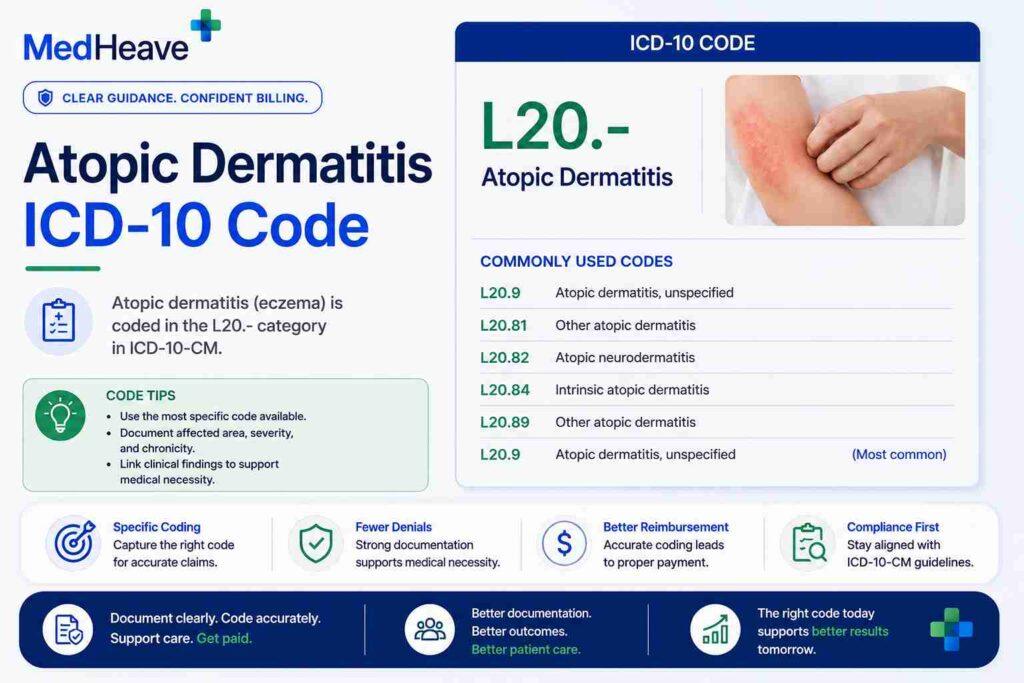


The ICD-10-CM code for atopic dermatitis, unspecified is L20.9. It’s a billable code used when the provider documents atopic dermatitis without specifying a subtype.
But L20.9 is not always the right choice — six more specific L20 codes exist, and picking the wrong one or defaulting to L20.9 out of habit is a common code selection error in dermatology.
In this guide, we’ll go through the complete L20 code table and where coding decisions actually get tricky:
- How to distinguish L20.9 from L20.89
- Why severity does not change the code
- When L20.9 applies and when it does not
- Six realistic documentation-to-code examples
- The documentation checklist that prevents audit findings
- How atopic dermatitis differs from contact and unspecified dermatitis for coding
TLDR: Atopic dermatitis ICD-10 code
- L20.9 is atopic dermatitis, unspecified — use when no subtype is documented
- Seven billable L20 codes exist, & the right one depends entirely on provider documentation
- L20.89 is for a specified form of AD that doesn’t match a named subcode
- L20.89 is not a synonym for L20.9
- Severity does not change the ICD-10 code — the L20 family is organized by type, not severity
- If the note says “eczema” without the word “atopic,” L20.9 is not automatically correct
- Verify code validity for the date of service (FY 2026 applies through September 30, 2026)
What is the ICD-10 code for atopic dermatitis?
The ICD-10-CM code for atopic dermatitis, unspecified is L20.9.
It sits within the L20 code family (all atopic dermatitis subtypes), within the L20-L30 block (dermatitis and eczema), inside L00-L99 (diseases of the skin and subcutaneous tissue).
- ICD-10-CM code — L20.9
- Billable — yes
- Use when the provider documents atopic dermatitis without a named subtype
- Verify validity for the date of service using the CDC/NCHS ICD-10-CM Browser Tool
What is the complete L20 code table?
Every atopic dermatitis claim starts with choosing the right code from the L20 family. According to ICD10Data, ICD-10-CM classifies atopic dermatitis under L20 with seven billable child codes.
| Code | Descriptor | When documentation says… |
| L20.0 | Besnier’s prurigo | “Besnier’s prurigo” or “prurigo Besnier” |
| L20.81 | Atopic neurodermatitis | “Atopic neurodermatitis” or “diffuse neurodermatitis” |
| L20.82 | Flexural eczema | “Flexural eczema,” “eczema of flexures,” “antecubital eczema” |
| L20.83 | Infantile acute or chronic eczema | “Infantile eczema,” “infantile atopic dermatitis” |
| L20.84 | Intrinsic allergic eczema | “Intrinsic allergic eczema,” “non-IgE-mediated atopic dermatitis” |
| L20.89 | Other atopic dermatitis | A specified subtype that doesn’t match L20.0, L20.81-L20.84 |
| L20.9 | Atopic dermatitis, unspecified | “Atopic dermatitis” with no further subtype detail |
When should you use L20.9?
L20.9 is appropriate when the provider’s note documents atopic dermatitis without identifying a specific subtype. Use it only when all four conditions are met.
- No more specific L20 subtype is documented in the note
- The provider explicitly documents atopic dermatitis (not just “eczema” or “rash”)
- The diagnosis is not better described by a contact dermatitis or other dermatitis code
- The code is valid for the date of service under the applicable ICD-10-CM fiscal year
When is L20.9 not specific enough?
If the provider’s documentation supports a more specific L20 subtype, the more specific code should be used. Defaulting to L20.9 when a subtype is clearly documented is one of the most common atopic dermatitis coding errors.
- “Besnier’s prurigo” → L20.0
- “Intrinsic allergic eczema” → L20.84
- “Flexural eczema” or “antecubital eczema” → L20.82
- “Infantile eczema” or “infantile atopic dermatitis” → L20.83
- “Atopic neurodermatitis” or “diffuse neurodermatitis” → L20.81
- “Eczema NOS” without any atopic language → review L30.9 before assigning L20.9
That last entry is worth pausing on. If the provider writes “eczema” or “rash” without using the word atopic anywhere in the note, L20.9 is not automatically the right answer.
The atopic designation has to come from the provider documentation. A coder cannot infer it from symptoms, location, or clinical context.
How do L20.9 and L20.89 differ?
L20.9 is for atopic dermatitis that is unspecified — no subtype documented. L20.89 is for atopic dermatitis that is other specified — the provider names a specific form that doesn’t match a named subcode.
L20.9 example
Note reads — “Patient presenting with atopic dermatitis, tolerating topical steroids well, will continue current regimen.” No subtype described. Code L20.9.
L20.89 example
Note reads — “Chronic lichenified atopic eczema of bilateral hands, atopic pattern not consistent with flexural or infantile distribution.”
The provider described a specific clinical presentation that is atopic but doesn’t fit any named subcode. Code L20.89.
What ICD-10 code should you use for severe atopic dermatitis?
There is no separate ICD-10-CM code for mild, moderate, or severe atopic dermatitis.
The L20 code family is organized by type, not severity. A severe case of flexural eczema is still L20.82. A mild case of unspecified atopic dermatitis is still L20.9.
Severity should still be documented clearly in the clinical note — it supports medical necessity documentation, prior authorization requests, and step therapy documentation. It just doesn’t create a different code.
How does atopic dermatitis differ from other dermatitis codes?
The dermatitis code family runs from L20 to L30. Using the wrong dermatitis range is a coding error that can contribute to claim denials and compliance reviews.
| Code | Category | Key clue |
| L20 | Atopic dermatitis | Must say “atopic” — don’t code L20 from eczema alone |
| L21 | Seborrheic dermatitis | Scalp involvement, greasy scaling |
| L22 | Diaper dermatitis | Rash in diaper area, infant |
| L23 | Allergic contact dermatitis | Specific allergen exposure required |
| L24 | Irritant contact dermatitis | Chemical or mechanical irritant |
| L25 | Unspecified contact dermatitis | Contact documented but cause unclear |
| L30.9 | Dermatitis, unspecified | “Eczema NOS” with no type specified |
The most important boundary to protect is L20 vs. L23/L24. Contact dermatitis requires evidence of an exposure. Atopic dermatitis requires the provider to use that term. Never upgrade an unspecified dermatitis to atopic without documentation support.
What do six realistic coding examples look like?
Atopic Dermatitis — No Subtype
Documentation:
“Atopic dermatitis” with no subtype, distribution, or characterization.
No additional subtype is documented, so use the unspecified atopic dermatitis code.
Flexural Eczema
Documentation:
“Flexural eczema of elbows and knees, chronic.” The flexural distribution is explicitly documented.
Use the specific flexural eczema code when the distribution is documented.
Infantile Eczema
Documentation:
“Infantile eczema, currently in flare.” The provider identifies infantile eczema and the patient is an infant.
The documented infantile subtype supports the more specific code.
Rash After Detergent Exposure
Documentation:
“Rash on bilateral hands following detergent exposure.” An exposure is documented and “atopic” does not appear.
Review for irritant contact dermatitis rather than assigning L20.9.
Severe Generalized Atopic Dermatitis
Documentation:
“Severe atopic dermatitis, generalized, not responding to topicals.” Severity is documented, but no subtype is named.
Severity supports medical necessity, but without a named subtype, use L20.9.
Eczema NOS
Documentation:
“Eczema NOS.” The word “atopic” does not appear in the documentation.
Do not assign L20.9 when atopic dermatitis is not documented. Consider unspecified dermatitis instead.
What are the most common coding mistakes?
- Treating severity as a code modifier (it isn’t in the L20 family)
- Carrying forward old codes without reviewing the current note
- Ignoring pediatric specificity (L20.83 exists for infantile eczema)
- Defaulting to L20.9 by habit when documentation supports a more specific code
- Coding atopic dermatitis when the note says contact dermatitis (different code families)
Clear subtype documentation also reduces the risk of adverse coding audit findings when diagnosis specificity is reviewed.
Accurate atopic dermatitis coding starts with accurate documentation
If your practice is seeing denials on dermatology claims, the issue often sits in how diagnoses are documented.
MedHeave’s dermatology billing services help practices align documentation, code selection, and claim submission so the right code reaches the payer the first time.
Accurate coding also improves the likelihood that the submission reaches the payer as a clean claim the first time.
- Performance-based pricing (4-7% of collections) with no lock-in
- Annual code set updates verified for date-of-service compliance
- L20 subtype accuracy reviewed for every atopic dermatitis claim
- Pre-submission claim submission checks verify that ICD-10-CM code selection matches the provider’s documentation.
- Dermatitis code family boundaries (L20 vs. L23/L24 vs. L30.9) enforced at the coding level
Contact us to see how our medical billing and coding experts can help your practice improve reimbursement while staying compliant.
Frequently asked questions
Here are some commonly asked questions on this topic:
L20.9 is the ICD-10-CM code for atopic dermatitis, unspecified. Use a more specific L20 code when the provider documents a named subtype such as flexural eczema (L20.82) or infantile eczema (L20.83). The L20 family contains seven billable codes, and the correct one depends entirely on the provider’s documented diagnosis. Verify code validity for the encounter date of service using the current fiscal year code set.
L20.9 is for atopic dermatitis that is unspecified — no subtype documented. L20.89 is for a specified form of atopic dermatitis that doesn’t match a named subcode (L20.0 through L20.84). The provider’s note must describe a specific clinical presentation to support L20.89. If the note simply says “atopic dermatitis” with no further characterization, L20.9 is the correct code.
There is no separate ICD-10-CM code for severity within the L20 family. Select the code by type based on documentation. Severity should be documented in the clinical note to support medical necessity and prior authorization requests, but it does not change which L20 code is assigned. A severe case of flexural eczema is still L20.82, and a severe case of unspecified atopic dermatitis is still L20.9.
Atopic dermatitis is a type of eczema, but eczema is a broader term that includes contact dermatitis, seborrheic dermatitis, and other skin conditions. For coding purposes, always follow the provider’s documented diagnosis. If the note says “eczema” without using the word “atopic,” do not assign L20.9 — the atopic designation must come from the provider’s documentation.
L20.9 requires the provider to have documented atopic dermatitis. L30.9 is for dermatitis that is unspecified with no further detail — “eczema NOS” or “dermatitis NOS” without any type specified. Do not use L20.9 unless the word “atopic” appears in the provider’s documentation. L30.9 is the correct fallback when no specific dermatitis type is documented.