
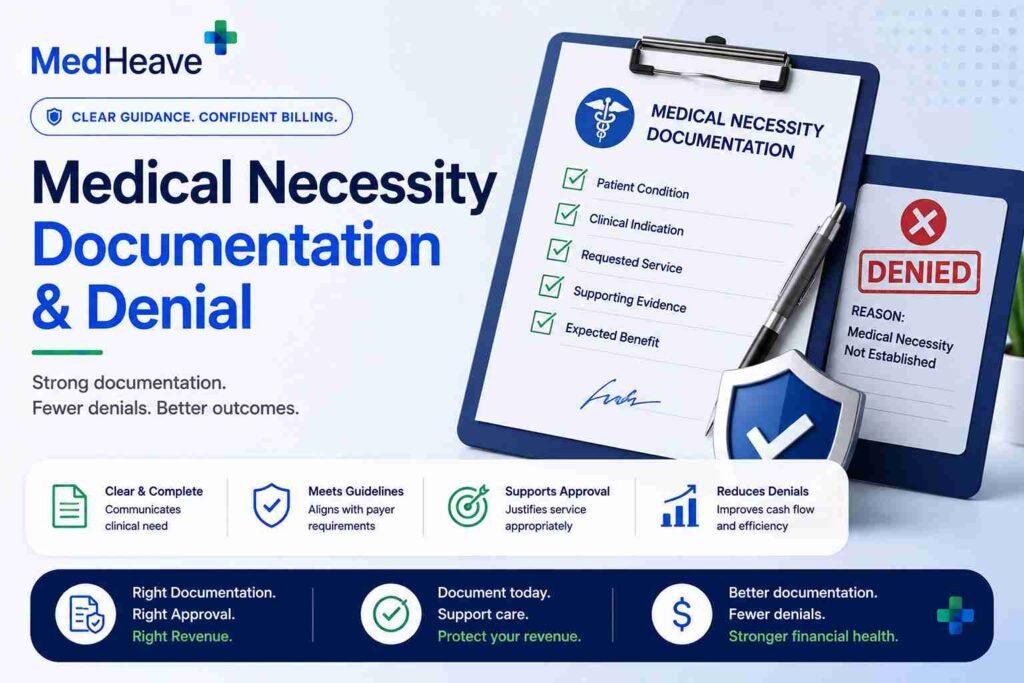


Medical necessity documentation is the clinical evidence in a patient’s record that connects the diagnosed condition, the patient’s current symptoms, and the specific service rendered — in a way that satisfies the payer’s coverage criteria.
A medical necessity denial occurs when the payer concludes that the submitted record failed to establish those criteria.
In CMS’s FY2025 national CERT measurement, insufficient documentation accounted for 53% of all Medicare FFS improper-payment dollars ($15.3 billion), while medical necessity errors added another 15.3% ($4.4 billion).
Documentation is not an afterthought — it is the largest single category of Medicare payment errors.
Requirements vary by payer, plan, service, and setting. But the core concept holds across all of them. In this article, we’ll go through:
- What reviewers look for in a medical record
- Weak vs. strong documentation with examples
- How to build a criterion-based appeal after a denial
- What changed with CMS’s 2026 prior-authorization rules
- How to tell a documentation failure from a coverage dispute
- Why payers deny claims for medical necessity (& what that means)
What documentation proves medical necessity?
A diagnosis alone rarely proves medical necessity.
A reviewer’s real question is not “Does this patient have a condition?” — it is “Does the record prove why this specific service, at this intensity, for this patient, at this point in time, was clinically appropriate?”
The answer has to come from the medical record itself, not from a standalone letter or attestation.
For Medicare DMEPOS specifically, CMS states that contemporaneous medical records — not standalone attestations — support medical necessity.
The evidence chain
The strongest documentation follows a logic chain that mirrors how a payer reviewer evaluates a claim.
Documentation Framework
The medical necessity evidence chain
1. Condition
What is being diagnosed or treated?
2. Current evidence
Symptoms, findings, severity — documented now
3. Impact / risk
Functional impairment or clinical risk if untreated
4. Criteria match
Which payer/LCD/NCD criteria apply?
5. Service rationale
Why this treatment, why now?
6. Intensity
Frequency, duration, quantity, level, setting
7. Alternatives
Prior treatments tried, failed, or contraindicated
8. Outcome
Expected benefit, or progress supporting continuation
Each element answers a specific question a reviewer will ask. Miss one link in the chain, and the record may not satisfy the coverage criterion — even if the care was clinically appropriate.
Diagnosis and condition
Diagnosis establishes context, but the ICD-10 code alone does not justify the service. The record should show the current clinical picture — not just a diagnostic label carried forward from a prior visit.
Symptoms, findings, and severity
Include frequency, duration, intensity, objective test results, examination findings, and standardized measures where appropriate. Vague phrases like “patient is doing worse” do not give a reviewer anything to evaluate.
Functional impact or clinical risk
The bridge between diagnosis and service need.
- Can the patient work?
- Perform daily activities?
- Is there risk of deterioration, hospitalization, or safety concern without the proposed service?
In behavioral health and rehabilitation especially, functional impairment is often the element that separates an approved claim from a denied one.
Service rationale and intensity
The part most frequently missing from denied claims.
The record should answer not only what was done, but why this service, why now, why at this frequency, why at this level of care, and why not a less intensive alternative.
CMS’s 2025 CERT data on major hip and knee replacements found 119 sampled claims where the inpatient admission was not medically necessary and the procedure should have been billed outpatient. The procedure was clinically indicated — but the setting failed the necessity standard.
Alternatives and prior treatment
When the applicable payer policy requires it, the record should document what was tried before, what failed, what was contraindicated, or why a less intensive option is not appropriate.
Not every service requires a failed-conservative-therapy trail, but when the coverage criteria call for it, its absence is a common denial trigger.
Goals, progress, and continued necessity
Initial necessity and continued necessity are different evaluations. Ongoing services require current evidence — not a treatment plan copied forward from three months ago.
Document baseline findings, treatment goals, actual response, remaining deficits, and rationale for continuing, adjusting, or tapering.
Why do medical necessity claims get denied?
Understanding why insurance companies deny claims starts with an important distinction: a medical necessity denial does not always mean the care was wrong.
It means the payer concluded — based on what was submitted — that the applicable coverage criteria were not established.
The difference between clinically appropriate and documented to the payer’s standard is where most denials live.
The record misses a required criterion
The most common failure mode is not a bad note — it is a note that omits one specific piece of evidence the payer policy requires.
Missing severity indicators, absent functional scores, no documented prerequisite, or no objective findings can each trigger a denial on an otherwise well-documented case.
CMS’s Alabama IRF Review Choice Demonstration found that 59% of non-affirmation decisions cited documentation that did not support the beneficiary’s need for rehabilitation-physician supervision.
The patient may have genuinely needed rehab — but the record did not prove the specific intensity criterion.
Intensity is documented but not justified
A service appears in the record, but the rationale for its frequency, duration, or setting is missing.
Weekly therapy visits are documented, but there is no explanation of why weekly (rather than biweekly) is necessary.
Inpatient care is billed, but nothing in the note establishes why the patient could not have been treated outpatient.
Documentation tells an inconsistent story
When the diagnosis, orders, progress notes, and billed CPT/HCPCS codes do not align, the reviewer sees a fragmented record. Five CPT codes are billed, but the progress note only supports three.
An ultrasound CPT code appears, but the physician’s note never mentions ordering an ultrasound or why it was needed. The claim contains the code — but the clinical chain is broken.
In practice, EHR design contributes to this problem. Some systems allow providers to enter CPT codes without documenting the corresponding order in the orders section.
The code is technically on the claim, but the medical record does not contain the ordering, clinical rationale, or supporting documentation that would justify it to a reviewer.
Continued services look repetitive
Copy-forward notes are a red flag for utilization reviewers.
When every visit note reads identically — same symptoms, same plan, same boilerplate language — the record fails to demonstrate ongoing medical necessity because there is no evidence of reassessment, progress, or clinical decision-making.
The denial is actually a different problem
Not every denial labeled “medical necessity” is actually a medical necessity issue. Billing teams should distinguish the denial type before deciding how to respond. If the remittance instead identifies missing or incomplete claim information, review the CO-16 denial code before treating the issue as a pure medical necessity dispute.
| Denial type | What it means | What to check first |
| Medical necessity | Payer says clinical criteria were not met | Denial rationale + payer policy |
| Insufficient documentation | Required evidence is absent or incomplete | What was submitted vs. what was required |
| Benefit exclusion | Service is not covered under the plan | Evidence of coverage or benefit document |
| Coding or billing error | Claim data does not support payment | CPT/HCPCS, ICD-10, modifiers |
| Missing authorization | Required prior auth was absent or invalid | PA rules and authorization history |
Filing a medical necessity appeal when the real problem is a coding error wastes 60-90 days.
Identifying the actual denial type is the first step in effective denial management and in choosing the right response.
Maintaining a working reference to common denial codes also helps billing teams distinguish clinical denials from coding, authorization, and submission problems before choosing an appeal strategy.
What does weak vs. strong documentation look like?
The difference between a denied claim and a paid one often comes down to specificity.
Weak documentation states conclusions. Strong documentation provides the evidence behind those conclusions.
Hospital admission
Weak: “Patient admitted for observation. Continue monitoring.”
Strong: Current hemodynamic instability (documented vitals, trending labs), IV medication required every 4 hours, respiratory status requiring continuous pulse oximetry, risk of deterioration that cannot be managed in an outpatient or lower-acuity setting. Physician assessment documents why inpatient-level resources — nursing ratio, monitoring frequency, proximity to critical care — are required for this patient’s current clinical status.
Outpatient therapy
Weak: “Patient continues to have pain. Continue treatment.”
Strong: PHQ-9 score of 18 (severe), down from 22 at intake. Patient reports continued difficulty with daily activities (specific examples). Current intervention is CBT targeting catastrophic thought patterns. Patient demonstrates measurable improvement in sleep latency (90 min → 45 min) but continues to meet criteria for moderate-to-severe functional impairment in occupational and social domains. Recommend continued weekly sessions for 6 additional weeks with reassessment at session 12.
Diagnostic service
Weak: “Order MRI lumbar spine.”
Strong: Patient presents with radiculopathy, progressive over 8 weeks despite 6 weeks of conservative management (NSAIDs, physical therapy — documented). Straight-leg raise positive at 35 degrees bilaterally. Neurological examination shows decreased sensation in L5 dermatome. MRI lumbar spine ordered to evaluate for disc herniation or stenosis prior to surgical consultation.
The difference is not just length. The stronger examples contain the specific clinical evidence that maps to payer coverage criteria — prior treatment, objective findings, severity measures, and clinical rationale.
What should you do after a medical necessity denial?
A medical necessity appeal works best when it is built around the payer’s specific criteria, not around a general argument that the care was needed.
Step 1: Read the exact denial reason
Do not assume “not medically necessary” is the full explanation.
Starting in 2026, CMS requires impacted payers to provide a specific reason for applicable denied non-drug prior authorization requests. Use that specific reason as the starting point — not a generic appeal template.
Step 2: Find the applicable policy
Locate the exact coverage criteria the payer used. For Medicare, that means the relevant NCD, LCD, or associated Billing & Coding Article in the Medicare Coverage Database.
For commercial payers, check the plan’s medical policy through the provider portal.
Depending on the payer and service, utilization review may also rely on frameworks such as InterQual criteria, so teams should identify the actual standard used for the determination.
For MassHealth, the product/service-specific guidelines identify clinical information required for applicable prior-authorized services.
Step 3: Map criteria to evidence
Build a criterion-to-evidence table before writing anything.
| Payer criterion | Evidence in record | Submitted? | Gap or action needed |
| Documented severity | Lab results, exam findings | Yes | None |
| Failed conservative therapy | PT notes, medication history | No | Obtain and submit |
| Functional impairment | ADL assessment | Partial | Supplement with specific scores |
This table is the backbone of a strong appeal. It forces the response to be criterion-specific rather than narrative-heavy.
Step 4: Gather contemporaneous records
The appeal should point to evidence that already exists in the medical record — not create a new clinical story after the denial. Include applicable notes, test results, imaging, treatment history, orders, and outcome measures.
Step 5: Write the clinical narrative
Address the specific disputed criterion. Where does the supporting evidence appear? Why does the patient’s situation satisfy the requirement? Keep the narrative tight and connected to the record.
Step 6: Submit through the correct route
For Original Medicare, first-level appeal is a redetermination, and CMS generally gives 120 days from receipt of the initial determination to file.
Commercial payer deadlines vary — check the denial notice and provider manual. Do not assume one universal timeline applies.
A 2025 JAMA Network Open study of anticancer medication appeals in Medicare Part D found that among therapies denied for failure to meet prior-authorization criteria, 61.1% ultimately received favorable review on second-level appeal.
For successfully appealed off-label therapies, more than 87.9% had support in Medicare-approved clinical compendia or peer-reviewed literature. The evidence quality of the appeal materially affects the outcome.
When does a letter of medical necessity help — and when doesn’t it?
A letter of medical necessity (LMN) can support an appeal by summarizing the clinical rationale in a focused, readable format. But an LMN is a supplement to the medical record, not a replacement for it.
For Medicare DMEPOS, CMS is explicit: attestations alone do not provide sufficient documentation of medical necessity.
The strongest appeal tells the same clinical story already supported by the contemporaneous record — it does not try to manufacture a new narrative after the denial.
An LMN should contain:
- Patient and service identifiers
- References to supporting records
- Diagnosis and relevant clinical history
- Why alternatives are insufficient (when applicable)
- Clinical rationale tied to the patient’s specific circumstances
- Expected benefit and risk without the service
- Provider credentials and signature
- Requested treatment or service
How do documentation requirements change by service?
A generic documentation checklist will not cover every service type. CMS’s own compliance data shows that the dominant error varies by setting.
| Service type | Improper-payment rate | Primary documentation problem |
| Physical therapy (private practice) | 15.8% ($659M) | 88.6% insufficient documentation |
| Non-fee-schedule lab tests | 27.2% ($1.3B) | 87.7% insufficient documentation |
| Home health | 6.7% ($1.1B) | 51.4% insufficient documentation, 33.7% medical necessity |
| Evaluation & management | 10.3% ($3.9B) | 49.1% incorrect coding, 34.1% insufficient documentation |
Source: CMS Medicare Provider Compliance Tips, 2024 reporting-period data.
For physical therapy and lab services, the problem is overwhelmingly documentation sufficiency. For E&M, coding-level errors dominate.
A practice running the same documentation improvement strategy across every service line is likely fixing the wrong problem in at least one area.
CMS FY2025 CERT Data
The dominant error type depends on the service
Percentage of improper payments by primary error category
Physical therapy
E&M services
How can organizations prevent medical necessity denials?
Individual documentation improvement helps, but systematic denial prevention requires a workflow — not just training.
A 2025 JAMA Network Open study found that integrating payer criteria visibility directly into clinical workflows reduced prior-authorization denials from 7.6% to 2.6% — a 65.4% reduction — across 6,551 cases and 86 health plans.
Treatment utilization did not change significantly. The denials dropped because the documentation matched the criteria, not because care was restricted.
A radiation-oncology quality-improvement study found that redesigning clinical templates by disease site to include payer-required information reduced delayed or denied cases from 32% to 8%.
And a cardiology study using a prior-authorization documentation checklist saw initial PCSK9 inhibitor approvals rise from 78% to 97%.
The pattern across all three studies is the same. Denials dropped when clinicians could see what the payer needed while documenting — not after the claim was rejected.
The practical framework looks like this:
- Build EHR prompts around missing evidence, not generic templates
- Feed denial patterns back into clinician workflow as targeted education
- Maintain a payer-policy and criteria library accessible at the point of care
- Review documentation before the claim becomes a denial (CDI/UR workflows)
- Categorize denials by root cause — separate medical necessity from coding, authorization, benefit, and documentation issues
Organizations should also audit recurring claim denial mistakes so process failures do not get repeatedly mislabeled as documentation problems.
CMS warns in its Program Integrity Manual that reimbursement-focused templates may be insufficient if they do not collect enough information to establish applicable coverage and coding requirements.
Building prompts around payer criteria — not billing convenience — is the difference between a template that helps and one that creates a false sense of compliance.
Documentation gaps are a solvable problem, not an inevitable cost
Most medical necessity denials do not happen because the care was wrong. They happen because the record did not tell the story the payer needed to hear.
At MedHeave, our denial management services help practices close the gap between clinical care and payer-ready documentation — before the denial hits.
- Payer-criteria mapping aligned to your highest-volume services
- Medical necessity appeal support with criterion-based evidence packages
- CDI-informed documentation improvement programs built around your EHR
- Denial root-cause analysis that separates documentation failures from other issues
Frequently asked questions
Here are some commonly asked questions on this topic:
The record should demonstrate an evidence chain connecting the diagnosed condition, current symptoms and severity, functional impact or clinical risk, applicable payer criteria, clinical rationale for the specific service, justification for the intensity and setting, prior treatments tried or ruled out when applicable, and expected outcome. The strongest documentation follows the payer’s coverage criteria explicitly rather than relying on general clinical narrative. Requirements differ by payer, service, and setting.
No. A medical necessity denial means the payer acknowledges the service could be covered but says the clinical criteria were not met based on what was submitted. A benefit exclusion means the plan does not cover the service under any circumstances. The response is completely different — one requires better documentation or an appeal with clinical evidence, the other requires verifying whether the plan actually excludes the service or whether coverage exists elsewhere.
Yes. Payer coverage determinations depend on applicable benefits and coverage criteria in addition to a clinician’s recommendation. HHS-OIG found that 13% of sampled Medicare Advantage prior-authorization denials met Medicare coverage rules, suggesting the initial denial was not always correct. A physician recommendation strengthens an appeal but does not guarantee payment.
No. A diagnosis code establishes context — it does not prove that the specific service billed was necessary for that patient at that time. The record needs to show current symptoms, severity, clinical rationale, and why the requested service (at the requested intensity) is appropriate. In KFF’s 2024 data, the coding and documentation mismatch between diagnosis and service was a common contributor to denied claims.
A strong appeal includes the denial notice, the applicable payer policy or coverage criteria, relevant medical records (notes, orders, test results, treatment history), a criterion-by-criterion explanation mapping the record evidence to each payer requirement, supporting clinical literature when an indication is unusual, and clear submission through the correct appeal route before the applicable deadline. The appeal should reference existing documentation rather than constructing a new clinical narrative.
Not necessarily. An LMN can summarize the clinical rationale and provide a focused argument, but the underlying medical record and applicable payer requirements carry more weight. For Medicare DMEPOS, CMS specifically states that attestations alone do not provide sufficient documentation. The LMN should support the clinical story already present in the chart — not attempt to replace records that were never created.