


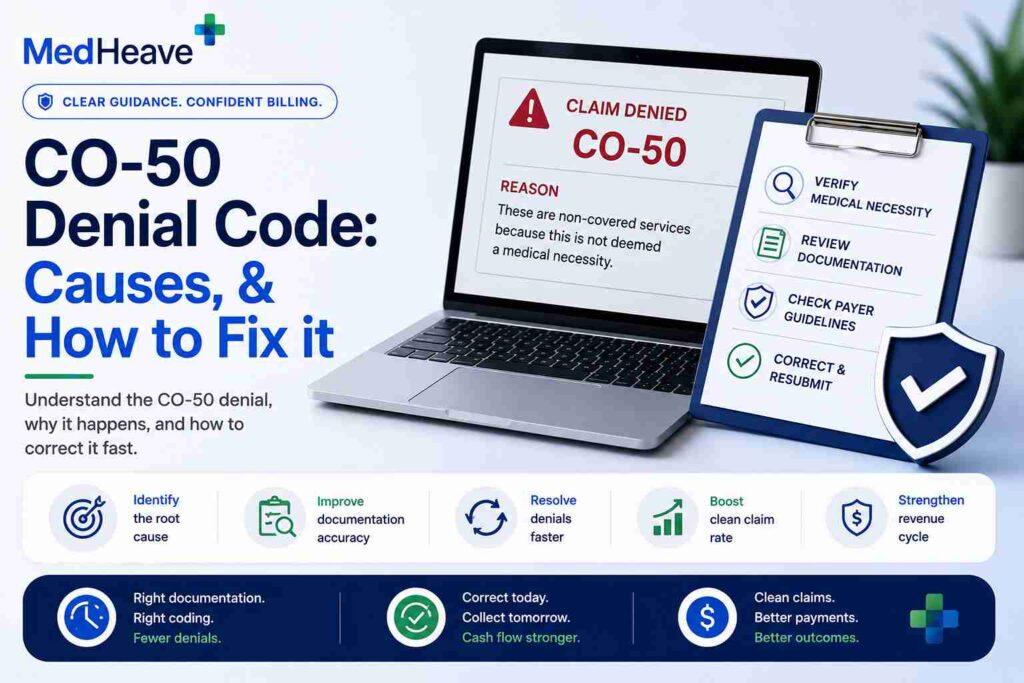
CO-50 is a claim adjustment that combines the Contractual Obligation (CO) group code with Claim Adjustment Reason Code (CARC) 50, which X12 defines as services that are “non-covered services because this is not deemed a ‘medical necessity’ by the payer.”
When CO-50 appears on a remittance advice or Explanation of Benefits, it means the payer reviewed the claim and determined that the billed service did not meet its medical necessity criteria — and the adjustment falls under the provider’s contractual obligation.
In CMS’s FY2025 national CERT measurement, medical necessity errors accounted for $4.4 billion in improper payments — 15.3% of all Medicare FFS payment errors.
The immediate question after seeing CO-50 is not “how do I resubmit?” — it is “should I correct, appeal, or write off?” The answer depends on what actually caused the denial. CO-50 is one specific branch of the broader reasons insurance companies deny claims, so identifying the actual CARC, policy, and documentation issue comes before choosing a response. Here’s what we’ll cover:
- What CO and 50 mean separately ( why the group code is important)
- Common causes — and codes that look like CO-50 but are not
- How to decide between a corrected claim and an appeal
- How to build a medical necessity appeal that works
- A step-by-step workflow for resolving CO-50
- CO-50 vs. PR-50 vs. Modifier 50
- Prevention by workflow stage
What do “CO” and “50” mean separately?
CO-50 is not one code. It is two codes working together, and reading them separately tells you more than treating them as a single label.
| Component | Name | Function |
| CO | Contractual Obligation | Group code — identifies who is financially responsible for the adjustment |
| 50 | CARC 50 | Reason code — the payer does not deem the service medically necessary |
The group code determines financial responsibility.
CMS describes CO adjustments as generally provider write-offs, meaning the provider cannot typically bill the patient for the adjusted amount under the CO designation.
PR (Patient Responsibility), by contrast, assigns the adjustment to the patient.
That financial-responsibility piece matters immediately. If a biller sees CO-50 and bills the patient for the balance without checking the group code and applicable payer rules, the practice has a compliance problem — not just a revenue problem.
X12 also instructs the recipient of CARC 50 to check the 835 Healthcare Policy Identification Segment (loop 2110 Service Payment Information REF) when present.
The remittance may contain a reference to the specific payer policy that drove the denial. Missing that reference means missing the fastest path to understanding why the claim was denied.
How do you resolve a CO-50 denial?
One of the most costly claim denial mistakes is treating every CO-50 as the same type of problem.
Some CO-50 denials are correctable claim errors. Some are genuine medical necessity disputes. Some are contractual adjustments that cannot be recovered.
The resolution path depends on which one you are dealing with.
Step 1: Read the full remittance
Before anything else, pull the complete ERA, EOB, or remittance advice and identify:
- The CARC (50)
- The group code (CO)
- The denial date and claim number
- The payer’s policy reference, if present
- Any Remark Code (RARC) that accompanies it
- The claim/service line level (is it the whole claim or specific line items?)
CO-50 tells you the category of problem. It does not tell you the exact factual reason. The RARC and policy reference fill that gap.
Step 2: Identify the governing policy
“Check payer guidelines” is advice that appears in every CO-50 article online. It is also too vague to be useful. Here is what that process actually looks like.
For Original Medicare:
- Search the CPT/HCPCS code in the Medicare Coverage Database
- Identify the applicable National Coverage Determination (NCD)
- Check for a jurisdiction-specific Local Coverage Determination (LCD)
- Review the associated Billing & Coding Article (coding requirements may reside there, not in the LCD itself)
- Check ICD-10-CM indications, prerequisites, and documentation requirements
CMS confirms that NCDs apply nationally while LCDs are MAC-specific, and coding guidance may reside in associated articles rather than the LCD itself.
For commercial payers, the process runs through the provider portal — find the medical policy, locate the specific procedure or service, and review the coverage indications, exclusions, prerequisites, and documentation requirements.
Step 3: Compare the claim and chart against the policy
Map the payer’s requirements against what was actually submitted and documented.
| Check | Question to answer |
| Procedure | Was the correct CPT/HCPCS code submitted? |
| Diagnosis | Does the documentation support the ICD-10-CM code billed? |
| Clinical criteria | Does the record show each required indication? |
| Prior treatment | Were prerequisite or conservative therapies documented, if required? |
| Frequency | Is the service within the policy’s frequency limits? |
| Setting | Was the service performed in an allowed setting? |
| Modifier | Is a required service-specific modifier supported? |
Never add or change a diagnosis code simply because it is payable. Code only what the medical record supports.
Falsifying a diagnosis to match coverage criteria is fraud — regardless of whether the patient genuinely needed the service.
Step 4: Decide — correct, appeal, or write off
This is where most billing teams need to slow down. The choice between correction and appeal changes the timeline, the process, and the outcome.
CO-50 Resolution Logic
Correct it or appeal it?
✓ Correct / reopen when…
A supported diagnosis was omitted from the claim
A modifier or data field was entered incorrectly
A minor claim error exists and the chart supports the fix
Payer correction or reopening rules permit it
⟶ Appeal when…
The claim accurately represents what the chart shows
The payer disagrees with the medical necessity determination
Documentation meets the policy criteria but the payer denied anyway
Additional clinical evidence needs to be reviewed
✗ Write off when…
The service genuinely does not meet the applicable coverage criteria, the chart does not support it, and no additional evidence exists. Review patient liability rules before writing off.
For Medicare, CMS explicitly distinguishes appeals (redetermination) from correction of minor claim errors and omissions, which should use the reopening or correction route instead.
A CO-16 denial, for example, generally points toward missing or incomplete information and requires a different investigation from a true CO-50 medical-necessity dispute.
Step 5: Build the evidence packet
For a medical necessity appeal, assemble:
- The original denial notice
- Physician order or referral
- The applicable payer policy
- Diagnostic findings (imaging, lab results)
- A letter of medical necessity when useful
- Relevant chart notes from the date(s) of service
- Claim identifiers (claim number, date of service, provider info)
- Treatment history and failed conservative therapy when required
The competitive advantage in an appeal is the mapping — connecting each payer criterion to specific evidence in the chart.
| Payer criterion | Documented evidence | Record location |
| Symptom severity | PHQ-9 score of 22 | Progress note, 3/15/2026 |
| Failed conservative therapy | 8 weeks PT, documented non-response | PT discharge summary, 2/28/2026 |
| Functional impairment | Unable to perform ADLs | Physician note, 3/15/2026 |
A 2026 JAMA Network Open study of Part D anticancer medication appeals found that among therapies denied for failure to meet prior-authorization criteria, 61.1% ultimately received favorable review at second-level appeal.
For successfully appealed off-label therapies, more than 87.9% had support in Medicare-approved compendia or peer-reviewed literature. Evidence quality directly affects appeal outcomes.
Step 6: Submit and track
Submit through the correct channel (payer portal, fax, or mail per payer requirements), record the confirmation or reference number, set a follow-up date, and track the outcome.
Classify the result by root cause — that data feeds your prevention workflow.
What are the most common causes of CO-50 denials?
CO-50 denials usually fall into four patterns. Identifying which pattern applies determines the response.
Missing clinical evidence
The chart does not contain the specific findings, severity indicators, or functional data the payer’s policy requires. Symptoms are documented in general terms. Objective measurements are absent.
The clinical rationale for the service is implied but not stated.
CMS’s 2025 CERT data found 119 hip/knee replacement claims where inpatient admission was not medically necessary — the procedure was clinically indicated, but the setting (inpatient vs. outpatient) was not supported by the documentation.
The service was right. The level-of-care documentation was not.
Diagnosis-procedure mismatch
The diagnosis code billed does not establish medical necessity for the procedure code billed, based on the payer’s coverage criteria.
A 2025 study of cancer-related next-generation sequencing claims found that among hospital claims with denial-reason information, 67.3% cited diagnosis as the basis and 18.1% cited noncoverage for medical necessity.
The diagnosis-to-service linkage is a frequent failure point.
Frequency, duration, or prerequisite violations
The service exceeds the policy’s frequency limits, the required conservative-treatment prerequisite was not documented, or the setting does not match coverage rules.
The chart may fully support the clinical need — but the specific criteria for that service at that interval were not met.
The denial is actually a different code
Not every medical-necessity-related problem lands as CO-50. Other common denial codes can represent completely different root causes and resolution paths.
- CARC 167: Diagnosis not covered
- CARC 152: Length of service not supported
- CARC 197: Authorization/precertification absent
- CARC 151: Frequency/number of services not supported
- CARC 204: Service not covered under current benefit plan
When CARC 197 appears under the CO group, a CO-197 denial points to an authorization or precertification problem rather than a CARC 50 medical-necessity determination.
If the denial is really an authorization problem (197) or a benefit exclusion (204), the response is entirely different from a medical necessity appeal.
Checking the actual CARC before building a response prevents wasted effort.
How should you read remark codes with CO-50?
The Remittance Advice Remark Code (RARC) that accompanies CO-50 often reveals the specific policy basis for the denial.
N115 specifically means the determination was based on a Local Coverage Determination.
If you see N115, go to the Medicare Coverage Database and find the LCD for your jurisdiction and service — that document contains the criteria the reviewer used.
N429 means the service is not covered when considered routine.
The denial is not about the service being medically unnecessary in general — it is about the service being classified as routine in the payer’s coverage framework.
Do not memorize a fixed CO-50/RARC pairing. Read the actual remark code on the remittance, then locate the actual policy it references.
What is the difference between CO-50, PR-50, and Modifier 50?
Three very different concepts share the number 50, and confusing them is surprisingly common.
| CO-50 | PR-50 | Modifier 50 | |
| What it is | Contractual Obligation + Medical necessity denial | Patient Responsibility + Medical necessity denial | Bilateral procedure modifier |
| Who owes | Generally the provider | Generally the patient | N/A — it is a billing modifier |
| Relation to medical necessity | Direct | Direct | None |
| Action | Review policy, correct or appeal | Verify liability rules before billing patient | Apply per bilateral surgery indicator |
CO-50 and PR-50 share the same CARC 50 reason but assign the financial responsibility differently. CMS identifies CO and PR as group codes that assign financial responsibility.
Modifier 50 is completely unrelated. It indicates a bilateral procedure.
For Medicare procedures with bilateral indicator 1, payment may be based on 150% of the single-procedure fee-schedule amount, subject to CMS rules.
The number 50 is a coincidence.
How do you appeal a CO-50 denial?
Let’s look at the next-steps for appealing a CO-50 denial for both Medicare and commercial situations:
Medicare appeals
For Original Medicare, first-level appeal is a redetermination. CMS generally gives 120 days from receipt of the initial determination to file.
Include the claim identifiers, the exact denial being disputed, the applicable medical policy, clinical rationale with criterion-by-criterion evidence, and supporting records.
Commercial payer appeals
Check the denial notice, provider manual, payer portal, and contract for:
- Appeal filing period
- Number of appeal levels available
- Whether peer-to-peer review is available
- Submission channel
- Required forms
Do not confuse the appeal deadline with the payer’s timely filing limit for submitting the original claim; they govern different stages of the revenue cycle.
Do not assume a universal “90–180 day” rule applies. Each payer sets its own deadlines.
What makes a CO-50 appeal strong
The appeal letter should follow a structure that directly addresses the payer’s coverage criteria:
- Claim and patient identification
- The exact denial being contested
- A clear request for reconsideration and payment
- Clinical rationale mapped to each coverage criterion
- The applicable medical policy (NCD, LCD, or commercial policy)
- Supporting clinical records with specific references (note date, page, finding)
How do you prevent CO-50 denials?
Prevention is a workflow responsibility, not a single team’s job. The root cause of a CO-50 denial can originate at scheduling, in the exam room, at the coding desk, or in claim submission.
Prevention Framework
Who owns CO-50 prevention at each stage?
Verify benefits and eligibility. Identify services subject to medical policy restrictions. Confirm prior authorization requirements. Flag likely noncoverage before the patient is seen.
Document symptoms, severity, and clinical rationale. Record prior treatments and outcomes. Note diagnostic findings. Explain why this service — at this frequency, in this setting — is necessary for this patient.
Match ICD-10-CM diagnoses to documented conditions. Validate CPT/HCPCS against payer-specific policy criteria. Apply modifiers only when requirements are met. Query providers rather than assuming missing diagnoses.
Track CO-50 by payer, CPT/HCPCS, provider, and location. Run denial analytics to find recurring patterns. Feed findings upstream to scheduling, providers, and coders. Measure appeal success by root cause.
The pattern we see across practices with high CO-50 volume is usually not a single catastrophic documentation failure — it is a disconnect between clinical documentation and payer-specific coverage requirements that repeats across dozens of claims per month.
Fixing it requires a denial management feedback loop between denial data and clinical workflow. Without that loop, the same denials recur indefinitely.
CO-50 denials are diagnosable — and most are preventable
A CO-50 on your remittance is not a final verdict. It is a signal that the payer’s medical necessity criteria were not established by the submitted claim and documentation.
MedHeave’s denial management services help practices trace CO-50 denials back to their root cause, build criterion-based appeals for recoverable revenue, and redesign documentation workflows so the same denial stops recurring.
- Denial analytics by CARC, payer, CPT, and provider
- Criterion-to-evidence appeal support for medical necessity disputes
- Documentation workflow redesign aligned to payer-specific coverage criteria
- Pre-submission claim validation to catch CO-50 triggers before they deny
Frequently asked questions
Here are some commonly asked questions about CO-50 denial code:
CO-50 combines the Contractual Obligation group code with CARC 50, which X12 defines as “non-covered services because this is not deemed a ‘medical necessity’ by the payer.” The CO group code means the financial adjustment is generally the provider’s responsibility rather than the patient’s. It appears on the ERA, EOB, or remittance advice when the payer has processed a claim and determined the billed service did not meet its medical necessity criteria.
Generally, no. CMS describes CO adjustments as provider write-offs, meaning the adjusted amount is the provider’s contractual responsibility. For Original Medicare, advance beneficiary notice (ABN) rules and modifiers like GA can affect liability when noncoverage was properly anticipated and notice requirements were satisfied before the service. But billing a patient for a CO-50 balance without checking the applicable group code, payer contract, and notice rules creates compliance risk.
Correct when the claim contains a legitimate billing error (omitted diagnosis code, wrong modifier, data entry mistake) and the medical record supports the correction. Appeal when the claim accurately represents the chart but the payer’s medical necessity determination is disputed. The two paths use different processes, different timelines, and produce different outcomes. CMS distinguishes redetermination appeals from correction of minor claim errors.
N115 is a Remittance Advice Remark Code indicating that the coverage decision was based on a Local Coverage Determination. When N115 accompanies CO-50, it tells you to locate the specific LCD for your jurisdiction and service in the Medicare Coverage Database. That LCD contains the exact criteria the reviewer used — and those criteria are the starting point for your correction or appeal.
For Original Medicare redetermination, CMS generally requires filing within 120 days from receipt of the initial determination. Commercial payer deadlines vary and are specified in the denial notice, provider manual, or payer contract. Do not assume one universal deadline applies across all payers. Check the specific denial and file within the stated window — missing the deadline can forfeit appeal rights entirely.
No. Authorization problems can generate other CARCs, including CARC 197 for absent authorization/precertification. While a prior authorization issue and a medical necessity issue may be related, they are not the same denial. Always check the actual CARC on the remittance before deciding on a response. Treating a 197 as a 50 (or vice versa) sends the appeal down the wrong path.
No. Modifier 50 indicates a bilateral procedure and has nothing to do with CARC 50 or medical necessity. For Medicare procedures carrying bilateral indicator 1, payment may be based on 150% of the single-procedure fee-schedule amount. The number 50 is shared coincidentally — the modifier, the group code, and the reason code are unrelated concepts.