


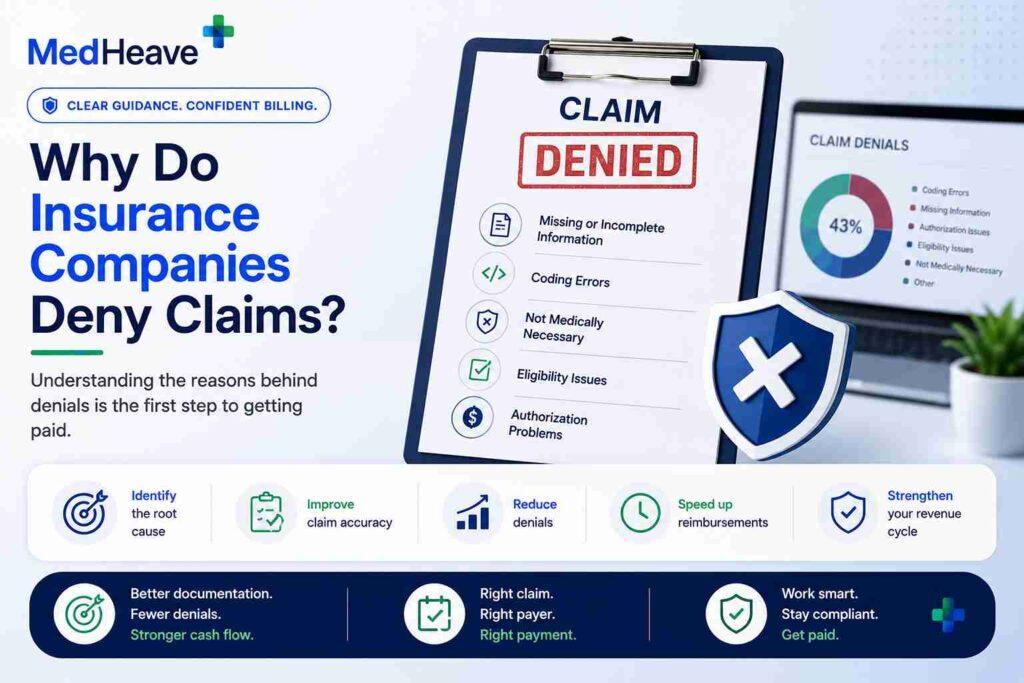
Insurance companies deny claims when the submitted request fails to meet the policy’s coverage terms, documentation requirements, or procedural rules.
Paying premiums buys contractual coverage for defined risks and services — not blanket approval for every bill.
In 2024, HealthCare.gov plans denied 19% of in-network claims and 37% of out-of-network claims, according to KFF’s analysis of CMS data.
Massachusetts insurers denied 20.4% of 45.9 million commercial claims that same year, with administrative reasons alone exceeding 16% of all submissions.
The reasons fall into a few categories, and not all of them mean the denial is final. Here’s what we’ll cover:
- The common reasons insurance claims get denied
- When a denial deserves closer scrutiny and how to proceed
- Whether a denial can be corrected, appealed, or overturned
- What the latest federal data says about appeal success rates
- How health, auto, and homeowners denials differ from one another
TLDR: Why do insurance companies deny claims
Most claim denials are not a judgment call about whether your care or loss was legitimate.
The 2024 Massachusetts Health Policy Commission study found that strictly clinical denials (medical necessity plus experimental/investigational) accounted for no more than 1% of denials for any insurer. The vast majority were administrative.
KFF 2024 HealthCare.gov In-Network Denial Reasons
Where denied claims actually come from
36%
“Other” reasons (payer-specific rules, contractual terms)
25%
Administrative errors (missing info, coding, duplicates)
13%
Excluded services (not covered under plan benefits)
9%
Missing prior authorization or referral
5%
Medical necessity (clinical criteria not met)
Source: KFF analysis of CMS Transparency in Coverage data, March 2026. Percentages are for reported in-network denial reasons.
The biggest bucket of denied claims is fixable without a formal appeal — it just needs the right information resubmitted correctly.
What are the most common reasons insurance claims get denied?
The denial reasons that show up most often fall into three buckets. Understanding which bucket your denial sits in determines whether you correct, appeal, or accept the decision.
Administrative errors
Missing or incorrect information is the single largest category of claim denials.
The Massachusetts HPC study found that “other administrative” reasons alone accounted for 5.4 million denied claims in 2024 — more than 11% of all claims submitted. Typical causes include:
- Missing signatures
- Incorrect dates of service
- Wrong member ID or policy number
- Coding errors (wrong CPT, ICD-10, or HCPCS code)
- Duplicate claim submission
- Incomplete claim forms
In practice, the real issue with administrative denials is that they look small individually but create enormous revenue drag at scale.
A single coding error on a $200 claim is a nuisance. Two thousand coding errors across a practice is a staffing problem.
Coverage and eligibility problems
Coverage and eligibility problems occur when the service or member does not meet the plan’s active coverage terms on the date of service.
An insurer can deny a claim because the service, procedure, or loss falls outside the policy’s coverage terms. The claim was submitted correctly, but the policy simply does not cover what was billed.
- A coverage limit or benefit cap was reached
- The policy had lapsed due to unpaid premiums
- The claim falls outside the coverage effective dates
- The specific service is excluded from the plan
- The service was received out of network
One area that generates consistent confusion is the “pre-existing conditions” denial.
For ACA-compliant Marketplace health plans, insurers cannot deny essential health benefit coverage simply because the condition existed before coverage started.
But for property insurance, an insurer absolutely can dispute whether damage existed before the policy or covered event.
The term “pre-existing” means different things in different insurance lines, and conflating them leads to wasted appeals.
Disputed facts or medical necessity
When the insurer disagrees with whether the service was needed (or whether the claimed event actually caused the damage), the denial becomes a substantive dispute rather than a paperwork issue.
- Liability or fault in an accident is contested
- The insurer says treatment was not medically necessary
- The cause of property damage is disputed (storm vs. wear and tear)
- The insurer alleges fraud or misrepresentation
A 2024 JAMA Network Open study found that even ACA-recommended preventive services — meant to be covered without cost sharing — had a 1.34% denial rate, driven primarily by benefit denials and billing errors. Patients in lower-income households had 43% greater adjusted odds of denial.
Administrative complexity functions like a transaction cost — a benefit may formally exist, but whether the insurer actually pays depends on successful navigation of the claims system.
How do denial reasons differ for health, auto, and homeowners insurance?
“Medical necessity” only applies to health insurance. “Wear and tear” only applies to property. Mixing them leads to people appealing the wrong issue with the wrong evidence.
| Denial reason | Health | Auto | Homeowners |
| Missing information | ✓ | ✓ | ✓ |
| Coverage lapse | ✓ | ✓ | ✓ |
| Policy exclusion | ✓ | ✓ | ✓ |
| Medical necessity | ✓ | — | — |
| Prior authorization | ✓ | — | — |
| Out-of-network | ✓ | — | — |
| Liability dispute | Sometimes | ✓ | Sometimes |
| Wear and tear | — | Limited | ✓ |
| Cause-of-loss dispute | — | ✓ | ✓ |
| Fraud/misrepresentation | ✓ | ✓ | ✓ |
Standard homeowners coverage, for example, generally excludes flood damage, which FEMA treats as a separate flood-insurance risk.
Submitting a flood claim to a homeowners insurer will result in a denial regardless of how well-documented the damage is — because it is an exclusion, not a documentation problem.
Why can insurance deny a claim when you’ve been paying premiums?
A premium buys coverage under specific terms. It does not buy automatic approval for every claim.
The policy defines what events, services, or losses are covered, what is excluded, what conditions the policyholder must meet, and what limits apply. A denial can be contractually legitimate even when the premium is current.
The confusion usually shows up as:
“I pay thousands a year — how can they refuse to cover this?”
The answer is that premiums fund the risk pool and purchase the contractual coverage. If the specific loss or service falls outside the policy’s defined boundaries, the premium payment does not override the exclusion.
That said, a denial being contractually permitted is not the same as a denial being correct. Insurers make mistakes. They cite wrong provisions, miss submitted documentation, and apply criteria inconsistently.
The Commonwealth Fund’s 2025 survey found that among privately insured adults who experienced a post-service claim denial, nearly 70% said it cost their household additional money, and 43% reported resulting medical debt.
Only about half appealed.
Is a claim denial final?
No — and the data on this point is striking. Denials are routinely overturned.
Among Medicare Advantage prior-authorization denials that were appealed in 2024, insurers reversed 80.7% of them, according to KFF’s analysis of CMS Part C/D reporting data.
For skilled-nursing-facility admissions specifically, HHS-OIG found that 95% of appealed denials were overturned — and naviHealth, a UnitedHealth Group subsidiary handling roughly half of those requests, saw 97% of its appealed denials reversed.
OIG concluded that the extraordinarily high reversal rate indicated that some patients had initially been denied medically necessary care.
Federal Data on Appeal Outcomes
How often are denied claims overturned on appeal?
Sources: HHS-OIG 2026 (SNF, IRF); KFF 2026 (MA prior auth, HealthCare.gov). Rates are for appealed denials only — not all denials.
The catch is that very few people appeal.
Fewer than 1% of denied in-network HealthCare.gov claims were internally appealed in 2024. The denial system’s power lies partly in the friction it creates — not just in the initial decision.
Effective denial management starts by separating correctable administrative failures from denials that require a documented appeal.
Internal appeals
For health plans, CMS allows consumers to ask their plan to reconsider the denial decision.
Property and auto claims usually have a carrier-specific reconsideration or dispute process rather than a statutory appeal system.
External review
For health insurance, an independent external review allows a separate organization to evaluate the denial.
The insurer generally must accept the external reviewer’s decision where the process applies. External review is a health-plan mechanism — it does not exist in the same form for homeowners or auto insurance.
What should you do first when a claim is denied?
Before anything else, read the denial letter or Explanation of Benefits carefully.
The stated reason, the policy provision cited, and the appeal deadline are three pieces of information that determine every next step.
Read the denial
The denial notice should include:
- The policy or plan provision cited
- The exact stated reason for the denial
- Any missing documentation the insurer wants
- The appeal or resubmission deadline
- Contact information for disputes
For health coverage specifically, CMS requires plans to explain why a claim was denied and provide information about appeal rights.
Determine the type
A denied claim and a rejected claim are not the same thing, and the response to each is different.
Many billing teams (and patients) treat them interchangeably, which leads to filing a formal appeal when a simple correction would have resolved the issue faster.
| Outcome | What happened | Best first move |
| Rejected | Failed initial processing or validation | Correct the error and resubmit |
| Denied | Insurer processed the claim and declined payment | Investigate, then appeal if warranted |
| Underpaid | Partial payment, less than expected | Challenge the valuation or benefit calculation |
| Delayed | Decision or payment still pending | Follow up, document the timeline, escalate if unreasonable |
In medical billing, the difference between a rejection and a denial can mean the difference between a 15-minute fix and a 90-day appeal cycle. Getting the classification right early saves everyone time.
Compare denial against policy language
Do not accept the denial letter’s summary as the full picture.
Pull the actual policy, Summary of Benefits and Coverage, or plan document and compare the cited exclusion or rule against what actually happened.
Insurers sometimes cite a provision that does not match the facts of the claim — and that gap is the foundation of a successful appeal.
Gather targeted evidence
Match the denial reason to a specific rebuttal. A random document dump rarely works.
- Policy lapse → premium payment history, effective date proof
- Medical necessity denial → physician letter, clinical records, diagnostic results
- Storm vs. wear and tear → photos, independent inspection report, contractor estimate
- Liability dispute → police report, witness statements, video evidence
- Late filing → submission timestamp, confirmation receipt
For many health-plan appeals, federal rules give at least 180 days for internal appeal. But those health-plan deadlines do not apply to auto, homeowners, or life insurance — each has its own rules.
Which insurance company denies the most claims?
There is no reliable all-insurance, nationwide ranking. Denial rates depend on the insurance product, market, state, and measurement method.
The most granular recent data comes from KFF’s analysis of HealthCare.gov plans.
Among large parent companies processing more than 5 million claims, in-network denial rates ranged from 8% (Elevance Health) to 25% (Oscar Health). Across individual reporting insurers, rates ranged from 3% to 36%.
KFF’s August 2026 analysis of the first federally required prior-authorization metrics showed average standard-request denial rates of 12% in Medicare Advantage, 14% in Medicaid managed care, and 18% in ACA Marketplace plans.
The range across individual insurers was enormous — 5% to 17% in MA, 2% to 23% in Medicaid, and 3% to 25% in Marketplace.
In practice, a headline like “Oscar denies the most claims” would materially overstate the evidence.
Denial rates are not static, they vary by product line, and a high denial rate in one dataset does not mean the same company behaves the same way across all its products or all states.
When does a denial deserve closer scrutiny?
Not every denial is improper. But some patterns should raise questions.
- Evidence you submitted was apparently ignored
- The denial does not identify the relevant policy provision
- The cited exclusion does not appear to match what actually happened
- The insurer gave inconsistent or changing reasons across communications
- The investigation seems incomplete or unreasonably delayed
- Required procedures were not followed by the insurer
Bad-faith standards and remedies are state-specific, and the bar is higher than “the insurer denied my claim.”
But if the denial does not make sense against the actual policy language and documented facts, that gap is worth pursuing — either through a regulatory complaint with your state Department of Insurance or through legal counsel for high-value disputes.
Do insurers use automation or AI to deny claims?
Automated systems can flag, route, or screen claims.
ProPublica documented specific Cigna and EviCore systems involving algorithm-supported denial and review processes. But automation by itself does not prove a denial is improper, and the role varies significantly by insurer and claim type.
The bigger concern from recent evidence is not AI as a concept — it is the quality of first-pass review. When HHS-OIG found that naviHealth denied 14% of SNF requests and 97% of those appealed denials were reversed, OIG raised questions about contractor training and oversight.
Whether the initial review was algorithmic or human, the outcome suggests the first decision was not reliably reflecting the clinical evidence.
Starting in 2026, CMS now requires impacted payers to provide a specific reason for denied prior authorization decisions on applicable non-drug items and services.
That regulatory shift makes it harder for payers to issue vague denials and easier for providers to build targeted appeals.
How can you reduce future claim denials?
Prevention is less dramatic than appeals — but far more effective at scale.
- Keep records of every insurer communication
- Respond to insurer document requests within the stated timeframe
- Keep premiums current and confirm eligibility before major services
- Obtain prior authorization when required and document the approval
- Know your policy exclusions before a loss occurs or a service is rendered
- Report losses promptly and photograph property before and after damage
- Save proof of every submission (timestamps, confirmation numbers, fax receipts)
- Review claim forms for coding errors, wrong dates, and missing information before submission
For healthcare providers specifically, the pattern we see most often is not a single catastrophic documentation failure — it is a steady drip of small administrative errors that individually seem minor but collectively erode revenue and create unnecessary rework.
Your billing team shouldn’t be fighting the same denials every month
Preventable denials are a revenue cycle problem with a documentation and workflow solution.
MedHeave’s denial management services help healthcare providers identify the root causes behind recurring claim denials, fix the documentation and coding gaps that trigger them, and build submission workflows that get claims paid the first time.
These workflows are designed to produce clean claims and get them paid the first time.
- Denial root-cause analysis by payer, CPT, and provider
- Pre-submission claim validation against payer-specific rules
- Documentation improvement programs designed around your EHR
- Appeal support for medical necessity and authorization denials
Frequently asked questions
Here are some commonly asked questions on this topic:
Yes. Denials are common across every insurance type. For HealthCare.gov plans specifically, about 19% of in-network claims were denied in 2024, according to KFF’s analysis of CMS data. Massachusetts reported a 20.4% denial rate across commercial insurers. Frequency varies by insurer, plan, and claim type, but denials are a built-in part of claims adjudication — not an anomaly. The issue is whether the denial is correct, not whether it happened.
There is no universal success rate. In 2024 HealthCare.gov data, insurers upheld 66% of internally appealed denials — meaning roughly 34% were reversed at that stage. For Medicare Advantage prior-authorization denials that were appealed, 80.7% were fully or partly overturned. For MA skilled-nursing-facility admissions, the reversal rate reached 95%. Results vary dramatically by plan, denial reason, evidence quality, and insurance type.
For ACA-compliant Marketplace plans, insurers cannot deny essential health benefit coverage simply because the condition existed before enrollment. Grandfathered plans are a notable exception. For property insurance, “pre-existing” has a different meaning — an insurer may dispute whether damage existed before the policy or covered event. The term applies differently depending on the insurance type, so always check which rules govern your specific coverage.
It means the health plan concluded the service did not meet its clinical coverage criteria — not that the service was medically inappropriate in the clinical sense. The payer evaluates the claim against specific coverage criteria (often tied to NCDs, LCDs, or internal medical policies), and a denial means the submitted documentation did not establish those criteria. A physician letter, supporting clinical records, and a targeted appeal addressing the specific criterion can be central to overturning the decision.
When the financial stakes are substantial, the insurer’s reasoning appears inconsistent with the actual policy language, important evidence has been ignored, a fraud or bad-faith allegation is involved, or you have exhausted ordinary appeal channels without resolution. For health claims, exhaust the internal appeal and external review process before considering legal action. For property or liability claims with significant dollar value, earlier legal consultation can be worthwhile — especially if the insurer’s investigation appears incomplete or unreasonably delayed.