
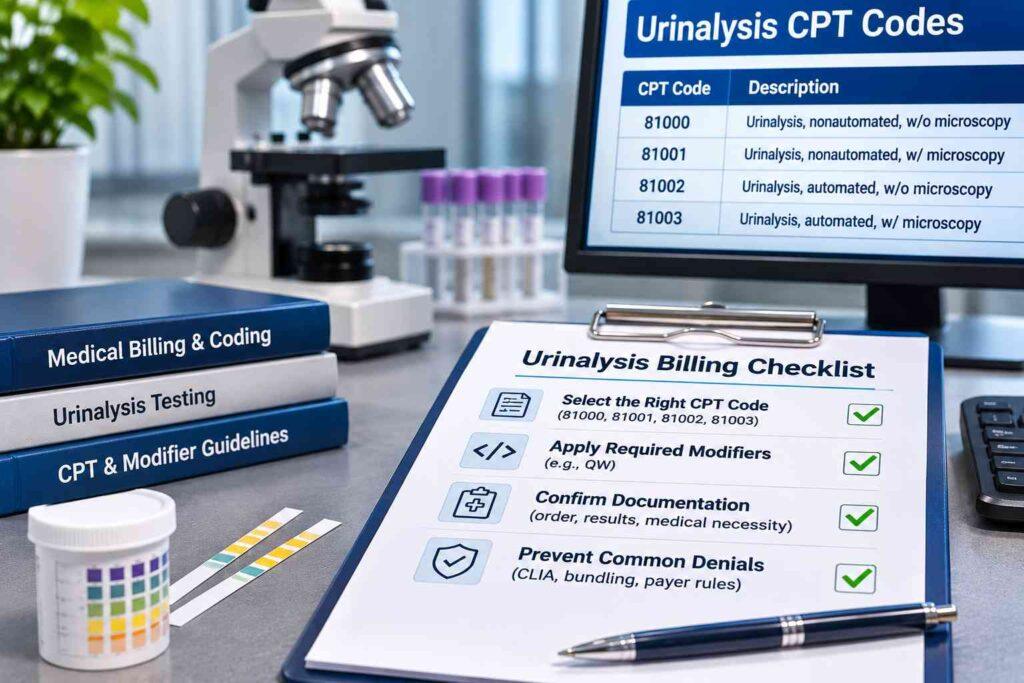

The urinalysis CPT code you report depends on two variables — whether the dipstick reading was automated and whether microscopic examination was performed. The four primary codes are 81000, 81001, 81002, and 81003.
Related codes include 81005 (qualitative or semiquantitative urinalysis), 81015 (microscopy only), and 81025 (urine pregnancy test by visual color comparison). Each one reports a different test with different CLIA requirements, different modifier rules, and different payer reimbursement conditions.
Most urinalysis claim denials don’t start with a wrong code. They start with a missing prerequisite — a CLIA certification gap, an incorrect QW modifier, an undocumented physician order, or a payer-specific bundling rule the billing team never checked.
CMS reported an 11.5% improper payment rate on urinalysis lab tests in its 2024 compliance reporting period, and documentation failures drove the majority of those errors.
The rest of this guide covers everything between picking the right code and actually getting paid for the test.
- Every urinalysis CPT code and what each one reports
- The two-question framework for choosing between 81000, 81001, 81002, and 81003
- CLIA certification levels and QW modifier requirements (including the 81002 exception)
- Documentation, physician orders, and medical necessity rules
- Same-day E/M bundling traps that differ by payer
- Common denial causes and a prevention workflow that catches problems before submission
TLDR: Code selection is the starting line, not the finish line
Getting the urinalysis CPT code right is step one. Getting the claim paid requires checking the CLIA status, modifier rules, physician order, and payer-specific edits that sit behind every code.
- The four primary urinalysis CPT codes (81000, 81001, 81002, 81003) differ by two variables — automation (manual vs. automated dipstick reading) and microscopy (included vs. not included). Match the code to the test actually performed, not the equipment available in the lab.
- Noridian Medicare identifies billing 81001 when the physician’s order supports only 81003 as a common billing error. Internal lab protocols that automatically trigger microscopy do not authorize the additional service for billing purposes.
- CPT 81002 is among the codes CMS recognizes as waived without requiring the QW modifier, but 81003 may require QW depending on the test system and FDA categorization. Do not apply QW automatically to every urinalysis claim.
- CMS reported an 11.5% improper payment rate on urinalysis lab tests in its 2024 reporting period, with documentation and medical necessity as the primary issues.
- Same-day E/M bundling rules differ by payer. Horizon BCBSNJ does not separately reimburse 81002 or 81003 with an E/M service, even with modifiers 25 or 59. EmblemHealth allows it under different stated conditions.
- Prevent denials by verifying the physician’s order, confirming CLIA certification for the specific test system, checking QW requirements by code, and reviewing payer-specific bundling edits before claim submission.
What does each urinalysis CPT code describe?
Eight CPT codes in the 81000–81099 range cover different methods of urine testing. The correct code must reflect the specific test performed and documented — not the general category of “urinalysis” and not the equipment sitting in the lab.
Here is the full code family with descriptions, testing methods, and common billing contexts.
| CPT Code | Description | Testing Method | Microscopy | Common Billing Context |
| 81000 | Urinalysis, dipstick or tablet reagent | Non-automated (manual) | Yes | Manual dipstick with microscopic sediment examination |
| 81001 | Urinalysis, dipstick or tablet reagent | Automated | Yes | Automated analyzer with microscopic sediment examination |
| 81002 | Urinalysis, dipstick or tablet reagent | Non-automated (manual) | No | Manual dipstick read by visual color comparison |
| 81003 | Urinalysis, dipstick or tablet reagent | Automated | No | Automated analyzer without microscopy |
| 81005 | Urinalysis, qualitative or semiquantitative | Other specified methods | Depends on test | Specialized urine testing, except immunoassays |
| 81007 | Urine bacteriuria screen | Non-culture screening | No | Bacterial screening, not by culture or dipstick |
| 81015 | Microscopic examination of urine only | Microscopy only | Yes | Standalone microscopic urine sediment analysis |
| 81025 | Urine pregnancy test | Visual color comparison | No | Qualitative urine pregnancy testing |
Four of those codes handle the bulk of urinalysis billing. Each one represents a different combination of two variables (automation and microscopy), and the rest of this guide focuses on getting that combination right.
CPT 81001
CPT code 81001 reports an automated urinalysis with microscopy. The lab runs the dipstick or reagent strip through an automated analyzer for the chemical analysis, and a qualified person performs microscopic examination of the urine sediment (looking for red blood cells, white blood cells, casts, crystals, and bacteria).
The documentation must support both components. If the physician’s order only calls for an automated dipstick and the lab’s internal protocol triggers microscopy without a separate clinical indication, the claim should be reported as 81003, not 81001. Noridian Healthcare Solutions (a Medicare Administrative Contractor) has specifically identified billing 81001 when the order supports only 81003 as a common billing error.
CPT 81003
CPT code 81003 reports an automated urinalysis without microscopy. The lab runs the reagent strip through an automated analyzer, and no microscopic examination is performed. Among the highest-volume urinalysis codes in urgent care billing and point-of-care settings, 81003 often appears alongside same-day E/M services — which creates payer-specific bundling questions covered later in this guide.
Whether 81003 requires the QW modifier depends on the specific test system and its FDA-approved waived status, not on the code alone.
CPT 81002
CPT code 81002 reports a non-automated (manual) urinalysis without microscopy. A medical assistant or lab technician dips the reagent strip into the urine specimen and reads the results by comparing the color changes to the manufacturer’s reference chart. No automated analyzer. No microscopy.
CPT 81002 carries a notable CLIA billing exception — CMS recognizes 81002 among the codes that do not require the QW modifier to be identified as a waived test. That exception does not automatically extend to 81003 or other codes in the family.
CPT 81000
CPT code 81000 reports a non-automated (manual) urinalysis with microscopy. The manual dipstick reading is combined with microscopic sediment examination. Because the microscopy component requires a higher CLIA certification level than a Certificate of Waiver, practices performing 81000 need to hold at least a Certificate of Provider-Performed Microscopy Procedures (PPMP).
CMS NCCI guidance identifies 81000 and 81001 as mutually exclusive procedures because they describe the same test (urinalysis with microscopy) performed by different methods (manual vs. automated). Billing both for the same specimen and encounter is an edit violation.
CPT 81025, 81005, 81015, and 81007
CPT 81025 (the procedure code for a urine pregnancy test) reports a qualitative pregnancy test using visual color comparison. The test detects human chorionic gonadotropin (hCG) in urine. CPT 81025 is not a routine urinalysis code and should not be confused with 81002 or 81003 — the tests measure completely different analytes.
CPT 81005 covers qualitative or semiquantitative urinalysis testing that falls outside the standard dipstick codes and immunoassay kits. CPT 81015 reports a microscopic-only examination of urine sediment (no dipstick component), which creates separate billing and CLIA considerations. CPT 81007 reports non-culture, non-dipstick bacterial screening of urine.
Stop Losing Revenue to Preventable Urinalysis Denials
Selecting the right urinalysis CPT code is only part of the billing process. Missing CLIA requirements, incorrect modifiers, documentation gaps, and payer-specific bundling rules can turn routine lab claims into recurring denials.
How do you choose the correct urinalysis CPT code?
Two questions determine which of the four primary urinalysis CPT codes applies. First, was the dipstick reading automated or manual? Second, was microscopic examination performed?
| Without Microscopy | With Microscopy | |
| Manual (non-automated) | 81002 | 81000 |
| Automated | 81003 | 81001 |
The grid looks simple. The billing errors happen when a practice’s real workflow doesn’t match the grid.
Urinalysis CPT Code Selection Path
Question 1
Was the dipstick or reagent strip read by an automated analyzer, or manually by visual color comparison?
Question 2
Was microscopic examination of the urine sediment performed and documented?
81002
Manual + No Microscopy
81000
Manual + Microscopy
81003
Automated + No Microscopy
81001
Automated + Microscopy
The most common code selection error
A physician orders an automated urinalysis without microscopy. The lab’s internal protocol automatically triggers microscopic examination when certain dipstick values fall outside a reference range (a process called reflex microscopy). The billing team submits 81001.
That’s a billing error.
The additional microscopic examination was not part of the physician’s order. The lab’s internal protocol — however clinically reasonable — does not establish authorization for a separately billable service. The claim should have been submitted as 81003 unless the physician also ordered microscopy and the documentation supports it.
Noridian’s urinalysis billing guidance emphasizes that a provider’s order must support the service billed. Reflex microscopy triggered by an internal lab standard does not replace a documented physician order.
When reflex microscopy is billable
Reflex microscopy can be billed as 81001 (or as a separate 81015 in addition to 81003, depending on the payer) if the ordering physician has documented standing orders that explicitly authorize microscopy under defined reflex criteria.
The standing order must be specific and documented in the medical record — a blanket internal lab policy is not enough. Verify the payer’s specific rules before billing reflex microscopy as a separately reportable service.
What are the CLIA and QW modifier rules for urinalysis billing?
CLIA certification and the QW modifier are separate billing requirements, and they apply differently to each urinalysis code depending on the test, the test system, and the payer. Treating them as one blanket rule is a common source of claim problems.
CLIA certification levels
The Clinical Laboratory Improvement Amendments (CLIA) regulate laboratory testing quality in the United States. The certification level a practice needs depends on the complexity of the tests it performs.
- Certificate of Waiver — allows a facility to perform tests the FDA has classified as waived (simple, low-risk tests with minimal chance of error). Most point-of-care dipstick urinalysis tests (81002, 81003) qualify as waived when performed on an FDA-approved waived test system.
- Certificate of Provider-Performed Microscopy Procedures (PPMP) — required when a physician or mid-level practitioner performs microscopic examination. Codes 81000 and 81001 include microscopy and typically require at least a PPMP certificate.
- Certificate of Registration, Compliance, or Accreditation — applies to laboratories performing moderate- or high-complexity testing.
A practice without the appropriate CLIA certificate for the test it performs cannot bill that test to Medicare or most commercial payers. The certificate must be current and cover the specific test complexity.
QW modifier requirements
Modifier QW identifies certain CLIA-waived tests on Medicare claims. But it does not apply universally to every waived urinalysis code.
Here is where the rules split by code.
- CPT 81002 — CMS recognizes 81002 as inherently waived. It does not require QW to be identified as a waived test. Adding QW to an 81002 claim is not an error, but it is not required.
- CPT 81003 — Whether 81003 requires QW depends on the specific test system and its FDA waived-test classification. Some automated urinalysis systems are FDA-cleared as waived; others are not. Verify the current CMS waived-test list and CLIA quarterly updates before assuming QW applies or doesn’t.
- CPT 81000 and 81001 — Both include microscopy, which changes the CLIA complexity level. Microscopy performed by a qualified provider may fall under PPMP, not waived testing. QW is generally not appropriate for codes involving microscopy.
The practical trap
A billing team that adds QW to every urinalysis claim (or leaves it off every claim) will eventually trigger a denial. The modifier decision requires checking three things.
- The specific CPT code
- The FDA classification of the actual test system or analyzer in use
- The current CMS instructions for that code and test system
For practices running multiple analyzers across locations (or mixing manual and automated methods), the QW decision may differ from one site to another for the same CPT code. Track the CLIA certificate and test-system status per location, not as a single organization-wide rule.
What documentation does a urinalysis claim need?
Every urinalysis claim needs three things to survive a payer review — a documented physician order, a clinical reason that supports medical necessity, and a record that the test was performed as billed.
CMS requires that diagnostic laboratory tests be ordered by the treating practitioner, with documentation supporting the intent to order and the medical necessity for the test. The claim-submitting entity must retain the order and relevant diagnostic information.
Physician order requirements
The physician’s order should identify the specific test intended (not just “urinalysis”). For coding purposes, the order determines whether the claim should include microscopy. A general order for urinalysis that does not specify microscopy does not support billing 81001 or 81000.
- The order must be documented in the medical record
- Standing orders are acceptable when they are specific to the patient population and clinical scenario
- Verbal orders must be signed and dated per the practice’s own policy and applicable state requirements
Medical necessity and diagnosis linkage
The ICD-10-CM diagnosis code on the claim must support the clinical reason for ordering the test. Common diagnoses that support urinalysis include the following.
- R30.0 (dysuria)
- N39.0 (urinary tract infection, site not specified)
- R31.9 (hematuria, unspecified)
- R35.0 (frequency of micturition)
- R82.90 (unspecified abnormal findings in urine)
- N30.00 or N30.01 (acute cystitis without or with hematuria)
- E11.9 (type 2 diabetes without complications, when monitoring urine)
- Z34.90 (supervision of normal pregnancy, when prenatal testing)
The diagnosis must reflect the patient’s actual clinical situation. A practice that defaults to the same diagnosis code on every urinalysis claim (regardless of the reason for the test) creates a pattern that invites audits and denials.
What the lab record must capture
A defensible urinalysis claim has a lab record that shows who ordered the test, the date and time, the specimen type and collection method (clean-catch, random, or first-morning), the testing method used (manual or automated), whether microscopy was performed, the results, and who interpreted them. When the test results influence the clinical decision (for example, a positive leukocyte esterase result leading to a prescribed antibiotic), that connection strengthens the medical necessity chain.
Why documentation gaps cause denials
CMS’s urinalysis compliance data reported an 11.5% improper payment rate and a projected $5.6 million in improper payments for urinalysis lab tests during the 2024 reporting period. Documentation and medical necessity were the primary issues, not incorrect code selection.
That tells you where the real risk sits. A practice can select the right CPT code every time and still lose reimbursement if the order, diagnosis, or lab record doesn’t support the claim.
Can you bill urinalysis with an E/M service on the same day?
Payer rules differ, and the answer depends on which insurer is processing the claim. Assuming that modifier 25 automatically makes a urinalysis separately payable is one of the fastest ways to create recurring denials.
Horizon BCBSNJ
Horizon Blue Cross Blue Shield of New Jersey states that CPT codes 81002 and 81003 are not separately reimbursed when billed with an E/M service by the same provider for the same member on the same day. Horizon’s policy specifically says that modifiers 25 and 59 do not override the edit. The urinalysis is considered part of the E/M encounter, and separate payment is denied.
EmblemHealth
EmblemHealth’s bundling guidance takes a different approach. Under its published conditions, separate reimbursement for 81002 or 81003 may be allowed when modifier 25 is appended to the E/M service and the urinalysis is diagnostic (not a routine screening performed as part of a standard office visit).
Side-by-side comparison
| Element | Horizon BCBSNJ | EmblemHealth |
| Separate reimbursement for 81002/81003 with E/M? | No | Yes, under stated conditions |
| Does modifier 25 override the edit? | No | Yes, with documentation |
| Does modifier 59 override the edit? | No | Not specified for this scenario |
| Screening vs. diagnostic urinalysis distinction? | Not applicable (denied either way) | Yes — diagnostic urinalysis only |
What the billing team should do
Before billing urinalysis alongside an E/M service, check the specific payer’s reimbursement policy. The workflow is straightforward.
- Confirm whether the payer bundles 81002 or 81003 into the E/M service
- If separately payable, verify whether modifier 25 is required on the E/M code
- Confirm whether the payer distinguishes between screening and diagnostic urinalysis
- Document the diagnostic indication in the medical record (the urinalysis was ordered to evaluate a specific clinical concern, not performed as a routine part of the visit)
- Track denials by payer — if a payer consistently denies same-day urinalysis, stop billing it as a separate line item and adjust the fee schedule accordingly
The billing team that treats same-day E/M bundling as a universal rule (either always billing separately or never billing separately) will leave money on the table with some payers and create denials with others. Payer-specific awareness is the difference.
What causes urinalysis claim denials and how do you prevent them?
Most urinalysis denials trace back to one of six problems — and all six can be caught before the claim leaves the practice.
| Denial Cause | What Happens | Prevention |
| Incorrect code selection | 81001 billed when only 81003 was ordered | Verify the physician’s order matches the test performed and the code selected |
| Missing or incomplete physician order | Payer cannot confirm the test was authorized | Require a documented, signed order before any urinalysis is coded |
| CLIA certification gap | Facility lacks the certificate for the test complexity level | Confirm CLIA certificate type covers the specific test and update before expiration |
| Incorrect QW modifier | QW appended to a code that doesn’t require it, or missing when it is required | Check the CMS waived-test list and FDA classification for the specific test system |
| Medical necessity failure | Diagnosis does not support the clinical indication for the test | Match ICD-10-CM code to the documented reason for the test, not a default diagnosis |
| Same-day E/M bundling | Payer bundles urinalysis into the E/M and denies the separate charge | Check payer-specific bundling policy before submitting urinalysis as a separate line |
Pre-submission prevention workflow
The denial causes above share one characteristic — they’re all detectable before the claim is submitted. A billing team that runs through these checks at the point of claim creation (not after the denial arrives) eliminates the most common urinalysis payment failures.
Urinalysis Claim Pre-Submission Checklist
Check each item before submitting the claim
Physician order documented
Order specifies test type and whether microscopy is included
Code matches test performed
Automation method and microscopy status align with the selected CPT code
CLIA certificate covers the test
Certificate type (waiver, PPMP, moderate/high complexity) matches the test complexity
QW modifier decision verified
Checked CMS waived-test list for the specific code and test system
Diagnosis supports medical necessity
ICD-10-CM code reflects the documented clinical reason, not a default
Payer bundling policy checked
Confirmed whether the payer reimburses urinalysis separately from same-day E/M
When denials still happen
Even with a clean pre-submission process, denials can appear from payer system errors, claim processing delays, or coverage policy changes that took effect after the service date. When a urinalysis denial comes back, the first step is to match the denial reason to the six causes above. If the claim was submitted correctly, the denial is appealable — and the documentation that supported the original submission becomes the appeal’s foundation.
Practices that track urinalysis denials by payer, denial reason, and CPT code can identify patterns early. A spike in 81003 denials from one payer, for example, may indicate a new bundling edit or a coverage policy update the billing team hasn’t incorporated into its workflow yet.
Which codes get confused with routine urinalysis?
Several urine testing codes sit near the 81000–81099 range and frequently appear on the same encounters as routine urinalysis. They report different tests, have different billing rules, and should never be used interchangeably.
CPT 81025
The 81025 procedure code reports a urine pregnancy test by visual color comparison. The test detects human chorionic gonadotropin (hCG) in urine — it is not a dipstick urinalysis and does not measure the chemical analytes that 81002 or 81003 report (pH, protein, glucose, ketones, blood, nitrite, leukocyte esterase, specific gravity, bilirubin, and urobilinogen).
A practice ordering both a routine urinalysis and a urine pregnancy test on the same patient should bill the appropriate urinalysis code (81002 or 81003, depending on the method) and 81025 as separate line items with separate clinical indications.
CPT 87086
CPT 87086 reports a quantitative bacterial urine culture — growing organisms from the specimen and counting colony-forming units. A urinalysis may suggest infection (positive leukocyte esterase, positive nitrite, bacteria on microscopy), but only a urine culture confirms the organism and its quantity. Billing 87086 instead of a urinalysis code (or vice versa) misrepresents the test performed.
When both a urinalysis and a urine culture are ordered and performed, both codes can generally be billed for the same encounter. CPT 87088 (identification of bacterial isolates) and CPT 87186 (antimicrobial susceptibility testing) may follow if the culture is positive.
CPT 81015
CPT 81015 reports a microscopic-only examination of urine sediment. No dipstick or chemical analysis is included. The billing situation becomes complicated when a practice performs 81003 (automated dipstick without microscopy) and then adds microscopy as a separate test — can 81015 be billed alongside 81003?
The answer depends on the payer and NCCI edits. Some payers allow it with appropriate documentation and modifiers. Others treat 81003 plus 81015 as equivalent to 81001 and deny the 81015. Check the payer’s specific policy and current NCCI edit status before routinely billing both codes together.
CPT 82043 and 82044
CPT 82043 (quantitative urine albumin) and CPT 82044 (semiquantitative urine albumin) are separate laboratory tests used primarily for kidney disease screening and diabetes monitoring. Albumin testing is not part of a standard dipstick urinalysis panel, and the codes should not be confused with the 81000–81003 family.
When a physician orders both a routine urinalysis and a urine albumin test, each code is billed separately with its own clinical indication.
Stop losing reimbursement to urinalysis billing gaps you can fix
Code selection, CLIA verification, QW modifier decisions, payer-specific bundling edits, and medical necessity documentation all have to be right before the claim is submitted — not after the denial arrives.
MedHeave operates as a full revenue cycle department inside your practice, handling the complete claim lifecycle from charge capture through payment posting with dedicated account managers, payer-specific billing workflows, and defined turnaround times.
- Claims submitted within 24 to 48 hours of signed encounter notes, with pre-submission scrubbing that catches code, modifier, and documentation errors before they reach the payer
- Denial response within 72 hours, with payer-specific appeal templates and an 80%+ denial overturn rate
- CLIA, NCCI, and payer-edit checks built into the billing workflow — not treated as an afterthought
- Dedicated account managers who know the payer rules for your state, specialty, and practice setup
Ready to stop chasing urinalysis denials and start preventing them? Contact our team for a billing assessment.
Frequently asked questions
Both codes report automated urinalysis, but 81001 includes microscopic examination of the urine sediment and 81003 does not. The physician’s order and documentation must support whichever code the billing team selects. Billing 81001 when the order only supports 81003 is a common Medicare billing error identified by Noridian Healthcare Solutions.
CPT 81002 is among the codes CMS recognizes as inherently waived. Adding QW is not required for 81002 to be processed as a waived test under Medicare. That exception does not apply to all urinalysis codes — 81003, for example, may require QW depending on the specific test system and its FDA classification.
CPT 81025 reports a urine pregnancy test performed by visual color comparison methods. The test detects human chorionic gonadotropin (hCG) in urine. CPT 81025 is not a routine urinalysis code and should not be substituted for 81002, 81003, or any other dipstick urinalysis code.
No. CMS NCCI guidance identifies 81000 and 81001 as mutually exclusive because they describe urinalysis with microscopy performed by different methods (manual vs. automated). Billing both for the same specimen and encounter is an edit violation.
CPT 87086 reports a quantitative bacterial urine culture. A urine culture grows organisms from the specimen and counts colony-forming units, while urinalysis (81000–81003) performs chemical and (optionally) microscopic analysis. Both can be billed for the same encounter when both tests are ordered and performed.
Medicare covers urinalysis when it is medically necessary and ordered by the treating practitioner. A routine screening urinalysis without a documented clinical indication may not meet Medicare’s medical necessity requirements. The diagnosis code on the claim must support the reason for the test.
It depends on the payer. Some insurers (like EmblemHealth) allow separate reimbursement for 81002 or 81003 alongside an E/M service with modifier 25 when the urinalysis is diagnostic. Others (like Horizon BCBSNJ) deny separate payment regardless of modifiers. Always check the specific payer’s bundling policy.
A Certificate of Waiver covers most point-of-care dipstick urinalysis tests (81002, 81003) when performed on FDA-approved waived test systems. Codes that include microscopy (81000, 81001) require at least a Certificate of Provider-Performed Microscopy Procedures (PPMP). The certificate must be current and match the specific test complexity.
Modifier 91 identifies a repeat clinical diagnostic laboratory test performed on the same day for the same patient when medically necessary. The repeat test must be ordered separately, and the documentation must support the clinical need for repeating the urinalysis (for example, monitoring a patient’s response to treatment during the same encounter). Modifier 91 should not be used for repeat testing due to equipment failure or specimen problems.
Common denial reasons for 81003 include same-day E/M bundling (the payer considers the urinalysis part of the office visit), missing or incorrect QW modifier, medical necessity failure (diagnosis doesn’t support the test), CLIA certification issues, or an NCCI edit violation when another urinalysis code was also billed for the same encounter.