
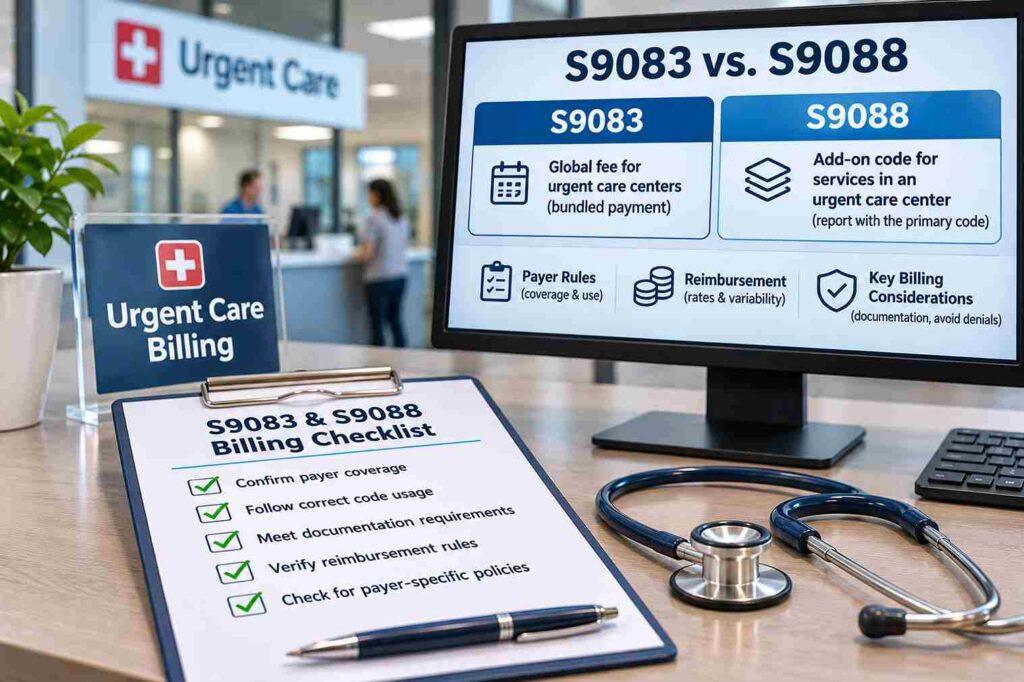

S9083 and S9088 are HCPCS Level II codes used in urgent care billing, but they represent different billing concepts and should never be treated as interchangeable.
S9083 describes a global fee for urgent care centers a bundled payment arrangement where one contracted rate covers a defined set of services. S9088 describes services provided in an urgent care center and is listed as an add-on code reported alongside the code for the actual service performed.
One important clarification before anything else: these are HCPCS S codes, not CPT codes. People commonly search for “S9083 CPT code” and “S9088 CPT code,” but both belong to HCPCS Level II, a national coding system maintained by CMS for products, supplies, and services not covered by the CPT code set. S codes within HCPCS are generally used by private insurers, managed care plans, and certain state programs not by traditional Medicare.
The challenge with both codes is that a code’s existence in HCPCS does not guarantee coverage or reimbursement. Whether a payer recognizes S9083, S9088, both, or neither depends entirely on the payer’s current policy and the provider’s contract.
Here is what this guide covers
- What S9083 and S9088 each mean in urgent care billing
- The practical differences between a global fee and an add-on code
- Which payers reimburse these codes (and which do not)
- The 2026 Ambetter POS 20 policy update
- Common denial reasons and how to prevent them
- How to verify the correct billing approach before submitting a claim
TL;DR: S9083 and S9088
Reimbursement depends on the plan, provider contract, and payer billing instructions. Check the applicable rules before billing.
- UnitedHealthcare’s 2026 commercial policy lists both codes as nonreimbursable.
- Several Ambetter markets announced reimbursement for both codes from August 2026 when billed with POS 20.
What is S9083?
S9083 is associated with a global fee or case-rate reimbursement model. Under a global fee arrangement, a payer may reimburse an urgent care visit using one contracted flat rate rather than paying separately for every service performed during the encounter.
A visit involving an evaluation, basic lab testing, and other services may fall under one case-rate payment. Whether additional procedures (laceration repair, splinting, imaging) can be billed separately depends on
- The payer contract
- Negotiated carve-outs for specific procedures
- The payer’s definition of what services the global rate includes
The Journal of Urgent Care Medicine has discussed how global case-rate contracts can disadvantage urgent care centers treating higher-acuity patients, because a flat fee may not adequately compensate visits requiring complex services. Contract carve-outs for expensive procedures become an important negotiating point when the practice operates under an S9083 arrangement.
The main operational risk with S9083 is underpayment. If the contract bundles too many services into the global rate without appropriate carve-outs, the practice absorbs the cost difference on complex visits.
What is S9088?
S9088 identifies that services were provided in an urgent care center. The official HCPCS descriptor says it should be listed in addition to the code for the service making it an add-on code, not a standalone replacement for the E/M or procedure code.
Reporting S9088 does not guarantee separate reimbursement. Some payers reimburse it as an additional payment for the urgent care setting. Others treat it as informational only. Others do not recognize or reimburse it at all.
Highmark’s provider manual instructs participating urgent care centers to report S9088 alongside applicable E/M and service codes, while identifying certain member-plan exceptions. Premera treats both S9083 and S9088 as informational and non-reimbursable.
How do S9083 and S9088 differ?
CODE COMPARISON
S9083 vs S9088 at a glance
S9083
Global fee approach
Contracted case rate for the urgent care visit
May bundle E/M, labs, and basic services
Main risk: underpayment on complex visits
S9088
Urgent care add-on
Identifies services provided in an urgent care setting
Listed alongside the E/M or procedure code
Main risk: denial or informational-only treatment
| Factor | S9083 | S9088 |
| Code purpose | Global urgent care fee | Identifies urgent care setting |
| Payment model | Contracted case rate or flat fee | Possible add-on reimbursement |
| Relationship to other codes | May bundle services into one payment | Listed with the service code |
| Main billing concern | Bundling, carve-outs, underpayment | Add-on eligibility, payer acceptance |
| Reimbursement | Contract-dependent | Contract-dependent |
| Common confusion | Assuming all services are included identically across payers | Assuming separate payment by every payer |
The critical distinction: S9083 replaces individual service billing with a global rate. S9088 supplements the actual service code with an urgent care identifier. The correct approach depends on what the payer’s policy and the provider’s contract require.
Not Every Payer Handles S-Codes the Same Way
Keeping track of payer-specific S9083 and S9088 requirements shouldn’t mean chasing policies after claims get denied. MedHeave helps urgent care practices navigate payer billing requirements and reduce avoidable reimbursement issues.
How do payer reimbursement policies differ?
Payer variation is the single most important concept in S9083 and S9088 billing. There is no universal rule.
| Payer example | Published policy position |
| UnitedHealthcare commercial | Lists S9083 and S9088 as nonreimbursable; directs providers to report the actual E/M and procedure codes |
| Premera Blue Cross | Treats both codes as informational and nonreimbursable |
| Highmark | Instructs participating urgent care centers to report S9088 alongside applicable service codes, with member-plan exceptions |
| Ambetter (selected markets) | Announced reimbursement for both codes effective August 2026, when billed with POS 20 |
| Molina Healthcare | Lists both codes as nonreimbursable in the reviewed policy |
Traditional Medicare does not reimburse HCPCS S codes. State Medicaid programs and Medicaid managed care plans have their own rules and those rules differ by state, plan, and contract.
What changed in 2026?
Several Ambetter market bulletins published in 2026 announced that S9083 and S9088 would become reimbursable effective August 1, 2026, when billed with Place of Service 20 (urgent care facility). The bulletins describe S9083 as a facility-level global service and S9088 as an add-on for urgent care operational costs, with in-person service requirements specified for S9088.
Arizona Complete Health published a similar update. Ambetter Texas set an August 15, 2026 effective date for the POS 20 requirement.
These updates do not mean both codes became universally reimbursable across the United States. Other payer policies including UnitedHealthcare’s 2026 commercial policy continue to list both codes as nonreimbursable.
The practical takeaway: billing teams should monitor payer-specific policy updates rather than applying one rule to all plans.
What are the most common S9083 and S9088 denial reasons?
DENIAL PATTERNS
Why S9083 and S9088 claims get rejected
Code not recognized the payer does not reimburse S9083 or S9088 under its current policy
Wrong place of service claim uses POS 11 (office) instead of POS 20 (urgent care facility) when the payer requires POS 20
Contract mismatch billing S9083 when the contract does not include a global fee arrangement
Unbundling error separately billing services the contract includes in the S9083 global rate
S9088 without qualifying service submitting S9088 without an accompanying E/M or procedure code
Outdated billing rules using billing configurations that do not reflect the payer’s current reimbursement policy
The most expensive denial pattern is not a single rejected line it is a systematic billing configuration that does not match the payer’s current expectations. A practice using last year’s billing rules against a payer that changed its S-code policy in 2026 will generate recurring denials until the configuration is updated.
How should billing teams verify the correct approach?
Before reporting S9083 or S9088, a billing team should confirm
- Whether the payer recognizes the code
- Whether the provider’s contract permits or requires its use
- Whether the payer requires POS 20
- Whether S9088 is separately payable, informational, or not reimbursable
- Whether S9083 bundles specific services and whether carve-outs apply
- Whether the payer has specific claim-submission instructions for either code
- Whether the payer’s policy has changed since the last contract review
A practical four-step verification process
Identify the payer and plan
Confirm the exact product, network, and applicable provider contract. Commercial, Medicaid managed care, Medicare Advantage, and workers’ compensation plans may have different S-code rules even within the same insurance company.
Verify the required billing model
Determine whether the payer expects S9083 global billing, E/M with S9088, or E/M without either S code. The answer may differ by plan within the same payer.
Check POS and claim requirements
Confirm POS 20 where the payer specifies it. Verify modifier requirements and qualifying service-line rules.
Review payment against contracted terms
After adjudication, compare the paid amount against the expected reimbursement. Flag underpayments, bundled lines, and unexpected adjustments.
Can S9083 and S9088 be billed together?
Do not assume they can always be billed together and do not assume they can never be billed together. The answer depends on the payer contract and current billing policy.
S9083 represents a global fee that may include the services S9088 would otherwise identify. Billing both codes on the same claim may result in a denial, an adjustment, or duplicate payment depending on how the payer’s system processes the combination.
The safest approach is to check the payer’s specific instructions for code combinations before submitting a claim with both codes on the same date of service.
What should urgent care providers understand about global fee contracts?
Global fee arrangements under S9083 work best when the contract clearly defines
- Which services the global rate covers
- Which procedures have negotiated carve-outs
- How higher-acuity visits are handled
- Whether the global rate includes lab testing, imaging, or supplies
- Whether the practice can bill additional CPT codes alongside S9083
The risk of an unclear global contract is revenue leakage on complex encounters. If the practice routinely treats lacerations, fractures, and infections but the global rate was priced for low-acuity visits, the financial gap compounds over hundreds of encounters.
Contract renegotiation is not a billing team responsibility alone; it requires clinical documentation data showing the actual acuity mix and per-visit resource use.
Frequently asked questions
Here are some commonly asked questions on this topic:
S9083 represents a global fee for an urgent care visit, a contracted case rate that may cover a defined package of services under one payment. S9088 identifies that services were provided in an urgent care setting and is reported as an add-on alongside the actual E/M or procedure code. S9083 replaces individual service billing with a flat rate. S9088 supplements the service code with an urgent care identifier. They serve different billing purposes, and their use depends on the payer’s policy and the provider’s contract.
Both are HCPCS Level II S codes, not CPT codes. People commonly search for “S9083 CPT code” and “S9088 CPT code,” but the correct classification is HCPCS Level II. S codes are generally used by private insurers, managed care plans, and certain state programs. Traditional Medicare does not reimburse HCPCS S codes. The distinction matters because HCPCS Level II codes follow CMS’s national coding system, while CPT codes are maintained by the American Medical Association for reporting medical procedures and services.
Traditional Medicare does not reimburse HCPCS S codes. Medicare providers should report the appropriate CPT E/M and procedure codes with the correct place of service. Medicare Advantage plans may have different rules from traditional Medicare, so the specific MA plan’s urgent care reimbursement policy should be checked. Medicaid fee-for-service and Medicaid managed care plans also have their own state-specific and plan-specific rules for S-code recognition. Do not assume that a commercial billing rule applies to government programs.
POS 20 is the Place of Service code for an urgent care facility. Several payers now require POS 20 when billing S9083 or S9088. The 2026 Ambetter market bulletins specify that both codes are eligible for reimbursement only when billed with POS 20 in the applicable markets. A claim submitted with POS 11 (office) instead of POS 20 may be denied even if the payer otherwise recognizes the code. Billing teams should verify the payer’s current POS requirements before claim submission.
Payer reimbursement decisions for S9088 depend on each plan’s coverage policy, provider contract terms, and billing instructions. UnitedHealthcare’s 2026 commercial policy lists S9088 as nonreimbursable. Premera treats it as informational only. Highmark instructs participating urgent care centers to report it alongside applicable service codes. Ambetter announced reimbursement effective August 2026 in selected markets. A code’s existence in HCPCS does not establish coverage. Each payer independently determines whether the code is payable, informational, or not recognized.