
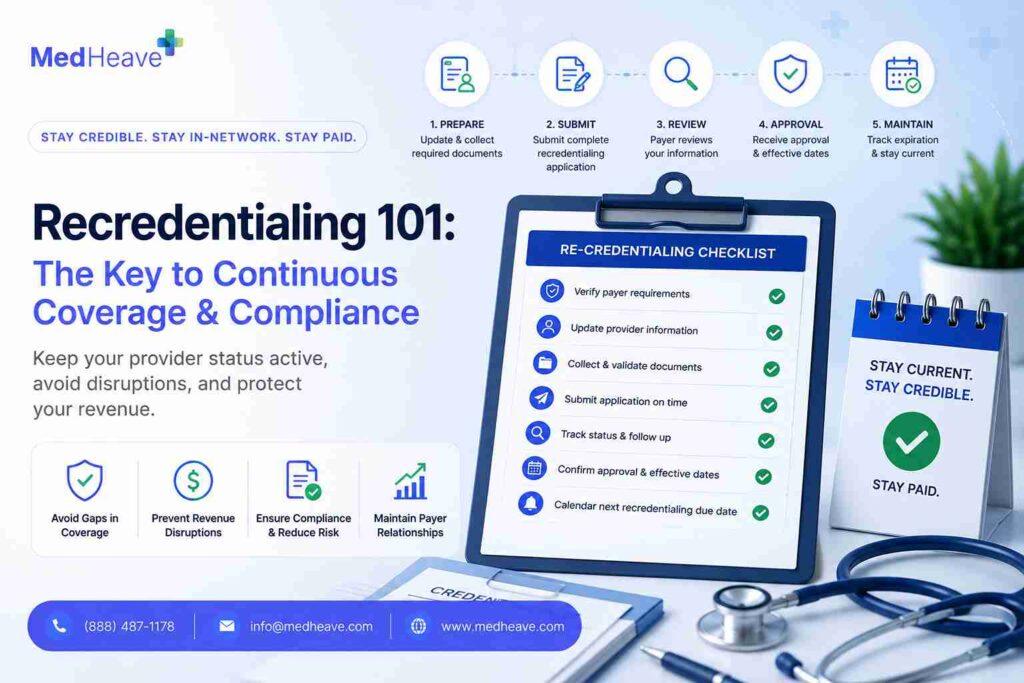


Recredentialing is the periodic re-verification of a provider’s qualifications, licensure, and performance history required to maintain active network participation with insurance payers.
Every two to three years, health plans and accreditation bodies like NCQA require providers to prove they still deserve the network seat they already earned. Miss the deadline, and network status ends along with the ability to see insured patients and get paid.
In the rest of this guide, we’ll be exploring:
- The full recredentialing checklist verified during each cycle
- A 120-day countdown recredentialing timeline with owners at every phase
- What happens when a deadline slips and how the revenue gap compounds
- How recredentialing requirements differ from initial credentialing
- Practitioner vs organizational recredentialing scope
TLDR: The deadline nobody takes seriously until revenue stops
Recredentialing is a recurring governance system, not a paperwork repeat. Every section below maps a specific part of that system to a specific revenue risk.
- Recredentialing re-verifies a provider’s qualifications every 2 to 3 years to maintain payer network status, and NCQA allows no grace period once the cycle expires.
- Unlike initial credentialing, the recredentialing process reviews performance since the last cycle, including OPPE data, malpractice claims, and sanctions activity.
- A missed deadline triggers network termination, forces a restart of full initial credentialing, and creates a revenue gap that can stretch for months.
- Start the recredentialing timeline 120 days before expiration with a phase-by-phase countdown assigning clear owners to every task.
- CAQH ProView re-attestation, primary source verification, and credentialing committee review are required steps, not optional updates.
- Sanctions screening against NPDB, OIG LEIE, and SAM.gov runs continuously between cycles, so recredentialing should confirm what ongoing monitoring already caught.
What is provider recredentialing?
Provider recredentialing is the formal process through which health plans, hospitals, and accreditation bodies re-verify a clinician’s qualifications, licensure, malpractice history, and professional standing at scheduled intervals.
The goal is not to repeat the initial application for the fun of it. The goal is to confirm that nothing has changed that would affect a provider’s ability to safely treat patients and remain in-network.
NCQA sets the baseline standard, requiring recredentialing at least every three years with primary source verification of licensure, board certification status, sanctions monitoring, and credentialing committee review. CMS Conditions of Participation (42 CFR 482.22) reinforce the requirement at the federal level by mandating that hospital medical staff undergo periodic appraisals and credential examinations.
How recredentialing differs from initial credentialing
The credentialing checklist categories are largely the same—licenses, DEA, board certification, malpractice insurance, NPI, and work history. The difference is what gets added on top, and that performance layer is what gives the credentialing committee actual teeth.
Elements unique to the recredentialing process include:
- Patient complaints and quality indicators
- Malpractice claims filed since the last review
- OPPE data reflecting clinical performance between cycles
- FPPE outcomes if the provider was under focused monitoring
- Sanctions or disciplinary actions from state licensing boards, OIG, or NPDB
The Joint Commission requires NPDB querying at every reappointment and limits privilege periods to a maximum of three years reinforcing that recredentialing reevaluates whether a provider should stay in the network (a harder question than whether they should join).
How often is recredentialing required?
Every two to three years, depending on the state, the accreditation body, and the individual payer contract.
NCQA standards set the ceiling at every three years with no grace period. Some states like Illinois follow that NCQA maximum, while some commercial plans independently impose two-year intervals.
The variation creates a real tracking headache for multi-payer practices. One provider credentialed with ten plans can face ten different recredentialing deadlines, each with its own submission portal.
The practices that avoid surprises track every payer deadline independently rather than assuming all cycles align (they almost never do).
Recredentialing vs credentialing vs revalidation
Four terms get tangled together in conversations about provider enrollment. Each one belongs to a different process with a different owner and a different timeline.
| Term | What it means | Who requires it | Typical cycle |
| Credentialing | Initial verification for network entry | Health plans, hospitals | One-time (then recredentialing) |
| Recredentialing | Periodic re-verification to maintain network status | Health plans, hospitals, NCQA | Every 2 to 3 years |
| Revalidation | CMS Medicare enrollment renewal through PECOS | CMS | Every 5 years |
| Reappointment | Hospital medical staff renewal tied to clinical privileges | Hospital governing body | Every 2 to 3 years |
Confusing recredentialing with revalidation is one of the fastest ways to miss a deadline, because the timelines and portals are separate. A provider can be current on Medicare revalidation and still lose commercial network status if recredentialing lapses.
120-day recredentialing timeline
Start the recredentialing timeline 120 days before the deadline.
Anything shorter compresses the margin for payer response delays, provider procrastination, and missing documents (all three of which will happen at least once per cycle).
The countdown below assigns a clear owner to every phase.
RECREDENTIALING COUNTDOWN
120-day timeline with task owners
Confirm payer list, expiration dates, and provider roster
Owner — Credentialing coordinator
Collect updated licenses, malpractice insurance, DEA, board cert, work history
Owner — Credentialing coordinator + provider
Update CAQH ProView profile and complete re-attestation
Owner — Provider (with coordinator follow-up)
Confirm payer portal access and submit all remaining items
Owner — Credentialing coordinator
Follow up with each payer and document application status
Owner — Credentialing coordinator
Escalate any missing provider documents to practice leadership
Owner — Credentialing manager
Confirm payer receipt and current review status for each application
Owner — Credentialing coordinator
Escalate all unresolved applications to leadership and payer reps
Owner — Practice administrator
Recredentialing documentation checklist
Every recredentialing cycle verifies the same core documents plus performance data since the last review.
CCHP specifies that practitioners must submit a signed attestation, current unrestricted license, liability insurance at $1M/$3M minimum, no federal sanctions, current DEA, and malpractice history since the last cycle.
The items that stall the process most often are updated malpractice certificates and CAQH re-attestation, both of which can delay CAQH recredentialing and payer recredentialing decision if the provider profile is incomplete.
DOCUMENTATION CHECKLIST
Recredentialing verification items
The recredentialing process step by step
The recredentialing process follows the same sequence whether managed by a CVO, a health plan, or a practice’s credentialing staff.
- The credentialing team notifies the provider 60 to 120 days before the due date
- The provider updates their CAQH ProView profile and completes re-attestation
- The CVO or health plan performs primary source verification of licenses, certifications, and training
- Sanctions and exclusion screening runs against NPDB, OIG LEIE, and SAM.gov
- Performance review pulls OPPE outcomes, complaints, and malpractice activity since the last cycle
- The credentialing committee reviews the complete file and votes on a decision
- The provider receives written notification of approval, conditional approval, or denial
The sanctions step is where most practices assume they are safe.
The HHS OIG Fall 2025 semiannual report recorded $19.04 billion in monetary impact and 1,336 exclusions in six months.
If a practice only checks sanctions at recredentialing, it may discover a problem that should have been caught months earlier.
What happens if you miss the recredentialing deadline?
Network termination comes first. Claims submitted after termination cannot process under the provider’s previous in-network status.
The provider must restart initial credentialing from scratch with every affected payer, which takes two to four months for commercial plans and longer for government programs.
During that gap, the provider either stops seeing insured patients or works at out-of-network rates. Revenue loss accumulates daily, and the financial damage is wildly disproportionate to the administrative cause.
Some plans send reminders. Many do not. Treating payer reminders as your safety net is the credentialing equivalent of treating your car’s check engine light as optional maintenance.
The Indian Health Service 2025 credentialing SOP cites Larson v. Wasemiller, where a hospital was found negligent for approving privileges at reappointment despite ten prior malpractice claims and licensing actions. Recredentialing is a liability firewall, and the clock does not pause for busy schedules.
Practitioner vs organizational recredentialing
Recredentialing applies to both individual clinicians and organizations, though the scope and documentation differ meaningfully.
Practitioner recredentialing
Individual providers undergo verification of personal licensure, certifications, malpractice history, NPI, sanctions status, and clinical performance. The credentialing committee reviews the provider as a clinician within the network, and OPPE data plays a direct role in the decision.
Organizational recredentialing
Hospitals, skilled nursing facilities, home health agencies, and behavioral health organizations undergo facility-level assessment.
The review covers accreditation status, facility licensure, liability insurance, quality metrics, and corrective action plans. Both follow a three-year NCQA cycle, but organizational reviews often involve the medical executive committee alongside the credentialing committee.
The HHS OIG behavioral health network report found that 55% of Medicare Advantage behavioral health providers listed in directories were inactive. Weak organizational recredentialing creates phantom networks. Strong organizational recredentialing eliminates them.
Recredentialing denial and appeals
If the credentialing committee denies recredentialing, the provider receives written notice specifying the reasons and the data sources used. Most plans allow an appeal within 30 days.
The appeal follows a standard path:
- Submit a written response with supporting documentation
- It should address each stated reason for the recredentialing denial
- The credentialing committee or a separate review panel reconsiders within 60 days
- If the second review upholds the denial, most plans offer no further recourse
Recredentialing denials most often stem from:
- Adverse OPPE findings
- Lapsed board certification
- Unresolved malpractice claims
- Active sanctions or exclusion activity
- Incomplete or outdated documentation
The HHS OIG availability report found that 45% of surveyed behavioral health providers were not available to treat new Medicare or Medicaid patients. Recredentialing should verify actual clinical availability, not just licensure status.
Your recredentialing deadlines should not depend on your memory
MedHeave’s medical credentialing services help practices manage payer renewals, CAQH updates, credential expirations, and recurring recredentialing deadlines.
Recredentialing is one of 14 integrated service areas we manage, with dedicated account managers tracking every payer deadline and CAQH attestation window.
- CAQH profile management & PECOS enrollment
- Re-credentialing handled as ongoing maintenance
- Over 95% of credentialing applications approved without rejection
- Primary source verification completed in-house across all state licensing boards
- Multi-state and multi-payer enrollment managed separately by state under each group tax ID
- Expirables tracked 60 to 90 days before lapse with structured follow-up every 14 business days
Ready to stop treating recredentialing as a calendar reminder? Contact our team today.
Frequently asked questions
Here are some commonly asked questions about recredentialing:
Recredentialing is the scheduled re-verification of a healthcare provider’s qualifications, licensure, certifications, and professional standing required by health plans, hospitals, and accreditation bodies to maintain active network participation. NCQA requires the process every three years, and it includes primary source verification, sanctions screening, OPPE performance review, and credentialing committee evaluation. The cycle runs independently from CMS revalidation and from hospital reappointment. Every payer may set its own recredentialing timeline within the NCQA maximum, so providers credentialed with multiple plans need to track each deadline separately.
NCQA sets the maximum interval at every three years with no grace period once the cycle expires. Some states and individual health plans impose shorter intervals, often every two years, based on state regulations or internal plan policies. Providers credentialed with multiple payers typically face different recredentialing dates for each plan, which makes centralized tracking a practical requirement rather than a convenience. The safest approach is maintaining a single master calendar with every payer’s deadline and starting the documentation process at least 120 days before each one.
Network termination is the immediate consequence. Claims submitted after termination cannot process under the provider’s previous in-network status, which means the practice either stops seeing insured patients or absorbs out-of-network reimbursement rates during the gap. The provider must restart the full initial credentialing process from scratch, and commercial plans typically take two to four months while government payers take longer. Revenue loss during the gap can reach tens of thousands of dollars per month depending on provider volume and payer mix.
The core documentation categories overlap, including state licenses, DEA registration, board certification, malpractice insurance, NPI, and work history. Recredentialing adds a performance review layer that initial credentialing does not include. Credentialing committees evaluate OPPE data, malpractice claims filed since the last cycle, patient complaints, sanctions or disciplinary activity, and FPPE outcomes if the provider was under focused monitoring. The additional performance scrutiny is what separates recredentialing from a simple document refresh.
CAQH ProView serves as the data intake platform that most health plans use for recredentialing, but it does not manage the recredentialing process itself. Providers must log in, update their profile information, and complete re-attestation before the recredentialing window opens. The health plan or its contracted CVO then pulls the updated data from CAQH for primary source verification and credentialing committee review. CAQH re-attestation alone does not complete recredentialing, because the provider’s file still requires verification, sanctions screening, performance review, and committee approval through the plan’s own process.