



A payor contract determines what a practice actually gets paid, months before a single claim is submitted.
Most physicians sign these agreements once and rarely revisit them — which is exactly how underpaid fee schedules and unfavorable clauses go unnoticed for years.
Payor contracting isn’t a one-time signature. It’s an ongoing negotiation and tracking discipline.
So to help you, we’ve prepped this guide that dives in:
- Common contract red flags to avoid
- Contract tracking and underpayment audits
- What payor contracts cover and why they matter
- Best practices for long-term contract management
- How to negotiate stronger reimbursement rates
- Payment models and key contract clauses
TLDR: Payor Contracting
- A payor contract sets reimbursement rates, covered services, and claims/denial rules between a provider and an insurer
- Strong contracting means benchmarking rates before negotiating
- Read unilateral amendment, audit, and auto-renewal clauses line by line
- Track renewal dates so contracts don’t silently continue on outdated terms
- Paid-claim audits against the signed fee schedule catch underpayments payers won’t flag
- Practices that only revisit contracts when something breaks are already leaving money on the table
What do payor contracts actually cover?
A payor is any entity that reimburses providers for care — commercial insurers, Medicare, Medicaid, and self-funded employer plans administered through a TPA.
Accountable Care Organizations are sometimes listed alongside payors, but that’s a mismatch — ACOs are provider organizations participating in value-based arrangements, not payors themselves.
Signing a contract is one step toward becoming an in-network provider, not the final one.
Credentialing and enrollment still have to clear before claims are reimbursed at contracted rates, and that process commonly runs 60–180 days.
In practice, the gap between “contract signed” and “claims paying at contracted rate” is where most new-provider revenue delays originate.
Which payment models will you negotiate?
The reimbursement model in your contract shapes both revenue and risk exposure. Payers typically set which models they offer, and negotiation happens within that menu.
| Model | How it pays | Risk level | Best fit |
| Fee-for-service | Per service rendered | Low | Most independent practices |
| Bundled payment | Single payment per episode | Medium | Surgical and procedural specialties |
| Shared savings | Bonus for cost efficiency | Medium | Groups in value-based arrangements |
| Capitation | Fixed payment per patient per period | High | Large groups with population health tools |
For most independent practices, fee-for-service remains the dominant model — and the negotiation that affects revenue most directly is the fee schedule attached to that FFS contract.
Which contract clauses actually affect your revenue?
Most of a payor contract is boilerplate. A handful of clauses determine whether the agreement works in your favor when something goes wrong — and those are the ones worth reading line by line.
Payment and fee schedule
- Confirm the fee schedule is attached, not just a stated percentage of Medicare
- Check how often the payer can update rates unilaterally
- Verify payment timing and late-payment penalties
Unilateral amendment rights
Many contracts let the payer change terms with limited notice. A common failure mode is that the practice discovers a rate reduction after it takes effect because the notice was posted to a portal nobody checked.
- Look for a minimum notice period (ideally 90 days)
- Require written notice for material changes, not just a portal posting
- Push for mutual agreement language on rate changes specifically
Audit and recoupment terms
Audit clauses determine how far back a payer can claw money back — and whether you get to appeal before the recoupment hits your next payment.
- Confirm the audit lookback window
- Check whether recoupment requires a formal appeal opportunity first
- Verify offset limits against future payments
Termination and renewal
Auto-renewal clauses are where outdated rates quietly persist for years. A contract that auto-renews without a renegotiation window keeps paying 2021 rates in 2026.
- Note the renewal date and required notice to renegotiate
- Check termination-without-cause notice periods
- Flag any exclusivity or non-compete language tied to termination
How do you negotiate a better payor contract?
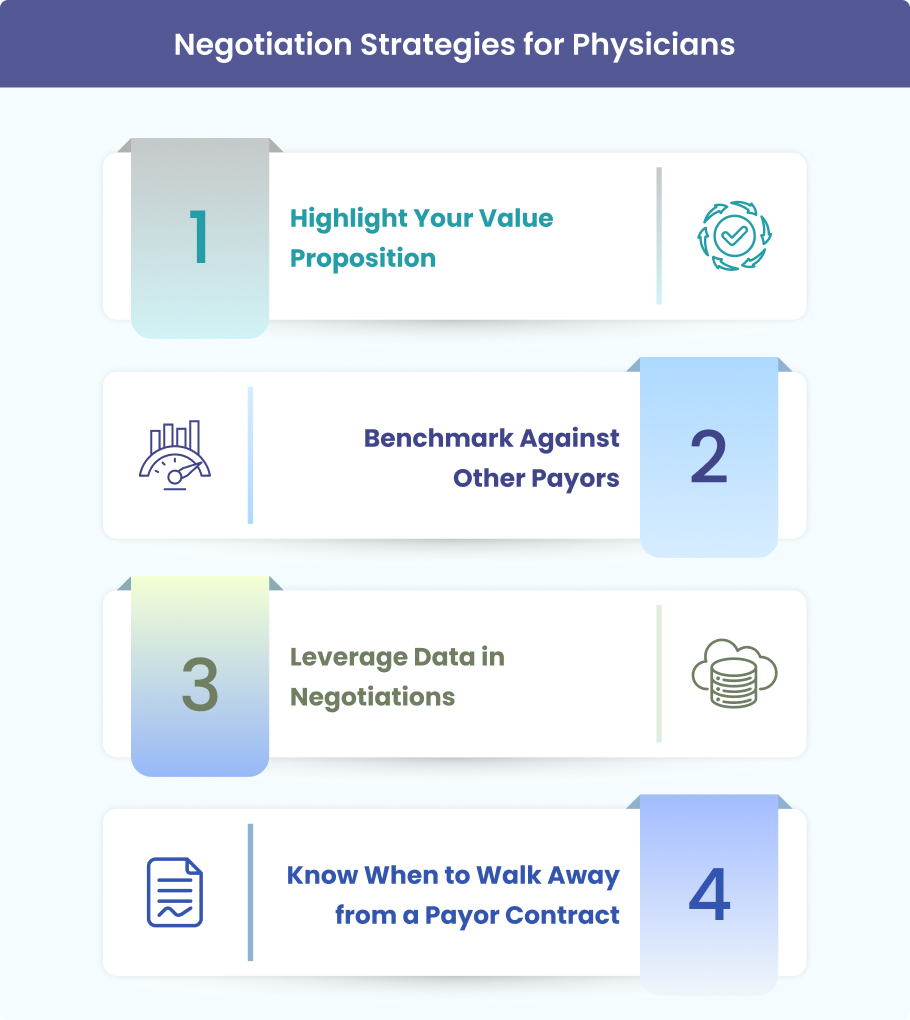
Negotiation works better with data than with a general request for a raise. Payers respond to evidence that your practice brings something specific to their network — not to a stated preference for higher rates.
Benchmark before asking
Rate benchmarking compares your reimbursement against similarly situated providers in your specialty and market. It’s the step most practices skip.
- Compare your top CPT codes against Medicare and regional commercial averages
- Identify which codes are underpaid relative to peers
- Use claims history to show volume and consistency
Bring objective data
Generic requests get generic answers. Specific data gets specific rate movement.
- Patient volume and specialty access gaps in your market
- Clinical quality outcomes and patient satisfaction scores
- Appointment availability compared to other in-network providers
Watch for red flags before signing
- Mandatory arbitration with no carve-out
- Downcoding rights without an appeal process
- Automatic renewal without a renegotiation window
- Silent fee schedule updates via portal only
- Unlimited audit rights with no time limit
How does behavioral health contracting differ?
Behavioral health payor contracting carries its own wrinkles — session-based CPT codes (90834, 90837), RAE or managed-care carve-outs in some states, and telehealth modifiers that vary by payer.
Rate benchmarking still applies, but compare against behavioral-health-specific peer data rather than general primary care averages, since reimbursement for therapy codes tends to run on a separate fee schedule entirely.
How do you track contracts after signing?
Tracking payor contracts is where most of the ongoing value — or ongoing loss — actually happens. A contract signed correctly three years ago can quietly become unfavorable if nobody watches the renewal date or fee schedule updates.
Build a renewal calendar
Missed renewal windows are how outdated rates persist the longest.
- Log renewal and termination notice deadlines for every payer
- Set reminders 120 days before each deadline
- Review fee schedule updates against benchmark data annually
Monitor paid claims against signed terms
Signing a good rate doesn’t guarantee the payer honors it in practice. Spot-checking is where most underpayment recovery begins.
- Spot-check paid claims against the contracted fee schedule
- Track denial and underpayment patterns by payer
- Flag discrepancies for dispute before the appeal window closes
In practice, the practices that recover the most underpayment revenue are the ones that audit paid claims — not just denied ones. A claim that pays at 80% of the contracted rate looks “paid” in the billing system, but it’s an underpayment that nobody catches unless someone compares the payment to the signed fee schedule.
Contract terms are only as good as who’s watching them
Negotiating a fair rate is only half the work. Someone still has to track renewal windows, catch underpayments against the signed fee schedule, and flag denials tied to contract terms.
MedHeave handles that ongoing oversight alongside your billing.
- Performance-based pricing with no lock-in
- Paid-claim audits against contracted fee schedules
- Rate benchmarking against specialty and regional data
- Contract clause review before signing or renewing
- Renewal and termination deadline tracking
Contact us for a payor contract audit if your contracts haven’t been benchmarked or reviewed recently.
Related guides & resources
The resources below cover closely related topics and the broader service workflow they connect to:
- In network billing services — In network billing services
- Out of network billing explained — Out-of-Network (OON) Billing: Claims & Reimbursement
- Credentialing vs contracting vs paneling — Credentialing vs Contracting vs Paneling: Key Differences
- Get approval — How to Get a Single Case Agreement Approved: Step-by-Step
- Verify patient insurance — Patient Insurance Verification: Process, Checklist, & Tools
- Medical credentialing — Simplifying Medical Credentialing: An Introductory Guide
Frequently asked questions
Here are some commonly asked questions about payor contracting:
Payor contracts are agreements between a healthcare provider and an insurer that define reimbursement rates, covered services, claims processing rules, and network participation terms. The contract sets the fee schedule (what the payer pays per CPT code), the claims submission requirements, denial and appeal timelines, and the conditions under which either party can terminate. Signing the contract is one step — credentialing and enrollment must also clear before claims pay at contracted rates.
They’re spelling variants of the same term — an entity that reimburses healthcare providers for services. Commercial insurers, Medicare, Medicaid, and self-funded employer plans all qualify. “Payer” is the more common spelling in CMS documentation. “Payor” appears more often in legal and contract language. Both refer to the same entity. ACOs are sometimes confused with payors, but ACOs are provider networks in value-based arrangements, not insurance companies.
Yes, though negotiating power depends on patient volume, specialty demand in the market, and objective benchmarking data rather than a general request for higher rates. Payers respond to evidence that your practice fills a network gap — specialty access, geographic coverage, or quality outcomes that other in-network providers don’t match. Benchmarking your top CPT codes against Medicare and regional commercial averages provides the specific data that moves rate discussions.
At least annually, and always before a scheduled renewal date. Fee schedules and payer policies change more often than most contracts get revisited, and auto-renewal clauses can lock in outdated rates for another full term. Set reminders 120 days before each renewal deadline. Review paid claims against the contracted fee schedule at least quarterly to catch underpayments that the payer won’t flag.
No. Accountable Care Organizations are provider networks participating in value-based payment models — they take on financial risk for patient outcomes but don’t issue insurance policies or process claims. The insurer (Medicare, a commercial payer) still processes and pays the claim. ACOs receive shared savings or penalties based on cost and quality performance, but the claim itself flows through the payer, not the ACO.