
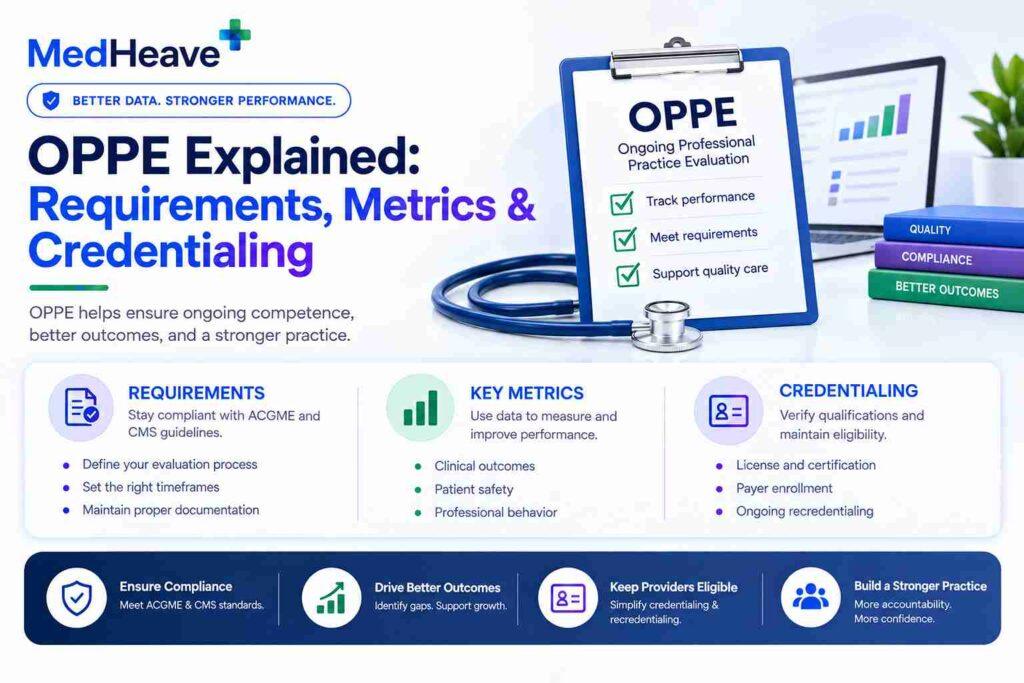


Most organizations treat OPPE as a compliance checkbox. The ones that get the most value from it treat it as a patient-safety system — one that catches performance trends early, before they escalate into adverse events or privilege actions.
When OPPE is designed well, it produces a continuous, data-driven record of how each practitioner is performing against the specific privileges they hold. When designed poorly, it produces paperwork that satisfies auditors without protecting patients.
In this guide, we’ll go through what OPPE requires, how the ACGME framework structures the metrics, who owns each step, and what happens when the data flags a concern, including:
- What OPPE is and why it’s mandated by The Joint Commission
- The six required elements per TJC standard MS.08.01.01
- ACGME competency-based metrics by specialty
- What happens when OPPE identifies an outlier
- How OPPE data feeds credentialing decisions
- Who is involved and what each role owns
- How OPPE differs from FPPE
TLDR: OPPE
- OPPE is continuous, data-driven performance monitoring for all privileged practitioners
- The Joint Commission mandates it under MS.08.01.01 with six required elements
- Reviews run every 6-8 months using both quantitative and qualitative data
- OPPE is non-punitive and not reportable to the NPDB
- Metrics should map to the six ACGME core competencies and be privilege-specific
- When thresholds are breached, escalation path runs from department chair review through FPPE
- OPPE findings feed directly into re-privileging and recredentialing decisions
What is OPPE?
Ongoing Professional Practice Evaluation is a continuous, data-driven process for assessing the performance of every privileged practitioner at a hospital or health system.
It is mandated by The Joint Commission under standard MS.08.01.01 and applies to all privileged practitioners — physicians, nurse practitioners, physician assistants, CRNAs, and other advanced practice providers.
Three characteristics define what OPPE is:
Non-Punitive
Identifies performance trends rather than serving as a disciplinary process.
Not Reportable to the NPDB
Only formal adverse privilege actions trigger NPDB reporting.
Privilege-Specific
Metrics must align with each practitioner’s specific privileges and specialty.
Under CMS Conditions of Participation (42 CFR 482.22), hospitals must periodically appraise medical staff and make recommendations to the governing body. OPPE is the operational mechanism most hospitals use to satisfy that federal requirement.
Because OPPE feeds privilege decisions over time, it operates within the broader medical credentialing process.
What are the six required elements per TJC?
TJC defines exactly what an OPPE program must include. John Muir Health was cited by TJC specifically for failing to seriously review OPPEs as part of its credentialing process.
Intent
OPPE must identify professional practice trends that may affect quality and patient safety.
Scope
Every privileged practitioner must be included in the OPPE process.
Frequency
OPPE must occur more than annually. Most organizations run 6–8 month cycles.
Data
Use both quantitative data, such as rates, counts, and outcomes, and qualitative data, such as peer review and observation.
Data Source
Data must come from the organization where the practitioner is privileged.
Outcome
Findings must feed directly into privileging and re-privileging decisions.
How do ACGME competencies structure the metrics?
ACGME competencies determine what aspects of physician performance OPPE should measure, while specialty-specific metrics determine how those competencies are measured in practice.
The reliability of those metrics also depends on how clinical data is captured and coded before it is analyzed.
| ACGME Competency | OPPE Metric Category | Specialty Example |
| Patient Care | Complication rates, infection rates, readmissions | Surgical site infection rate (surgery) |
| Medical Knowledge | Guideline adherence, evidence-based practice | Sepsis bundle compliance (hospitalist) |
| Communication | Patient satisfaction, peer feedback | HCAHPS communication scores |
| Professionalism | Complaint data, punctuality, documentation timeliness | Medical record completion rate |
| Practice-Based Learning | CME completion, QI participation | Peer review feedback integration |
| Systems-Based Practice | Resource utilization, LOS, cost per case | Average LOS (hospitalist); OR turnover (surgery) |
Who is involved in OPPE?
A list of people + bodies invovled OPPE:
Medical Staff Professionals (MSPs)
Collect data, maintain files, prepare scorecards, and coordinate the review calendar.
Department Chairs
Review scorecards, identify trends, and initiate conversations when thresholds are breached.
Credentials Committee
Reviews findings for reappointment and re-privileging decisions.
Medical Executive Committee (MEC)
Provides governance oversight and makes final recommendations.
Practitioners Themselves
Receive scorecards, review and respond to findings, and engage with improvement plans.
What happens when OPPE identifies an outlier?
OPPE identifies trends. What happens next depends on the nature and severity of the finding. The standard escalation path runs through five steps.
- Threshold breach identified on the OPPE scorecard
- Department chair reviews data, considers context, meets with the practitioner
- Coaching or education for minor or explainable trends (targeted CME, structured mentoring)
- Extended monitoring with more frequent data collection until performance stabilizes
- FPPE initiation for significant, persistent, or patient-safety concerns (targeted, time-limited, may involve direct observation)
How does OPPE differ from FPPE?
Here’s how OPPE is different from FPPE:
| Feature | OPPE | FPPE |
| Scope | All privileged practitioners, continuously | One practitioner, specific privileges |
| Timeline | Ongoing, every 6-8 months | Time-limited, defined start and end |
| Trigger | Calendar-driven, routine cycle | Event-driven (new privilege or identified concern) |
| Nature | Routine monitoring, non-punitive | Situational, may be punitive for cause |
| Reportable to NPDB | No | Potentially, if for-cause and results in action |
| Outcome | Feeds recredentialing and re-privileging | Recommendation to restore, modify, or revoke privilege |
The most important practical difference is reportability.
OPPE findings are never reported to the NPDB. FPPE conducted for cause, where the result is a privilege restriction or suspension, may be reportable.
That’s why OPPE’s non-punitive structure protects the organization’s ability to monitor performance openly without triggering reporting obligations prematurely.
How does OPPE connect to credentialing?
OPPE data is a core component of recredentialing and re-privileging decisions. Each practitioner’s OPPE history becomes part of the credentialing file reviewed during reappointment. This clinical-performance review should stay distinct from payer contracting and paneling workflows.
Consistent performance data supports privilege renewal. Recurring threshold breaches, extended monitoring, or prior FPPE referrals may require additional review before privileges are renewed or modified.
Need help building an OPPE program that actually works?
Most OPPE programs collect data. Few produce findings that change a privilege decision. MedHeave’s medical credentialing services help medical staff offices design performance monitoring workflows that satisfy TJC requirements and generate defensible data for reappointment.
- Reappointment timeline monitoring with advance alerts
- Provider credentialing support and enrollment management across all payers
- Performance-based pricing (4-7% of collections) with no lock-in
- Provider roster maintenance with license, certification, and enrollment tracking
- Documentation and coding accuracy that supports the clinical data OPPE measures against
Contact us to schedule a free consultation.
Frequently asked questions
Here are some commonly asked questions about OPPE:
OPPE stands for Ongoing Professional Practice Evaluation. It is the continuous, data-driven performance monitoring process required by The Joint Commission under standard MS.08.01.01 for all privileged practitioners at hospitals and health systems. It uses both quantitative data (complication rates, readmissions, guideline adherence) and qualitative data (peer review, observation) to identify performance trends over 6-8 month review cycles.
TJC requires OPPE more frequently than annually. Most organizations conduct reviews every 6-8 months, though some use quarterly data collection with semi-annual formal review cycles. The frequency should be sufficient to identify performance trends before they become patient safety concerns. A single annual review is not frequent enough to satisfy the standard.
No. OPPE is a non-punitive monitoring process and is not reportable to the National Practitioner Data Bank. Only formal adverse privilege actions — which may follow FPPE — trigger NPDB reporting requirements. This non-reportable status is what allows organizations to monitor performance openly without creating reporting obligations that could discourage transparent evaluation.
No. OPPE applies to all privileged practitioners, including nurse practitioners, physician assistants, CRNAs, and other advanced practice providers who hold clinical privileges at the organization. Any clinician who has been granted privileges must be included in the OPPE program, with metrics aligned to their specific scope of practice and privilege set.
OPPE does not have a pass/fail outcome. It identifies performance trends. When a threshold breach is identified, the response ranges from a coaching conversation with the department chair, to targeted education or CME requirements, to extended monitoring with more frequent data collection, to FPPE initiation for significant or persistent concerns. The escalation path depends on the nature and severity of the finding.