
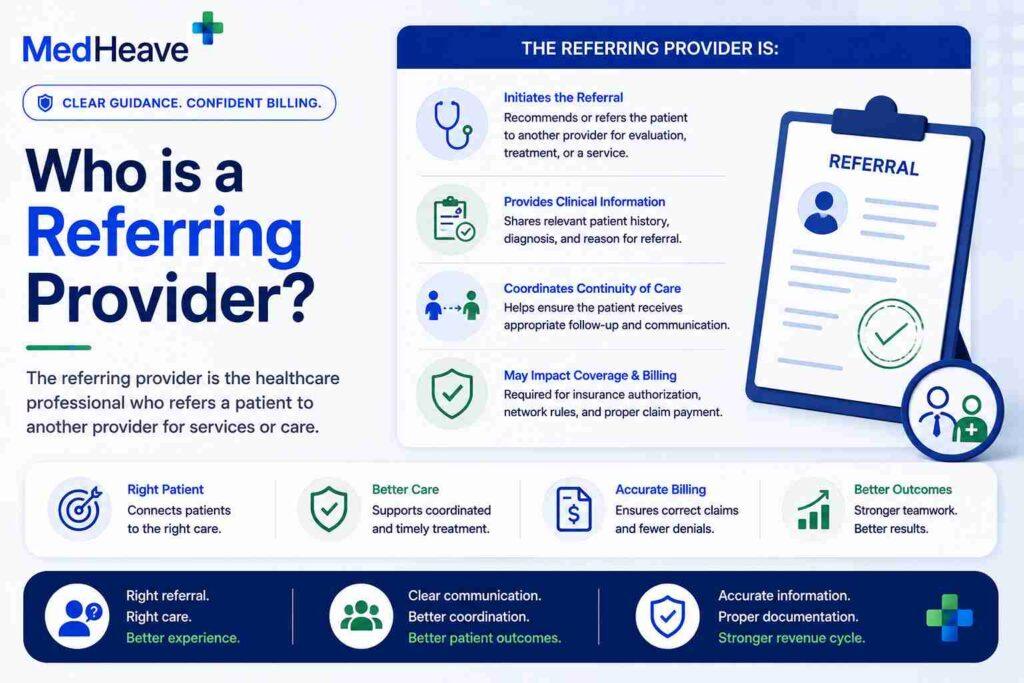


A referring provider is the clinician who directs a patient to another provider for further care.
On Medicare claims that require referral information, the referring provider’s name goes in CMS-1500 Box 17 and the individual NPI in Box 17b.
A missing, incorrect, or group NPI in that field produces a denied or unprocessable claim.
In this guide, we’ll go through where referring provider information goes on a claim, which services require it, who qualifies, and how to catch the errors that cause denials before they reach the payer:
- What a referring provider is and who qualifies under Medicare
- Where the referring provider appears on CMS-1500 and UB-04
- How referring differs from ordering, rendering, and billing providers
- Which services require referral information on the claim
- What happens when the data is missing or wrong
TLDR: Referring provider
- The referring provider directs the patient to another clinician for evaluation or treatment
- Their individual NPI goes in CMS-1500 Box 17b (UB-04 FL 78-79, qualifier DN)
- Only individual practitioners qualify — a group practice cannot be listed as the referring provider
- The referring provider must be enrolled in PECOS or validly opted out for Medicare claims
- Missing or incorrect Box 17b NPI on a Medicare claim for a service requiring referral information results in denial
- Referring and ordering providers share Box 17 but represent different clinical actions
What is a referring provider?
According to NUCC, “The Referring Provider is the individual who directs the patient for care to the provider rendering the services being reported.”
The referring provider does not deliver the service — they direct the patient to someone who will.
- A therapist referring to a psychiatrist for medication evaluation
- An orthodontist referring to an oral surgeon for jaw realignment
- A PCP referring to physical therapy following an orthopedic injury
- A PCP referring a patient to a cardiologist for an abnormal EKG finding
The referring provider must be an individual practitioner. A group practice cannot be listed as the referring provider.
Empty Box 17 = specialist claim denied
Many specialty and hospital claims require a valid referring provider NPI in Box 17 — and the omission triggers rejection without a denial reason that points directly to that field. MedHeave populates and validates referring provider data before submission so specialist claims do not fail on a required field.
How does the referring provider differ from other provider roles?
Let’s look a the difference between referring provider and other providers:
| Role | Definition | Claim placement | Example |
| Referring provider | Directs the patient to another clinician for care | CMS-1500 Box 17/17b; UB-04 FL 78-79 (DN) | PCP referring to specialist |
| Ordering provider | Requests a specific item or service (lab, DME, imaging) | CMS-1500 Box 17/17b (same box, different qualifier) | Physician ordering an MRI |
| Rendering provider | Personally delivers the service to the patient | CMS-1500 Box 24J; UB-04 FL 82 | Physician, NP, PA treating the patient |
| Billing provider | Submits the claim and receives reimbursement | CMS-1500 Box 33; UB-04 FL 44 | Group practice, clinic, hospital |
The same physician can be both the referring and ordering provider during the same encounter. The role reported depends on the service being billed.
Where does the referring provider appear on a claim?
Based on claim form, here’s where the referring provider appears:
| Claim form | Field | Information reported |
| CMS-1500 | Box 17 | Referring provider’s name |
| CMS-1500 | Box 17b | Referring provider’s individual (Type 1) NPI |
| UB-04 | FL 78-79 | Referring provider (Qualifier DN) |
If a claim involves multiple referring or ordering providers, Medicare requires a separate CMS-1500 for each — one form cannot report more than one.
Which services require a referring or ordering provider?
Per Medicare Claims Processing Manual, Chapter 26:
- Consultations
- Hepatitis B vaccines
- Immunosuppressive drugs
- Diagnostic radiology services
- Parenteral and enteral nutrition
- Durable medical equipment (DME)
- Diagnostic laboratory services
- Physician extender referrals
- Portable x-ray services
- Incident-to services
Always verify current requirements, including any applicable local coverage determination, with the specific MAC for the date of service.
Who qualifies as a referring provider under Medicare?
- Medical doctor (MD)
- Doctor of optometry (OD)
- Doctor of podiatric medicine (DPM)
- Doctor of osteopathic medicine (DO)
- Doctor of chiropractic (DC), within scope
- Doctor of dental surgery (DDS), within scope
The referring provider must be enrolled in Medicare in approved or opt-out status with an active individual NPI. Groups cannot serve as referring providers. A provider credentialing checklist can help practices verify enrollment and identifier status before provider information reaches the claim.
What happens if the information is missing or wrong?
Here’s what happens if there is problem with the information provided:
Claim denial
A missing Box 17b NPI on a Medicare claim for a service that requires referral information results in denial.
NPI mismatch with PECOS
If the referring provider’s NPI doesn’t match their PECOS enrollment record, the claim is rejected — wrong NPI, lapsed enrollment, or a provider not yet enrolled all produce the same outcome.
Authorization failures
Many commercial payers require a valid referral authorization before specialty services are rendered. Incomplete referring provider information can mean the authorization was never submitted.
The rework problem
Each error requires a phone call, a correction, and a resubmission — time that comes directly out of the billing team’s day for a problem that was preventable at the point of claim preparation. Validating provider identifiers during charge entry helps catch these errors before the claim moves further through the billing workflow.
Referral-related denials are among the most preventable in the revenue cycle
Most denials stem from missing NPIs, lapsed PECOS enrollment, or directory data that was never updated. Accurate referring-provider data is one of the details that helps practices submit clean claims without avoidable information errors.
MedHeave works with practices to identify these gaps before they reach the payer.
- Performance-based pricing (4-7% of collections) with no lock-in
- Box 17/17b accuracy checks as part of pre-submission scrubbing
- Authorization tracking for payers requiring referral documentation
- Referring provider NPI verified against PECOS before claim submission
- PECOS enrollment status monitoring for all ordering and referring providers
If your practice is experiencing referral-related claim denials, contact MedHeave to learn how our medical billing services can help improve referral workflows and reduce denials.
Frequently asked questions
Here are some commonly asked questions about this topic:
Not for every service or payer. Medicare requires referring provider information for specific service categories listed in the Claims Processing Manual. Many commercial plans require a referral for specialty and therapy services. Check the payer’s specific requirements for the service being billed. Services not on the required list can generally be submitted without Box 17 information.
Some plans allow self-referral for specific services, such as OB/GYN or behavioral health. Coverage may still require a documented referring provider on the claim even when a formal referral process was not followed clinically. Verify with the specific payer before assuming self-referral eliminates the claim-level requirement.
Yes, for Medicare claims. The referring provider must be enrolled in Medicare in approved or opt-out status with a valid individual NPI. Claims deny when the ordering or referring provider’s NPI does not appear in PECOS with a valid specialty. The CMS-855O form exists specifically for providers who need PECOS enrollment for ordering and referring purposes without billing privileges.
The referring provider directs the patient to another clinician for care. The ordering provider requests a specific item or service (lab test, DME, imaging) that the patient will receive from another source. Both are reported in Box 17 and 17b of the CMS-1500, distinguished by the qualifier used. The same physician can fill both roles during the same encounter depending on the services being billed.
Referral validity varies by plan. Some limit by time period, some by number of visits, and some by episode of care. Always verify the referral’s authorization status with the specific payer before services are rendered to avoid delivering care under an expired or exhausted referral that the payer will not cover.