
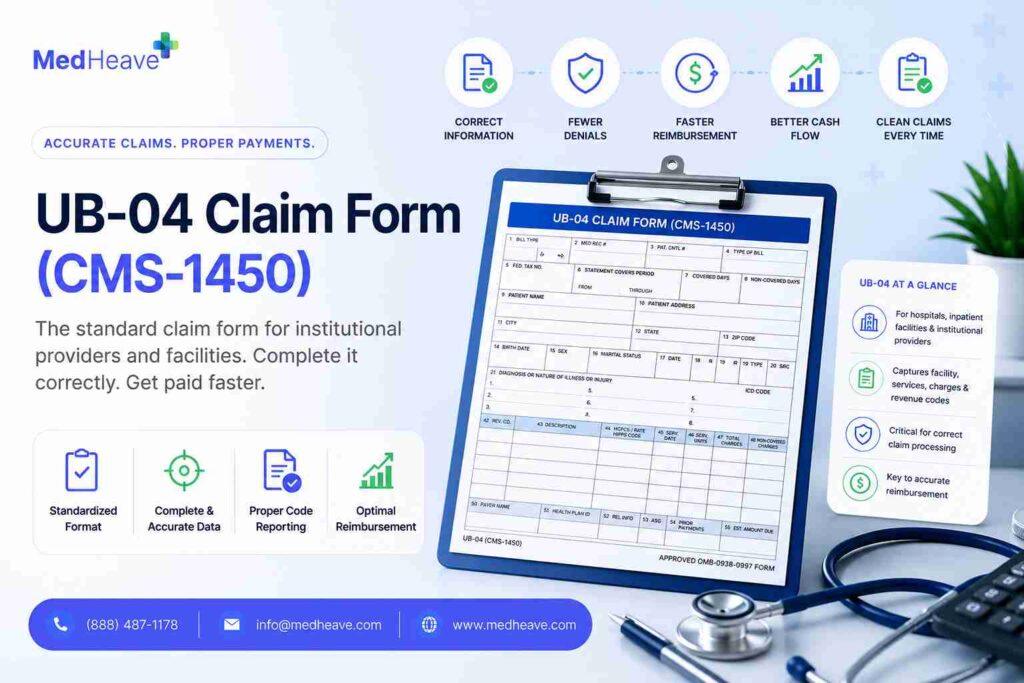


The UB-04 claim form is the standardized paper claim that hospitals, skilled nursing facilities, hospices, and other institutional providers use to bill Medicare, Medicaid, and commercial payers.
It also goes by CMS-1450 (the government’s name for it) and 837I (the electronic version under HIPAA). Three names for one institutional claim, and the confusion alone generates more billing desk headaches than it should.
The form packs 81 Form Locators onto a single page. One wrong digit in the Type of Bill field can kill a claim before it reaches adjudication.
Whether you are learning how to fill out UB-04 claims for the first time or auditing a process that has been running for years, the practical path through the UB-04 starts with learning which fields actually cause problems.
The guide moves through these pieces:
- How UB-04 and 837I relate to each other
- Common denial reasons and a pre-submission checklist.
- The 81 Form Locators grouped into six plain-English blocks
- How patients can request a UB-04 from a hospital for reimbursement.
- Type of Bill, revenue codes, and the special code fields that trip up experienced billers.
TLDR: One form, three names, 81 fields, and zero room for error
The UB-04 becomes far less intimidating once you break the 81 fields into logical groups and learn which ones actually trigger denials.
- UB-04, CMS-1450, and 837I all describe the same institutional claim, with UB-04 and CMS-1450 referring to the paper form and 837I referring to the HIPAA-standard electronic version
- The 81 Form Locators break into six groups covering provider info, patient info, condition and occurrence codes, revenue lines, payer data, and diagnosis and procedure coding
- Type of Bill (FL 4) is a 3-digit code that controls how the payer processes the entire claim, and a wrong digit here triggers an automatic rejection
- Revenue codes (FL 42) categorize the department or service and directly affect DRG, APC, and per-diem payment calculations
- NUBC maintains the Official UB-04 Data Specifications Manual as the only authoritative source for UB data (and yes, it is behind a paywall)
- Patients can call a hospital’s patient accounts department and request a copy for specific dates of service
- A pre-submission check covering Type of Bill, NPI validation, payer sequence, and revenue code alignment prevents the majority of claim denials
What is a UB-04 claim form?
If you ever asked “what is UB-04” while staring at a claim, the short answer is this.
The UB-04 claim form is the standardized document that institutional providers use to submit claims to Medicare, Medicaid, and commercial health insurance payers. CMS describes the CMS-1450 (also known as UB-04) as the standard institutional paper claim form used for Medicare billing when an institutional provider qualifies for an ASCA paper exception.
The National Uniform Billing Committee (NUBC), housed under the American Hospital Association (AHA), maintains and updates the UB-04 form. NUBC states that the Official UB-04 Data Specifications Manual is the only official source of UB data and that no private or government publication should be treated as authoritative. (So treat this article as a practical guide, not a replacement for that manual).
The form contains 81 Form Locators, each capturing a specific piece of claim data.
Provider identification, patient demographics, condition and occurrence codes, revenue line items, payer information, diagnosis codes, and provider NPIs all fit on one page. The UB-04 institutional billing separates facility claims from the professional claims filed on the CMS-1500.
UB-04 vs CMS-1450 vs 837I (three names, one claim)
The naming is simpler than it sounds. UB-04 and CMS-1450 are two labels for the exact same paper form. You may also see it written as CMS-1450 without the hyphen.
- UB-04 is the industry shorthand derived from the 2004 revision of the uniform bill.
- CMS-1450 is the official name assigned by the Centers for Medicare & Medicaid Services (CMS) in its forms catalog.
- 837I is the electronic version of the same institutional claim, different in delivery format but identical in purpose.
CMS connects the paper CMS-1450 to the electronic 837I institutional claim format, which follows the ASC X12N 837I Implementation Guide under HIPAA transaction standards.
When a hospital submits an institutional claim electronically (the default under HIPAA), the data from each UB-04 Form Locator maps directly to 837I segments.
Think of it this way:
- UB-04 = the paper claim form.
- CMS-1450 = the government catalog name for that paper
- 837I = The digital envelope carrying the same information.
Same claim data, three labels, one confused billing department.
Who uses the UB-04?
The UB-04 is filed by institutional providers. If the facility receives patients for treatment, observation, or residential care, it almost certainly uses this form for claims, including:
- The UB-04 for SNF covers skilled nursing stays.
- The UB-04 for hospitals covers both inpatient and outpatient departments.
- The UB-04 for home health covers home-based visits through a certified agency.
- The UB-04 for hospice covers palliative and end of life care billed by a hospice provider.
Other institutional providers using UB-04 include hospitals, skilled nursing facilities, home health agencies, hospices, rural health clinics, ESRD facilities, and community mental health centers.
The UB-04 is typically prepared and submitted by the billing department, not the individual clinician.
In hospitals with dedicated revenue cycle management (RCM) teams, a biller or coder builds the claim as part of the hospital billing workflow. In smaller facilities like hospice agencies or home health providers, a billing manager or outsourced RCM team handles submission.
| Facility type | Uses UB-04? | Common bill types |
| Hospital (inpatient) | Yes | 011x |
| Hospital (outpatient) | Yes | 013x |
| Skilled nursing facility (SNF) | Yes | 021x |
| Home health agency (HHA) | Yes | 032x |
| Hospice | Yes | 081x |
| Critical access hospital | Yes | 085x |
| Federally qualified health center (FQHC) | Yes | 073x |
When a physician provides services inside a hospital, the facility files a UB-04 for the institutional component and the physician files a CMS-1500 for the professional component. (Because one form per encounter would be far too simple.)
Hospital billing teams may also encounter documentation terminology such as full code status during inpatient workflows.
UB-04 vs CMS-1500 (which form do you need?)
The UB-04 and CMS-1500 serve different billing tracks. Choosing the wrong form is one of the faster ways to earn a rejection.
The UB-04 covers institutional billing for hospitals, SNFs, hospices, and other facility-based providers. The CMS-1500 covers professional billing for physicians, therapists, and other non-facility clinicians. When both a facility and a clinician bill for the same patient encounter, each submits its own form.
FORM COMPARISON
UB-04 vs CMS-1500 at a glance
UB-04 (CMS-1450)
Institutional / facility billing
Hospitals, SNFs, hospices, HHAs
81 Form Locators
Electronic version is 837I
Revenue codes + HCPCS
CMS-1500
Professional / clinician billing
Physicians, NPs, therapists
33 numbered fields
Electronic version is 837P
CPT/HCPCS codes only
When a facility and a clinician both bill for the same patient encounter, the facility files a UB-04 and the clinician files a CMS-1500. Both claims tie to the same visit but travel separate paths.
The 81 form locators, grouped by purpose
The UB-04 form locators span 81 numbered fields, and nobody memorizes them in sequence.
The 81 Form Locators cover provider information, patient information, admission and discharge details, payer information, revenue and charge lines, diagnosis and procedure coding, provider identifiers, certifications, and remarks.
The practical approach is to group them by function and learn which fields within each group are most likely to trigger a rejection.
Provider and facility (FL 1-8)
- FL 5 is the federal tax ID
- FL 6 is the Statement Covers Period
- FL 1 holds the billing provider name and address
- FL 4 is Type of Bill, the single most important field on the form and the one most likely to cause a denial
A wrong facility type code in FL 4 or mismatched date range in FL 6 will reject the claim before adjudication starts.
Patient and admission (FL 9-17)
- FL 12 is the admission or start-of-care date.
- FL 17 is the patient status code at discharge.
- FL 14 is the admission type (emergency, urgent, elective, newborn, trauma).
UB-04 patient status codes in FL 17 must align with the Type of Bill. If a patient is discharged to home but the TOB indicates an interim continuing bill, the claim contradicts itself.
Condition, occurrence, and value codes (FL 18-41)
- FL 18-28 carry condition codes
- FL 35-36 carry occurrence span codes
- FL 39-41 holds value codes and amounts.
- FL 31-34 hold occurrence codes and dates,
Missing a required condition code when the payer expects one is a silent denial trigger. Medicaid may require state-specific codes that Medicare does not.
Revenue lines and charges (FL 42-49)
- FL 46 is service units
- FL 42 is the revenue code
- FL 44 is the HCPCS/CPT code
- FL 47 is total charges.
The revenue code and HCPCS mismatch between FL 42 and FL 44 is one of the most common denial reasons on the form. If FL 42 says “0250” (pharmacy) but FL 44 carries a radiology CPT code, the claim fails edit checks.
Payer and insurance (FL 50-65)
- FL 54 holds prior payments,
- FL 56 is the billing provider NPI
- FL 63 holds the treatment authorization code.
- FL 50 identifies the payer name for primary, secondary, and tertiary coverage.
Getting the payer sequence on a COB claim wrong is a common and entirely preventable denial. Always verify payer order against the patient’s current eligibility before submission.
Diagnosis, procedure, and provider (FL 66-81)
- FL 69 is the admitting diagnosis
- FL 76 is the attending provider NPI
- FL 81 carries facility taxonomy codes.
- FL 67 is the principal diagnosis (ICD-10-CM)
- FL 74 holds the principal procedure code (ICD-10-PCS for inpatient)
The principal diagnosis in FL 67 drives DRG assignment under IPPS, so coding accuracy here directly affects reimbursement.
Type of Bill (FL 4) explained
UB-04 type of bill is a 3-digit code in FL 4 that tells the payer what kind of facility filed the claim, what type of care is being billed, and what the billing frequency is.
Type of Bill (FL 4) uses a 3-digit code consisting of facility type, bill classification, and bill frequency, where the frequency codes distinguish original, corrected, replacement, and void claims.
Getting even one digit wrong reroutes the entire claim through the wrong payment logic.
FL 4 BREAKDOWN
Type of Bill: three digits, three decisions
Facility type
1 = Hospital
2 = SNF
3 = Home health
8 = Hospice / ASC
Bill classification
1 = Inpatient (Part A)
2 = Inpatient (Part B)
3 = Outpatient
4 = Other (Part B)
Frequency
1 = Original
7 = Replacement
8 = Void / cancel
5 = Late charge
Example → TOB 131 = Hospital + Outpatient + Original claim
A hospital submitting an original outpatient claim uses TOB 131. A skilled nursing facility submitting an original inpatient claim uses TOB 211.
Getting the wrong first digit means the payer processes the claim under the wrong payment system entirely (wrong DRG vs wrong APC vs wrong per-diem rate), and that mistake usually only surfaces when the remittance comes back short or denied.
Common UB-04 bill type codes that billers should know by reflex
- 811 = Hospice, admit through discharge
- 111 = Hospital inpatient, admit through discharge
- 851 = Critical access hospital, admit through discharge
- 321 = Home health, admit through discharge (non-PPS)
- 131 = Hospital outpatient, admit through discharge
- 211 = SNF inpatient, admit through discharge
Revenue codes (FL 42) and how facility charges are grouped
Revenue codes are 4-digit codes entered in FL 42 on each revenue line of the UB-04.
Revenue code (FL 42) categorizes the department or service revenue category and affects payment grouping under DRG and APC systems.
Each line item gets its own revenue code, telling the payer which department or service category generated the charge.
Common UB-04 revenue codes worth memorizing:
- 0250 = Pharmacy (general)
- 0450 = Emergency room (general)
- 0636 = Drugs requiring detailed coding
- 0120 = Room and board, semi-private (two-bed)
- 0320 = Radiology, diagnostic (general)
- 0300 = Laboratory (general)
- 0510 = Clinic (general)
Revenue codes must align with the HCPCS code in FL 44 for the same line. When the revenue code indicates pharmacy but the HCPCS code is a radiology procedure, the claim fails payer edit checks.
Drug claims may also use HCPCS J codes in FL 44, making code-to-revenue-line alignment especially important for pharmacy charges.
The FL 42 and FL 44 mismatch is one of the most common denial reasons on the form and one of the easiest to prevent with a line-by-line pre-submission review.
For outpatient claims under OPPS, revenue codes combine with HCPCS codes to determine the Ambulatory Payment Classification (APC).
For inpatient claims under IPPS, revenue codes support the charge detail but the DRG assignment from the principal diagnosis drives the payment.
Condition, occurrence, and value codes on the UB-04
UB-04 condition codes, UB-04 occurrence codes, and UB-04 value codes fill FL 18 through FL 41 and capture situational information the payer needs beyond the standard claim fields.
All three code types serve different functions, and missing a required entry is a quiet way to lose a claim.
Condition codes (FL 18-28)
Condition codes flag specific circumstances that affect claim processing.
- 40 = Same-day transfer
- P7 = Medicaid state-only claim
- 02 = Condition is employment-related
- 07 = Treatment of non-terminal condition for hospice patient
Occurrence codes (FL 31-34)
Occurrence codes record dates of specific events relevant to the claim.
- 11 = Onset of symptoms/illness
- 01 = Accident/medical emergency date
- 27 = Date home health plan established
Value codes (FL 39-41)
Value codes carry dollar amounts or numeric values the payer needs for adjudication.
- 80 = Covered days
- 06 = Medicare blood deductible
- 08 = Medicare lifetime reserve amount
In practice, the challenge is knowing when a payer requires a specific code. Medicare has detailed rules per claim type, Medicaid requirements vary by state, and commercial payers sometimes add requirements on top of both.
Diagnosis and procedure coding on the UB-04
UB-04 diagnosis codes appear in FL 67 (principal diagnosis) and FL 67A through FL 67Q (additional diagnoses), with FL 69 capturing the admitting diagnosis.
ICD-10-CM principal diagnosis (FL 67) drives DRG assignment for inpatient hospital payment under IPPS. The MS-DRG grouper uses the principal diagnosis, secondary diagnoses, and procedure codes to assign a DRG, and that DRG determines the fixed payment amount.
A coding error on FL 67 that shifts the DRG assignment can change payment by thousands of dollars in either direction. The DRG does not care that the coder was having a rough Monday.
Procedure codes go in FL 74 (principal procedure) and FL 74a through FL 74e (additional procedures) using ICD-10-PCS for inpatient claims.
Outpatient claims use the HCPCS codes on FL 44 instead. External causes of injury codes in FL 72 capture circumstances like motor vehicle accidents, falls, or workplace injuries.
Provider identifiers on the UB-04
Provider identifiers span multiple Form Locators on the UB-04 claim form.
The attending provider NPI goes in FL 76, the operating physician NPI in FL 77 (required for surgical procedures), and other provider NPIs in FL 78 and FL 79 for rendering, referring, or supervising providers.
The billing provider’s NPI appears in FL 56, the facility taxonomy code occupies FL 81, and the federal tax ID sits in FL 5.
A missing or invalid National Provider Identifier is one of the fastest routes to a rejection. The NPI in FL 76 must be active, enrolled with the payer, and linked to the correct taxonomy code.
If the attending provider recently changed locations or if the facility went through re-credentialing, NPI enrollment status should be verified before every claim cycle.
Sample completed UB-04 (annotated)
Below is a fictional outpatient hospital UB-04 form example with callouts for the highest-risk fields.
Jane Doe visits Metro General Hospital’s emergency department on March 15, 2026, presents with chest pain (R07.9), receives an EKG and chest X-ray, and is discharged the same day.
Medicare Part A is the primary payer, and the attending physician is Dr. Robert Chen, NPI 1234567890. Field-by-field callouts:
| Form Locator | Field name | Value entered | Why is it important |
| FL 4 | Type of Bill | 131 (Hospital, Outpatient, Original) | Wrong TOB = wrong payment system |
| FL 6 | Statement Covers Period | 03/15/2026 – 03/15/2026 | Dates must match actual service |
| FL 17 | Patient Status | 01 (Discharged to home) | Must align with TOB frequency |
| FL 42 | Revenue Codes | 0450 (ER), 0730 (EKG), 0320 (Radiology) | Must match the HCPCS on each line |
| FL 44 | HCPCS | 99283 (ER E/M), 93005 (EKG), 71046 (Chest X-ray) | Must align with revenue codes |
| FL 67 | Principal Dx | R07.9 (Chest pain, unspecified) | Drives APC assignment for outpatient |
| FL 76 | Attending NPI | 1234567890 (Dr. Robert Chen) | Must be active and enrolled with Medicare |
Real claims carry more revenue lines and secondary payers, but the pattern holds.
The fields that cause the most trouble (Type of Bill, revenue code and HCPCS alignment, principal diagnosis, NPI) are the same ones that determine whether the claim processes or bounces.
837I and the electronic equivalent of the UB-04
The UB-04 837I relationship is straightforward. The 837I is the HIPAA-standard electronic institutional claim transaction, and every 837I claim carries the same data elements as the paper form.
The 837I follows the ASC X12N 837I Implementation Guide, and every data element on the paper UB-04 maps to a corresponding 837I segment.
| UB-04 field | 837I segment | Data carried |
| FL 4 (Type of Bill) | CLM05-1 | Facility type code |
| FL 42 (Revenue Code) | SV201 | Revenue code |
| FL 44 (HCPCS) | SV202 | Procedure code |
| FL 67 (Principal Dx) | HI (BK qualifier) | ICD-10-CM code |
| FL 69 (Admitting Dx) | HI (BJ qualifier) | ICD-10-CM code |
| FL 76 (Attending) | NM1 (71 qualifier) / PRV / REF | Provider NPI |
| FL 50 (Payer) | SBR / Loop 2010BB | Payer identification |
Most institutional claims go through a clearinghouse that converts the billing software’s output into a compliant 837I file and transmits it to the payer.
The clearinghouse runs automated edit checks against the claim data, which is why many revenue code and NPI errors get caught before they ever reach adjudication. (The clearinghouse is basically the bouncer checking IDs at the door.)
Paper vs electronic UB-04 and ASCA rules
Under the Administrative Simplification Compliance Act (ASCA), Medicare does not accept paper claims from covered entities unless an exception applies.
Paper UB-04 submission is limited to small providers (fewer than 25 full-time equivalent employees), providers experiencing disruptions in electronic capability, and certain other unusual circumstances defined by CMS.
Downloaded copies of the CMS-1450 should not be used for actual claim submission because color accuracy matters for automated reading.
The red ink on the official form is calibrated for OCR scanning by MACs, and a photocopied version with incorrect color registration will fail the scan. (Yes, the shade of red on a piece of paper can reject your claim. Welcome to healthcare billing.)
For most institutional providers, the practical workflow is entirely electronic.
The paper UB-04 remains the structural reference for field definitions and Form Locator numbering, even when no physical form ever changes hands.
Payer-specific UB-04 rules
Claim requirements vary by payer, and the differences go beyond cosmetic.
The UB-04 for Medicare follows one set of edit rules, the UB-04 for Medicaid follows another, and commercial payers layer their own requirements on top.
Medicare Part A
Medicare Part A claims follow CMS rules administered by Medicare Administrative Contractors (MACs).
The MAC for your region determines processing rules and timely filing limits (generally 12 months). Inpatient claims under IPPS require a valid MS-DRG based on the principal diagnosis in FL 67 and procedure codes in FL 74.
Medicare crossover claims follow MSP rules, and the payer sequence in FL 50 must reflect COB order accurately.
Medicaid (state variations)
Medicaid programs are state-administered, and requirements vary accordingly.
Some states require condition codes, occurrence codes, or value codes that Medicare does not. Timely filing limits range from 90 days to 365 days depending on the state.
Medicaid MCOs may layer their own editing rules on top of state requirements, so always check both the state provider manual and the MCO’s billing guidelines before submitting. (Every state apparently decided to be just different enough to keep billing departments guessing.)
Commercial payers
Commercial payers generally follow the NUBC standard but impose payer-specific edits on revenue code and HCPCS alignment, prior authorization requirements (checked against FL 63), and condition or occurrence code expectations.
Some reject claims when the patient status code in FL 17 does not match the bill frequency in FL 4. Others require additional documentation via FL 80 (remarks) or the 837I attachment segment.
COB and secondary payers
When a patient has more than one insurance, the claim must reflect the correct payer sequence in FL 50 through FL 54. COB errors are among the most common denial reasons on the UB-04.
The primary payer processes first, and prior payment amounts in FL 54 tell the secondary payer what has already been paid.
Getting the COB sequence wrong typically results in a denial from the secondary payer, followed by a timely filing risk when the corrected claim takes too long to resubmit.
Common UB-04 denial reasons and how to prevent them
Most claim denials on the UB-04 trace back to a predictable set of field-level errors. The pattern is consistent enough that a focused pre-submission review prevents the majority of rejections.
DENIAL PREVENTION
Top UB-04 rejection triggers and how to fix them
⚠ REJECTION
Wrong Type of Bill (FL 4)
✓ FIX
Verify the 3-digit TOB against the payer’s facility and service rules
⚠ REJECTION
Missing or invalid NPI (FL 56 / FL 76)
✓ FIX
Confirm NPI enrollment with the target payer before every claim cycle
⚠ REJECTION
Revenue code / HCPCS mismatch (FL 42 vs FL 44)
✓ FIX
Cross-check each revenue line against its HCPCS code before submission
⚠ REJECTION
Patient status / bill type mismatch (FL 17 vs FL 4)
✓ FIX
Align discharge status with the bill frequency code on every claim
⚠ REJECTION
Wrong payer sequence on COB claims (FL 50)
✓ FIX
Re-verify eligibility and COB order before creating the claim
Additional denial triggers that round out the usual suspects
- Incorrect corrected-claim frequency code (third digit of TOB is wrong or missing the Document Control Number on replacement/void claims)
- Missing condition, occurrence, or value codes the payer requires for the specific claim scenario
- Using UB-04 when CMS-1500 applies (or the reverse), which happens more often than anyone wants to admit
Corrected, replacement, and void UB-04 claims
When a submitted claim needs correction, the third digit of the Type of Bill code in FL 4 controls how the payer processes the resubmission. A UB-04 corrected claim uses frequency code 7 (replacement) or 8 (void), not frequently code 1 (original).
- Frequency 8 = Void/cancel of a prior claim (the payer cancels the original claim entirely)
- Frequency 7 = Replacement of a prior claim (the corrected claim replaces the original, and the payer reprocesses with the new data)
Both replacement and void claims require a Document Control Number (DCN) or Internal Control Number (ICN) from the original claim.
The DCN goes in FL 64 and links the new submission to the original. Without the DCN, the payer cannot identify which claim is being replaced or voided, and the resubmission gets rejected.
A corrected claim is not the same as a duplicate submission. Submitting the same claim with frequency code 1 (original) when a prior version is already on file triggers a duplicate denial. The frequency code must change to 7 for corrections, and the DCN must be present.
When the claim needs only a minor fix (updated diagnosis code, corrected NPI), frequency 7 is the standard. When the claim should never have been submitted at all, frequency 8 removes it.
How patients request a UB-04 from a hospital
Patients sometimes need a copy of the UB-04 (CMS-1450) for insurance reimbursement, out-of-network claims, or legal proceedings.
If you are wondering how to get a UB-04 from hospital billing?, here is the practical path.
Call the hospital’s patient accounts or billing department. (Not the medical records department, which handles clinical records, not billing claims.) Ask specifically for a copy of the UB-04 for hospitals covering your dates of service.
Have the following ready before calling.
- Dates of service
- Insurance information at the time of service
- Hospital account or medical record number (if available)
- Full name as it appears on hospital records
- Date of birth
Most hospitals provide a copy within 5 to 10 business days. Some charge a small processing fee.
If the hospital sends an itemized bill instead, request the UB-04 specifically. The two documents serve different purposes, and an itemized bill will not work for filing an insurance claim.
UB-04 vs itemized bill (for patients)
Patients frequently confuse the UB-04 with an itemized bill, and the two documents are not interchangeable.
The claim form is what the hospital sends to the insurance company. The itemized bill is what the hospital gives the patient to explain charges in plain language.
| Feature | UB-04 (CMS-1450) | Itemized bill |
| Purpose | Coded claim submitted to a payer for adjudication | Detailed charge list provided to the patient |
| Audience | Insurance company or payer | Patient |
| Format | Standardized 81-field form | Hospital-specific, varies by facility |
| Codes included | Revenue codes, HCPCS, ICD-10, condition codes | May or may not include billing codes |
| Primary use | Filing insurance claims, reimbursement | Reviewing charges, disputing costs |
If a patient needs to file a claim with an out-of-network insurer or a secondary payer, the UB-04 is the document they need. An itemized bill is useful for reviewing charges but is not a valid submission document.
Where to get official UB-04 forms
The official paper form is available from approved vendors and from Medicare Administrative Contractors (MACs). Hospital billing departments can provide patient copies for specific dates of service.
The NUBC UB-04 Data Specifications Manual is the authoritative reference for every Form Locator, code definition, and data rule.
The manual is licensed (not free) and available through the NUBC website. No private or government publication replaces it.
For billing teams working electronically (nearly everyone at this point), the 837I Implementation Guide governs the electronic format. Billing software vendors build their claim editors against these specifications.
Pre-submission checklist for UB-04 claims
A focused pre-submission review catches the majority of rejections before they happen. Run through these checks on every UB-04 claim.
Type of Bill — FL 4
Confirm the Type of Bill matches the facility type, care classification, and billing frequency.
Provider NPIs — FL 56 & 76
Verify the billing provider NPI and attending provider NPI are active and enrolled with the target payer.
Statement Period — FL 6
Ensure the Statement Covers Period aligns with the patient’s actual dates of service.
Revenue & HCPCS — FL 42 & 44
Confirm revenue codes match the corresponding HCPCS codes on every revenue line.
Principal Diagnosis — FL 67
Code the principal diagnosis to the highest level of specificity supported by the documentation.
Admitting Diagnosis — FL 69
Include the admitting diagnosis when it is required for inpatient claims.
Additional Claim Codes
Populate condition, occurrence, and value codes whenever the payer requires them.
Payer Sequence — FL 50
Make sure the claim reflects the correct primary, secondary, and tertiary payer order.
Patient Status — FL 17
Confirm the patient status code aligns with the bill frequency reported in FL 4.
Corrected & Replacement Claims
For corrected or replacement claims, include the appropriate frequency code (7 or 8) and DCN in FL 64.
If every item clears, the claim is ready. Catching errors at this stage always costs less than reworking a denial.
Missing or incomplete claim information can also surface as CO-16-type denials, so required fields should be validated before submission.
Stop losing institutional claims to errors you already know how to prevent
The UB-04 has 81 fields, but the same handful cause the vast majority of denials.
The facilities that keep their rejection rate low are not filling out the form differently. They are catching field-level mismatches, verifying payer-specific rules, and resolving problems before submission.
MedHeave operates as a full revenue cycle department inside your practice’s own systems, with dedicated teams that handle claim scrubbing, payer-specific edit checks, and denial resolution from submission through final payment.
- Denials addressed within 72 hours, with 80%+ overturn rates
- Claims submitted within 24–48 hours, with 90%+ first-pass rates
- Payer-specific billing guidelines maintained by practice and facility type
- Credentialing and NPI enrollment continuously verified to prevent claim delays
- Full COB management, including Medicare Secondary Payer and commercial sequencing
MedHeave’s hospital billing services help facilities improve UB-04/837I claim preparation, coding alignment, and denial prevention.
If institutional claim rejections, payer edit failures, or denial backlogs are eating into your revenue cycle team’s time, contact us and let’s fix the process.
Frequently asked questions
Here are some commonly asked questions on this topic:
Yes. UB-04 and CMS-1450 refer to the exact same standardized institutional paper claim form. UB-04 is the industry shorthand (named after the 2004 form revision), and CMS-1450 is the Centers for Medicare and Medicaid Services catalog designation. Payer guidelines, billing manuals, and clearinghouse documentation use both names interchangeably, so either term works in any professional context. The form itself, the 81 Form Locators, and the data requirements are identical regardless of which name appears in the conversation.
Hospital billing staff, revenue cycle teams, coders, or outsourced billing partners fill out the UB-04 on behalf of institutional providers. The individual clinician does not complete the form. For hospital inpatient and outpatient claims, the facility’s billing department prepares and submits the UB-04 or its 837I electronic equivalent. Smaller facilities like hospice agencies or home health providers may have a single billing manager or an external RCM team handling submission, but the form always originates from the facility’s billing function.
You can download a blank UB-04 from the CMS website for reference purposes, but downloaded copies should not be used for actual paper claim submission. CMS notes that color accuracy on the official form is calibrated for automated optical character reading by Medicare Administrative Contractors. A printed or photocopied UB-04 with incorrect red ink calibration will fail the OCR scan and get returned. For actual claims, use forms from an approved vendor or (far more commonly) submit electronically via the 837I through a clearinghouse.
The 837I is the HIPAA-standard electronic institutional claim transaction that carries the same data as the paper UB-04 form. Under HIPAA, electronic submission is the default for covered entities, and paper submission requires an ASCA exception. The 837I follows the ASC X12N Implementation Guide and maps each UB-04 Form Locator to a corresponding segment or loop in the electronic file. Clearinghouses convert billing software output into compliant 837I files and transmit them to payers, running automated edit checks in the process.
Call the hospital’s patient accounts or billing department (not medical records) and request the UB-04 for your specific dates of service. Have your name, date of birth, service dates, and insurance details ready before calling. Most hospitals fulfill the request within 5 to 10 business days. If the hospital sends an itemized bill instead, ask for the UB-04 specifically. The two documents function differently, and only the UB-04 works for filing an insurance claim with a secondary or out-of-network payer.
No. The UB-04 is a coded claim form submitted to an insurance payer for adjudication, built on a standardized 81-field layout with revenue codes, diagnosis codes, HCPCS codes, and payer data structured for electronic processing. An itemized bill is a detailed charge list that a hospital provides to the patient, usually in the hospital’s own format. For filing an insurance claim or requesting reimbursement, the UB-04 is the required document. For reviewing charges, disputing a bill, or understanding what services were rendered, the itemized bill is the right one to request.
FL 4 is the Type of Bill field on the UB-04, and it is arguably the single most consequential field on the entire form. The Type of Bill is a 3-digit code where the first digit identifies the facility type (hospital, SNF, home health, hospice), the second digit identifies the bill classification (inpatient, outpatient, other), and the third digit identifies the billing frequency (original, interim, replacement, void). A wrong Type of Bill code causes the payer to process the claim under the wrong payment system or reject it outright, and the error often goes unnoticed until the remittance arrives.