



Hospital billing isn’t physician billing wearing a bigger hat — it runs on different claim forms, different coding systems, and different payment methodologies entirely.
The UB-04 (CMS-1450) replaces the CMS-1500. ICD-10-PCS replaces CPT for inpatient procedures. MS-DRGs and APCs replace the Physician Fee Schedule. Confusing the two is where a lot of billing content — and a lot of new billing staff — goes wrong from the first step.
In this guide, we’ll go through how hospital billing actually works.
- The chargemaster (CDM) and revenue code logic
- How hospitals get paid under MS-DRG and APC methodologies
- The hospital billing workflow from registration through payment posting
- How institutional billing differs from professional billing (forms, codes, payment)
- Hospital AR management and why it runs differently than physician AR
- Common institutional billing mistakes and how to prevent them
TLDR: Hospital billing
- Hospital billing uses the UB-04 (CMS-1450) form and 837I electronic claim
- Facility coding uses ICD-10-CM, ICD-10-PCS, HCPCS, and revenue codes
- Inpatient reimbursement follows MS-DRGs under the IPPS
- Outpatient reimbursement follows APCs under the OPPS
- Critical Access Hospitals are generally reimbursed on a cost basis
- A single hospital stay commonly generates both a facility bill and a professional bill
- Both billing types include coding — the code sets and forms differ
How does hospital billing differ from physician billing?
Hospital (institutional) billing and physician (professional) billing are distinct processes with different forms, codes, and payment logic. A single hospital encounter commonly generates both — one for the facility and one for each treating physician.
| Category | Hospital (institutional) | Physician (professional) |
| Claim form | UB-04 / CMS-1450 | CMS-1500 |
| Electronic claim | 837I | 837P |
| Coding systems | ICD-10-CM, ICD-10-PCS, HCPCS, revenue codes | CPT, HCPCS, ICD-10-CM |
| Payment methodology | MS-DRGs (inpatient), APCs (outpatient) | Physician Fee Schedule / RVUs |
Both billing types absolutely include coding. The original article needed to correct the misconception that hospital billing excludes coding — it doesn’t. Hospital coding pulls from a broader set of code systems than professional billing.
What does the hospital billing workflow look like?
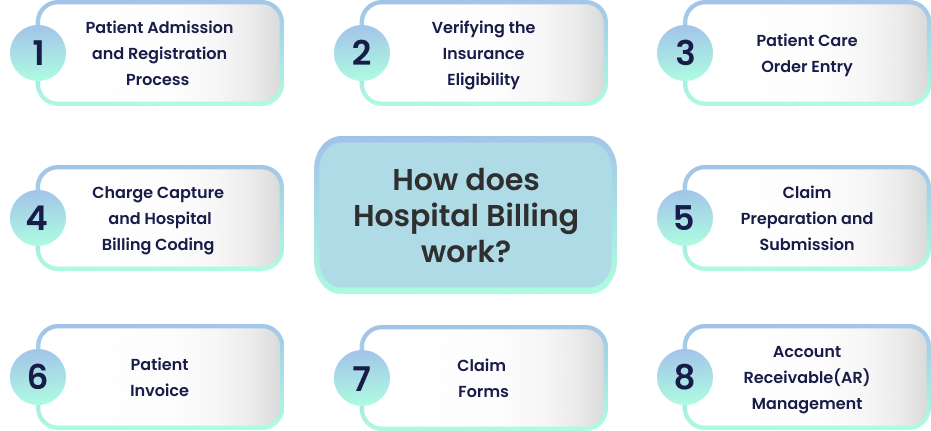
The process runs from the moment a patient registers to the moment the account closes. Errors early in the chain tend to surface as denials much later — which is why front-end accuracy sets up everything downstream.
Registration and verification
- Confirm prior authorization where required
- Verify eligibility and benefits before non-emergency services
- Collect demographics and insurance information at admission
- Identify coordination of benefits for patients with multiple coverages
Charge capture
Every billable service needs to hit the account accurately as care is delivered.
- Revenue codes tie each charge to the correct billing category
- Ancillary services (lab, radiology, pharmacy) post charges as delivered
- Departments record charges against the hospital’s chargemaster (CDM)
- Operating room, recovery, and supply charges are captured per procedure
Facility coding
Hospital coding pulls from a broader set than professional billing.
- ICD-10-CM for diagnoses (same as professional billing)
- Revenue codes that map each charge to the correct UB-04 line
- ICD-10-PCS for inpatient procedures (not CPT — this is a key difference)
- HCPCS Level II for supplies, drugs, and outpatient services
DRG and APC assignment
- MS-DRG assignment for inpatient claims (based on diagnosis, procedures, complications, and comorbidities)
- APC assignment for outpatient claims (based on procedure and service category)
- DRG accuracy directly controls inpatient reimbursement — a coding error that assigns the wrong DRG changes the entire payment
Claim submission and payment
- Payer adjudicates against the applicable payment methodology
- Claims submit electronically via 837I to the payer or clearinghouse
- Payment posting applies insurer payment, contractual adjustment, and patient responsibility
- Denied claims enter the institutional denial management workflow
How do hospitals actually get paid?
Reimbursement methodology depends on where the service happened, not just what was done. Medicare uses distinct payment systems for inpatient and outpatient settings.
Inpatient (IPPS)
The Inpatient Prospective Payment System pays a fixed MS-DRG rate per admission.
The DRG is determined by the principal diagnosis, procedures performed, complications, comorbidities, and discharge status.
A higher-weighted DRG produces a higher payment — which is why DRG coding accuracy has direct financial impact and why DRG upcoding is one of the most audited categories in healthcare billing.
Outpatient (OPPS)
The Outpatient Prospective Payment System pays per Ambulatory Payment Classification (APC). Each outpatient service is assigned an APC based on the procedure or service category, and payment follows the APC rate. Multiple APCs can apply to a single outpatient visit when multiple services are performed.
Critical Access Hospitals
Critical Access Hospitals (CAHs) are generally reimbursed on a cost basis rather than through IPPS/OPPS.
The payment methodology is structurally different from the prospective payment systems that govern most hospitals — cost-based reimbursement means the hospital is paid based on its reasonable costs of providing care, not a predetermined rate per DRG or APC.
Commercial payer variation
Commercial payers negotiate their own hospital payment terms, which may follow DRG-based logic, per diem rates, case rates, or percentage-of-charges arrangements. The methodology is defined in the hospital’s payor contract, not by CMS rules.
What is the chargemaster and why does it affect every claim?
The chargemaster (CDM) is the master database of every billable item and service in the hospital, each mapped to a CPT/HCPCS code, a revenue code, and a standard charge amount.
Revenue codes
Revenue codes are a UB-04-specific field that doesn’t exist on the CMS-1500.
Each charge line on a hospital claim must carry a revenue code that identifies the department or type of service (room and board, operating room, pharmacy, lab, etc.). Missing or incorrect revenue codes produce claim rejections that physician billing teams never encounter.
CDM maintenance
- New HCPCS and revenue codes are added throughout the year
- Hospital CDM errors are a common finding in compliance audits
- CDM should be updated at least annually when CMS publishes new rates
- Outdated CDM entries produce claims with deleted codes (rejected) or wrong charge amounts (underpaid)
How does hospital AR differ from physician-office AR?
Hospital AR tends to run higher and more complex than physician-office AR because of longer claim cycles, larger dollar amounts, and multi-payer coordination on a single account.
Segment AR by payer and age
Not all outstanding balances carry the same urgency or resolution path.
- Flag accounts crossing 90 days for focused follow-up
- Segment by payer to spot payer-specific delay patterns
- Separate denied-claim AR from pending AR (they require different workflows)
Resolve denials before they become bad debt
A denied claim isn’t a lost claim if it’s worked promptly.
- Identify the denial reason before resubmitting or appealing
- Correct coding or documentation gaps that triggered the denial
- Track denial patterns by payer to prevent repeat occurrences
In practice, hospital AR is harder to manage than physician AR because a single admission can generate multiple claims (facility + multiple professional), involve multiple payers (Medicare primary, commercial secondary), and require coordination between hospital coders, physician billing, and patient financial services — all before the account closes.
What are the most common hospital billing mistakes?
Most hospital billing errors are structural — using the wrong form or code set — rather than one-off data entry mistakes.
- Treating hospital billing as excluding coding
- Letting denied claims age without a resolution plan
- Missing revenue code assignment on chargemaster entries
- Using CPT codes where ICD-10-PCS is required for inpatient procedures
- Applying physician fee schedule logic to a facility claim
- Submitting claims on outdated form standards
Your facility claims shouldn’t lose revenue in the coding gaps
Hospital billing runs on its own claim forms, its own coding systems, and its own payment logic. Treating it as a scaled-up version of physician billing is where avoidable errors start — and where revenue gets lost on some of the largest claims a healthcare organization submits.
MedHeave treats institutional billing as its own discipline, not an extension of professional billing.
- UB-04/837I claim preparation and coding review
- DRG and APC assignment accuracy checks
- Revenue code and CDM validation
- Denial tracking segmented by payer and reason
- AR follow-up prioritized by age and dollar value
- Performance-based pricing (4–7% of collections) with no lock-in
Contact us if your hospital’s AR or denial rate needs attention from a team that understands facility-level billing.
Related guides & resources
The resources below cover closely related topics and the broader service workflow they connect to:
- Hospital billing services — Hospital billing services
- Full code — Full Code Explained: In Context To A Hospital or Medical Emergency
- Medical billing — Beginner’s Guide to Medical Billing and Coding
- Emergency room billing explained — Emergency Room Billing 2026: Claims, Coding & Payment
- A CMS 1500 form — CMS-1500 Form (HCFA-1500): Boxes, PDF, Instructions & Errors
Frequently asked questions
Here are some commonly asked questions about hospital billing:
Yes. Hospital billing includes facility coding across ICD-10-CM, ICD-10-PCS, HCPCS, and revenue codes. The misconception that hospital billing excludes coding confuses the billing function (claim submission) with the coding function (code assignment). Both happen in hospital billing. The coding systems differ from professional billing — hospitals use ICD-10-PCS for inpatient procedures instead of CPT, and revenue codes are a UB-04-specific requirement that physician billing doesn’t encounter.
Hospitals use the UB-04 (CMS-1450) for paper claims and the 837I for electronic claims. The UB-04 is structurally different from the CMS-1500 used in physician billing — it includes revenue codes, condition codes, occurrence codes, and value codes that have no equivalent on the professional claim form. A single hospital stay typically generates both a UB-04 (facility charges) and one or more CMS-1500 forms (physician professional charges).
Hospital billing covers facility charges using institutional claim forms (UB-04/837I) and payment methodologies based on DRGs for inpatient care and APCs for outpatient services. Physician billing covers the provider’s own professional service using CMS-1500/837P and the Medicare Physician Fee Schedule. The coding systems also differ — hospitals use ICD-10-PCS for inpatient procedures, while physicians use CPT. Both generate separate claims for the same patient encounter.
Hospital claims involve higher dollar amounts, multiple payers per account, and more complex coding than physician-office claims. A single admission can generate facility and professional claims that require coordination between hospital coders, physician billing teams, and patient financial services. Multi-payer coordination (Medicare primary, commercial secondary) adds adjudication steps. Denied claims require institutional-specific appeal processes. All of these factors extend the resolution timeline compared to physician-office AR.