
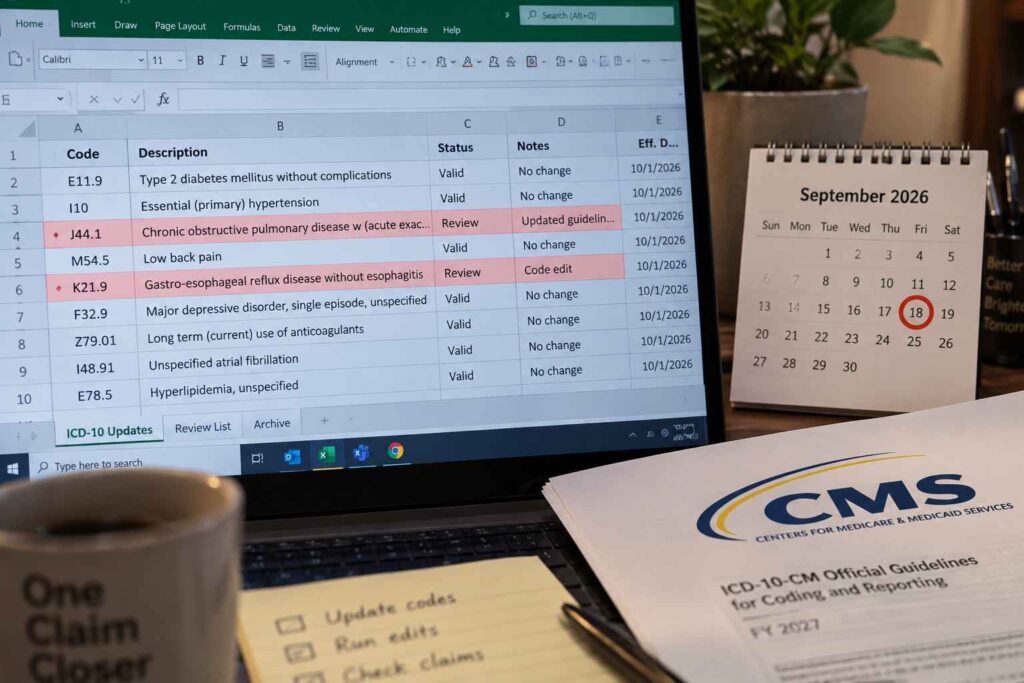

CMS issued Transmittal R13967OTN on September 18, replacing the August version of Change Request 14429. The agency corrected two typographical errors in the 276/277 edits spreadsheet used for Medicare electronic claim-status transactions. CMS stated that all other information remains the same.
The October EDI front-end update is effective October 1, with CMS listing October 5 as the implementation date.
What 276/277 transactions do?
The correction applies to specifications governing electronic claim-status inquiries, not the medical claim itself.
- A 276 is an electronic request a provider or billing system sends to check the status of a submitted Medicare claim
- A 277 is Medicare’s response, containing the claim-status information
- Many billing systems automate these requests and post returned data directly to patient accounts
CMS did not describe the two September 18 errors in plain language, identify them as particular rejection codes, or state that they caused production failures. Providers unsure whether their software handles 276 transactions automatically should contact their vendor or billing service.
Five revisions since April
CR 14429 has been revised multiple times during the run-up to October implementation.
| Date | CMS action | Changes |
| April 16 | R13742OTN issued | Original October 2026 EDI front-end update |
| June 5 | R13816OTN replaced April | Replaced 837P and 276/277 edit attachments, added 837I flat file and TCEDI requirements |
| July 10 | R13865 issued | Intermediate revision (later replaced August 27) |
| August 27 | R13934OTN replaced July | Added requirement 14429.8, updated 276/277 flat file with COBOL PIC and typo corrections |
| September 18 | R13967OTN replaced August | Corrected two typographical errors in 276/277 edits spreadsheet |
Source: CMS 2026 Transmittals
The revision history is the most operationally relevant part of this story. Technical specifications for the October EDI release have continued to be corrected relatively close to implementation.
CR 14429 REVISION HISTORY
Five versions in five months
April 16
Original October EDI update issued
June 5
837P, 276/277 edits replaced; 837I flat file added
July 10
Intermediate revision (replaced Aug. 27)
August 27
Added requirement 14429.8, COBOL PIC corrections
September 18
Two 276/277 spreadsheet typos corrected — nothing else changed
Source: CMS Transmittals R13742OTN through R13967OTN
What did CMS not change?
CMS did not change Medicare coverage policy, reimbursement rates, or claim-denial rules on September 18. CR 14429 is an EDI/front-end technical update — it sits in Medicare’s transaction-processing infrastructure, not in the physician coding or fee-schedule layer. CMS’s provider-education line for the current transmittal reads simply “None.”
Several common mischaracterizations to avoid.
“CMS found errors in Medicare claim edits”
This implies adjudication problems, which the correction does not describe
“Practices must manually install the new spreadsheet”
The CR is directed at contractors and shared-system maintainers, not individual offices
“Two bad edits were causing Medicare denials”
CMS identifies typographical errors, not widespread claim failures
What should practices be careful about?
For organizations that automate Medicare claim-status workflows — where a billing system sends 276 requests and posts 277 responses into patient accounts — the practical steps after go-live are specific.
- Verify that your billing vendor or clearinghouse is working from the latest CMS specifications
- Monitor for unexpected 276/277 status-query failures after October 5
- If claim-status responses behave differently in early October, check whether the cause is the EDI update before assuming a coding or medical-necessity problem
The differentiation between a transaction-layer issue and a clinical coding issue can prevent wasted appeal effort on problems that belong to a vendor or clearinghouse.