



Medicaid credentialing for providers runs through your state Medicaid agency, not CMS directly, and confusing that with Medicare credentialing is the single most common terminology mistake in this space.
Medicare and Medicaid are separate programs with separate rules, separate agencies doing the reviewing, and separate applications, even though providers often need to think about both.
Here’s what this guide covers:
- What Medicaid credentialing actually requires
- The complete checklist, organized by category
- Provider screening, timelines, and managed care credentialing
- Common mistakes and how revalidation works
- How it differs from Medicare credentialing
What is Medicaid credentialing for providers?
Credentialing, enrollment, and contracting get used interchangeably, and that’s exactly why so many providers submit the right documents to the wrong place.
| Process | Purpose |
| Credentialing | Verifies your qualifications, licensure, and professional history |
| Enrollment | Registers you with your state Medicaid agency so you can bill |
| Contracting | Adds you to a specific managed care organization’s network |
A provider can be fully credentialed and still unable to bill Medicaid until state enrollment is approved, and enrolled with the state while still needing separate contracting to join a specific Medicaid managed care plan’s network. All three steps typically need to happen before claims actually get paid.
How is Medicaid credentialing different from Medicare credentialing?
Providers researching one program often need the other too, which is exactly why the two get blended together in search and in badly edited articles.
| Medicaid | Medicare | |
| Administered by | State Medicaid agency, within federal rules | CMS directly, through PECOS |
| Who it covers | Low-income individuals, children, pregnant people, seniors, and people with disabilities who qualify by state rules | People 65 and older, and some younger people with disabilities |
| Funding | Joint federal and state, matched through FMAP | Federal only |
| Enrollment system | State-specific portal | PECOS |
A provider serving both populations needs to complete both processes separately. Neither credentialing approval transfers to the other program automatically.
What’s the complete Medicaid credentialing checklist?
Long, undifferentiated document lists make it hard to tell what’s actually required for a given provider type. Sorting by category fixes that.
Provider identifiers
- Taxonomy code
- National Provider Identifier (NPI)
- Tax Identification Number or Employer Identification Number
- Social Security Number, for individual providers where required
Professional credentials
- Board certification
- Education and training verification
- DEA registration, where applicable
- Active state license
Enrollment documentation
- Completed state Medicaid application
- Banking and payment information
- Group or facility affiliation details
- Practice location information
Compliance disclosures
- Sanction history
- Ownership disclosure
- OIG exclusion list screening
- Criminal history disclosure, where applicable
Missing an ownership disclosure or submitting an outdated CAQH profile are two of the most common reasons a technically complete application still gets sent back for corrections.
How does provider screening work under federal Medicaid rules?
Since the ACA expanded Medicaid provider screening, not every provider gets reviewed the same way, and the level of scrutiny depends on a federally defined risk category.
Fingerprinting and site visits aren’t universal requirements; they apply specifically to categories a state or CMS has flagged as higher risk. Assuming your provider type falls into the lightest tier without checking is a common way an application stalls partway through review.
What does the Medicaid credentialing process actually look like?
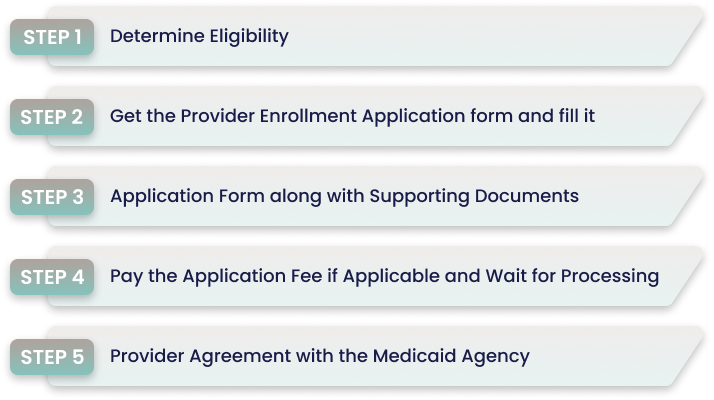
Every state runs its own version of this process, but the underlying stages follow a similar sequence.
State review is typically the longest stage, and it’s also the one least within a provider’s control. A complete, error-free submission at Stage 1 doesn’t guarantee a fast Stage 3, but it does eliminate the resubmission cycles that turn an already-long process into a much longer one.
How does Medicaid Managed Care add extra credentialing steps?
Most Medicaid beneficiaries today get their care through a managed care organization, not fee-for-service Medicaid directly, and that changes what “credentialed” actually means for a provider.
A provider enrolled with the state but not contracted with a specific MCO generally can’t bill that plan’s members, even though the state-level enrollment is complete.
MCO credentialing commonly draws on CAQH profile data, so keeping that profile current does double duty across managed care plans rather than repeating the same paperwork for each one.
Does Medicaid credentialing vary by state?
Medicaid is jointly funded and state-administered, which means requirements genuinely differ rather than just sounding different in each state’s paperwork.
- Fingerprinting rules vary in scope and enforcement
- Site visit requirements differ by risk category and state policy
- State enrollment portals and required forms aren’t standardized nationally
- Application fees apply in some states and not others
Confirming your specific state’s requirements before assuming a general checklist applies unchanged saves a resubmission cycle later, since a document list that’s complete for one state can still be missing something another state requires.
What is Medicaid revalidation, and how often is it required?
Enrollment isn’t permanent. Providers have to periodically reconfirm they still meet the requirements that got them approved in the first place.
- Continued eligibility status
- Current licensing and certifications
- Ownership and disclosure information
- Practice location accuracy
Missing a revalidation deadline can suspend billing privileges even for a provider who’s done nothing else wrong, which is why tracking the revalidation date is worth treating as seriously as the original application.
What are the most common Medicaid credentialing mistakes?
Most delays and denials trace back to a small number of recurring, avoidable errors rather than genuinely difficult judgment calls.
| Mistake | Why it causes delays |
| Outdated CAQH information | MCOs and some states pull directly from CAQH, so a stale profile propagates the error |
| Expired license at submission | Screening stops until an active license is on file |
| Missing ownership disclosure | Federal rules require this regardless of provider type |
| Incorrect taxonomy code | Mismatched taxonomy can misroute the application entirely |
| Skipping MCO enrollment after state approval | State enrollment alone doesn’t cover managed care billing |
Which provider types face unique Medicaid credentialing considerations?
The core checklist above applies broadly, but a few provider types run into requirements the general process doesn’t fully capture.
Behavioral Health Providers
Psychologists, licensed clinical social workers, and counselors often encounter state-specific licensing requirements and network shortages, which can significantly extend credentialing timelines.
Durable Medical Equipment (DME) Suppliers
DME suppliers are frequently classified as higher-risk providers, resulting in additional screening requirements such as fingerprinting or site inspections.
Home Health Agencies & Facilities
Home health organizations generally require group-level enrollment in addition to individual provider credentialing before services can be billed.
Medicaid remains the largest payer for behavioral health services in the country, which is exactly why credentialing delays in that category carry a bigger access impact than they might for other specialties.
Where Medicaid credentialing turns into a revenue problem
A missed ownership disclosure or an expired CAQH profile doesn’t just delay approval; it delays every Medicaid claim a provider would otherwise be billing during that gap.
- MCO contracting support alongside state enrollment
- CAQH profile setup and upkeep for managed care credentialing
- Revalidation tracking so deadlines don’t turn into suspended billing
- Credentialing file review against state-specific requirements, not just a generic checklist
Ready to see whether your Medicaid enrollment is actually complete? Contact Medheave for a Medicaid credentialing review built to catch what state and MCO reviewers actually check.
Related guides & resources
The resources below cover closely related topics and the broader service workflow they connect to:
- Medical credentialing services — Medical credentialing services
- Do nurses require NPI number — Do Nurses Have NPI Numbers?
- Apply for NPI — How to Get an NPI Number: Step-by-Step Guide
- FPPE — FPPE Explained: New Privileges vs For-Cause Review
- Mental health credentialing explained — How to Get Credentialed with Insurance Companies as a Mental Health Professional
- Medical credentialing — Simplifying Medical Credentialing: An Introductory Guide
- Provider credentialing checklist — Provider Credentialing Checklist: EVERY Document You Need
Frequently asked questions
Here are some commonly asked questions on this topic:
Timelines vary significantly by state, provider risk category, and application completeness, so there’s no single reliable number that applies everywhere. State review is typically the longest stage, and a complete, error-free application at submission is the most reliable way to avoid adding delays on top of that baseline.
Credentialing verifies your qualifications, licensure, and professional history. Enrollment is the separate step of registering with your state Medicaid agency so you receive a provider number and can actually submit claims. A provider can be credentialed and still unable to bill until enrollment is separately approved.
At minimum, expect to provide an NPI, taxonomy code, tax identification information, active state license, and ownership disclosure, along with any provider-type-specific credentials like DEA registration or board certification. Exact requirements vary by state, so confirming the specific state’s document list before submitting is worth the extra step.
Generally, no. Providers typically cannot submit Medicaid claims until both credentialing and state enrollment are fully approved, and services rendered before approval may not be reimbursable depending on the state’s retroactive billing policies.
Medicaid credentialing runs through your state Medicaid agency and follows state-specific rules within federal guidelines. Medicare credentialing runs through CMS directly via PECOS, with rules that are consistent nationwide. A provider serving both populations has to complete each process separately, since approval in one program doesn’t carry over to the other.
MCO credentialing is a separate contracting step with each managed care plan a provider wants to join, on top of state Medicaid enrollment. Many MCOs pull credentialing data from CAQH, so a current CAQH profile can speed up this step, but it doesn’t replace the need to contract with each plan individually.
Revalidation frequency varies by state, so checking the specific state’s cycle is more reliable than assuming a fixed national timeline. What’s consistent across states is the consequence of missing it, since suspended billing privileges follow until the revalidation is completed.
It can, particularly for managed care credentialing, where many MCOs pull provider data directly from CAQH ProView. State-level fee-for-service enrollment, however, typically requires its own state-specific application separate from CAQH, so a complete CAQH profile helps but doesn’t substitute for the state application.
Yes. Providers can enroll in multiple state Medicaid programs, and a practice location isn’t required to sit within every state where a provider is enrolled, though licensure and state-specific rules still apply to each enrollment separately.