
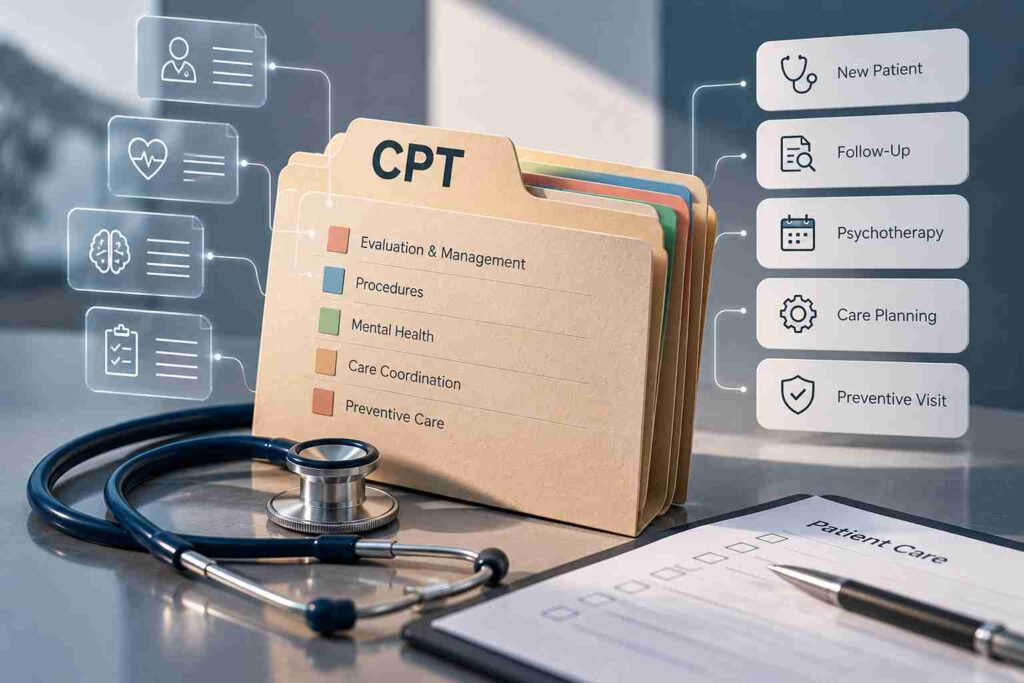

CPT code 99203 reports an office or outpatient visit for the evaluation and management of a new patient involving low medical decision-making.
It belongs to the E/M category and applies exclusively to patients who have not received professional services from the same physician or same-specialty group within the past three years.
Providers select 99203 through either low MDM (two of three elements at the low level) or 30-44 minutes of qualifying physician time on the date of service.
New-patient status is where most 99203 errors begin. CMS maintains an automated Recovery Audit specifically targeting incorrect new-patient coding across 99202-99205 — and OIG has settled cases where providers billed new-patient codes for patients who were actually established.
The second most frequent mistake is upcoding to 99204 based on a single moderate element that does not change the overall MDM level.
What does CPT code 99203 cover?
The essential reference facts for 99203 billing in one table.
| Detail | CPT 99203 |
| Description | New patient office visit, 30-44 minutes |
| Category | Evaluation and Management (E/M) |
| Patient type | New only |
| MDM level | Low |
| Time | 30-44 total physician/QHP minutes |
| Common modifiers | 25, 95, 93 |
| Medicare rate | ~$117.57 non-facility / ~$71.48 facility (2026) |
| Commonly compared with | CPT 99204 |
CPT Code Snapshot
99203 — New Patient Office Visit
Patient Type
New
MDM Level
Low
Time Range
30-44 min
Medicare Rate (2026)
$117.57
Non-facility national baseline
Key Modifier
Mod 25
Separately identifiable E/M
The AMA describes a typical 99203 encounter as a new patient with a stable chronic illness or acute uncomplicated injury.
Most 99203 visits involve patients establishing care for straightforward conditions — controlled hypertension, an ankle sprain, or uncomplicated dermatitis — where the clinical work stays below moderate complexity.
Every claim filed right, every dollar collected
MedHeave prevents new-patient coding errors before they become denials and recovers revenue lost to documentation gaps across every E/M level.
When should you use CPT 99203?
Two requirements must both be satisfied — the patient must qualify as new, and the clinical work must meet low complexity without reaching moderate.
Use CPT 99203 when
- The patient has not received professional services from the physician or same-specialty group in the past 3 years
- At least two of three MDM elements meet the low level
- Or the provider spends 30-44 qualifying minutes on the date of service
- The visit involves stable chronic disease evaluation, uncomplicated acute injury assessment, or minor problem management without moderate-level complexity
Consider a new patient establishing care for well-controlled hypertension.
The physician assesses the stable condition, reviews an outside primary-care note and a recent metabolic-panel result, and continues the existing treatment plan.
One stable chronic illness gives low problems; two qualifying data items give limited data — low MDM supports 99203.
When not to use it
- The patient was seen by any same-specialty physician in the same group within 3 years — use established-patient 99213 instead
- Two or more MDM elements reach moderate — use 99204
- Total qualifying time hits 45+ minutes and the provider elects time-based coding — use 99204
- The visit addresses only a single self-limited minor problem with minimal data and under 30 minutes — 99202 may apply
- The E/M work is bundled into a same-day minor procedure without separately identifiable service
How is CPT 99203 selected?
Two independent pathways support 99203. A provider does not need both.
MDM pathway
At least two of these three elements must meet the low level per the AMA MDM grid.
| MDM element | Low threshold for 99203 |
| Problems addressed | 2+ self-limited or minor problems, or 1 stable chronic illness, or 1 acute uncomplicated illness/injury |
| Data reviewed | Category 1 — any combination of 2 (review of unique external notes, review of unique test results, ordering unique tests) or Category 2 — assessment requiring an independent historian |
| Risk | Low risk of morbidity from additional diagnostic testing or treatment |
The biggest 99203/99204 trap involves prescription management.
A new patient prescribed medication has moderate risk — but if problems and data remain low, only one element reaches moderate. One moderate element does not change the overall MDM level, and 99203 remains the correct code.
Time pathway
If 30-44 total physician/QHP minutes are spent on the date of service, 99203 is independently supported.
Qualifying time includes chart review, history gathering, examination, counseling, ordering, coordination, and documentation. Time assigned to separately billed procedures does not count.
When MDM determines the code, there is no CPT requirement to document time or to spend 30 minutes.
Code Selection
Three gates to 99203
Gate 1 is mandatory. Then meet Gate 2 OR Gate 3.
Gate 1 — Required
Patient is genuinely NEW
No professional services from same physician or same-specialty group in prior 3 years
Gate 2 — Low MDM
Meet 2 of 3 elements at low
Problems + Data + Risk — at least two must reach the low level
Gate 3 — Total Time
30-44 min
Total physician/QHP time on date of service
What documentation supports CPT 99203?
For a new-patient visit, the note should establish both the patient’s new status and the clinical work supporting the code level.
The documentation should show
- Treatment decisions and risk level
- Medical necessity for the encounter
- What data was reviewed or ordered, if counting toward MDM
- Which conditions the provider actually evaluated or managed
- Why the patient qualifies as new under the three-year/same-specialty rule
When billing by time, record actual total minutes (e.g., “Total physician time today — 36 minutes”). If MDM supports 99203 independently, CPT does not require time documentation or a 30-minute visit.
CMS emphasizes that the volume of documentation does not determine the E/M level — medical necessity and the actual clinical work do.
OIG’s June 2026 settlement involving falsified E/M time underscores why credible time documentation matters.
How much does CPT 99203 reimburse?
Payment varies by setting, geography, and payer.
| Payment type | 2026 rate |
| Medicare non-facility (national baseline) | ~$117.57 |
| Medicare facility (national baseline) | ~$71.48 |
| Commercial payers (median observed) | ~$116.74 |
| Commercial 25th-75th percentile | ~$91.56-$160.14 |
| Medicaid | Varies by state |
Medicare rates from CMS 2026 PFS national baselines (non-QP conversion factor ~$33.40). Commercial median from Transparency-in-Coverage data (Reddenda, 2026).
The $46 gap between non-facility and facility rates reflects the difference in who bears overhead costs. Geographic Practice Cost Indices further adjust these amounts by Medicare locality.
NPs, PAs, and CNSs generally receive 85% of the physician PFS amount under Medicare, which reduces the effective rate to roughly $100 for qualifying non-physician practitioners.
Which modifiers apply to CPT 99203?
Only modifiers relevant to new-patient encounters at the low-complexity level.
| Modifier | When it applies |
| 25 | Significant, separately identifiable E/M on the same day as a procedure — new-patient status alone does NOT justify separate billing |
| 57 | E/M resulting in the decision for major surgery (90-day global) |
| 95 | Synchronous audio-video telehealth (Medicare uses POS 02/10 rather than universally requiring 95) |
| 93 | Audio-only telehealth (Medicare qualifying services through 12/31/2027) |
For Medicare telehealth, POS 10 (patient home) pays the non-facility rate (~$117.57) while POS 02 (other location) pays the facility rate (~$71.48).
Commercial payer modifier requirements vary — UHC’s 2026 policy states that modifiers 95/GT are not required to identify telehealth but may be accepted informationally.
OIG has specifically targeted modifier-25 abuse in same-day E/M billing. A new patient undergoing a minor procedure does not automatically justify separate 99203-25 — the E/M work must genuinely exceed the evaluation inherent in the procedure.
CPT 99203 vs. 99204 — which one fits?
Both codes cover new patients. The entire difference rests on whether the clinical work reaches moderate complexity or stays at low.
| Feature | CPT 99203 | CPT 99204 |
| Patient type | New | New |
| MDM level | Low | Moderate |
| Time | 30-44 minutes | 45-59 minutes |
| Typical use | 1 stable chronic condition, uncomplicated acute injury, 2+ minor issues | 2+ stable chronic conditions, exacerbation, uncertain-prognosis problem |
| Medicare rate (2026) | ~$117.57 | ~$177.36 |
| Work RVU | 1.60 | 2.60 |
Choose 99203 when overall MDM is low (fewer than two elements reach moderate) and qualifying time is 30-44 minutes.
Choose 99204 when at least two MDM elements reach moderate, or qualifying time reaches 45+ minutes.
The upcoding pattern that draws the most scrutiny — one uncomplicated condition plus prescription management. The prescription satisfies moderate risk, but a single uncomplicated problem is only low.
With just one moderate element, overall MDM stays low and 99203 applies. Add a second chronic condition, and the problems element jumps to moderate — now two elements qualify, and 99204 is correct.
Code Comparison
99203 vs. 99204
99203
MDM Level
Low
Time
30-44 min
Typical Visit
Stable chronic illness, uncomplicated acute problem
Medicare 2026
$117.57
99204
MDM Level
Moderate
Time
45-59 min
Typical Visit
Multiple chronic conditions, exacerbation, uncertain diagnosis
Medicare 2026
$177.36
The ~$60 gap between 99203 and 99204 makes level selection consequential — but CMS specifically audits new-patient codes. Bill 99204 only when two moderate MDM elements or 45+ qualifying minutes are documented.
What billing errors should you avoid with CPT 99203?
Five errors account for most 99203 denials and audit exposure.
1. Billing 99203 for an established patient
CMS runs an automated Recovery Audit targeting incorrect new-patient coding. Verify the three-year/same-specialty history before selecting any new-patient code. “First time I saw them” does not mean new under CPT if another physician in the same group specialty treated them within three years.
2. Upcoding to 99204 because one element is moderate
Prescription drug management satisfies moderate risk — one element. Without a second moderate element in problems or data, overall MDM is low, and 99203 is correct.
3. Using old history/exam bullet counting to determine the level
Current office E/M levels are selected by MDM or time, not the pre-2021 key-component system. A medically appropriate history and exam are still expected, but they do not drive the code level.
4. Time-based 99203 with fewer than 30 qualifying minutes
The time threshold begins at 30 minutes. Staff time, separately billed procedure time, and work on other dates do not count. Record actual total physician/QHP minutes.
5. Automatically attaching modifier 25 because the patient is new
New-patient status does not justify separate E/M billing alongside a same-day procedure. The E/M work must genuinely exceed the evaluation inherent in the procedure.
Frequently asked questions about CPT 99203
Here are some commonly asked questions about CPT 99203:
CPT 99203 reports a new patient office visit involving low medical decision-making or 30-44 minutes of qualifying physician time. It covers initial evaluations for stable chronic conditions, uncomplicated acute injuries, and minor problems that do not require moderate-level workup.
Medicare pays approximately $117.57 (non-facility) and $71.48 (facility) at the 2026 national baseline before geographic adjustment. Commercial medians sit around $117, varying by payer, region, and contract.
Both cover new patients. 99203 requires low MDM or 30-44 minutes. 99204 requires moderate MDM or 45-59 minutes. Prescription management alone does not upgrade a visit from 99203 to 99204 — a second MDM element must also reach moderate.
Yes. HHS lists 99203 as permanently telehealth-eligible. For Medicare, use POS 10 (patient home, non-facility rate) or POS 02 (other location, facility rate). Audio-only flexibility for qualifying non-behavioral services extends through December 31, 2027 under current federal policy, using modifier 93.