
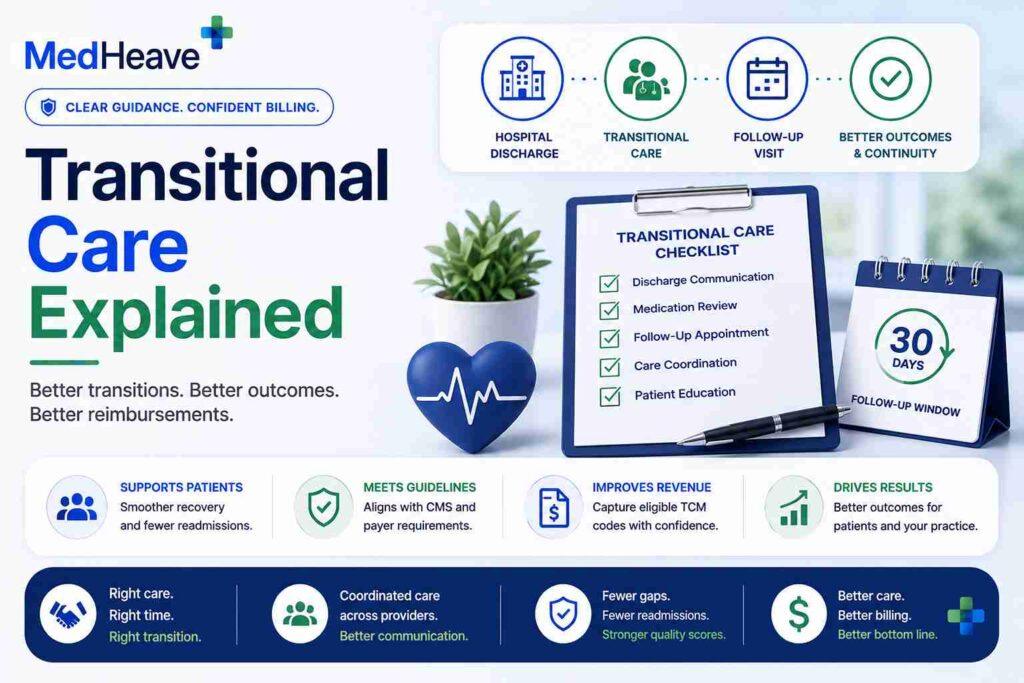


A landmark study of Medicare fee-for-service claims found that nearly 1 in 5 Medicare patients discharged from a hospital were readmitted within 30 days. Breakdowns in care transitions are a major source of preventable post-discharge adverse events, including medication errors and failures in follow-up.
Transitional care is a set of time-limited services designed to support safe and seamless transitions between care settings, with AHRQ defining transitions of care around patient movement and discharge planning.
The problem is that transitional care, transition of care, and transitional care management are three separate concepts that most resources treat as interchangeable. That confusion alone creates clinical and financial risk.
In this guide, we’ll go through how to prevent readmissions with a structured post-discharge plan.
- Definition (with context)
- Who is responsible for what during recovery
- Evidence-based models that actually reduce readmissions
- How Medicare pays for TCM and whether your situation qualifies
- Warning signs of a failing transition before it becomes a readmission
- A structured 30-day post-discharge plan with clear tasks at every stage
TLDR: Transitional care
- Transitional care is the services, transition of care is the event, and transitional care management (TCM) is the Medicare-billable program with specific CPT codes and timelines
- The 30-day post-discharge window is when readmission risk peaks, and CMS structures TCM billing around that exact period
- Medication verification should happen within 24 hours as a best practice, and again at every follow-up visit, because adverse drug events are the single most common post-discharge complication
- The Care Transitions Intervention (Coleman) and APN Transitional Care Model (Naylor) both show measurable reductions in readmissions and per-patient costs
- Warning signs of a failed transition include new confusion, worsening symptoms, medication mix-ups, and missed follow-ups within the first two weeks
- NCQA’s HEDIS Transitions of Care measure tracks four components (admission notification, discharge info, patient engagement, and medication reconciliation) that define quality at the system level
How are transitional care, transition of care, and TCM different?
Transition of care describes the handoff, transitional care covers the broader coordination around it, while TCM is the specific, time-limited Medicare service with requirements that must be met before CPT 99495 or 99496 can be billed.
Transition of care
Transition of care is the handoff that occurs when a patient moves between healthcare settings, providers, or levels of care. A hospital discharge to a primary care practice is one example.
It focuses on the transfer of the patient and their clinical information; effective health information exchange helps carry the care plan, medications, and follow-up needs across settings.
Transitional care
Transitional care is broader. It includes the clinical and support activities that help a patient remain safe and connected to care during and after a transition.
These activities can include medication reconciliation, care coordination, patient education, follow-up planning, and communication between providers.
Transitional care management (TCM)
Transitional Care Management (TCM) is a specific Medicare-reimbursed service for eligible patients following qualifying discharges.
It covers a defined 30-day period and requires meeting the CMS Transitional Care Management requirements for contact, medical decision-making, and visit timing.
When those requirements are met, the service may be reported with CPT 99495 or 99496.
What does the 30-day post-discharge plan look like?
30-day post-discharge timeline
Discharge Day
Confirm medication list, follow-up appointment, warning signs, care team contacts, and discharge summary
First 24 Hours
Verify home medications match discharge list, confirm PCP has the summary, check home equipment is ready
Days 2–7
Complete medication reconciliation, attend first follow-up visit, begin home health services, assess daily activity capacity
Weeks 2–4
Specialist visits, lab follow-ups, caregiver wellness check, final care plan review before TCM window closes
An integrated EHR and billing workflow can help keep post-discharge documentation connected to the TCM claim process.
How does Medicare pay for TCM?
TCM is billed under Medicare Part B using the CPT codes 99495 and 99496, representing moderate- and high-complexity TCM respectively. Three non-negotiable requirements apply.
- Interactive contact with the patient or caregiver within two business days of discharge
- Face-to-face visit within 7 calendar days (99496) or 14 calendar days (99495)
- Ongoing care coordination throughout the full 30-day post-discharge period
Only one provider can bill TCM per patient per 30-day episode.
Once the timing, contact, and visit requirements are met, accurate documentation and coding still matter for submitting a clean claim.
What are the warning signs of a failed transition?
Red flags after discharge
6 Warning Signs of a Failed Care Transition
⚠️
New confusion
May signal adverse drug event, infection, or dehydration
📉
Worsening symptoms
Recovery that stalls or reverses within the first 14 days
💊
Medication errors
Wrong dose, duplicated meds, or discontinued drugs still being taken
📅
Missed follow-ups
No appointment scheduled or not attended within the first week
❓
No care plan recall
Patient or caregiver cannot explain medications, diagnosis, or next steps
😓
Caregiver burnout
Exhaustion, frustration, or withdrawal from the coordination role
Which transitional care models are evidence-based?
We can broadly divide these into three types:
Care Transitions Intervention (Coleman)
Uses a trained transition coach for 28 days focusing on four pillars — medication self-management, a patient-centered health record, scheduled follow-up visits, and awareness of red flags.
A randomized controlled trial of the Care Transitions Intervention, published in Archives of Internal Medicine (2006), showed lower rehospitalization rates at 90 days and approximately $500 lower mean hospital costs at 6 months.
APN Transitional Care Model (Naylor)
An advanced practice nurse manages the transition from hospital through home visits for 30–90 days post-discharge.
A randomized trial of the APN Transitional Care Model, part of three NIH-funded RCTs published in JAGS (2004), showed improved satisfaction, reduced rehospitalizations, and mean savings of approximately $5,000 per patient in the heart failure trial.
Acute Care for Elders (ACE)
A hospital-based model, examined in an Acute Care for Elders randomized trial, that redesigns inpatient care for older adults to preserve functional status and prepare safer discharges.
RCTs found higher functional status at discharge, along with shorter hospital stays and lower inpatient costs compared to usual care.
ACE is a prevention-first model, not a post-discharge model — combining it with CTI or APN creates a more complete safety net.
Your revenue cycle should not add to the care transition chaos
When a patient moves between settings, the last thing a practice needs is billing delays, missed TCM codes, or credentialing gaps that block reimbursement for the care coordination work already happening.
MedHeave’s medical billing services keep the financial side of care transitions running while the clinical team focuses on the patient.
- Weekly reporting to track TCM charge capture and revenue
- Full credentialing and enrollment across facilities and settings
- Denial management with 80%+ overturn rate, including TCM appeals
- Dedicated account managers tracking TCM timelines and contact windows
Ready to stop leaving TCM revenue on the table?
Frequently asked questions
Here are commonly asked questions about transitional care:
The standard period is 30 days post-discharge, aligning with the CMS TCM billing window and the Hospital Readmissions Reduction Program measurement period. Some models extend beyond that — the Naylor APN model follows patients for up to 90 days in certain high-risk populations. For most patients, the first 7 to 14 days carry the highest risk, and the 30-day mark is where formal monitoring typically ends. CMS structures both billing and quality measurement around this window.
Yes. Medicare Part B covers TCM under CPT 99495 (moderate complexity) and CPT 99496 (high complexity). Requirements include interactive patient contact within two business days of discharge and a face-to-face visit within 7 or 14 days depending on the code. Medicare also covers related post-discharge services separately, including home health, skilled nursing, and durable medical equipment. Only one provider can bill TCM per patient per 30-day episode.
Transitional care is a broad set of services supporting patients moving between care settings. A transitional care unit (TCU) is a specific physical facility — usually hospital-based or freestanding — providing short-term inpatient rehabilitation and medical oversight. TCU stays typically run 5 to 21 days and bridge the gap between acute care and discharge home. Not every hospital operates a TCU, and availability varies by region.
Older adults with multiple chronic conditions face the greatest risk, particularly those managing heart failure, COPD, diabetes, or recent surgical procedures. Formal risk stratification can help care teams identify which patients need more intensive monitoring during the transition period. Patients on five or more medications are especially vulnerable to adverse drug events during the handoff.
Confirm the medication list before anything else. Compare every bottle at home against the printed discharge medication list and remove any prescriptions that were discontinued. Then verify the follow-up appointment is scheduled (not just recommended) and call the PCP’s office to confirm they received the discharge summary. Those three steps — medication verification, appointment confirmation, and discharge summary transfer — address several of the most common preventable risks after discharge.