
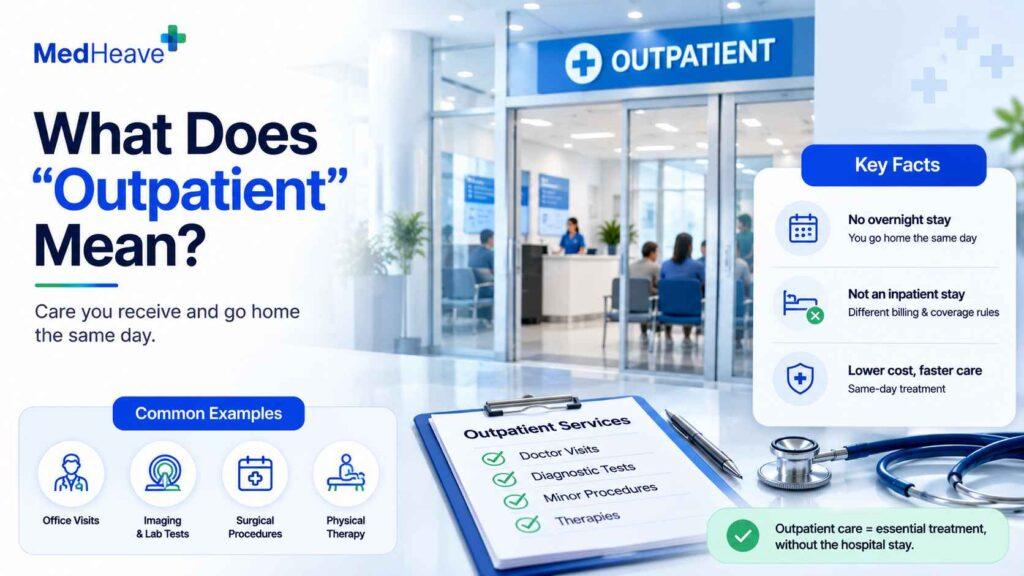


Outpatient means you received care and went home the same day, with no formal hospital admission attached to your name.
The CDC’s National Center for Health Statistics counts more than a billion physician office visits every year in the U.S., making this the default way most Americans experience healthcare.
But outpatient billing is also driven by a formal classification, and that’s usually where the confusion — and the surprise bill — starts.
In this guide, we’ll go through what outpatient actually means, where it quietly flips into inpatient territory, and why your treatment setting can change your total cost even for the exact same procedure. Let’s get into:
- What outpatient care means in plain English
- The overnight-stay trap called observation status
- Where outpatient ends and inpatient begins in billing
- What outpatient status does to your claim and your deductible
- Why the same procedure costs differently depending on where you get it
TLDR: What is “outpatient”
- Outpatient care is medical treatment without a formal hospital admission
- Most healthcare visits in the U.S. are outpatient — from flu shots to same-day surgery
- Observation status keeps you classified as outpatient even with an overnight hospital stay
- The same procedure at a physician office vs. a hospital outpatient department can cost hundreds more — same clinical service, different bill
- Outpatient claims run through the physician fee schedule or OPPS depending on the setting
- Your outpatient deductible, copay, and coinsurance follow your plan’s outpatient benefit rules
What does outpatient mean in plain English?
The CDC’s National Center for Health Statistics defines an outpatient visit as a direct exchange between a patient who isn’t currently admitted and a physician or other health care provider.
No overnight stay, no admission order.
Most people also hear the term ambulatory care, which functions as a near-synonym — it describes health services delivered in outpatient settings, covering everything from a five-minute vaccine to a same-day diagnostic scan.
In practice, the label doesn’t care how serious the visit is.
A flu shot and a same-day knee arthroscopy are both outpatient, provided nobody signs a formal inpatient admission order. What separates outpatient from inpatient is a piece of paper, not a stretcher.
If you searched what does outpatient mean because your bill or discharge summary used the word without explanation — you weren’t admitted.
Everything about how the visit gets billed and coded follows from that single fact.
What are the four categories of outpatient care?
Outpatient visits span far more than a basic office visit. Most fall into four categories that explain why cost and paperwork vary so much between visits that all technically count as outpatient.
Diagnostic visits
Diagnostic outpatient visits gather information without changing anything in your body yet.
- X-rays and MRIs
- Same-day biopsies
- Blood tests and lab panels
- Ultrasounds and CT scans
Procedural visits
Procedural outpatient visits involve an actual intervention planned to end with you walking out the same day. Outpatient surgery falls squarely here, and it has expanded significantly as anesthesia and monitoring have improved.
- Colonoscopies
- Cataract surgery
- Minor orthopedic repairs
- Same-day gallbladder or hernia surgery
Therapeutic visits
Therapeutic outpatient visits treat an ongoing condition across repeated sessions.
- Dialysis
- Physical therapy
- Behavioral health counseling
- Chemotherapy and infusion therapy
Preventive visits
Preventive outpatient visits happen before anything’s actually wrong.
- Vaccinations
- Annual physicals
- Cancer screenings
- Wellness checkups
None of these four categories, on its own, tells you what you’ll pay — because pricing depends on how outpatient stacks up against its costlier cousin, inpatient care.
How does outpatient differ from inpatient?
Outpatient vs. inpatient comes down to one requirement — a physician’s formal inpatient admission order. Inpatient care means that order exists.
Outpatient care is everything else, including a hospital stay that lasts multiple nights without ever crossing into admitted status.
That one requirement decides three things — which payment rules apply, which deductible applies, and which cost-sharing structure hits your bill.
| Attribute | Outpatient | Inpatient |
| Admission status | No formal admission order | Formal admission order on file |
| Typical stay | Same day, sometimes overnight under observation | One or more nights as an admitted patient |
| Billing pathway | OPPS or physician fee schedule, depending on setting | Inpatient Prospective Payment System (IPPS) |
| Average cost | Roughly $500 per visit | Roughly $30,000 for a three-day stay |
| Common examples | Office visits, same-day surgery, imaging | Major surgery, extended monitoring, complex childbirth |
The average cost gap exists mostly because inpatient billing adds room and board and round-the-clock nursing on top of a completely different payment system.
It’s also why insurers watch admission status so closely — and why observation status, covered next, generates so much confusion.
What is observation status and why is it an overnight surprise?
Observation status confuses more patients than almost anything else in healthcare billing, because it feels exactly like being admitted. None of the following makes you an inpatient.
- A hospital bed
- A gown and wristband
- A nurse checking in every few hours
Without a physician’s formal inpatient admission order, you’re still classified as outpatient — even after a full night or two in a hospital bed. Observation status hits Medicare beneficiaries hardest, changing three things patients don’t expect.
- Coinsurance obligations
- Whether Part A or Part B coverage applies
- Eligibility for Medicare’s skilled nursing facility benefit
That SNF benefit normally becomes available only after three consecutive inpatient days.
A patient who spends 48 hours under observation, then gets discharged to a nursing facility, can be shocked to learn Medicare won’t cover that stay at all.
The test itself is simple. If a doctor writes the words “admit to inpatient,” you’re inpatient. If that order never gets written, you’re outpatient — hospital bed or not.
Why does the same procedure cost differently by setting?
Outpatient care happens in more places than a single “doctor’s office,” and where you go changes what you pay. AHRQ defines ambulatory care as health care delivered in settings such as:
- Clinics
- Dialysis centers
- Physician offices
- Ambulatory surgery centers
- Hospital outpatient departments
The clinical service can be identical across every setting. The bill almost never is.
On the claim side, the place of service helps identify where the care occurred and can affect how the service is processed and paid.
Physician offices
In a typical physician office setting, services bill under the physician fee schedule, which covers the provider’s professional work only. No separate facility fee. For routine outpatient care, this setting is usually the least expensive option.
Ambulatory surgery centers
ASCs handle outpatient surgery that doesn’t require hospital-level resources.
ASCs bill their own facility fee, typically lower than a hospital’s facility fee for the same procedure. Insurers increasingly steer patients toward ASCs for routine same-day procedures like cataract removal or colonoscopies.
Hospital outpatient departments
HOPDs bill a facility fee on top of the professional fee, and that facility fee runs through CMS’s OPPS framework, which applies to designated hospital services at roughly 3,500 hospitals nationwide.
The same MRI ordered at an HOPD instead of a freestanding imaging center can cost noticeably more, purely because of where the machine happens to sit.
How does outpatient status affect your medical bill?
Outpatient billing runs through a different mechanical process than inpatient billing, starting with how the claim gets coded.
Before those charges reach the claim, charge capture turns the documented services performed during the encounter into billable items.
Outpatient visits use CPT codes to describe the specific service performed, and the claim itself can include a professional component alongside a facility component when the setting requires one. Your outpatient costs depend on three moving pieces.
The physician-side professional claim is commonly submitted using the CMS-1500 claim form or its electronic equivalent.
- Which billing components apply (professional only, or professional plus facility)
- How much of your deductible you’ve already met this year
- Which payment system processes the claim
The payment-system split is also where deductibles and coinsurance kick in.
Your plan’s outpatient benefit determines your cost share, and that share applies regardless of whether your visit lasted ten minutes or included an overnight observation stay.
A coinsurance percentage on a $500 office visit looks very different once that same percentage applies to an HOPD claim carrying a facility fee.
| Payment system | Applies to | What it covers |
| OPPS | Hospital outpatient departments | Facility fee plus ancillary hospital resources |
| Physician fee schedule | Physician offices and most ASC professional fees | The provider’s professional service only |
Practices that catch mismatched CPT-to-setting coding or an unflagged facility fee before submission are more likely to produce a clean claim and avoid the slower, more expensive path of fixing it after a patient disputes the bill.
Outpatient confusion is exactly where revenue starts leaking
If a patient calls confused about an outpatient bill, that confusion is usually a symptom of a bigger workflow problem further upstream — a wrong CPT-to-setting mapping, an unflagged facility fee, or a coinsurance calculation nobody double-checked before the claim went out.
MedHeave‘s medical billing services operate as an embedded revenue department for practices that need outpatient claims coded, scrubbed, and billed correctly on the first pass.
- Patient billing that verifies responsibility against the EOB
- AAPC-certified coding aligned with OPPS and physician fee schedules
- Claim scrubbing for CPT, POS, and modifier accuracy before submission
- Denial management with a 72-hour response window to prevent aging AR
Outpatient billing shouldn’t be the reason your front desk spends Tuesday afternoon on hold with a payer. Contact MedHeave’s team to see how a dedicated revenue department handles it instead.
Frequently asked questions
Here are some commonly asked questions on this topic:
Usually, yes. An ER visit is outpatient unless a physician writes a formal inpatient admission order during or after treatment. Most ER visits end with discharge instructions rather than an admission, keeping the entire encounter classified as outpatient. If you’re later admitted from the ER for extended monitoring or surgery, the billing splits at the moment the admission order is written, not at the moment you walked through the doors. Your EOB will reflect whichever classification applied at each stage.
Not always. Hospital outpatient departments bill a facility fee under OPPS, which can make an HOPD outpatient visit cost more than the same service delivered in a physician’s office or an ambulatory surgery center. The clinical service can be identical while the price tag differs by hundreds of dollars, purely based on setting. Before assuming outpatient means affordable, ask where the service will actually take place and whether a lower-cost setting handles it just as well.
It means the insurer processed your claim as non-admitted care rather than an inpatient hospital stay. Your deductible, copay, and coinsurance amounts follow whichever outpatient benefit rules your specific plan applies. If your EOB also shows a separate facility fee line, that usually means the service happened at a hospital outpatient department rather than an independent office. Reviewing both lines against your plan’s outpatient policy is the fastest way to catch a billing error early.
Yes, and outpatient surgery has expanded considerably as anesthesia, monitoring, and surgical technique have all improved. Many procedures that once required multi-day hospitalization — including certain orthopedic repairs and gallbladder removals — now run routinely on a same-day basis. Safety depends heavily on patient selection, meaning your care team evaluates whether your specific health profile fits a same-day recovery plan. If a procedure carries higher risk factors, your provider may still recommend inpatient admission instead.
Observation status is a subset of outpatient — you’re in a hospital bed receiving monitoring and treatment, but without a formal admission order. Clinically it can feel identical to being admitted, but the billing classification stays outpatient, which changes which insurance rules apply, what you owe in coinsurance, and whether Medicare’s skilled nursing facility benefit kicks in. The difference is administrative, not clinical, and it catches patients off guard when the bill arrives.