



Laboratory billing turns a blood draw or tissue sample into a paid insurance claim, and it depends on two separate coding systems working together correctly. CPT and HCPCS codes describe what test was performed.
ICD-10-CM codes prove why the test was medically necessary. Confuse the two, or leave the diagnosis link too vague, and the claim gets denied.
Let’s explore:
- How CPT, HCPCS, and ICD-10-CM actually work together
- Medicare’s Clinical Laboratory Fee Schedule
- KPIs and compliance checks worth tracking
- The biggest sources of lab billing denials
- Panel bundling and modifier rules
TLDR: Laboratory billing
Clean laboratory billing comes down to matching the right CPT or HCPCS procedure code to a diagnosis that actually supports medical necessity, avoiding unbundled panel components, and applying modifiers like 90, 91, and QW correctly.
Lab results are estimated to influence a large share of clinical decisions, though the often-cited 70% figure lacks strong empirical backing, which is exactly why getting the coding right on the way in counts as much as the test itself.
Here’s a quick example before the full breakdown.
| Element | Detail |
| Clinical service | Lipid panel |
| CPT code | 80061 |
| ICD-10-CM diagnosis | E78.5 (hyperlipidemia, unspecified) |
| Why it works | The diagnosis directly supports the medical necessity for the test |
What is laboratory billing and coding?
Laboratory billing and coding means identifying the test performed, assigning the correct CPT or HCPCS code, linking it to a diagnosis that justifies the test, and submitting the claim for reimbursement.
It’s a common misunderstanding that ICD-10-PCS procedure codes belong somewhere in this process. They don’t, since that code set is reserved for inpatient hospital procedures and never appears on an outpatient lab claim.
The pattern worth remembering is that CPT answers “what was done” while ICD-10-CM answers “why it was needed,” and a claim needs both pieces pointing at the same clinical story to get paid.
Which CPT and HCPCS codes cover common lab tests?
Most laboratory claims draw from a fairly small set of high-volume codes, which makes a quick-reference table more useful than memorizing the full code set.
| Lab test | CPT code |
| Basic metabolic panel | 80048 |
| Comprehensive metabolic panel | 80053 |
| Lipid panel | 80061 |
| CBC with differential | 85025 |
| Urinalysis | 81001 |
| Hemoglobin A1c | 83036 |
| Thyroid stimulating hormone | 84443 |
| Infectious agent detection by nucleic acid testing | 87635 |
| Rapid infectious agent test | 87880 |
| Surgical pathology examination | 88305 |
| Surgical pathology, complex specimen | 88307 |
HCPCS Level II codes cover a narrower slice of certain lab tests, drugs, supplies, and specialized services that CPT doesn’t fully address, so they show up less often but still need the same diagnosis linkage as any CPT-coded test.
How does ICD-10-CM prove medical necessity?
Every lab claim needs a diagnosis code that makes clinical sense next to the test ordered, or the payer has no basis to approve payment.
| Clinical condition | ICD-10-CM example |
| Diabetes mellitus | E11.- |
| Thyroid disease | E03.- |
| Anemia | D64.- |
| Elevated cholesterol | E78.- |
A CBC ordered for anemia evaluation, infection monitoring, or chemotherapy monitoring is easy to justify. A CBC billed with no supporting indication at all is a fast path to a medical necessity denial, since the payer can’t infer intent from a missing diagnosis.
- Documentation missing entirely
- Wrong ICD-10 code linked to the test
- Diagnosis doesn’t support the test ordered
- Screening code used where a diagnostic code was needed
How does Medicare pricing work for lab tests?
Medicare pays most laboratory services through the Clinical Laboratory Fee Schedule, a national rate table that CMS updates annually based on statutory requirements and market pricing data.
CMS currently maintains payment rates for more than 1,000 laboratory services, and rates shift every year, which is easy to overlook until a claim pays less than expected for a test that hasn’t changed at all.
Labs that check CLFS updates once a year, rather than treating last year’s rate as permanent, catch pricing changes before they show up as a revenue surprise.
How should laboratory panels be billed?
CPT panel codes already bundle several individual tests into one code, and billing those components separately is one of the more common compliance mistakes in laboratory billing.
Differential white blood cell count
Liver markers, glucose
Billing any of these components as a separate line item alongside the panel code is what NCCI edits are built to catch.
The National Correct Coding Initiative exists specifically to flag this pattern, since separating panel components (intentionally or not) creates an overpayment that OIG audits routinely trace back to.
Which modifiers apply to laboratory billing?
Modifiers tell the payer something about the circumstances of a test that the code alone doesn’t capture, and getting them wrong either delays payment or triggers an incorrect denial.
| Modifier | Purpose |
| 90 | Reference (outside) laboratory performed the test |
| 91 | Repeat clinical diagnostic test, same day, medically necessary |
| QW | CLIA-waived test |
Modifier 91 gets misused more than the other two, since it’s meant for a genuine repeat test tracking a clinical change, not a rerun to correct a lab error, which payers treat very differently.
What makes molecular and genetic testing billing different?
Molecular diagnostics have expanded quickly across oncology, infectious disease, and pharmacogenomics, and the coding hasn’t stayed simple alongside that growth.
- Payer-specific coverage policies that vary by test
- Proprietary Laboratory Analysis codes for branded tests
- Separate molecular pathology codes layered on top of standard CPT
- Prior authorization requirements that are easy to miss
A genetic test billed with the correct CPT code but thin diagnosis support is still a denial waiting to happen, since documentation carries even more weight here than it does for routine panels.
What causes the most laboratory billing denials?
Most denials trace back to a handful of recurring problems, and each one has a specific fix rather than a vague “improve documentation” answer.
| Denial cause | Fix |
| Diagnosis doesn’t support the test | Confirm the ordering diagnosis before the claim goes out |
| Unbundled panel components | Bill the panel code, not the individual line items |
| Missing prior authorization | Check payer rules for molecular and specialty testing upfront |
| Incorrect modifier use | Match the modifier to the actual test circumstance |
| Outdated CLFS rate assumptions | Refresh fee schedule data at the start of each year |
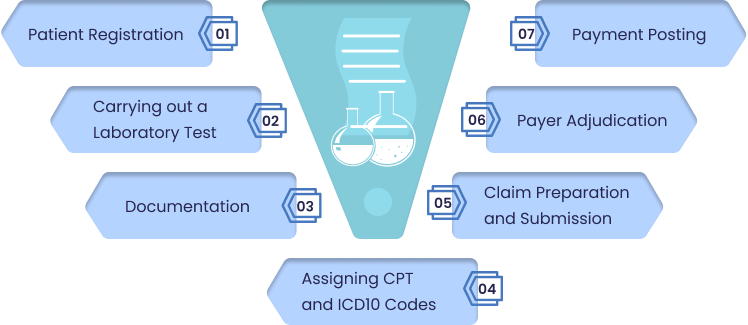
What does the laboratory billing process actually look like?
The path from test order to posted payment runs through eight steps, and a delay or error in any one of them shows up later as a denial or a slow payment.
Most laboratory billing systems (LIS, coding software, and billing platforms working together) exist specifically to keep these eight steps from depending on someone remembering the right code by hand.
Which KPIs and compliance checks keep labs audit-ready?
Tracking a handful of numbers monthly catches problems long before an external audit would.
| KPI | Purpose |
| Clean claim rate | Measures how often claims go out error-free |
| Denial rate | Flags recurring billing problems early |
| Days in A/R | Measures how fast the lab actually gets paid |
| Medical necessity denial rate | Tracks documentation quality specifically |
| Reimbursement per test | Shows profitability by test type |
HHS-OIG has repeatedly flagged laboratory billing as vulnerable to improper payments, largely from unnecessary testing, incorrect coding, and thin documentation, which makes the checklist below less of a formality and more of an audit-prevention habit.
- Verify payer coverage before ordering expensive or specialty tests
- Link every test to a diagnosis that supports it
- Confirm panel codes aren’t being billed as separate components
- Refresh CLFS rates and coverage policies at the start of each year
- Audit molecular and genetic testing claims specifically
Lab billing accuracy that holds up under audit
Between panel bundling rules, modifier logic, and medical necessity documentation, laboratory billing leaves very little room for guesswork, and one unbundled panel can trigger a review of far more than a single claim.
- Modifier and panel review checked against current NCCI edits
- CLFS and coverage policy monitoring built into the billing calendar
- Denial follow-up focused on medical necessity and documentation gaps
- Coders trained specifically in CPT, HCPCS, and ICD-10-CM linkage for lab services
Ready to see where your laboratory’s claims are actually breaking down? Contact Medheave for a clinical laboratory billing review built specifically for diagnostic and pathology labs.
Related guides & resources
The resources below cover closely related topics and the broader service workflow they connect to:
- Laboratory billing services — Laboratory billing services
- Guidelines for labs and diagnostic centers — Comprehensive Laboratory Billing Guidelines for Labs and Diagnostic Centers
- Medical coding — Medical Coding 101: The Ultimate Guide
- Medical billing — Beginner’s Guide to Medical Billing and Coding
- Role in healthcare system — Role of Pathology Billing Services in Modern Healthcare System
Frequently asked questions
Here are some commonly asked questions about this topic:
CPT (and HCPCS) codes describe the procedure performed, such as a lipid panel or a CBC. ICD-10-CM codes describe the diagnosis that justifies why the test was ordered. Confusing the two, or assuming one code set can stand in for the other, is one of the most common structural errors in laboratory billing and a frequent cause of claim rejections.
The coding itself is learnable within a few months, since most claims draw from a fairly small set of high-volume CPT codes. What takes longer is developing judgment around medical necessity, payer-specific coverage rules, and when a modifier applies, which is why lab billing for dummies guides tend to cover code lists well but underexplain the judgment calls that actually prevent denials.
A CLIA-waived test is a laboratory test simple enough, under federal Clinical Laboratory Improvement Amendments rules, to be performed accurately with minimal risk of error, often at the point of care. Billing that test with modifier QW attached tells the payer it was performed under a CLIA waiver rather than in a full-service lab setting.
Modifier 91 applies when the same clinical diagnostic test is genuinely repeated on the same day to track a changing patient condition, such as monitoring glucose levels during treatment. It should not be used to rerun a test after a lab error or specimen problem, since that scenario doesn’t represent medically necessary repeat testing and payers review modifier 91 claims closely for exactly this difference.
Billing panel components as separate line items alongside or instead of the panel code creates an unbundling error, which NCCI edits are specifically designed to catch. Beyond the immediate claim denial or recoupment, a pattern of unbundling is one of the issues HHS-OIG has flagged as a recurring driver of improper laboratory payments, making it a compliance risk and not just a coding mistake.
Molecular and genetic tests often require Proprietary Laboratory Analysis codes or specific molecular pathology CPT codes, layered on top of standard coding rules. Reimbursement depends heavily on payer-specific coverage policies and, frequently, prior authorization. Documentation needs to support medical necessity even more thoroughly than routine panels, since payers scrutinize these higher-cost claims more closely.
A Local Coverage Determination (LCD) is a coverage policy issued by a Medicare Administrative Contractor that defines when a specific test is considered medically necessary within that contractor’s region. Because LCDs vary by region and payer, a diagnosis that supports coverage in one area may not automatically support it in another, so labs billing across regions need to check the applicable LCD rather than assume uniform national rules.
CMS updates the Clinical Laboratory Fee Schedule annually, adjusting rates based on statutory requirements and market pricing data, and it currently maintains pricing for more than 1,000 laboratory services. Labs that treat last year’s rate as fixed risk under-collecting on tests where the rate shifted, so checking the updated CLFS at the start of each year is worth building into the billing calendar.