


A clinician types “MI” in one of several EHR systems. Another records “heart attack” in a different system across the hall. A third documents “acute myocardial infarction” during a transfer. Same patient, same event, three records that cannot talk to each other.
SNOMED CT exists to fix exactly that problem.
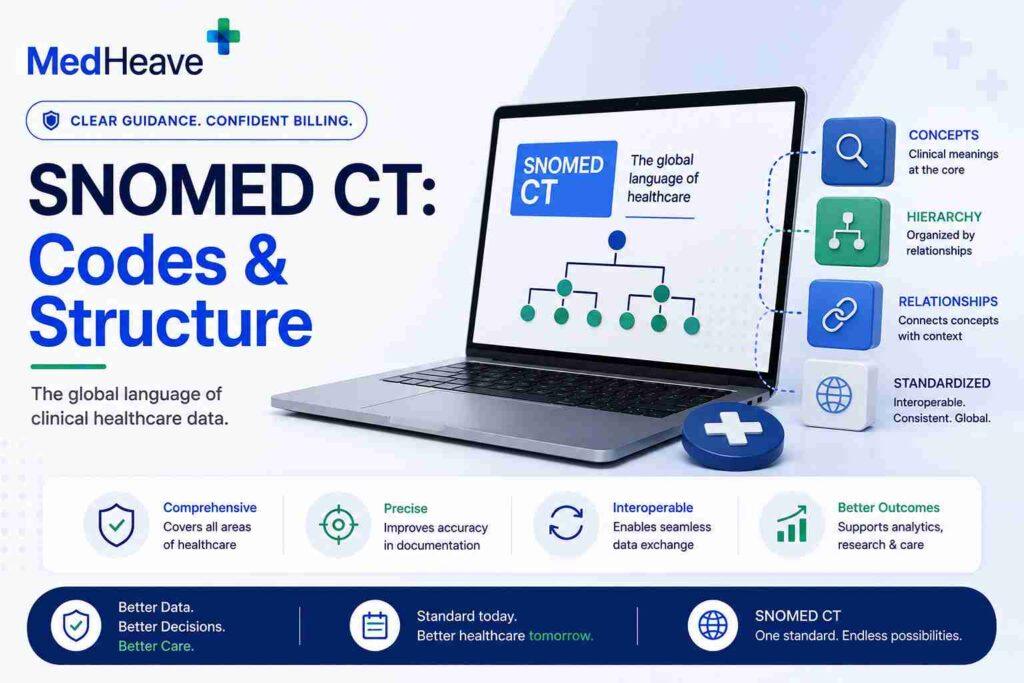
SNOMED CT (Systematized Nomenclature of Medicine, Clinical Terms) is a multilingual clinical terminology system that assigns a unique, machine-readable concept identifier to every clinical idea a provider might document.
Unlike billing code sets that classify encounters after the fact, SNOMED CT captures the full clinical picture during documentation.
It’s used in more than 80 countries, and in the United States, the National Library of Medicine (NLM) distributes the official US Edition.
In this guide, we’ll go through how SNOMED CT works and where it fits alongside ICD-10 in U.S. healthcare:
- Where SNOMED CT to ICD-10-CM mapping breaks down
- How concepts, descriptions, and relationships fit together
- Difference between SNOMED CT and ICD-10 with code examples
- Where the terminology sits inside US infrastructure, FHIR APIs, and your EHR
- How to get access through NLM and what implementation teams need before going live
TLDR: SNOMED CT
- SNOMED CT is a clinical terminology with 360,000+ concepts that gives every clinical idea a unique identifier, making documentation machine-readable across systems and languages.
- ICD-10 classifies encounters for billing and statistics; SNOMED CT captures clinical detail that ICD-10 was never designed to hold, and neither replaces the other.
- Every SNOMED CT concept carries a unique concept ID, at least one fully specified name with a semantic tag, a preferred term, and defined relationships to parent and sibling concepts.
- The NLM distributes the SNOMED CT US Edition twice a year (March and September), and US users access it at no cost through a UMLS Terminology Services account.
- HL7 FHIR binds SNOMED CT directly into clinical data exchange through CodeSystem, ValueSet, and ConceptMap resources used in Condition, Procedure, and Observation elements.
- Mapping from SNOMED CT to ICD-10-CM is not always one-to-one, so implementation teams should expect to manage many-to-one and one-to-many relationships between clinical and billing codes.
How does SNOMED CT work?
The terminology is built on three core components — concepts, descriptions, and relationships.
SNOMED CT Core Architecture
Three components, one clinical meaning
Concept
A unique clinical meaning with a permanent numeric ID (SCTID) that never changes
Description
Human-readable labels (FSN, preferred term, synonyms) in multiple languages and dialects
Relationship
Logical links (Is-a hierarchy + attribute relationships) that define what a concept means to machines
Concepts
Every concept gets a numeric SCTID that never changes, even if the words used to describe it evolve.
Concept 22298006 will always mean myocardial infarction regardless of which language or description is displayed.
Concepts are either primitive (partially defined) or fully defined — fully defined concepts enable automated classification.
Descriptions
A single concept carries multiple descriptions.
- Fully Specified Name (FSN) — includes a semantic tag like “Myocardial infarction (disorder)”
- Synonyms — alternative terms like “MI,” “cardiac infarction,” or “heart attack”
- Preferred Term — the clinician-facing label, which can vary by region
Relationships
The Is-a hierarchy structures all concepts into a polyhierarchy, and attribute relationships express clinical meaning.
For myocardial infarction, that includes a “Finding site” attribute pointing to myocardial structure and an “Associated morphology” attribute pointing to infarction.
| Component | Example |
| Concept ID | 22298006 |
| Fully specified name | Myocardial infarction (disorder) |
| Preferred term (US English) | Myocardial infarction |
| Synonyms | Heart attack, MI, cardiac infarction |
| Is-a parent | Ischemic heart disease (disorder) |
| Finding site | Myocardial structure (body structure) |
| Associated morphology | Infarct (morphologic abnormality) |
How does SNOMED CT compare to ICD-10?
SNOMED CT is a clinical terminology designed for documentation. ICD-10 is a statistical classification designed for billing. They serve fundamentally different jobs.
Head-to-Head
SNOMED CT vs ICD-10: different jobs, different builds
SNOMED CT
360,000+ concepts
Polyhierarchy with formal logic
Captures full clinical detail
Updated monthly (Intl Edition)
ICD-10-CM
~72,000 diagnosis codes
Mono-hierarchy by body system
Groups encounters for billing
Updated annually by CMS/NCHS
They are complementary, not competing. SNOMED CT handles clinical precision; ICD-10-CM handles billing classification. Most US workflows need both.
| Dimension | SNOMED CT | ICD-10-CM |
| Primary purpose | Clinical documentation and interoperability | Billing and public health statistics |
| Granularity | 360,000+ concepts with formal definitions | ~72,000 codes organized by chapters |
| Structure | Polyhierarchy with attribute relationships | Mono-hierarchy by body system |
| Machine reasoning | Supports automated classification | Limited to hierarchical grouping |
| US authority | NLM (via UMLS) | CMS and NCHS (via CDC) |
| Update cycle | Monthly (International), biannual (US Edition) | Annual with mid-year additions |
ICD-10-CM medical coding is required for US billing, while SNOMED CT captures clinical detail ICD-10 was never built to hold. Both are needed in most US healthcare workflows.
How does SNOMED CT map to ICD-10-CM?
The NLM provides an official SNOMED CT to ICD-10-CM map. Mappings are not always one-to-one.
- One-to-one means a concept maps directly to a single ICD-10-CM code
- One-to-many means a concept can produce multiple targets depending on clinical context
- Many-to-one means several granular concepts collapse into one broader ICD-10-CM category
In practice, the workflow runs like this — a clinician documents a finding using SNOMED CT, the system runs the NLM map to suggest ICD-10-CM codes, and a coder or automated rule selects the most specific applicable code for the claim.
That handoff sits at the intersection of clinical data management and medical coding, where structured clinical concepts become usable downstream data.
How is SNOMED CT used in the United States?
The NLM serves as the US National Release Center. The US Edition includes everything in the International Edition plus US-specific content, released biannually in March and September.
US users access it at no cost through UMLS Terminology Services — free account, signed license agreement, no subscription fee.
The ONC references SNOMED CT in its Health IT Certification Program.
The United States Core Data for Interoperability (USCDI) standard includes SNOMED CT as a required or preferred vocabulary in data classes including problems, procedures, and health concerns.
HL7 FHIR uses SNOMED CT in core clinical resources — Condition.code, Procedure.code, Observation.code, and AllergyIntolerance.code. The terminology appears through CodeSystem, ValueSet, and ConceptMap FHIR resources.
That standardized terminology also supports more consistent clinical data exchange between systems.
Implementation Orientation
What US teams need before going live with SNOMED CT
Register for a free UMLS Terminology Services account and sign the license agreement through NLM
Download the US Edition RF2 files and load them into your terminology server or EHR terminology module
Identify which VSAC value sets your quality measures and CDS rules depend on, and confirm SNOMED CT coverage
Build an update cycle around the biannual US Edition releases (March and September) including inactive concept handling
Test SNOMED CT to ICD-10-CM maps against real clinical data before relying on them for automated billing code suggestions
When SNOMED CT meets your revenue cycle
The terminology standards that power clinical documentation eventually connect to the billing pipeline. When SNOMED CT concepts are recorded cleanly at the point of care, the downstream map to ICD-10-CM produces more specific billing codes, fewer coding queries, and fewer denials rooted in vague diagnoses.
MedHeave‘s healthcare data analytics services help connect structured clinical data to downstream workflows, while its revenue cycle teams manage the billing processes that follow.
- Weekly reporting by provider, payer, and service type
- AAPC-certified coders using ICD-10-CM, CPT, and HCPCS
- Credentialing and enrollment across 10–20+ payers per provider
- Denials addressed within 72 hours, including diagnosis-code denials
Ready to close the gap between clinical documentation and clean claims? Contact our team today.
Frequently asked questions
Here are some commonly asked questions about SNOMED CT:
SNOMED CT stands for Systematized Nomenclature of Medicine, Clinical Terms. The “CT” specifically references the merger with Clinical Terms Version 3, the Read codes system previously used in the UK. The terminology was created in 1999 by merging SNOMED RT with CTV3 and first released in January 2002. It is maintained by SNOMED International and now contains more than 360,000 active concepts organized into formal hierarchies.
Yes. US users access the terminology at no cost through the NLM’s UMLS Terminology Services. You need a free UMLS account and a signed license agreement, but there is no subscription fee, per-user charge, or volume restriction. The NLM distributes the US Edition biannually in March and September, including all International Edition content plus US-specific additions. Member countries access SNOMED CT through their National Release Centers.
No. SNOMED CT and ICD-10 serve different purposes. SNOMED CT captures granular clinical detail during documentation — formal definitions, hierarchical relationships, and machine-processable meaning. ICD-10-CM classifies encounters for billing, reimbursement, and public health statistics. US billing requires ICD-10-CM. Clinical documentation and interoperability benefit from SNOMED CT. Most US healthcare workflows need both working together.
The International Edition releases monthly. The US Edition releases biannually in March and September. Each release can introduce new concepts, retire existing ones, update descriptions, revise relationships, and modify reference sets. Implementation teams need a process for importing new RF2 files, handling inactive concepts, validating value sets used in CDS rules, and testing cross-maps against changes in each release.
Not directly. SNOMED CT is a clinical documentation terminology, not a billing classification. US billing requires ICD-10-CM for diagnosis coding and CPT or HCPCS for procedure coding. However, SNOMED CT concepts documented at the point of care can be mapped to ICD-10-CM codes through the NLM’s official cross-map, which supports the billing pipeline indirectly by producing more specific and accurate diagnosis codes from structured clinical data.