



Domestic partner health insurance is coverage extended to an unmarried partner through an employer-sponsored plan or state-mandated program.
The short answer on eligibility — probably not, unless your employer specifically offers domestic partner benefits or you live in a state that requires them for certain plans.
Health insurance in the United States is built around legal relationships. Spouses and dependent children under 26 are the standard categories. Boyfriends, girlfriends, and unmarried partners don’t fit either category under federal law.
That doesn’t mean coverage is impossible.
Some employers voluntarily offer domestic partner health insurance as part of their benefits. A smaller number of states require certain plans to include registered domestic partners.
And alternative pathways — ACA Marketplace plans, Medicaid, employer-defined dependent eligibility — can provide coverage even when your partner doesn’t qualify under your plan.
In this guide, we’ll be exploring:
- Enrollment timing rules and why they differ from spousal coverage
- How marriage, domestic partnership, and no recognition compare
- Alternatives when your partner can’t be added to your plan
- 3 pathways to domestic partner coverage and their eligibility rules
- Imputed income and the real tax cost of domestic partner insurance
Do you have to be married to be on someone’s health insurance?
For most insurance plans — yes.
Marriage is the legal relationship that triggers automatic eligibility for spousal coverage under federal law, employer plans, and the ACA. Marriage creates a qualifying life event (QLE) that allows mid-year enrollment. The employer-paid spousal premium is tax-free. None of that applies to unmarried partners by default.
The exception is when your employer voluntarily extends coverage to domestic partners, or when your state requires certain plans to include registered domestic partners. Both are employer- or state-specific — not universal.
What are the three pathways to domestic partner coverage?
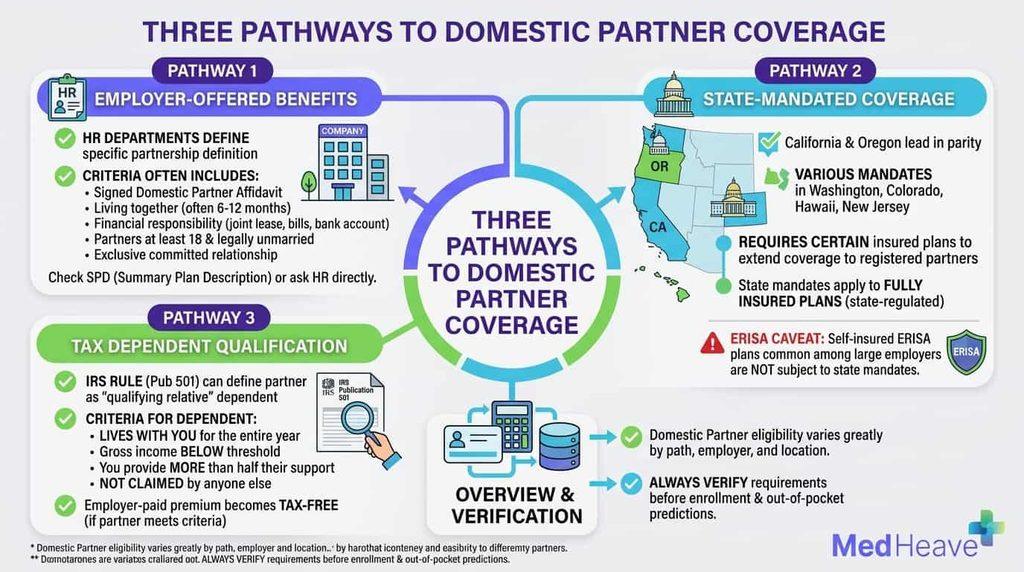
Domestic partner health insurance eligibility follows three possible routes, each with different documentation, tax treatment, and availability.
Employer-offered benefits
Some employers — particularly large companies, universities, and public-sector employers — include domestic partner coverage in their benefits. Eligibility typically requires meeting the employer’s partnership definition.
- Signed domestic partner affidavit
- Living together for a minimum period (often 6-12 months)
- Sharing financial responsibility (joint lease, shared bills, joint bank account)
- Both partners at least 18 and legally unmarried
- Exclusive committed relationship
Your HR department defines the specific criteria. There’s no national standard — each company sets its own rules. Check your Summary Plan Description (SPD) or ask HR directly.
State-mandated coverage
A few states require certain insurance plans to extend coverage to registered domestic partners.
California requires many insured group plans to cover registered partners with benefits equivalent to spousal coverage under California Family Code §§ 297-299.6
Meanwhile, Oregon recognizes registered partnerships with insurance parity under ORS §106.
Also, Washington, Colorado, Hawaii, and New Jersey provide varying degrees of recognition that may affect insurance eligibility
State mandates generally apply to fully insured plans (regulated by the state).
Self-insured ERISA plans — common among large employers — are governed by federal law and not subject to state insurance mandates. Even in a state with strong protections, your employer’s self-insured plan may not be required to cover your partner.
Tax dependent qualification
Under IRS rules (Publication 501), an unmarried partner may qualify as a “qualifying relative” dependent if they live with you for the entire year, their gross income is below the annual threshold, you provide more than half their support, and they aren’t claimed by anyone else.
If your partner meets these criteria, some employer plans allow adding them as a dependent — and the employer-paid premium becomes tax-free.
What does domestic partner coverage actually cost?
Most articles skip the tax impact, and it’s the part that surprises people most.
When your employer offers domestic partner health insurance and your partner doesn’t qualify as your IRS tax dependent, the employer-paid portion of your partner’s premium is added to your taxable income. This is called imputed income.
Consider a scenario where your employer pays $400/month toward your partner’s premium.
You pay $200/month as your contribution. The $400 employer portion is added to your W-2 as taxable income — $4,800 per year. At a 22% federal bracket plus state taxes, that’s roughly $1,200-$1,500 in additional annual taxes on top of the $2,400 you pay in premiums.
The total cost of domestic partner insurance is your premium contribution plus the tax on imputed income. For many couples, domestic partner coverage ends up significantly more expensive than spousal coverage for the same plan — which is a factor most people don’t calculate until they see their first adjusted paycheck.
Decision Guide
Can You Add Your Partner to Your Health Insurance?
ACA Marketplace (Healthcare.gov) · Medicaid (if income-eligible) · Private individual plan · Short-term health insurance
Does being engaged change insurance eligibility?
No. A fiancé is not a spouse, not a dependent, and not a domestic partner under most definitions. The engagement doesn’t trigger a qualifying life event or create insurance eligibility. Your fiancé gains access to your health insurance when you get married — not before. Marriage creates a QLE that allows enrollment within 30-60 days of the wedding date.
Some domestic partner policies may cover a fiancé if the couple meets the cohabitation and financial interdependence criteria, but the engagement itself isn’t the qualifying factor.
How does enrollment timing work for domestic partners?
Even when domestic partner health insurance is available, enrollment follows the same timing rules as other benefit changes — and the rules diverge from marriage in one important way.
- Open enrollment (typically fall for January coverage) is the standard window for adding a partner
- Getting married is a federally recognized QLE that triggers a 30-60 day special enrollment window
- Entering a domestic partnership is generally not a federally recognized QLE under ACA rules
- Some employers treat domestic partnership registration as a QLE under their own plan rules, but this is employer-specific
If you miss open enrollment and your employer doesn’t recognize domestic partnership as a QLE, your partner may need to wait until the next enrollment period or obtain separate coverage through the ACA Marketplace.
How do married, domestic partner, and unrecognized relationships compare?
The coverage gap between marriage and domestic partnership is wider than most people expect — and the gap between domestic partnership and no recognition is wider still.
Comparison
How Relationship Status Affects Health Insurance
What are the alternatives when your partner can’t be added?
If your employer doesn’t offer domestic partner health insurance and your state doesn’t require it, your partner needs their own coverage.
| Coverage option | When it applies |
| ACA Marketplace (Healthcare.gov) | Individual coverage with premium tax credits based on your partner’s own income. For an unmarried partner filing separately, subsidies may be more generous than expected because eligibility is based on individual income rather than combined household income. |
| Medicaid | Available if your partner’s income falls below the eligibility threshold in a Medicaid expansion state. |
| Private Individual Health Insurance | Health plans purchased directly from an insurer outside the Marketplace, without access to premium subsidies. |
| Short-Term Health Insurance | Temporary coverage designed for short gaps in insurance. These plans typically exclude pre-existing conditions and are generally considered a stopgap rather than a long-term solution. |
Finding the right coverage for your partner
MedHeave helps individuals and families understand health insurance eligibility rules, enrollment requirements, coverage options, and plan alternatives.
Whether you’re exploring domestic partner benefits through an employer plan or comparing Marketplace coverage options, our team helps you make informed coverage decisions with confidence.
- ACA Marketplace plan comparisons
- Health insurance eligibility guidance
- Domestic partner coverage and enrollment support
- Coverage transition and special enrollment assistance
- Dedicated support with clear plan and benefits explanations
If you’re evaluating health insurance options for a domestic partner or need help understanding your coverage choices, contact us to learn how MedHeave helps individuals navigate eligibility requirements, compare coverage options, and find the plan that best fits their needs.
Related guides & resources
The resources below cover closely related topics and the broader service workflow they connect to:
- Insurance eligibility verification services — Insurance eligibility verification services
- Verify patient insurance — Patient Insurance Verification: Process, Checklist, & Tools
- Insurance eligibility verification — Medical Insurance Eligibility Verification: A Complete Guide
- Eligibility verification process — Eligibility Verification Process in Medical Billing
- Pros and cons of two health insurance policies — Can You Have Two Health Insurances? (Pros, Cons & Rules)
Frequently asked questions
Here are some commonly asked questions on this topic:
Only if your employer offers domestic partner health insurance benefits and your partner meets the eligibility criteria — typically cohabitation, financial interdependence, and a signed affidavit. No federal law requires employers to cover unmarried partners. If your employer doesn’t offer domestic partner coverage, your partner can’t be added. Alternatives include ACA Marketplace coverage (where premium tax credits may apply based on their individual income), Medicaid if income-eligible, or a private individual plan.
For most plans, yes. Marriage is the legal relationship that creates automatic eligibility for spousal coverage under federal law. Unmarried partners can only be covered through employer domestic partner benefits (voluntary) or state mandates for registered domestic partners (limited to a few states). Living together, sharing finances, or being engaged doesn’t create insurance eligibility unless the employer specifically recognizes those circumstances in its benefits policy.
When your employer pays part of your domestic partner’s premium and your partner doesn’t qualify as your IRS tax dependent, the employer-paid portion is added to your taxable income on your W-2. At a 22% federal bracket, $400/month in employer contributions creates roughly $1,200+ in additional annual taxes. Imputed income doesn’t apply to legally married spouses — which makes domestic partner coverage measurably more expensive than equivalent spousal coverage.
Entering a domestic partnership is generally not a federally recognized qualifying life event under ACA rules — you typically can’t add your partner outside of open enrollment based on the partnership alone. Some employers treat domestic partnership registration as a QLE under their own plan rules, but this is employer-specific. Marriage, by contrast, is a universally recognized QLE that triggers a 30-60 day special enrollment window at any point in the year.
Generally no. A fiancé is not a spouse, dependent, or domestic partner under most plan definitions. Engagement doesn’t trigger a qualifying life event. Your fiancé becomes eligible when you get married. Some domestic partner policies may cover a fiancé if the couple meets cohabitation and financial criteria, but the engagement itself isn’t the qualifying factor — the living arrangement and financial interdependence are.
Your partner can apply for individual coverage through the ACA Marketplace (Healthcare.gov), where premium tax credits may be available based on their own income. If their income is below the Medicaid threshold in an expansion state, they may qualify for Medicaid. Private individual health insurance is available outside the Marketplace without subsidies. Short-term plans provide temporary coverage but typically exclude pre-existing conditions and have benefit caps.
There is no universal federal document checklist. Depending on the employer’s health plan and applicable law, required proof may include a registered domestic partnership certificate, a plan-specific affidavit, or documents establishing that the couple meets the plan’s eligibility criteria. Do not assume that a joint lease, utility bill, or bank account is always required or sufficient. Ask HR or the plan administrator for its official enrollment checklist and deadlines.
There is no single definition that applies to every U.S. health plan. A private employer plan may recognize an unmarried partner who meets its stated eligibility requirements, which may include a committed relationship, shared residence, or a registered domestic partnership. The plan’s governing documents determine its rules. Federal Employees Health Benefits (FEHB), however, generally covers legally married spouses, not unmarried domestic partners. Confirm eligibility with the specific plan before enrolling.